





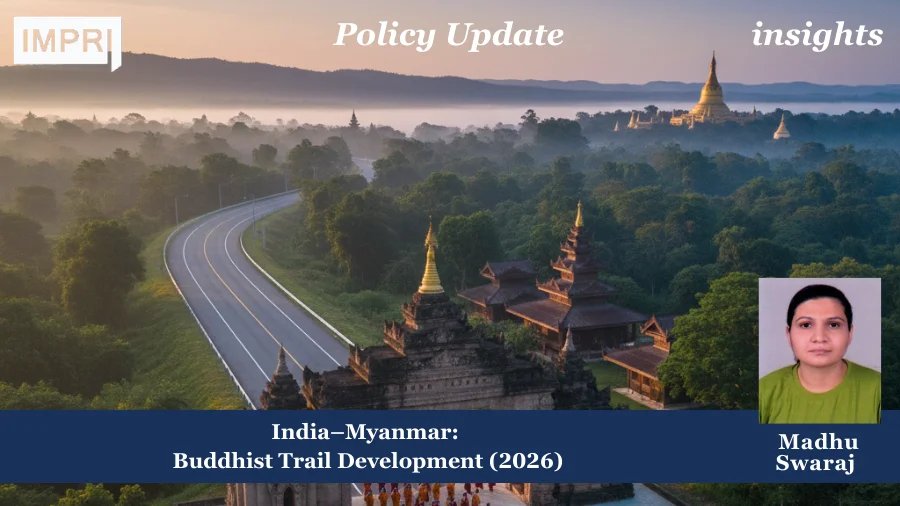
Policy Update
Madhu Swaraj
Background
The shared spiritual landscape between India and Myanmar is anchored in a 2,500-year-old history. Buddhism, which migrated from the plains of Magadha to the shores of the Irrawaddy, serves as the “civilizational glue” for bilateral relations. For Myanmar’s predominantly Theravada Buddhist population, India is Jambudvipa—the sacred land of the Enlightenment.
In recent years, India’s “Act East” and “Neighborhood First” policies have pivoted toward leveraging this “soft power.” The development of a formal Buddhist Trail aims to institutionalize these ancient links, transforming religious reverence into a structured corridor of tourism, commerce, and diplomatic stability.

Source: https://share.google/DPy46g4XxBYJ9TuxE
Functioning
The development of the trail operates through a multi-tiered framework involving infrastructure, institutional diplomacy, and digital integration:
- Infrastructure Corridors: The India-Myanmar-Thailand (IMT) Trilateral Highway and the Kaladan Multi-Modal Transit Transport Project serve as the physical backbone, linking Buddhist sites in India’s Northeast (like the Golden Pagoda in Namsai) to Myanmar’s Bagan and Mandalay.
- The Northeast Circuit: As of the Union Budget 2026–27, a dedicated scheme has been launched to develop Buddhist circuits across six Northeastern states (Arunachal Pradesh, Sikkim, Assam, Mizoram, Tripura, and Manipur), focusing on monastery preservation and interpretation centers.
- Institutional Frameworks: Cooperation is facilitated through the Mekong-Ganga Cooperation (MGC) and BIMSTEC, where tourism is a priority sector. India also provides technical assistance for the restoration of the Ananda Temple in Bagan.
- Pilgrimage Logistics: The “Bodhi Yatra” initiative and specialized tour packages managed by the Ministry of Tourism aim to streamline the transit of pilgrims between Bodh Gaya (India) and Shwedagon (Myanmar).
Source: https://share.google/DFGT7TEm0l7P3HPFR

Source: https://share.google/a2vjTsxedKszsmfQG
Performance
Despite regional volatility, the project has shown measurable progress:
- Connectivity Milestones: Work on the Zorinpui–Paletwa road stretch (109 km) is nearing completion, which will eventually allow seamless road travel from Mizoram into Myanmar’s heartland.
- Diplomatic Capital: The 2nd Global Buddhist Summit (January 2026) in New Delhi saw high participation from the Myanmar Sangha, reinforcing India’s role as the “custodian” of Buddhist heritage.
- Tourism Growth: Prior to 2024, foreign tourist arrivals (FTAs) to Buddhist sites saw a steady 10% annual increase. The 2026 budget’s allocation of ₹5,000 crore for City Economic Regions (CERs) in the Northeast is expected to further catalyze this growth by 2027.
Recent data underscores a significant upward trajectory in the performance of the Buddhist trail, driven by post-pandemic recovery and strategic infrastructure investments. As of late 2025, Uttar Pradesh’s Buddhist Circuit alone—a primary feeder for the India–Myanmar corridor—recorded over 61 lakh visitors in the first nine months of the year, with total footfall expected to exceed 64 lakh by year-end.
Internationally, Myanmar has emerged as a top contributor to pilgrimage traffic; for instance, in neighboring circuits like Lumbini, Myanmar ranked among the top three source countries with over 18,500 arrivals in 2025. This resurgence is mirrored in Myanmar’s domestic recovery, which welcomed an estimated 1.14 million international visitors in 2025, with Indian tourists forming one of the largest and fastest-growing segments.
On the policy and fiscal front, the Union Budget 2026–27 has institutionalized this momentum by launching a dedicated scheme for the development of Northeast Buddhist Circuits across Arunachal Pradesh, Sikkim, Assam, Manipur, Mizoram, and Tripura. This is supported by a significant push for “soft” infrastructure, including a pilot project to train 10,000 world-class tour guides across 20 iconic sites.
While the India-Myanmar-Thailand (IMT) Trilateral Highway faces a revised operational deadline of 2027 due to regional instability, the continued success of the Visa on Arrival facility for Indians (extended until August 2026) and the completion of 11 pagoda restoration projects in Bagan by Indian agencies have maintained strong diplomatic and religious throughput.

Source: https://share.google/kYK4hYoVOmRiWPCc2
Impact
The development of the trail has moved beyond religious merit to socio-economic transformation:
- Soft Power Enhancement: By positioning itself as the “Land of the Buddha,” India counters competing regional influences and builds a reservoir of goodwill among Myanmar’s influential monastic community.
- Economic Vitality: Local communities in border towns like Moreh (India) and Tamu (Myanmar) have seen a rise in “hospitality entrepreneurship,” ranging from eco-lodges to local guide services.
- Cultural Preservation: Increased funding has led to the scientific conservation of ancient Pali manuscripts and the revitalization of Tai-Phake monasteries in Assam, which share deep ethnic roots with Myanmar.
Emerging Issues
Several critical bottlenecks threaten the full realization of the trail:
- Political Instability: Ongoing internal conflicts within Myanmar have led to frequent closures of the Free Movement Regime (FMR) and delays in the IMT Highway’s operational deadline (now pushed to 2027).
- Security Concerns: The misuse of border corridors by insurgent groups and the trafficking of contraband goods remain significant hurdles for safe tourist transit.
- Infrastructure Gaps: While major hubs are well-connected, “last-mile” connectivity to remote monasteries in Chin and Sagaing states remains poor.
- The Rohingya Paradox: India must perform a delicate balancing act, ensuring that its “Buddhist Diplomacy” does not alienate other regional stakeholders or exacerbate existing ethnic tensions.

Source: https://share.google/A3mxJl1RS9us3nkvV
Way Forward
To ensure the Buddhist Trail becomes a sustainable reality, the following strategies are proposed:
- Digital Pilgrimage Passports: Implementation of a unified digital visa and “Pilgrim Pass” to simplify border crossings for religious travelers.
- Transnational Preservation Zones: Establishing joint India-Myanmar heritage committees to manage cross-border sites like the Pangsau Pass.
- Sustainable Tourism Models: Shifting focus toward “High Value, Low Impact” tourism to prevent the commodification of sacred sites.
- Track II Diplomacy: Engaging the Sangha (monastic community) as mediators to foster peace in border regions, utilizing the “Collective Wisdom” theme of the 2026 Global Buddhist Summit.
References
- ASEAN-India Centre (AIC). (2024). Mekong-Ganga Cooperation: Strengthening the civilizational bond (Policy Brief). https://aseanindiacentre.org.in/sites/default/files/Publication/MKG%20PB-Feb%202024.pdf
- Bhonsale, M. (2019). Religious tourism as soft power: Strengthening India’s outreach to Southeast Asia. Observer Research Foundation Special Report, (97). https://aseanindiacentre.org.in/sites/default/files/Publication/MKG%20PB-Feb%202024.pdf
- Choe, J. (2025). Socio-culturally sustainable development of wellness tourism in Bali. The Journal of Development Studies, 61(1), 1–23. https://doi.org/10.1080/00220388.2025.2577316
- Economic Research Institute for ASEAN and East Asia (ERIA). (2020). The India-Myanmar-Thailand Trilateral Highway and its possible eastward extension to Lao PDR, Cambodia, and Viet Nam: Background. https://www.eria.org/uploads/media/Research-Project-Report/2020-02-Trilateral-Highway-Report/2b-Background-Paper-5.pdf
- Fisher-Onar, N., & Kavalski, E. (2022). From trans-Atlantic order to Afro-Eur-Asian worlds? Reimagining international relations as interlocking regional worlds. Global Studies Quarterly, 2(4), ksac080. https://doi.org/10.1093/isagsq/ksac080
- Ministry of Finance, Government of India. (2026, February 1). Union Budget 2026–27: Key highlights and sectoral allocations. https://www.indiabudget.gov.in
- Ministry of Tourism, Government of India. (2025). India Tourism Statistics 2025: Footfall in religious and spiritual circuits. https://tourism.gov.in
- Oxford Academic. (2025, July 9). Where India and China meet: Competing regional statecraft in Southeast Asia. https://doi.org/10.1093/psquar/qqaf059/8195582
- Singh, S. (2025). Regional diversity of Buddhist heritage tourism in South Asia and Southeast Asia. Heritage, 8(4), 121. https://doi.org/10.3390/heritage8040121
- Wu, X., & Wang, Y. (2025). Sustainable tourism promotion through mobile gamification and reward systems for Chiang Mai Old Town, Thailand. Frontiers in Computer Science, 7, 1710089. https://doi.org/10.3389/fcomp.2025.1710089
- Yangon University of Economics. (2025). A study on the development and revitalization of tourism in Myanmar. https://meral.edu.mm/record/11455/files/May%20Neyin%20Chan%20San,%20EMDevS-26,%2019th%20Batch.pdf
About the Contributor:
Madhu Swaraj is a Research Intern at IMPRI.
Acknowledgement: The author extends sincere gratitude to the IMPRI team for their expert guidance and constructive feedback throughout the process.
Disclaimer: All views expressed in the article belong solely to the author and not necessarily to the organization.
Read more at IMPRI:
India-Saudi Arabia: Cybersecurity Cooperation and Critical Infrastructure Protection (2026)
Are Green Jobs Accessible to Women in Urban Informal Economies?