






Event Report
Pallavi Lad
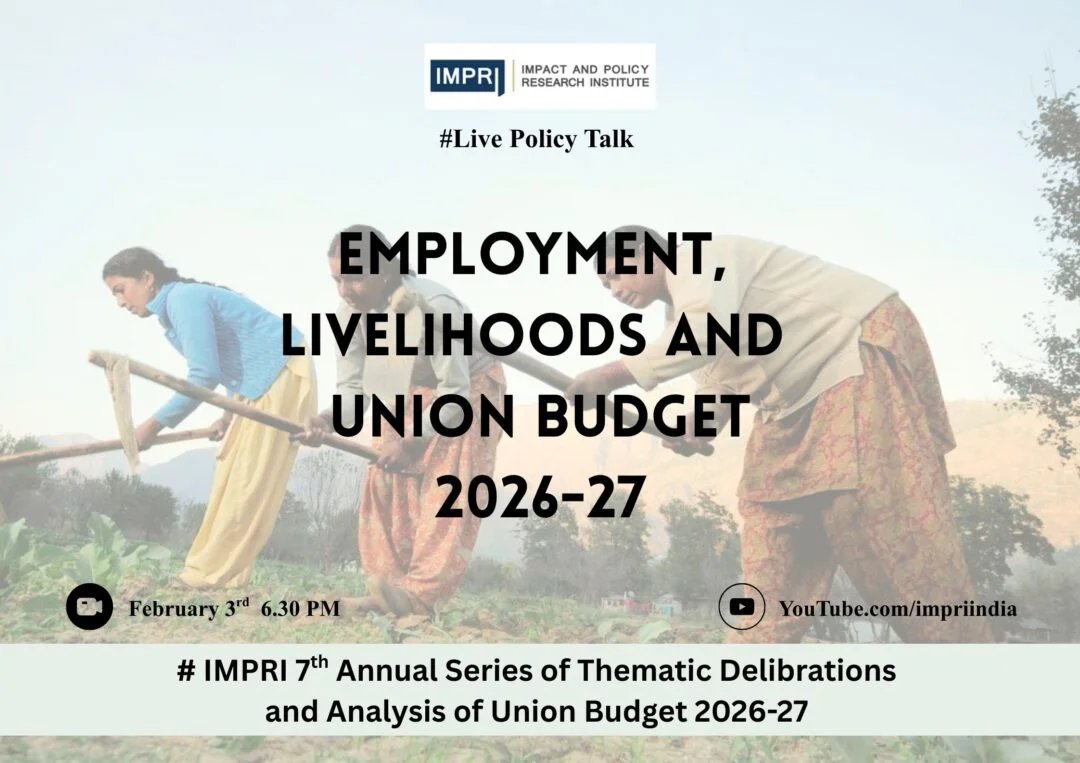
The IMPRI Centre for Work and Welfare (CWW) at the IMPRI Impact and Policy Research Institute, New Delhi, organised a thematic discussion on Employment, Livelihoods, and the Union Budget 2026–27 as part of its 7th Annual Series of Thematic Deliberations and Analysis of the Union Budget 2026–27, which was held on February 3.
The discussion was held online and brought together economists, migration scholars, education policy experts, trade union leaders and civil society practitioners to critically assess the Union Budget through the lens of employment generation, livelihood security, and social welfare.
The session commenced with Heer Lakhani, Researcher at IMPRI, who welcomed the speakers and participants and outlined the objective of the discussion. She then introduced the chair and moderator for the session, Prof. Suchita Krishnaprasad, Visiting Professor at IMPRI and former Associate Professor and Head of the Department of Economics at Elphinstone College, Mumbai.
The distinguished panel of speakers included:
- Prof Praveen Jha, Professor, Economics; Chairperson, Centre for Economic Studies and Planning (CESP), School of Social Sciences, Jawaharlal Nehru University.
- Mr Sandeep Chachra, Executive Director, ActionAid Association, India and Ex Co-Chair, World Urban Campaign, UN-HABITAT; Advisor, IMPRI.
- Ms Amarjeet Kaur, General Secretary, All-India Trade Union Congress.
- Mr Udit Misra, Writer for the Explained page, The Indian Express.
- Prof. S. Irudaya Rajan, Chair, International Institute for Migration and Development, India.
- Prof Randhir Singh Rathore, State Project Director, Haryana State Higher Education Council.
Opening Remarks & Contextual Framing: Growth, Geopolitics, and Fiscal Strategy:
In her opening remarks, Prof. Suchita Krishnaprasad framed the discussion within the broader macroeconomic and geopolitical context outlined in the Economic Survey. She drew attention to what the Survey terms the “paradox of 2025”: a period in which India’s macroeconomic performance is described as the strongest in decades, yet this growth has not translated into currency stability, sustained capital inflows, or strategic insulation in the global system.
Referring to the idea of a “strategic power gap”, she noted that the Survey suggests that a country’s currency performance and economic resilience are shaped by domestic fundamentals as well as by its geopolitical positioning. This raised an important question: to what extent are India’s current economic vulnerabilities externally driven, and to what extent are they a result of domestic policy choices?
She acknowledged that India’s recovery from the unprecedented GDP contraction of 23.9 per cent during the COVID-19 pandemic is significant. However, she cautioned that recovery alone does not answer deeper questions about the quality, inclusiveness, and sustainability of growth.
Reviewing budgetary trends over the past several years, she highlighted recurring themes: a strong emphasis on physical infrastructure such as roads, railways, ports, waterways, and airports; efforts to stimulate private sector investment through Production Linked Incentive (PLI) schemes; policy attention to MSMEs; promotion of tourism, electronics, and semiconductor manufacturing; and continued adherence to fiscal prudence, even during crisis periods when many countries opted for aggressive deficit financing.
Prof. Krishnaprasad also critically pointed out how certain phrases keep on recurring: “global hub,” “reducing dependency,” and “supply chains” in the budget. Whether we actually succeed in achieving these ambitions, she says, remains to be seen on the ground.
She noted that while these priorities suggest a clear direction, their implications for employment generation, labour markets, and livelihoods remain contested. Against this backdrop, she invited the panellists to examine whether the Union Budget 2026–27 meaningfully addresses job creation, employability, demographic change, and social protection.
The Macroeconomic Framework: Ambition vs. Statistical Reality:
Prof. Praveen Jha’s intervention on job creation, employment, and employability opened the substantive discussion by noting that public responses to the Union Budget 2026–27 appear to fall between two extremes. One view characterises the budget as a modest, “stay-the-course” exercise that avoids major disruptions while continuing existing policy trajectories. The other views it as a flat, non-event, calling it an ostrich-like approach and an evasive budget that refuses to confront India’s structural economic challenges.
Before assessing either position, Prof. Jha argued that it is essential to interrogate the macroeconomic context within which the budget is framed—particularly the credibility of India’s GDP growth figures. He recalled that former Chief Economic Advisers to the government, Prof. Raghuram Rajan, who also served as the Governor of the RBI, had stated after leaving office that India’s GDP estimates did not look appropriate.
According to him, actual growth may have been at least 1.5 to 2 percentage points lower than the official figures. Subsequently, another adviser who followed Dr Rajan, Arvind Subramanian, suggested that growth might be overstated by as much as half, meaning that if official growth was reported at 7 per cent, the actual figure might be closer to 3.5 per cent. These are individuals who were part of the establishment, and soon after leaving office, they expressed serious doubts about the most basic macroeconomic indicator, namely, GDP.
More recently, concerns raised by the IMF and remarks by Nobel laureate Abhijit Banerjee have further cast doubt on the reliability of India’s macroeconomic statistics. He noted that these doubts are not raised by fringe critics but by individuals and institutions embedded within the mainstream economic establishment. This makes them particularly significant.
Prof. Jha then pointed to a series of contradictions highlighted even within the Economic Survey itself. If India’s growth is as strong as claimed, why are investors exiting in large numbers? Why does the rupee remain among the most underperforming currencies in Asia and the developing world? Why are savings ratios at multi-decade lows, consumption muted, and inequality at levels not seen in nearly a century?
At the same time, Prof. Jha drew attention to the sharp escalation of inequality in the country. He noted that recent evidence points to inequality levels not witnessed in nearly a century, a concern that gained widespread public attention following the World Inequality Report 2025, associated with the work of Thomas Piketty and his collaborators. According to Prof. Jha, the extraordinary concentration of income and wealth documented in the report raises serious questions about the distributive consequences of India’s recent growth trajectory and its implications for social cohesion and long-term economic sustainability.
He further emphasised that revenue and expenditure as a share of GDP have remained largely stagnant over the last decade, constraining the state’s capacity to intervene meaningfully in employment and welfare. Citing recent estimates shared by economist Rathin Roy, he noted that government revenues have hovered around 9.5–10 per cent of GDP, while expenditures have remained in the range of approximately 12.7–13 per cent. Since 2019, tax reductions have been pursued aggressively, while deficit expansion has been treated as politically unacceptable except during the pandemic. The result is a severe squeeze on public resources.
Turning to the Union Budget 2026–27 itself, Prof. Jha criticised the government’s fondness for platitudes, like in the past three Rs, four Ds, and now, this time, it is the three “Kartavyas: Kartavya 1, Kartavya 2, and Kartavya 3. He notes that these are lofty slogans framed as grand visions and fall short of a clear analytical framework. While public capital expenditure has risen to ₹12.2 lakh crore, he argued that this infrastructure-led strategy has failed to generate employment at scale.
Ambitious claims about scaling up manufacturing, such as container manufacturing or the creation of “champion MSMEs”, were described as largely rhetorical. In the case of container manufacturing, for instance, China accounts for around 95 per cent of global production, making India’s modest allocation appear symbolic rather than transformative. Similarly, an allocation of ₹10,000 crore for MSMEs is grossly inadequate in a country with over 58 million such enterprises.
Prof. Jha concluded by stating that employment and livelihood generation are effectively absent from the budget’s analytical core. There is no serious engagement with the question of how growth will translate into jobs. As a result, he expressed deep pessimism about what the budget offers, even as a signal for addressing India’s employment crisis.
Demography, Migration, and the Silver Dividend:
Prof. S. Irudaya Rajan shifted the focus to demography and migration, arguing that India’s policy framework continues to rely on outdated population projections based on the 2011 Census. Fertility has declined far more sharply than expected; COVID-19 had a significant impact on mortality, and intensified migration, both internal and international, have fundamentally altered India’s demographic profile.
He emphasised that migration has intensified, particularly after the NDA came to power and promoted smart cities. Smart cities, he argued, essentially mean migration. The migration crisis of 2020 clearly demonstrated this trend. Despite these shifts, Prof. Rajan critiqued that the government has not seriously considered updating population projections for the country or for individual states, highlighting that even the Finance Commission continues to rely on outdated demographic assumptions.
While the Census is scheduled for 2027, it may also be delayed, raising concerns about whether current policy is being shaped by outdated demographic data. Prof. Rajan stressed that demographically, policy must be grounded in updated population data. The government claims that India’s demographic dividend will last for ten more years. However, new projections, funded by the Population Foundation of India and available in the public domain for all states and union territories, show that the demographic dividend will actually continue until around 2046.
According to these projections, India currently has about 93 million people in the labour force aged 15–54, and this number will rise to around 100 million by 2046, after which it will begin to decline. This makes the present decade crucial for investments in education, skills, and productive employment.
It is against this demographic opportunity that Prof. Rajan identified a striking contradiction in India’s education and employment landscape. Even as the government announces the expansion of higher education through new IITs, IIMs, and universities, a growing number of Indian students are choosing to leave the country. Official estimates place the number of Indian students studying abroad at around seven million, though the actual figure may be significantly higher.
Prof. Rajan highlighted the scale of India’s outward migration, noting that for every student entering India, approximately 28 leave the country, resulting in significant remittance outflows. While earlier described as brain drain and later reframed as brain gain or brain circulation, he argued that the current trend cannot be characterised in these terms and is more accurately described as brain waste.
He noted that India invests an estimated ₹20–30 lakh crore in educating its youth, yet many of these students, upon migration, end up in unskilled or semi-skilled work abroad, often misled by recruitment agents. As destination countries benefit from their labour, India’s human capital is underutilised. With tightening immigration regimes, many migrants are likely to return as “failed dreamers,” yet the government lacks any policy on return migration and reintegration into the domestic labour market.
Prof. Rajan then turned to emphasise India’s rapid ageing and fertility decline. He warned that India is approaching a fertility crisis. Around 40 per cent of couples are now opting to have only one child. He pointed to China’s experience with the one-child policy as a cautionary example. Thereafter, pointing to states such as Kerala, where grandparents now outnumber grandchildren. Rather than viewing ageing solely as a burden, he called for recognition of a second demographic dividend or ‘silver economy’. India is entering a prolonged phase, spanning 20 to 25 years, of population ageing. Older populations, he argued, contribute significantly through unpaid care work, especially childcare, yet this contribution remains invisible in policy discourse.
He flagged digital exclusion among senior citizens, noting that while digital addiction is widely debated, digital illiteracy is largely overlooked. Survey evidence indicates that only 20–30 per cent of elderly people utilise digital payment platforms, despite digital tools being essential to their daily economic life. This exclusion increases vulnerability to fraud and financial exploitation, contradicting the SDG commitment to leaving no one behind.
He noted that although India is demographically young, the average age of parliamentarians exceeds 60, and many global leaders are in their seventies. Elderly populations should therefore be treated as assets, not burdens. Prof. Rajan concluded by calling for policies on orderly migration, skill utilisation, digital inclusion, and the silver economy, warning that without these, India risks losing both its demographic dividend and the potential of its ageing population.
Education, Skills, and Alignment with Employment:
Prof. Randhir Singh Rathore addressed the education sector through three lenses: accessibility, quality, and relevance.
Beginning with accessibility, he noted that clear targets already exist. The National Education Policy (NEP) aims to attain a gross enrolment ratio of 100 per cent in school education by 2030 and 50 per cent in higher education by 2035. He observed that while primary school enrolment is close to 100%, higher education enrolment remains around 28-29 per cent, far below the NEP target of 50 per cent. The budget’s announcements on university townships, regional medical hubs, and new national institutes were presented as steps towards expanding educational infrastructure. Prof. Rathore emphasised that these announcements primarily relate to the creation of new infrastructure, which will help increase enrolment and access to education.
He then addressed the second vertical, quality of education, covering both school and higher education. Referring to school education, he noted that the Economic Survey highlights allocations for the National Achievement Survey (NAS) and the PRAGARH initiative (Performance Assessment, Review, and Analysis of Knowledge for Holistic Development), which focus on assessing and improving learning outcomes. The emphasis on these measures, he argued, reflects the government’s attention to quality in school education.
Turning to higher education, Prof. Rathore highlighted allocations of around ₹300 crore for the MERIT scheme, alongside significant funding for PM-USHA and PM-SETU, with over ₹6,000 crore earmarked for upgrading Industrial Training Institutes (ITIs). He also pointed to the ₹200 crore allocation for PM Research Chairs to attract overseas researchers back to India. Overall, he concluded that the Budget reasonably addresses infrastructure development and quality enhancement in education.
Prof. Rathore then turned to a third, indirect but significant dimension of the Budget: the question of relevance, particularly for STEM education. He noted that enrolments in STEM disciplines have declined over the past decade due to weak employment prospects, pushing students towards IT and commerce. However, he argued that several Budget initiatives could restore relevance by creating future demand for science and engineering skills, including the Bio-Pharma Shakti initiative, Semiconductor Mission 2.0, AI Mission, Critical Minerals Mission, and Electronic Component Manufacturing. He further cautioned that without addressing dropout rates, teacher shortages, and underfunding of government schools, skill-oriented initiatives risk benefiting only a limited segment of the population.
Responding to criticism of container manufacturing, he acknowledged China’s dominance but stressed the need for India to build domestic capacity. He pointed to investments in container and construction equipment manufacturing, ship repair, seaplane services, new national waterways, high-speed rail corridors, City Economic Regions, and chemical and Ayush-pharma parks as measures that would generate demand for technical skills. He concluded his primary remarks, stating that while infrastructure expansion may directly affect enrolment, these initiatives indirectly align education with future employment, reflecting a rational educational direction consistent with the vision of Viksit Bharat 2047.
Working People, Informality, and Climate Silence:
Mr Sandeep Chachra began his intervention by situating the Union Budget 2026–27 within a broader temporal and social context. He emphasised that no budget can be assessed in isolation, as each inherits the cumulative consequences of previous policy choices. In his view, the current budget must be read against the backdrop of deep and persistent distress faced by working people across the country, spanning both rural and urban areas, and affecting workers in the organised sector as well as, more acutely, those in the informal economy. Any serious assessment of the budget, therefore, must begin from the perspective of working people, using a caste, class, gender, and ethnicity lens to capture how policies affect the majority of the population.
Using a metaphor he frequently employs, Mr Chachra described a meaningful budget as one that “sings” to working people. In contrast, he characterised the Union Budget 2026–27 as largely songless, noting that its provisions fail to resonate with the lived realities of workers.
Drawing on data from the Periodic Labour Force Survey (PLFS) 2023–24, he highlighted the scale of employment distress. Of India’s approximately 145 crore population, around 61 crore constitute the working population, with nearly 3 crore actively seeking work but remaining unemployed. Income data further underscores the scale of precarity. Less than 22 per cent of workers earn more than ₹22,000 per month, around 27 per cent earn below ₹100 per day, and nearly half earn less than ₹10,000 per month. More broadly, Prof. Chachra noted that roughly three-quarters of India’s workforce earns below ₹50,000 per month, highlighting the narrow income base within which the Union Budget 2026–27 is framed.
Examining employment trends, Mr Chachra noted that work in India is becoming increasingly casualised, informal, insecure, and part-time, despite repeated assurances that labour codes would improve conditions. A growing number of workers experience irregular hours, intermittent employment, and partial work. Against this backdrop, he questioned how India could aspire to become a Vishwaguru when such a large share of its workforce is trapped in precarious employment, warning that the country risks becoming a leader in what Marx termed the “reserve army of labour.”
He drew attention to a significant rise in women’s workforce participation over recent years, from around 23 per cent to over 42 per cent. While this increase is often presented as a positive indicator, he cautioned that it is largely driven by economic distress and declining household incomes, with many women entering the labour force under highly precarious conditions, including low-paid, irregular, and informal work. He linked this trend to the rapid expansion of the gig economy. India had fewer than one million gig workers in 2022, he noted, while NITI Aayog projects a 23-fold increase by 2029–30. This signals a massive push towards insecure forms of employment, with minimal social protection, particularly affecting women workers.
He then examined the structure of budgetary expenditure, noting the sharp rise in capital expenditure—from about ₹2.38 lakh crore a decade ago to nearly ₹12.2 lakh crore today. However, he questioned its employment impact, pointing out that 60–62 per cent of this spending has gone into roads and railways, without generating meaningful jobs. Promises that public capex would crowd in private investment have also not materialised, resulting instead in a capital-intensive growth path marked by gig work, underemployment, and growing urban precarity.
Turning to MSMEs and trade, he argued that the Budget’s claim of supporting MSMEs is undermined by the modest ₹10,000 crore allocation, which he described as grossly inadequate. He warned that impending trade deals with the US and EU could severely affect labour-intensive sectors such as agriculture, fisheries, and animal husbandry through dumping and tariff asymmetries, with serious consequences for informal workers.
Speaking on climate, Mr Chachra noted that the Union Budget 2026–27 is largely silent on the impact of climate change on livelihoods. He argued that climate-related shocks are already disrupting work and income for millions of working people across rural and urban India. Heatwaves, air pollution, construction bans, floods, landslides, and displacement routinely lead to the loss of workdays, jobs, homes, and small agricultural plots, particularly for informal and migrant workers.
He pointed out that the budget makes no provision for climate-linked employment support or loss-and-damage compensation. Even a minimalist welfare approach, he argued, would have required some recognition of the income, livelihood, and health losses caused by climate-induced disruptions. The absence of such measures, he concluded, reflects a broader failure to integrate climate vulnerability into employment and social protection policy.
While he acknowledged a limited recognition of the care economy through measures such as working women’s hostels and caregiver training, he stressed that allocations remain insufficient and issues of safety and dignity unresolved. He criticised the lack of investment in solidarity economies and cooperatives, minimal responses to the rapidly expanding gig workforce, stagnant cash transfer schemes, like the PM-Kisan allocation, declining MGNREGA allocations, and the absence of an urban employment guarantee. He concluded that the Budget signals a retreat from welfare-state principles, deepening inequality and precarity, and offers little relief to working people.
Workers, Welfare-State Retreat, and the Politics of Exclusion:
Ms Amarjeet Kaur began her remarks by arguing that while the budget may appear songless for working people, it does contain a clear message: a decisive retreat from the idea of India as a welfare state. Despite repeated announcements of large projects, corridors, smart cities, and digital initiatives, she contended that little has moved on the ground for workers and farmers. Referring to statements made by the government at international forums such as Davos, she criticised the emphasis on ease of doing business and corporate-led growth, describing it as a sharp departure from the state’s responsibility to guarantee welfare.
Ms Kaur examined the Union Budget from a trade unionist’s standpoint, arguing that it fails to address the lives and livelihoods of India’s working population. Citing PLFS data, she noted that the labour force stood at around 61 crore in 2023–24 and has likely risen to nearly 67 crore by 2026. Including families and small and marginal farmers, she estimated that close to 120 crore people depend directly on labour incomes. She argued that the Budget does not meaningfully engage with this reality.
She argued that both of India’s primary productive classes, workers and farmers, have been left out of the Union Budget 2026–27. While the budget speaks of supporting farmers, she noted that farmers continue to protest policies such as the proposed seed legislation, which they believe will harm agriculture and agricultural universities. Similarly, she criticised the closure of government schools, the growing emphasis on private and foreign universities, and declining public expenditure on research and development, questioning how ambitions around advanced technology and artificial intelligence can be realised under these conditions.
She cited the Jal Jeevan Mission as a key example of the government’s retreat from welfare commitments. Announced in 2019 with the promise of providing tap water to over 193 million households, the scheme received no allocation in the previous year or the current budget, with responsibility shifted entirely to state governments. Water, she stressed, is a basic necessity, particularly for poor and informal workers who cannot afford private alternatives.
Turning to employment guarantees, Ms Kaur argued that MGNREGA has been systematically weakened. Allocations have declined, the scheme has shifted from a demand-based entitlement to a supply-driven model, and states are now required to bear a larger share of the financial burden. Trade unions, she noted, have long demanded the expansion of employment guarantees to urban areas, increased workdays, and higher wages, none of which have been addressed.
Focusing on education, she criticised school closures, the reliance on para-teachers, and what she described as chronic underfunding under the National Education Policy. She argued that India’s spending on health and education lags behind comparable countries and echoed Amartya Sen’s critique that India aspires to great power status while neglecting basic human development.
From a trade union perspective, Ms Kaur contended that the budget continues a pattern of ignoring constitutional obligations under the Directive Principles of State Policy, particularly Article 39(a), (b), and (c), which mandate the right to livelihood, equitable distribution of resources, and prevention of wealth concentration. Instead, she criticised the introduction of the four labour codes, which trade unions have consistently opposed for weakening labour protections in the name of ease of doing business.
According to her, these codes aim to dismantle unionism and collective bargaining, shrinking the space for democratic struggle, with the government announcing their implementation from 1 April. With public sector recruitment frozen and sanctioned posts left unfilled, workers face increasing insecurity even in traditionally stable sectors.
She also called out the government’s emphasis on employability over employment, noting the poor track record of large-scale skill development schemes. Targets to train one crore workers, she pointed out, were met at less than three per cent, with little accountability for the funds spent. At the same time, large amounts of public sector bank loans have been written off, raising serious questions about corporate accountability.
Ms Kaur concluded by arguing that the budget reflects a broader political strategy of reducing citizens to labharthis, beneficiaries dependent on periodic cash transfers announced around elections, while diverting attention through religious, communal, linguistic, and migrant divisions. Democracy, social harmony, and the economy, she warned, are all in a precarious state. She announced a nationwide strike on 12 February by farmers, agricultural workers, and industrial workers to oppose the budget and the labour codes, reiterating that resistance would continue both on the streets and in public debate, and calling the budget out as being “a pro-corporate budget”.
Discussion, Interventions, and Question–Answer Session:
The discussion segment was opened by Prof. Suchita Krishnaprasad, who thanked the speakers for bringing together academic analysis and lived experiences of labour and welfare. Reflecting on the interventions, the moderator highlighted a central tension between rights and schemes, noting that while laws confer enforceable rights, welfare schemes offer visibility and political messaging. Drawing an analogy with the concept of the “flexible firm,” the moderator argued that contemporary governance increasingly relies on schemes rather than rights, allowing entitlements to be diluted, defunded, or shifted to states without accountability.
Concerns were raised about the centralisation of decision-making in employment schemes, particularly with reference to MGNREGA. While announcements often highlight increased workdays or wages, participants noted that the erosion of state and panchayat autonomy undermines effective implementation, leaving workers in persistent distress.
A major part of the discussion focused on education and the National Education Policy (NEP). Participants questioned whether NEP 2020 was contributing to school closures, declining access for marginalised communities, and the erosion of critical thinking. While one intervention argued that NEP promotes privatisation and discourages questioning, another view suggested that the policy should be read alongside the National Credit Framework and efforts to integrate experiential learning and Anganwadi–primary school linkages.
This view was challenged by speakers citing empirical evidence of school closures, including government data from multiple states, such as Maharashtra and Rajasthan, mergers of schools, dilution of Right to Education distance norms, and widespread reliance on para-teachers, particularly in Bihar. Speakers argued that these trends undermine educational quality and disproportionately affect poorer households.
Prof. Jha situated these developments within a broader neoliberal macroeconomic policy framework, arguing that chronic underinvestment in education and health has weakened India’s human development foundations. He reiterated long-standing critiques, including those by Amartya Sen, that India aspires to global power status while neglecting basic investments in health and education, especially when compared to countries such as China.
The discussion then shifted to employment and livelihoods. Responding to a question on whether the Union Budget 2026 prioritises job creation, Prof. Jha argued that employment generation is largely absent from the analytical structure of the budget. He expressed that recent claims of improved employment outcomes should not obscure long-term trends of jobless growth.
He introduced the concept of employment elasticity of output to explain this disconnect, noting that standard sectoral analyses, covering around 27 sub-sectors of the Indian economy, show a long-term decline in employment generation per unit of output growth. He observed that in nearly 12 sub-sectors in recent years, output growth has been accompanied not merely by weak job creation but by an absolute decline in employment, indicating job-expelling growth rather than jobless growth.
Trade union perspectives highlighted the expansion of insecure work, particularly gig and contractual employment, raising questions about how such a labour market structure aligns with the ambition of making India a global leader. Speakers argued that rising precarity, declining minimum wage protections, and judicial attitudes towards informal workers reflect a broader erosion of labour rights.
Interventions also addressed welfare schemes and entitlements, particularly Integrated Child Development Services (ICDS) and Anganwadi services. Speakers criticised the shifting of financial responsibility to states, attempts to merge or close centres, and the continued treatment of Anganwadi workers as volunteers rather than full-time workers with social security. This was linked to a broader critique of governance that prioritises beneficiaries (labharthis) over rights-bearing citizens, alongside concerns about weakening accountability mechanisms such as the Right to Information.
The climate dimension was also raised during the discussion. Participants noted the budget’s silence on loss-and-damage compensation and the absence of recognition for climate and ecological justice defenders, including ragpickers, informal sanitation workers, and sustainable agricultural workers. While a limited recognition of ecosystem services had appeared in earlier budgets, speakers argued that meaningful valuation and compensation remain absent.
Conclusion:
The session underscored deep concerns regarding the employment, welfare, and social sector priorities reflected in the Union Budget 2026–27. Across academic and trade union perspectives, speakers highlighted a growing disconnect between headline growth narratives and the lived realities of workers, particularly in the context of rising precarity, informalisation, and declining employment elasticity. The discussion repeatedly returned to the erosion of rights-based frameworks in favour of scheme-driven governance, raising questions about accountability, federal balance, and democratic participation.
Participants emphasised that sustained underinvestment in education, health, and employment guarantees weakens India’s capacity to harness its demographic potential. While infrastructure-led growth and capital expenditure were acknowledged as necessary, speakers cautioned that without parallel investments in human development, labour protections, and climate-resilient livelihoods, such growth risks deepening inequality and insecurity. The session concluded with a shared view that addressing India’s employment crisis requires a reorientation towards rights, decent work, and inclusive welfare, rather than reliance on capital-intensive growth and short-term welfare measures.
In the concluding exchange, the moderator synthesised the discussion by linking employment outcomes to broader macroeconomic trends. While consumption has recently supported GDP growth, rising household debt, falling savings, and high inequality were flagged as structural risks. Participants cautioned that heavy emphasis on capital expenditure, alongside cuts in social sector spending, may undermine the demographic dividend rather than strengthen it. The session concluded with a consensus that while infrastructure expansion may be necessary, the absence of rights-based welfare, quality employment generation, and sustained investment in health and education raises serious concerns about the inclusiveness and sustainability of India’s growth trajectory.
Acknowledgment: Written by Pallavi Lad, Research and Editorial Intern at IMPRI.