








Keshav Kabra
Introduction
India is witnessing one of the major demographic transitions in the world, marked by ongoing rapid urbanization and an upward trajectory. This transformation places a significant pressure on the country’s existing infrastructure systems. India’s urban population saw a rapid rise between 2001 to 2011, surging from 286.1 million to 377.1 million. It is estimated that by 2031, India will have approximately 600 million urban residents. This unprecedented demographic shift has profoundly impacted our current mobility networks, signaling a fundamental shift in urban design and transportation strategies. Urban transport has been a significant source of air pollution, a growing concern for major Indian cities, particularly Delhi.
National Urban Transport Policy
The National Urban Transport Policy (NUTP) of 2006 was introduced with the intention of addressing the mobility crisis driven by uncontrolled urban population growth. It was first introduced in 2006 and subsequently revised in 2014, representing a significant shift in urban planning priorities. The policy aimed to “move people, not vehicles”. The revised policy represented a decisive step toward systemic reform and a more holistic integration of urban mobility within broader urban planning frameworks.
A core framework for this transformation lies in the ‘Avoid-Shift-Improve’ model advocated by the Asian Development Bank (ADB) and the Bellagio Declaration (2009).
- Avoid: it aimed to reduce the number and length of trips to manage overall travel demand.
- Shift: it encourages movement from private vehicles to mass rapid transit and non-motorized transport modes, to make transportation more sustainable.
- Improve: it focused on increasing the use of clean fuels and vehicle technologies to enhance energy efficiency.
The Mobility “Consumption Crisis”
However, a critical review of the NUTP through the lens of Sustainable Urban Transportation reveals a stark contrast between this optimistic vision and on-ground reality. Indian cities are currently facing a mobility “consumption crisis”. The urban population has drastically surged, and the growth in private vehicle ownership has disproportionately outpaced it. Between 2011 and 2024, the percentage of urban households owning a motor vehicle surged from 40.1% to 68.2%. This 70% relative increase in the share of vehicle-owning households illustrates a deepening dependency on personal motorised transport.
Policy Implementation Gaps
- The overarching challenge in India’s urban mobility sector is the widening gap between progressive national policy frameworks and fragmented, under-resourced, and institutionally weak on-ground implementation by city and state agencies.
- Weak Institutional capacity, including a lack of strong UMTA and overlapping jurisdictions, has led to delays and duplication.
- Adequate infrastructure for moving people through non-motorized means, such as bicycle tracks and dedicated pedestrian pathways, is missing. Even where such infrastructure is available, it is not being used to its full extent.
- FAME India-II Scheme aimed to support the electrification of public and shared transportation through demand incentives, with an outlay of ₹10,000 crore. Ministry of Heavy Industries data reveals that in the financial year 2023-24, out of a total budget allocation of ₹5,171.97 crore, only ₹1,980.83 crore was utilized (as of Jan 31, 2024). This indicates an under-utilization of less than 40% for that period.
- The PM E-DRIVE Scheme focuses on e-buses and e-trucks but excludes N1 category vehicles (Light Commercial Vehicles <3.5 tonnes). Industry data from SIAM indicates that N1 vehicles constitute 60% of the commercial vehicle market in India. Excluding them significantly hampers the goal of decarbonizing urban logistics and last-mile delivery
- The most significant implementation gaps are found in areas crucial for achieving the modal shift target. By the time we read a sentence, over 20 cars (and 70 two-wheelers) would have been registered in India. Together, these 20 cars will, on average, emit 3.15 kilograms of carbon dioxide for every kilometre they are driven (157.5 g CO2 per km was the corporate average for cars in 2021-22) for the rest of their operational life. Personal vehicles continue to dominate urban mobility. India registered 25.5 million vehicles in FY 2024-25, of which 88% are personal vehicles, including two-wheelers and cars. The average share of personal vehicle usage is around 35-45 percent, that of intermediate public transport (IPT) is about 10 percent, and public transport models share a mere 25 percent in Indian cities. PT modal share in Indian cities is significantly below the NUTP target of 40-45 percent.
The progress in implementing the NUTP in Indian cities is not satisfactory. Change needs to happen before Indian cities double in population by 2050 (World Economic Forum, 2016). The current focus is on building roads and flyovers to cater to India’s ever-increasing vehicular traffic.
Way Forward
With rising urbanisation, it should become our foremost priority to manage urban transport.
- A futuristic transport policy will look into several factors: multi-modal options, targeted land use planning, use of technology for better commuting, diversifying energy use, efficient freight transportation, climate change, social equity, road safety, air quality, and noise pollution.
- Indian cities need the integration of motorised transportation systems with Non-Motorised Transport (NMT), e.g., bicycle, rickshaw, short-distance walking, through long-term sustainable urban mobility plans and targeted investments.
- New residential complexes should be built on the model of transit-oriented development to make the residents’ commute easy and sustainable. For example, recently Delhi Development Authority (DDA) has approved a key proposal for Delhi’s first TOD model housing project in Karkardooma. This will encourage walkable, mixed-use communities centred around public transport. The idea is to reduce dependency on private vehicles while promoting sustainable mobility and accessible housing.
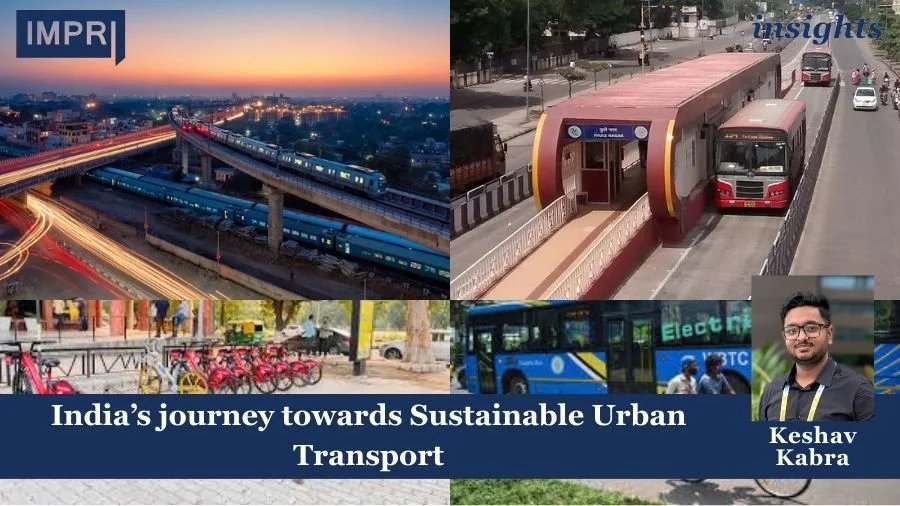
- A multi-modal transportation system to be developed at a faster pace, as it would utilize a variety of transport modes to make urban travel easier. For example, a Delhi commuter may use a bicycle to get to a local train or metro station, and then use a bus/ cycle rickshaw or an e-scooter to their office. Such a hybrid transport system will reduce traffic congestion by discouraging car use and provide employment, education, and leisure opportunities for the city residents. Additionally, integrating NMT with public transportation involves providing secure cycle parking at transit stations and establishing public bike-sharing and rental services.
- Despite prioritizing public transport on paper, governments are focusing more on visible projects for political gains by building more and more flyovers, highways, which will ultimately promote the use of more private vehicles. An equitable road distribution should be available for public transport with dedicated bus lanes and a harsh penalty for drivers who do not follow it.
- The city should be redesigned to make it less prone to traffic. It will ultimately reduce pollution levels, as well as traffic congestion, by controlling travel time. Recently, Kota has become the first city in India to become a traffic signal-free city. They have removed traffic signals from all major intersections by redesigning the roads in a way that ensures continuous traffic flow.
- Car pooling should be promoted to reduce vehicular pollution and will also help commuters save money with the comfort of a car. Electric vehicles should be promoted through incentives such as tax reliefs or subsidies.
- Deploy smart traffic management systems and digital solutions for real-time information, optimising traffic flow and improving the operational efficiency of public transport.
- Doing Away with the ‘One Size Fits All’ Approach. More cities are opting for MRT, LRT, and monorail systems, despite the fact that these are capital-intensive and require substantial capital and operating subsidies. Tier-II and Tier-III cities require a different approach, given their population densities, urban forms, and socio-economic conditions. Intermediate public transport (IPT) modes like e-rickshaws, shared autos, and cycle rickshaws, and NMT assume importance as they can meet the travel demands in small and medium-sized cities.
Conclusion
The National Urban Transport Policy (NUTP) sets a visionary path: to prioritize people, not vehicles. However, our cities are clearly stuck between this aspiration and a reality dominated by personal cars. The review highlights a crucial truth: while grand blueprints, such as the NUTP, and the success stories of BRT systems in cities like Ahmedabad, as well as NMT policies in Chennai, show what’s possible, systemic gaps persist.
We still see fragmented planning, a crippling underutilization of funds for crucial e-mobility programs, and public transport lagging far behind the 40-45% modal share target. Simply put, the policy exists, but the coordination, financial muscle, and institutional authority to truly implement it on the ground, especially in favour of buses, walking, and cycling, often do not. To bridge this gap, the path forward must be about more than just building infrastructure; it’s about shifting mindsets and empowering local action.
About the Author
This article was written by Keshav Kabra, who is currently pursuing a Master’s degree in Public Policy and Sustainable Development from TERI School of Advanced Studies (TERI-SAS). He has completed his graduation in Political Science (Honours) from the University of Delhi, Motilal Nehru College.
Acknowledgement: This article was posted by Vatsala Sinha, Research Intern at IMPRI.
Disclaimer: All views expressed in the article belong solely to the author and not necessarily to the organisation.
Read More at IMPRI
From Code To Coal: The Energy Footprint Of India’s Digital Ambitions