




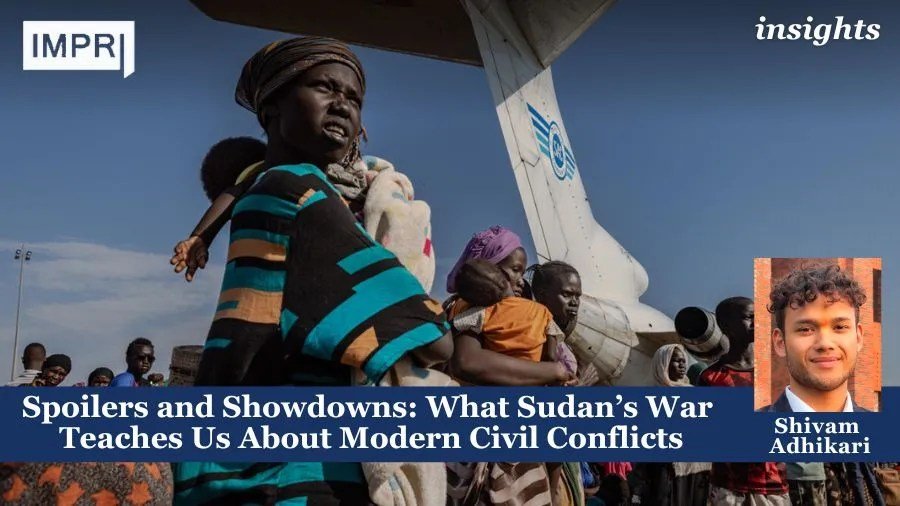
Shivam Adhikari
When Sudan’s capital, Khartoum, erupted into war in April 2023, the world watched with grim déjà vu. Another peace deal crumbled, and another country plunged into civil conflict. But the story of Sudan’s war isn’t just one of chaos but also of strategy. The violence, as horrifying as it has been, isn’t random. It’s part of a calculated playbook used by factions worldwide to win power by derailing peace and showcasing dominance.
Two key concepts help us decode this playbook: spoiling and outbidding. Political scientists Andrew Kydd and Barbara Walter introduced these terms in 2006 to explain why some groups resort to high-profile violence just when peace seems possible (Kydd & Walter, 2006). In Sudan, both the Sudanese Armed Forces (SAF) and the Rapid Support Forces (RSF) have weaponised these strategies. And what’s happening in Sudan has uncomfortable echoes in places as far-flung as Afghanistan, Colombia, and Somalia.
Killing Peace Before It Starts
Spoiling occurs when a faction, often excluded or mistrustful of a peace process, uses violence to sabotage it. In Sudan, this tactic was on display during the early ceasefire attempts and especially during the Saudi- and US-brokered Jeddah talks. Neither SAF nor RSF was genuinely committed to these negotiations. Instead, both used the talks as a stage for sabotage (Al Jazeera, 2023; Idris & Daqash, 2024).
Take the failed Khartoum ceasefire in April 2023. Just hours after it was announced, both factions resumed shelling and airstrikes, signalling that they viewed diplomacy not as a solution, but as a threat to their autonomy and control (The Guardian, 2023). Their message to the UN, the AU, and regional actors like IGAD was chillingly clear: no peace without us, and no peace we can’t veto.
This isn’t new. Spoiling has long been a tool for power retention. The Taliban in Afghanistan launched suicide attacks during U.S.-led peace talks to prove they could not be sidelined (Maizland, 2020). Colombia’s FARC did the same in the early 2000s, bombing infrastructure while talks were underway, undermining trust in negotiations (Ferrer, 2000). In all these cases, violence wasn’t irrational. It was a message: “Negotiate with us—or negotiate with no one.”
Outbidding: Who’s the Toughest of Them All?
Outbidding, on the other hand, is about internal competition. Factions vie for public support by appearing more militant, more disciplined, or more effective than their rivals. It’s less about destroying peace and more about proving dominance—militarily, politically, or even symbolically.
The RSF’s offensive on the western town of El-Nahud in May 2025 exemplifies this strategy. Footage circulated online of RSF fighters storming SAF checkpoints and claiming the town’s “liberation” (Sudan Tribune, 2025). This wasn’t just a military move—it was a media spectacle aimed at Darfur-based Arab tribes and rival factions like the SPLM-North. The RSF was signalling: “We are the true power in Sudan’s west.”
Again, Sudan’s conflict is part of a broader pattern. In Somalia, Al-Shabaab consistently outbids the central government by demonstrating both brutality and governance efficiency, often distributing aid and enforcing order in rural areas where the state is absent (Klobucista et al., 2022). In Mali, groups like Jama’at Nasr al-Islam wal Muslimin (JNIM) have used targeted attacks and blockades to dominate rivals and win local loyalty (Diallo, 2023).
Why It Matters: The Civil War Playbook Is Global
It’s tempting to dismiss Sudan’s crisis as “just another African conflict.” But that ignores the broader trend: civil wars today are increasingly characterised by strategic performances, not just chaos. Violent actors use media to stage victories. They destroy negotiations not out of irrationality, but as part of a logical calculus to maximise and maximise control. And they compete not just against the state, but against other insurgent groups. These strategies bleed across borders and inform how international bodies, donors, and peacebuilders should approach conflict resolution.
So, what can be done?
First, international mediators must recognise that violence during talks doesn’t always mean failure; it may mean someone is trying to win the narrative. That calls for deeper political inclusion, not just more pressure for ceasefires. Second, peacebuilding must focus not just on the end of violence, but on why violence is used, to sabotage, to perform, to compete. Understanding the function behind the firepower is key. Finally, accountability matters. Groups like the RSF and SAF may be using spoiling and outbidding to signal power, but they’re also committing horrific atrocities in the process (OHCHR, 2025; Human Rights Watch, 2024). The international community must ensure that strategic violence doesn’t pay off in the long run.
Sudan’s war is a stage, and both the RSF and SAF are performing. Their violence is calculated, symbolic, and globally familiar. From Khartoum to Kabul, from Mogadishu to Medellín, the same logic applies: if peace threatens your power, destroy it. If rivals compete, outshine them.
References
- Al Jazeera. (2023, May 31). The Sudan army suspends participation in Jeddah ceasefire talks. https://www.aljazeera.com/news/2023/5/31/sudan-army-suspends-participation-in-jeddah-ceasefire-talks
- Diallo, T. (2023, August 28). Islamist blockade on Timbuktu stops food and aid as prices spike. Reuters. https://www.reuters.com/world/africa/islamist-blockade-timbuktu-stops-food-aid-prices-spike-2023-08-28/
- Ferrer, Y. (2000, September 19). FARC, ELN Actions Hinder Peace Talks. Inter Press Service. https://www.ipsnews.net/2000/09/politics-colombia-farc-eln-actions-hinder-peace-talks/
- Human Rights Watch. (2024, April 13). Sudan: One year of atrocities requires a new global approach. https://www.hrw.org/news/2024/04/13/sudan-one-year-atrocities-requires-new-global-approach
- Idris, A., & Daqash, M. (2024, August 19). The failure of the Jeddah and IGAD mediation efforts for Sudan. https://arabcenterdc.org/resource/the-failure-of-the-jeddah-and-igad-mediation-efforts-for-sudan/
- Klobucista, C., Masters, J., & Sergie, M. A. (2022, December 6). Al-Shabaab. Council on Foreign Relations. https://www.cfr.org/backgrounder/al-shabaab
- Kydd, A. H., & Walter, B. F. (2006). The strategies of terrorism. International Security, 31(1), 49–80. https://www.jstor.org/stable/4137539
- Maizland, L. (2020, March 2). U.S.-Taliban peace deal: What to know. Council on Foreign Relations. https://www.cfr.org/backgrounder/us-taliban-peace-deal-agreement-afghanistan-war
- OHCHR. (2025, April). Sudan: UN Fact-Finding Mission deplores Darfur killings as conflict enters third year. https://www.ohchr.org/en/press-releases/2025/04/sudan-un-fact-finding-mission-deplores-darfur-killings-conflict-enters-third
- Sudan Tribune. (2025, May 1). RSF attacks Sudan’s El Nahud, residents report killings, looting. https://sudantribune.com/article300370/
- The Guardian. (2023, April 21). Sudan ceasefire fails as gunfire and shelling continue in Khartoum. https://www.theguardian.com/world/2023/apr/21/sudan-rsf-paramilitary-group-agrees-to-three-day-ceasefire-to-coincide-with-eid
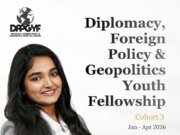
About the contributor: Shivam Adhikari is a fellow at DFPGYF Diplomacy, Foreign Policy & Geopolitics Youth Fellow at IMPRI and is a first-year BA (Honors) International Relations student at Ashoka University, with a minor in Environmental Studies.
Disclaimer: All views expressed in the article belong solely to the author and not necessarily to the organisation.
Read more at IMPRI:
China’s proxy war against India and implication of supporting Pakistan
Acknowledgment: This article was posted by Bhaktiba Jadeja, visiting researcher and assistant editor at IMPRI.