









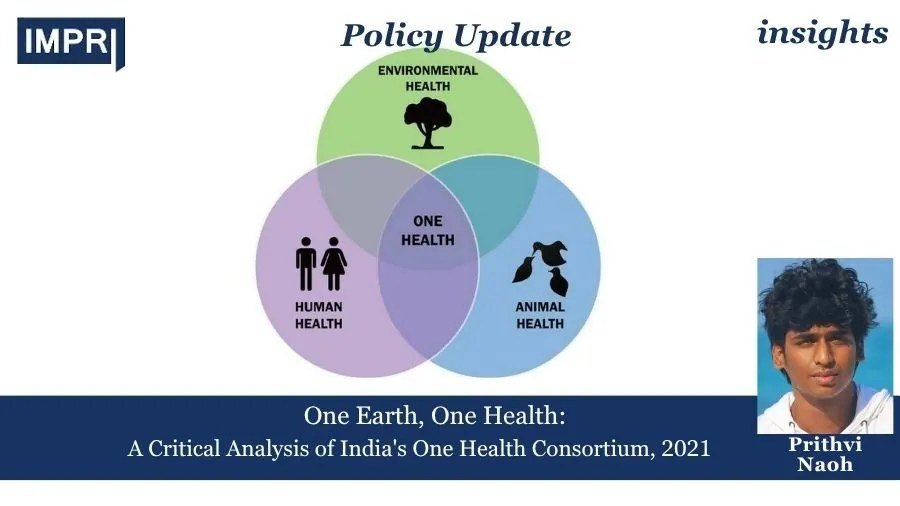
Policy Update
Prithvi Naoh
Introduction
The 21st century has been defined by the ever growing interdependence of human, animals and environmental health. With more than 60% of known infectious diseases in humans and 75% of the emerging infections being zoonotic in nature, the importance of an unified streamline approach is undeniable. The COVID-19 pandemic served as a nightmare which gave us all a wake-up call, highlighting the importance of a “One Health Network” framework – one that evolves traditional disciplinary boundaries to prevent future pandemics and ecological crises. In response to the global paradigm the Government of India launched the One Health Consortium (OHC) IN 2021 under the backing of the Department of Biotechnology ( DBT ), marking an important step in the nation’s pursuit of healthcare resilience through multidisciplinary collaborations.
Evolution of the One Health Consortium
The OHC pictured as a post COVID reform ideas to bridge the gap between veterinary science, human medicine, and environmental health. Launched precisely in October 2021 by DBT, it is supposedly the country’s largest inter-sectoral One Health initiative to date having more than 27 organizations including medical and veterinary institutes, public health bodies, and environmental agencies. OHC is also aligned with India’s commitment under WHO “One Health Global Agenda” and the Quadripartite collaboration (Food and Agricultural Organization, World Health Organization, World Organization for Animal Health, United Nations Environment Programme).
Structure and Key Stakeholders
Objectives of the One Health Consortium
The OHC works towards:
- Detecting Zoonotic Diseases Early: Developing infrastructures for observation of diseases that spill from animals to humans, including diseases such as Leptospirosis, Brucellosis, and Nipah virus.
- Integrating Observation Systems: Create a comprehensive, unified, interlinked observation ecosystem for human, livestocks, wildlife, and environmental health data.
- Conducting Interdisciplinary Research: Facilitate cross-disciplinary studies on Zoonoses, Antimicrobial resistance, and Vector borne diseases.
- Enhancing Workforce Training: Developing scientists, healthcare workers and veterinarians in goals related to one health principles.
- Policy Advocacy: Informing policy makers to promote data-driven and ecosystem sensitive health policies.
Area of Focus
The OHC HAS prioritized certain areas of focus which includes
- Zoonotic Disease Observation in hotspot regions like the Western Ghats and Northeast India.
- Wildlife and livestock pathogen mapping.
- Wastewater-based epidemiology for easier and faster pathogen detection.
- Tracking Antimicrobial resistance(AMR) in animals and humans.
- Building One Health education modules across the country.
These areas of focus are grounded in India’s high risk status for Zoonotic spillover due to its dense human-animal juncture.
Achievements and Pilot Testings
The consortium has planned out observation pilot programs in Karnataka, Assam, and Maharashtra using AI- based outbreak predicting tools. The programs also developed cross-species diagnostics platforms and established genome sequencing hubs in collaborations with ICAR labs. In addition, many educational campaigns have been initiated in collaboration with state veterinary universities to train community health workers in One Health Literacy.

Source- https://dbtonehealth.com/
Merits of the One Health Consortium
- Systemic Integration
OHC tries bringing together different stakeholders under one unified framework, enabling partnership across disciplines. - Disease Prevention
Early detection and pre-emptive response to Zoonotic threats have reduced the likeliness of other epidemics. - Environmental Sustainability
By taking into account the ecosystem’s health, OHC contributes to sustainable agriculture and industrial practices. - Policy Innovation
The consortium’s interdisciplinary research advises national health policies with scientific backings and ecological sensitivity.
Challenges and Limitations
- Institutional fragmentations
Despite collaborations and unified frameworks, administrative and bureaucratic friction across ministries slows down implementations. - Data Silos and Privacy
The lack of a unified digital infrastructure and clear working modules on data privacy limits information sharing across sectors. - Skill Shortage
There is a huge vacancy of trained professionals, particularly in the veterinary and ecological health sectors. - Funding and Prioritization
Limited and inconsistent funding has hindered progress which in turn has slowed down the process of full scale implementation beyond pilot programmes.
Way Forward
To strengthen the One Health Consortium and ensure it long term sustainability the stakeholders must ensure
- Adopting a National One Health Policy
Unifying institutions and intersectoral co-ordinations through legislative and financial backings. - Invest in Digital Health Infrastructure:
Building interoperable programmes for disease driven data across human, animal, and environmental sectors. - Promote Community Engagement
Conducting grassroots health literacy programmes to educate the people on Zoonotic risks. - Enhance Global Partnerships
Collaborating with international research institutions and donors on a more streamlined approach to scale innovation and best practices. - Integrate into Education
Embedding the One Health principles in curricula for medicine, veterinary science, and environmental studies.
Conclusion
The One Health Consortium is not just a research initiative- it is a vision of integrated resilience of many human minds and institutions combined for a country grappling with the ever growing crisis of infectious disease, environmental degradation and healthcare inequality. This offers India a chance to lead the countries of the global south in a unified and operationalized One Health approach. With sustained policy support, resilience, investment in capacity building, and genuine collaborations, the OHC could be a transformative model for 21st century public health.
References
Department of Biotechnology. (2022). DBT’s One Health Consortium advances zoonotic surveillance in India. Ministry of Science and Technology. https://dbtindia.gov.in
Gibbs, E. P. J., & Atlas, R. M. (2013). One Health: People, animals, and the environment. Johns Hopkins University Press.
Observer Research Foundation. (2023). Building bridges across disciplines: Operationalizing One Health in India. https://www.orfonline.org
Press Information Bureau. (2021, October 14). Dr. Jitendra Singh launches DBT-supported Pan-India One Health Consortium. https://pib.gov.in/PressReleasePage.aspx?PRID=1766796
The Lancet Global Health. (2021). One Health and equity. The Lancet Global Health, 9(11), e1459–e1460. https://doi.org/10.1016/S2214-109X(21)00419-6
World Health Organization. (2022). Operational framework for building climate resilient and environmentally sustainable health systems. https://www.who.int
About the contributor- Prithvi Naoh is a research intern at IMPRI.
Acknowledgement- The author sincerely thanks Ms. Aasthaba Jadeja and the fellow IMPRI fellows for their valuable contributions
Disclaimer: All views expressed in the article belong solely to the author and not necessarily to the organisation.
Read more at IMPRI:
National Scholarship Portal, 2016
Ministry of Tribal Affairs: Empowering India’s Indigenous Communities, 1999