








Policy Update
Aditi Bisht
Background
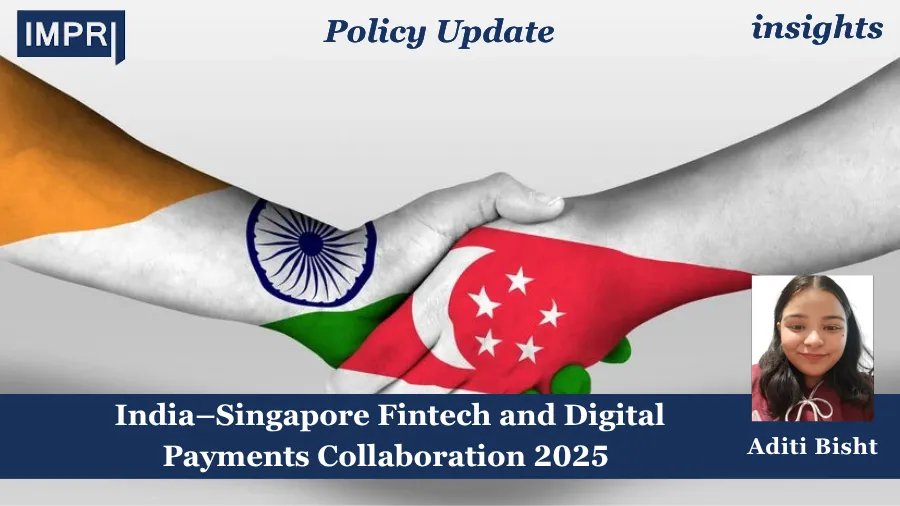
India and Singapore have come to be two of the most dynamic players in the international fintech and digital payment ecosystem. With India’s Unified Payments Interface (UPI) as the pillar of digital transactions and Singapore establishing itself as a global payments hub, the coming together of the two economies in the financial technology space assumes monumental importance.
The basis for this cooperation was established by way of signing of a Memorandum of Understanding (MoU) between Monetary Authority of Singapore (MAS) and the Reserve Bank of India (RBI) in September 2021. The collaboration saw connecting India’s UPI with Singapore’s PayNow, to facilitate real-time, low-cost cross-border fund transfers. This vision came to fruition in February 2023, when Prime Minister Narendra Modi and Prime Minister Lee Hsien Loong, alongside RBI Governor Shaktikanta Das and MAS Managing Director Ravi Menon, inaugurated the UPI–PayNow linkage together.
The partnership has grown since then. NPCI International Payments Limited (NIPL), the overseas subsidiary of the National Payments Corporation of India (NPCI), collaborated with Singapore payment infrastructure company HitPay in 2025 to take UPI acceptance to more than 12,000 merchants in Singapore. More recently, Indian fintech giant Razorpay has entered Singapore, its second foray in Southeast Asia after Malaysia. The step highlights the increasing economic and technological integration between the two countries, echoing their common desire to create a seamless, cashless, and innovative financial economy.
Functioning
The India–Singapore fintech partnership works on various levels:
1. UPI–PayNow Cross-Border Linkage – Instant and real-time transfer of funds between accounts in India and Singapore is possible through this system through the use of just a mobile number or UPI ID. The process of transferring money mirrors the convenience of making domestic payments, freeing the user from registering on the foreign country’s payment service. Originally limited to SGD 1,000 per day, the system was meant to reduce transaction cost from an average 5 percent to almost half, which will directly benefit migrant workers, students, and SMEs.
2. Integration of Merchants via NPCI–HitPay – NIPL’s 2025 tie-up with HitPay has increased the acceptance of UPI in Singapore. With more than 12,000 merchants now integrated, Indian travelers can pay effortlessly at retail stores, such as Singapore’s Changi Airport. This initiative is indicative of operational success of two-way fintech collaboration while offering Indian customers a convenient and affordable payment option overseas.
3. Fintech Growth through Razorpay – Razorpay’s foray in Singapore in 2025 is a strong private-sector contribution to this partnership. Drawing on its experience in India and Malaysia, the company has introduced AI-driven payment solutions that aim to cut cross-border transaction charges by 30–40 percent. By overcoming issues like remittance costs (4–6 percent per transaction) and dispersed payment systems, Razorpay seeks to enable Singaporean small and medium enterprises (SMEs) and deepen cross-border business links with India.
These various channels—government-led payment linkages, institutional collaborations, and private fintech growth—are building a strong ecosystem of financial linkage between India and Singapore.
Performance
With the recent inception of the UPI–PayNow mechanism and Razorpay’s foray into Singapore in 2025, definitive performance statistics are yet to be made available. Nevertheless, preliminary pointers and corresponding statistics demonstrate the future impact potential:
Remittance Volumes: India–Singapore remittance flows run over USD 1 billion annually. The UPI–PayNow mechanism, through cost reduction and instant transfer availability, stands to capture a huge portion of this corridor.
UPI Growth in India: UPI handled around 74 billion transactions of ₹125.94 trillion (USD 2 trillion) in 2022, which is an indicator of the platform’s maturity for scaling up. Its international expansion, including Singapore, has a tried-and-tested infrastructure for cross-border usage.
Merchant Acceptance: With 12,000 Singapore merchants activated via NIPL–HitPay, UPI payments are going mainstream among Indian tourists and business travelers.
Private-Sector Initiatives: Razorpay’s operations in Malaysia expanded ten times in two years, a trend it hopes to repeat in Singapore. Although there is no performance data yet available, the company expects 30 percent higher merchant conversion rates and substantial cost savings from its AI-based solutions.
With this, although thorough quantitative analysis will take time, there are early indications of strong adoption and a replicable model for growth.
Impact
The India–Singapore fintech collaboration has many benefits:
1. For Individuals: Indian diaspora in Singapore, who make up nearly 9% of the population, now have faster, cheaper and more reliable remittance channels. Students and workers will save big on transaction costs.
2. For Businesses: SMEs in Singapore, who are often constrained by high cross-border payment charges, can use Razorpay’s solutions and UPI’s merchant integrations to go global. Reduced transaction fees means more profitability and competitiveness.
3. For Tourism and Trade: Indian travellers can now use UPI for payments in Singapore, making it more convenient and boosting bilateral tourism and retail trade.
4. For Policy Alignment: The collaboration is in line with the G20’s financial inclusion priorities and the UN Sustainable Development Goals by promoting transparent, affordable and accessible financial systems. It also fulfills the RBI’s Payments Vision Document (2019–21) which prioritized improving remittance corridors.
5. For Global Leadership: By linking UPI with PayNow, India and Singapore have created one of the world’s largest real-time cross-border payment systems. This can be replicated with other countries, as India has already signed MoUs with 13 countries for UPI adoption
Emerging Issues
A few issues have emerged:
Availability of Data: Since the initiatives are recent, data on performance is limited so far, curbing complete assessment.
Challenges in Interoperability: Though UPI–PayNow is seamless, extending such connections to additional nations is a technologically complex and regulatory harmonization process.
Business Transaction Costs: Even after the enhancements, cross-border charges of 4–6 percent still afflict SMEs in Singapore, impacting competitiveness.
Regulatory Compliance: Fintech growth such as Razorpay needs to weave through robust compliance structures in Singapore, needing tight regulatory coordination.
Customer Awareness: Take-up is dependent on extensive outreach to ensure Indian tourists, diaspora groups, and domestic merchants realize the full potential of the new systems.
Following suggestion can be use:-
- Increase data openness via combined RBI–MAS performance dashboards.
- Scale merchant onboarding initiatives to embed adoption.
- Develop multilateral infrastructures such as BIS’ Project Nexus to drive interoperability.
- Offer niche financial education programs for SMEs and migrant workers.
- Promote shared sandbox spaces to pilot AI-driven fintech innovations across borders.
Way Forward
The India–Singapore fintech and digital payment cooperation is a historic move towards developing a globally integrated financial ecosystem. It synergizes the strength of India’s advanced digital infrastructure with Singapore’s global financial hub status.
In the future, the agendas should be:
- Consolidating UPI–PayNow adoption and increasing transaction amounts.
- Facilitating greater merchant participation beyond the first 12,000 in Singapore.
- Assisting fintechs such as Razorpay in creating AI-based solutions designed for SMEs.
- Scaling up bilateral collaboration to multilateral frameworks within Southeast Asia through such initiatives as Project Nexus.
Through coordination between technology, policy, and private innovation, India and Singapore are not just strengthening their bilateral relationship but also setting the future of cross-border digital payments. This coordination will go a long way in both countries’ digital economies, enhance regional integration, and bring about the vision of a cashless, inclusive, and innovation-driven “New India.
References
Staff, T. G. (2025, March 6). Indian fintech firm Razorpay expands into Singapore – TNGlobal. TNGlobal. https://technode.global/2025/03/06/indian-fintech-firm-razorpay-expands-into-singapore/
Ajinkya Kawale. (2025, March 19). NPCI’s international arm partners with Singapore firm to expand UPI. @Bsindia; Business Standard. https://www.business-standard.com/finance/news/npci-s-international-arm-partners-with-singapore-fintech-to-expand-upi-125031900556_1.html
Amol Dethe, Sharma, S., & ET BFSI. (2025, July 22). India-Singapore UPI-PayNow link goes live as many banks join. ETBFSI.com; ETBFSI. https://bfsi.economictimes.indiatimes.com/articles/india-singapore-cross-border-payments-link-now-active-upi-paynow-revolutionizes-transactions/122828774
(2025). Nus.edu.sg. https://www.isas.nus.edu.sg/papers/india-singapore-digital-payment-systems-facilitating-cross-border-payments/
About the Contributor:
Aditi Bisht is a Research Intern at IMPRI. She holds a bachelor’s degree in Journalism and Mass Communication from Vivekananda Institute of Professional Studies (VIPS). Her research interests lie in government policy and economics.
Acknowledgement: The author extends her sincere gratitude to the IMPRI team and Ms. Aasthaba Jadeja for her invaluable guidance throughout the process.
Disclaimer: All views expressed in the article belong solely to the author and not necessarily to the organisation.
Read more at IMPRI:
District Development Coordination and Monitoring Committees (DISHA) 2016: A Decade of Decentralized Governance
How H1B Fee Hike Impact American Students More Than Indian IT