






Policy Update
Aditi Singh Kaushik
Background
In light of technological developments ushered in the past decade, the Union Ministry of Information and Broadcasting, Government of India has proposed a draft Broadcast Services (Regulation) Bill, 2023. The bill seeks to replace the existing Cable Television Networks (Regulation) Act, 1995 and other policy guidelines that primarily governed broadcasting channels and cable networks.
The Ministry of Information and Broadcasting with reference to the draft bill, defines broadcasting as, “one-to-many transmission of audio, visual or audio-visual programmes using a broadcasting network, intended to be received or made available for viewing, by the general public or by subscribers of the broadcasting network, as the case may be, and the expression “broadcasting services” shall be constructed accordingly.”
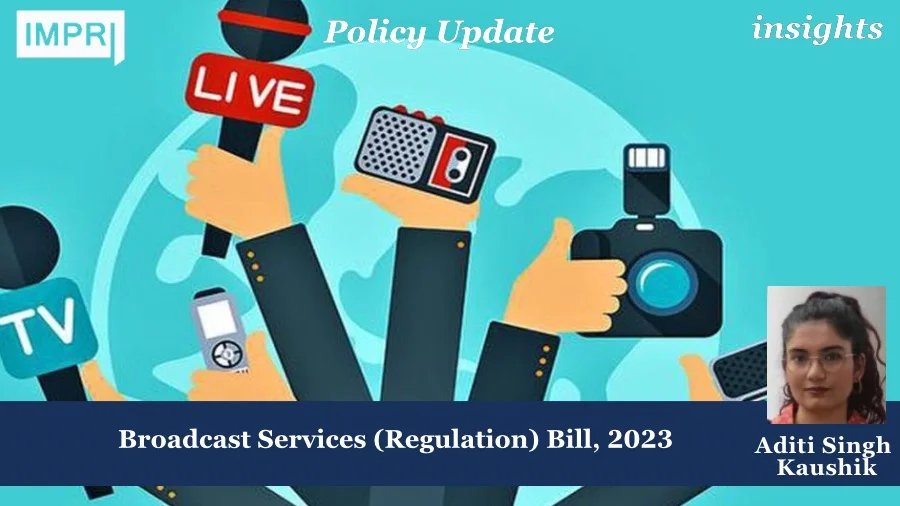
The proposed bill aims to streamline the regulatory framework by consolidating conventional TV Broadcasts, Cable TV, Direct-To-Home (DTH), Internet Protocol Television (IPTV), Over-The-Top (OTT) Platforms and Digital News Outlets under one umbrella. It mandates broadcasters and network providers to seek registration with the Government of India or notify the former before they begin to offer their services.
The rationale behind the proposed regulations has alluded to significant changes in the broadcasting landscape, digitisation of the sector, ease of doing business, and the need for a more cohesive and comprehensive law. In November 2023, the Ministry of Information and Broadcasting invited comments on the Broadcasting Services (Regulation) Bill.
In 2022, in line with the same underlined ethos expressed in this bill, the European Union passed the Digital Services Act to create a safer online environment for digital users and companies, and to protect fundamental rights in the digital space by establishing new rules.
Functioning
- Alteration of the Existing Act: In a new move, the bill aims to update the existing regulatory provisions for various broadcasting services by bringing them under a single regulatory framework, thereby making the streamlining process more efficient and contemporary.
- Broadcast Advisory Council (BAC): It proposes to establish a Broadcast Advisory Council (BAC) that provides oversight on broadcasting affairs. The board shall comprise five ministerial officers and another five independent experts chosen from different walks of life. The Council’s main duty will be to decide appeals brought forward by self-regulatory bodies of previously received complaints. The final decision, however, rests with the Central Government.
- Grievance Officer: The bill also proposes the creation of a Grievance Officer’s post, who will be in charge of receiving and addressing grievances within the Broadcasters and Broadcasting Network Operators. The complainant, in this case, has the autonomy to escalate the issue to a self-regulatory body that the Broadcaster should be a member of.
- Content Evaluation Committees: In another new development, it also suggests the creation of these committees to review and provide a green signal to content before it gets aired. The green signal paves the way for a certification, which formally allows broadcasters to air their respective content. However, the final decision vis-à-vis who gets a certification rests with the Central Government.
- Inclusion and Diversity: With the inclusion of Comprehensive Accessibility Guidelines, the draft bill addresses the specific needs of persons with disabilities, like making subtitles customizable so that they can be enlarged, resized, and coloured, along with a variety of fonts. This initiative to create more inclusivity also provides audio description in multiple languages and signs. (Pandey, 2024)
Impact and Performance
The Ministry of Information and Broadcasting circulated the draft bill and invited comments from prominent stakeholders, which in turn prompted critical reception from industry stakeholders, legal scholars and civil society. A large section of these stakeholders raised concerns over its potential impact on free speech and the autonomy of digital platforms. As of 2025, the bill is yet to be passed in either of the two houses of parliament.
Emerging Issues
- Concerns over Government Surveillance: Pandey (2024) highlights that constant monitoring by the state watchdogs may subvert independent free media and OTT platforms from expressing themselves. This, in turn, may jeopardise the kind of content they produce, since broadcasters and stakeholders within the creative industry will hesitate in investing time in creating anything which will not receive a green light from the government.
- Extension of Regulatory Obligations: The bill’s expansive measures over digital platforms could undermine media independence and editorial autonomy. In particular, its extension of regulatory obligations to digital news platforms also raises questions about press freedom, content moderation and the role of the state in shaping online discourses. (Basu, 2024)
- Jurisdiction of the Broadcast Advisory Council (BAC): Since the central government controls the procedures about how the BAC allocates cases to review panels, some deem this bill to be a tool that can be used by the government to create procedures and committees favourable to itself.
- Limitations of Self-Regulatory Organisations: The non-independent nature of Self-Regulatory Organisations raises concerns because their members are appointed by the government. This, in turn, creates jeopardy vis-à-vis the principles of impartiality and reasonableness, which may find no place in a space governed by constant surveillance.
- Absence of Robust Institutional Safeguards: Lack of institutional safeguards, including transparency to protect broadcasters against regulatory overreach, has raised questions and validated fears that the bill could strengthen state control, rather than streamlining and modernising media regulation.
- Ambiguous Definitions: The use of broad and ambiguous language to define content deemed as “harmful” or “offensive” also raises concerns amongst scholars about the extent of government overreach. Not only do these vaguely defined categories have the capability of paving the way for discretionary enforcement, but they also leave independent creators uncertain about what qualifies as permissible content. (Basu, 2024)
Way Forward
The principle behind drafting the Broadcast Services (Regulation) Bill caters to the evolving needs of the broadcasting sector. However, the stated principle of the bill (which involves digitisation and inclusivity measures) stands in juxtaposition with the actual aims it wishes to achieve. The direct or indirect intersection of governmental authority and the digital domain must be examined again in light of its review by a diverse group of stakeholders, and its broader implications on media practices and the existing plurality of opinions in the sector.
The Ministry of Information and Broadcasting must review such observations and make any revisions that honour the principles of media pluralism, freedom of speech, diversity of viewpoints, and empowerment of independent opinion in the long run. (Pandey, 2024)
References
- Pandey, M. (2024). THE IMPACT OF THE BROADCASTING SERVICES (REGULATION) BILL, 2023, ON MEDIA DIVERSITY AND FREEDOM OF EXPRESSION IN INDIA. Indian Journal of Law and Legal Research, VI(II), 9325–9327. https://www.ijllr.com/post/the-impact-of-the-broadcasting-services-regulation-bill-2023-on-media-diversity-and-freedom-of-ex
- Basu, S. & University of Leeds. (2024). DIGITAL AUTONOMY OR REGULATORY OVERREACH? A CRITICAL ANALYSIS OF INDIA’S BROADCASTING SERVICES (REGULATION) BILL. In NUJS Journal of Regulatory Studies: Vol. X (Issue I, pp. 2–4) [Journal-article]. https://www.cyberpeace.org/resources/blogs/broadcasting-services-regulation-bill-2024
- The Ministry of Information and Broadcasting proposes the Broadcasting Services (Regulation) Bill, 2023. (n.d.). https://www.pib.gov.in/PressReleasePage.aspx?PRID=1976200®=3&lang=2
- MINISTRY OF INFORMATION AND BROADCASTING. (2023). Broadcasting Services (Regulation) Bill, 2023. IN MINISTRY OF INFORMATION AND BROADCASTING. https://mib.gov.in/sites/default/files/Public%20Notice_07.12.2023.pdf
About the Contributor:
Aditi Singh Kaushik is a Research Intern at IMPRI. She also holds a Master’s degree in Political Science from Banaras Hindu University. Her research interest lies in understanding the evolving roles of traditional and organic intellectuals in post-colonial countries, within a Gramscian framework.
Acknowledgement: The author sincerely thanks the IMPRI team for their valuable support.
Disclaimer: All views expressed in the article belong solely to the author and not necessarily to the organisation.