








Rajashree Krishnan Bharadwaj
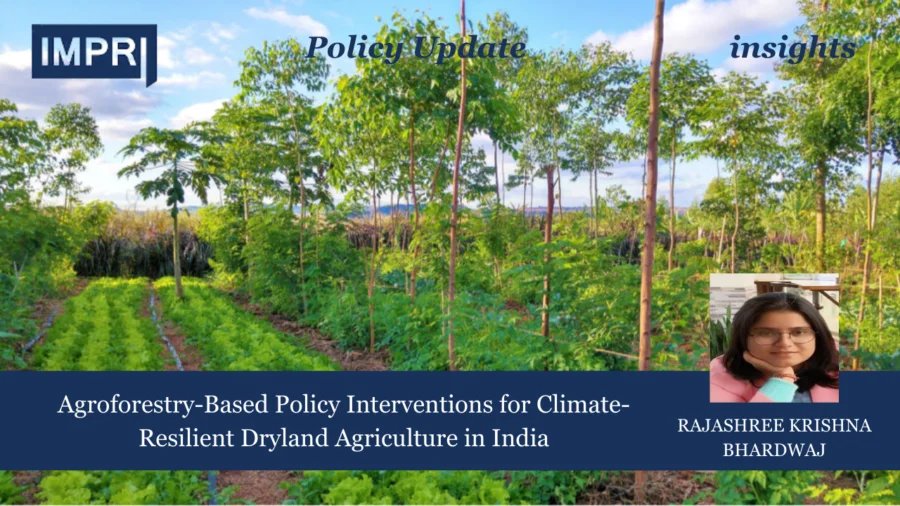
Dryland agriculture sustains nearly half of India’s cultivated area and supports the livelihoods of millions of smallholder farmers. Yet, it remains one of the most vulnerable sectors in the face of climate change — grappling with unpredictable rainfall, rising temperatures, frequent droughts, and land degradation. In this context, agroforestry emerges not only as a pragmatic farming practice, but also as a strategic policy imperative to build climate-resilient dryland systems that enhance productivity, ecological balance, and rural livelihoods.
Understanding the Challenge
India’s drylands span across arid, semi-arid, and dry sub-humid zones — including large parts of Rajasthan, Gujarat, Maharashtra, Karnataka, Andhra Pradesh, and Telangana. These regions endure low and erratic rainfall patterns, high evapotranspiration, and fragile soils that limit crop yield stability. Traditional monoculture cropping often fails in such stress conditions, leading to crop failures, economic distress, soil nutrient depletion, and increased migration from rural areas.
Climate change compounds these vulnerabilities. More intense heatwaves, shifting monsoon patterns, and prolonged drought spells are increasing the risk profile of dryland farming. Farmers often face agrarian distress due to low resilience, limited crop diversification, and weak access to climate-adapted technologies.
Agroforestry: A Natural Pathway to Resilience

Agroforestry — the intentional integration of trees with crops and/or livestock — aligns ecological processes with agricultural production. By diversifying farm systems spatially and temporally, agroforestry enhances resilience on multiple fronts:
- Soil health and water retention: Tree roots improve soil structure, enhance organic matter, reduce erosion, and increase infiltration. This can ameliorate soil moisture levels crucial for dryland cropping.
- Microclimate regulation: Tree canopies reduce ground temperatures, conserve soil moisture, and dampen the effects of heat stress on crops and livestock.
- Carbon sequestration: Trees absorb and store carbon, contributing to climate mitigation and supporting India’s commitments under the Paris Agreement.
- Economic and nutritional diversification: Fruit, fodder, timber, fuelwood, medicinal plants, and other tree products provide supplementary incomes and improve food and nutrition security.
- Biodiversity enhancement: Mixed farming systems with trees promote diverse flora and fauna, improving ecosystem resilience and pest regulation.
Policy Interventions for Scaling Agroforestry in Drylands

To realize the potential of agroforestry at scale, policy interventions must be coherent, farmer-centric, and integrated across agricultural, forestry, water, and climate governance frameworks. Here are key policy recommendations:
1. Recognize Agroforestry as a Core Pillar of Dryland Agriculture Policy
Historically, agroforestry often sat ambiguously between agriculture and forestry departments, leading to policy gaps and implementation bottlenecks. Official recognition of agroforestry as a mainstream agricultural practice — not merely an ancillary activity — will help in:
- Allocating dedicated funds and resources.
- Designing program schemes tailored to dryland contexts.
- Harmonizing land use norms to support on-farm tree cultivation.
2. Incentivize Farmer Adoption Through Financial Mechanisms
Farmers in drylands face resource constraints, and long gestation periods for tree products can deter adoption. Policy incentives can include:
- Subsidies for high-value drought-tolerant tree species (moringa, neem, tamarind, ber, banyan, etc.).
- Performance-linked support for soil and water conservation structures (contour trenches, farm ponds, check dams).
- Credit facilities with flexible repayment terms aligned to trees’ growth cycles.
- Carbon financing mechanisms where farmers receive payments for ecosystem services (PES) or carbon credits.
3. Promote Climate-Smart Agroforestry Models
Governments and research institutions should co-create scalable models customized to ecological zones. Examples include:
- Silvopasture systems that integrate fodder trees with grazing lands.
- Contour hedgerows and shelterbelts on slopes to reduce soil loss and wind damage.
- Intercropping trees with legumes and climate-resilient cereals to maintain productivity even under moisture stress.
These models should be validated through participatory field trials and disseminated through extension networks.
4. Strengthen Institutional Convergence and Capacity Building
A major hurdle in policy implementation has been siloed governance:
- Agriculture, forestry, rural development, watershed missions, and climate departments must coordinate at national, state, and district levels.
- Extension services need to be reoriented — promoting agroforestry knowledge, seedling production, nursery management, and best practices.
- Partnerships with universities, NGOs, and private sector organizations can enhance innovation and outreach.
5. Support Local Value Chains and Market Linkages
For agroforestry to be economically viable, farmers must see returns beyond subsistence. Policy measures could include:
- Creating aggregator platforms for tree products (fruits, honey, bamboo, resins, fodder).
- Promoting processing units at regional hubs to add value and generate employment.
- Integrating agroforestry produce into public procurement systems (school feeding programs, community kitchens).
6. Integrate with Water Conservation and Land Restoration Programs
Agroforestry must be embedded within larger landscape-level strategies:
- Watershed development programs can be linked with tree planting to maximize soil moisture recharge.
- Degraded lands under programs like Compensatory Afforestation or Green India Mission can be rehabilitated through community-led agroforestry.
- Social forestry initiatives should emphasize on-farm trees rather than only village common lands.
7. Monitor, Evaluate, and Learn
Robust data systems are required to monitor outcomes such as:
- Soil moisture levels
- Crop yield stability
- Income diversification
- Carbon sequestration
This evidence base will refine policy design over time and demonstrate agroforestry’s impacts.
Conclusion: Transforming Dryland Agriculture Through Policy Leadership
Agroforestry is more than an agricultural practice — it is a transformative approach capable of unlocking climate resilience, ecological restoration, and rural prosperity in India’s dryland regions. However, this requires proactive public policy that aligns incentives, builds institutional capacity, and nurtures farmer participation.
By mainstreaming agroforestry into national and state agricultural policies, India can lead a paradigm shift: from vulnerable monoculture systems to diversified, resilient landscapes that withstand climate shocks and nurture sustainable development.
About the contributor
Rajashree Krishna Bharadwaj is a postgraduate researcher in Agriculture, having completed her B.Sc. in Agricultural Sciences from Assam Agricultural University and her Master’s degree in Agriculture from Banaras Hindu University.
Disclaimer
All views expressed in the article belong solely to the author and not necessarily to the organisation.
Read more at IMPRI:
Acknowledgment
This article was posted by Varisha Sharma, a research intern at IMPRI.