








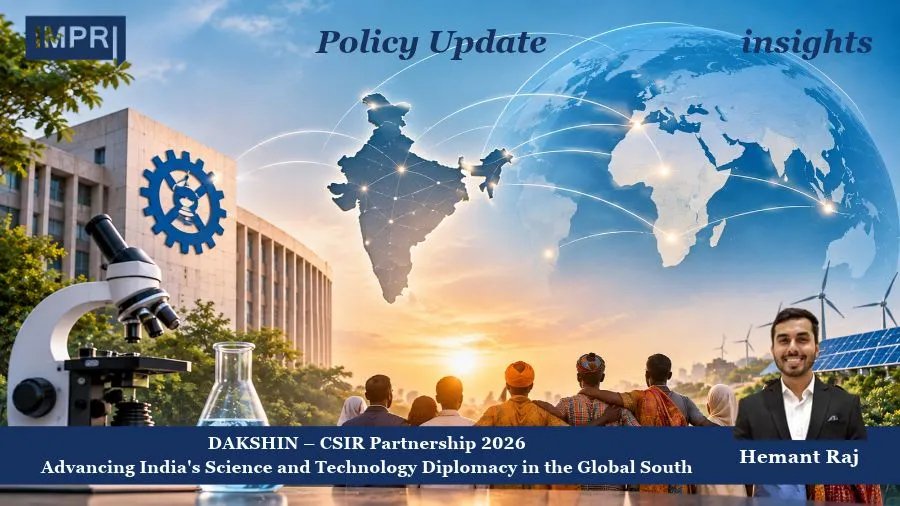
Policy Update
Hemant Raj
Background
In an evolving era, Scientific progress matters most when it reaches the people and communities that need it the most. Yet, for many developing countries, the challenge lies not merely in developing new technologies but in accessing affordable solutions and adapting them to local needs. Limited research infrastructure, technological dependence and shortages of skilled manpower often prevent scientific advances from translating into tangible developmental outcomes. This makes South-South cooperation in science, technology and innovation increasingly important, creating opportunities for developing countries to share knowledge, resources and technological capabilities.
Against this backdrop, the Council of Scientific and Industrial Research (CSIR) and DAKSHIN–Global South Centre of Excellence, hosted at the Research and Information System for Developing Countries (RIS), signed a Letter of Association (LoA) on 3rd November 2026 (Press Information Bureau, 2026a). The partnership aims to strengthen research collaboration, technology sharing, and capacity building among countries of the Global South.
The initiative builds upon India’s broader Global South engagement. DAKSHIN, which stands for Development and Knowledge Sharing Initiative, was announced at the first Voice of Global South Summit in January 2023 and inaugurated during the second summit on 17th November 2023. Its objective is to facilitate the exchange of development experiences and practical solutions among developing countries (Ministry of External Affairs, 2023).
The 2026 partnership brings together CSIR’s scientific research and technological capabilities with DAKSHIN’s international network of policy institutions. Its key objectives include:
- Joint policy research: Identifying affordable and locally relevant solutions to developmental challenges.
- Technology transfer: Facilitating the adaptation and wider use of Indian scientific innovations.
- Capacity building: Promoting technical training, skill development and institutional cooperation.
- Knowledge sharing: Documenting successful development practices and encouraging mutual learning.
- Further, healthcare, agriculture, infrastructure, the blue economy and the digital economy have been identified as important areas of cooperation.
The intended beneficiaries include research institutions, policymakers, entrepreneurs, industries and communities across developing countries. Unlike a conventional time-bound government programme, the partnership establishes a framework for cooperation, with individual projects and implementation arrangements to be developed subsequently.
Functioning
The DAKSHIN–CSIR partnership operates through institutional collaboration rather than a centrally administered government scheme. Its functioning is based on combining scientific expertise with policy research, international partnerships and development-oriented capacity building.
CSIR, an autonomous scientific research organisation under the Department of Scientific and Industrial Research (DSIR), provides the technical foundation. Its network of 37 national laboratories conducts research across fields including healthcare, biotechnology, agriculture, energy, oceanography and environmental science (Council of Scientific and Industrial Research, n.d.).
DAKSHIN, hosted at RIS, serves as a platform for engaging research institutions, governments and development partners across the Global South. It facilitates dialogue, knowledge exchange and the identification of projects suited to partner countries’ developmental priorities.
The Letter of Association envisages cooperation through joint policy studies, institutional engagement, training programmes and the dissemination of scientific innovations. Its intended implementation approach can be understood in three stages: identifying development challenges with partner countries, matching them with suitable technologies and expertise, and facilitating their adaptation and deployment through relevant institutions and industries.
An earlier Memorandum of Understanding signed between CSIR’s National Institute of Science Communication and Policy Research (NIScPR) and RIS on 6th May 2026 provides a complementary institutional foundation. It covers science diplomacy, joint research, publications, policy analysis, and capacity building (Press Information Bureau, 2026b). Funding arrangements remain an important aspect requiring clarification. The November 2026 announcement does not specify a dedicated financial allocation, project-wise funding mechanism, or fixed implementation timeline. Future projects may require separately agreed institutional and financial arrangements.
As of November 2026, the partnership is in its initial stage. Its immediate progress lies in formalising cooperation and identifying priority areas rather than completing technology deployments. The next step will be translating these commitments into jointly implemented projects with measurable outcomes.
Performance
Since the DAKSHIN–CSIR agreement was signed only in November 2026, its performance cannot yet be assessed through long-term outcomes. However, developments between 2023 and 2026 provide a useful basis for evaluating the institutional and technological capabilities available to support the partnership.
CSIR’s Technology Transfer Capacity
CSIR has an established record of developing and transferring technologies to industry. According to information presented in the Lok Sabha in July 2026, the number of technologies commercialised or transferred by CSIR increased substantially between 2023 and 2025.
Table 1: CSIR Technologies Commercialised or Transferred, 2023–2025
| Year | Technologies commercialised/transferred |
| 2023 | 59 |
| 2024 | 144 |
| 2025 | 249 |
Source: Ministry of Science and Technology, Lok Sabha reply, 22 July 2026, released through PIB (Press Information Bureau, 2026c).
These figures indicate growing activity in commercialising publicly funded research. The same parliamentary reply reported that CSIR technology licensing had facilitated the creation of 148 startups over the preceding three years, supporting approximately 7,200 jobs. This experience provides a foundation for extending technology partnerships to developing countries. However, these are CSIR-wide figures and should not be interpreted as achievements of the newly signed DAKSHIN–CSIR agreement.
Progress in Science Diplomacy and International Cooperation
DAKSHIN has gradually developed its international engagement since its establishment in 2023. Its publicly available activities include policy dialogues, thematic workshops and publications covering agriculture, digital public infrastructure, healthcare and development cooperation.
During 2024, DAKSHIN documented workshops on digital technologies in agriculture, digital public infrastructure and cybersecurity. In September 2025, it collaborated with the NIMS Institute of Public Health and Governance to organise a consultation on health diplomacy and capacity building in the Global South (DAKSHIN, 2025).
The year 2026 witnessed further institutional cooperation:
- CSIR-NIScPR and RIS signed an MoU to strengthen science, technology and innovation policy and diplomacy (Press Information Bureau, 2026b).
- CSIR and the Ministry of External Affairs organised the inaugural Tech Familiarization Programme, bringing together 33 ambassadors and embassy officials from 29 countries (Press Information Bureau, 2026d).
- CSIR and DAKSHIN-RIS signed the Letter of Association to strengthen research cooperation and facilitate technology partnerships across the Global South (Press Information Bureau, 2026a).
The October programme exposed foreign representatives to Indian innovations in sustainable infrastructure, genomics and healthcare. Although it preceded the DAKSHIN–CSIR agreement and was conducted separately, it demonstrates an existing mechanism for introducing Indian technologies to international partners. Together, these developments show increasing institutional engagement in science diplomacy.
Impact
The DAKSHIN–CSIR partnership has the potential to strengthen India’s role in science and technology diplomacy by linking domestic scientific capabilities with the development priorities of countries in the Global South.
- It can improve access to affordable technologies. CSIR’s experience in fields such as healthcare, drinking water, agriculture, and environmental management could help developing countries address challenges where expensive imported technologies are difficult to maintain or adapt.
- It could strengthen scientific capacity and local innovation. Training programmes, joint research and cooperation with local institutions may help partner countries build technical expertise rather than depend entirely on external technology providers.
- It provides an additional avenue for India’s development diplomacy. By sharing technological knowledge and promoting mutually beneficial partnerships, India can strengthen its relations with developing countries while contributing to the Sustainable Development Goals.
These objectives are consistent with the broader concerns highlighted in UNCTAD’s Technology and Innovation Report 2025, which emphasises the need for stronger innovation systems, technical skills and international scientific cooperation (United Nations Conference on Trade and Development, 2025).
However, the partnership’s actual impact remains uncertain. As of November 2026, there are no publicly documented, completed cross-border technology deployments attributable specifically to the agreement. Its effectiveness will therefore depend on whether institutional cooperation produces affordable, locally adapted, and sustainable solutions.
Emerging Issues
Despite its potential, several challenges could affect the partnership’s implementation and long-term effectiveness.
- Technology adaptation and local capacity: Technologies developed in Indian laboratories may not be immediately suitable for deployment in other developing countries. Differences in infrastructure, environmental conditions, technical skills, and regulatory standards can affect their performance and affordability.
- Financing and implementation arrangements: The absence of a publicly specified funding structure under the new agreement raises questions about how future projects will be financed. Technology transfer often requires expenditure beyond initial research, including pilot testing, local manufacturing, training and maintenance.
- Institutional coordination: Effective implementation will require coordination among CSIR laboratories, RIS, DAKSHIN, diplomatic institutions and partner-country agencies. Without clearly defined responsibilities and project-level mechanisms, cooperation could remain concentrated on policy dialogues rather than practical deployment.
- Intellectual property and equitable technology sharing: Licensing arrangements, intellectual property rights, and commercial interests may influence access to technologies. The partnership will need to balance the interests of Indian innovators with the affordability and developmental needs of recipient countries.
- Monitoring and accountability: The absence of publicly available partnership-specific performance indicators makes it difficult to measure progress. The number of agreements signed or workshops conducted cannot, by itself, demonstrate improvements in livelihoods, productivity, or technological self-reliance.
These concerns reflect broader challenges in international technology cooperation, particularly the gap between research capabilities and their practical application in developing economies.
Way Forward
To make the DAKSHIN–CSIR partnership more effective, the emphasis should shift from institutional agreements towards practical, measurable cooperation.
- Prioritise demand-driven technology partnerships: Joint projects should be selected according to the developmental priorities identified by partner countries. Affordable healthcare technologies, climate-resilient agriculture and water-treatment solutions could provide suitable starting points.
- Establish pilot projects in selected countries: CSIR and DAKSHIN could initiate small-scale demonstration projects with willing partner institutions. Successful technologies could subsequently be adapted and expanded through local industries and government agencies.
- Develop a sustainable financing mechanism: CSIR and DAKSHIN should explore project financing through the Ministry of External Affairs’ (MEA) development partnership channels, including Lines of Credit and grant assistance, wherever applicable. Co-financing arrangements with multilateral development banks, regional development institutions and industry partners could further mobilise resources. Clearly defined financial responsibilities would strengthen implementation and long-term maintenance.
- Ensure equitable access and address intellectual property concerns: Technology partnerships should incorporate clear intellectual property arrangements that balance the interests of Indian research institutions with the accessibility needs of partner countries. Appropriate licensing agreements, technology transfer provisions, and affordable pricing mechanisms could help ensure that publicly supported innovations remain accessible, particularly to resource-constrained communities.
- Promote joint research and local capacity building: Training should be accompanied by collaborative research, technical exchanges, and opportunities for local scientists and entrepreneurs to participate in adapting technologies. Greater involvement of local institutions would also strengthen their capacity to maintain and independently develop technological solutions.
- Introduce measurable performance indicators: Progress should be assessed through indicators such as technologies piloted, institutions engaged, professionals trained, successful deployments, and the affordability and continued use of technologies by local beneficiaries.
- Strengthen integration with India’s development diplomacy: Closer coordination with the Ministry of External Affairs and existing South-South cooperation initiatives could help identify partner-country requirements, align technology partnerships with India’s development assistance priorities, and facilitate sustainable international collaborations.
Therefore, the DAKSHIN–CSIR partnership marks another step in India’s efforts to place science and technology at the centre of its engagement with the Global South. By combining CSIR’s scientific expertise with DAKSHIN’s international development network, the collaboration opens avenues for research partnerships, technology sharing and capacity building.
However, its real success will depend not on the number of agreements signed but on the solutions they deliver on the ground. A stronger focus on locally identified needs, affordable technologies, adequate financing and effective implementation will be essential to translate India’s scientific capabilities into meaningful developmental outcomes. If supported by sustained institutional coordination, the partnership could strengthen technological self-reliance among developing countries while reinforcing India’s position as a partner in shaping a more inclusive and equitable global technology landscape.
References
Council of Scientific and Industrial Research. (n.d.). About CSIR, Government of India. https://www.csir.res.in/en/about-us/about-csir
DAKSHIN. (2025). Weekly Newsletter, 25 September–1 October 2025. https://dakshin.org.in/newsletter/sep/newsletter-25-Sep-01-Oct-2025.html
Ministry of External Affairs. (2023, November 17). Second Voice of Global South Summit 2023. Government of India. https://www.mea.gov.in/second-vgss.htm
Press Information Bureau. (2026b, May 7). NIScPR signed an MoU with RIS to strengthen Science Technology Innovation Policy and Diplomacy. Ministry of Science and Technology. https://www.pib.gov.in/PressReleasePage.aspx?PRID=2258639&lang=1®=3
Press Information Bureau. (2026c, July 22). Parliament Question: Commercialisation and Transfer of Government-Developed Technologies. Ministry of Science and Technology. https://www.pib.gov.in/PressReleasePage.aspx?PRID=2287709&lang=1®=3
Press Information Bureau. (2026d, October 14). India Strengthens Science and Technology Partnerships with Global South through Inaugural Ministry of External Affairs–CSIR Tech Familiarization Programme. https://www.pib.gov.in/PressReleseDetailm.aspx?PRID=2323546&lang=1®=3
Press Information Bureau. (2026a, November 6). CSIR and DAKSHIN-RIS join hands to advance Science, Technology and Innovation for the Global South. Ministry of Science and Technology. https://www.pib.gov.in/PressReleseDetailm.aspx?PRID=2332389&lang=1®=1
United Nations Conference on Trade and Development. (2025). Technology and Innovation Report 2025: Inclusive Artificial Intelligence for Development. United Nations. https://unctad.org/publication/technology-and-innovation-report-2025
About the Author
Hemant Raj is a Research and Editorial Intern at the Impact and Policy Research Institute (IMPRI), a postgraduate student in Political Science, and UGC-NET qualified in the discipline. His research interests span geopolitics, foreign policy, strategic affairs, and Indo-Pacific dynamics. He aims to contribute to evidence-based research and strategic insights that inform India’s foreign policy priorities and global engagement.
Reviewers
Samiksha Muskan, Ch. Shiva Karthik
Acknowledgement
I sincerely thank the Impact and Policy Research Institute (IMPRI) for providing me with the opportunity to research and write this Policy Update. I am grateful to the IMPRI team for their valuable guidance, encouragement, and support in strengthening my understanding of public policy research and analysis.
Disclaimer: The views of the article belong solely to the author and may not necessarily belong to the IMPRI Organisation.
Read more at IMPRI:
Rajasthan Industrial Park Promotion Policy 2026: Building Industrial Ecosystems