






Sachidanand Sinha
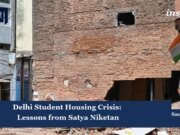
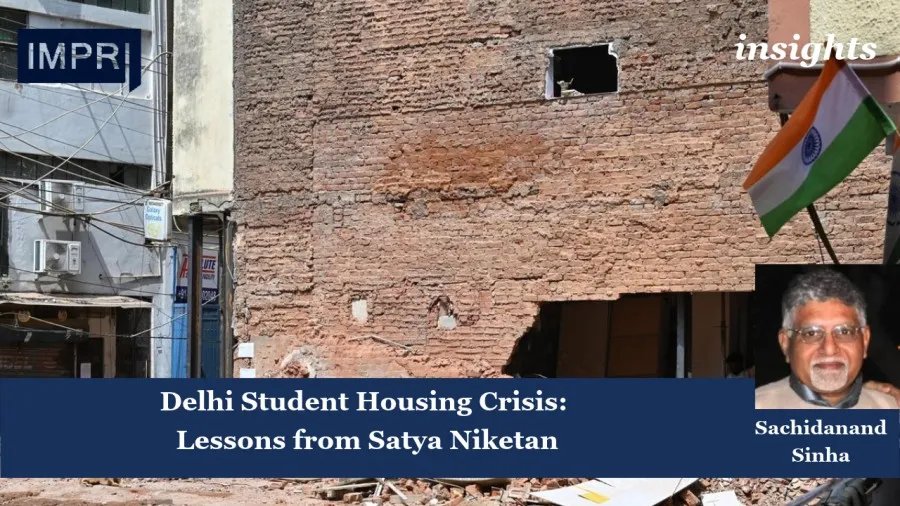
The September 6, 2026, building collapse brought attention to student accommodation shortages and safety concerns near Delhi University.
The PG accommodation tragedy that occurred on 6 September at Satya Niketan, New Delhi, raises several questions about governance, management, and the kind of agenda that dominates the thinking when it comes to running institutions of higher learning.
It is a serious tragedy, and one must reckon that this is not an isolated case. Similar tragedies are waiting to happen, not only in Delhi but in all major centres of educational learning, unless stringent action is implemented on the ground.
It was only a few months ago that a fire in a hotel led to several losses of life. A few years ago, the basement of a coaching centre was flooded in Mukherjee Nagar.
The Delhi Government and the Municipal Corporation of Delhi (MCD) have now swung into action, inspecting and raiding the so-called PGs. The fundamental question, however, is whether the MCD or the Delhi Government even knows the numbers, names, and locations of the private hostels masquerading as PGs.
Is there any well-thought-out policy, monitoring mechanism, or regulatory framework for such informal residences that provide shelter to aspiring students coming from far-off places?
Central Universities Failing Students:
At the centre of this tragedy are two main issues that relate to educational policies and institutional priorities. It is well documented that there is an uneven distribution of colleges and other institutions of higher and professional education across rural and urban areas in more than 700 districts of India.
It is not the quantity alone; the quality of education also varies significantly, even among the Central Universities. Institutions that were established during the colonial period and in the decades after independence are clamouring for funds to maintain facilities that are already meagre.
Aspiring youth converge at these few centres of higher education in order to build careers for themselves. On top of that, we have a situation where the government, under the National Education Policy (NEP) 2020, has introduced a centralised admission process in the country.
The Central University Entrance Test (CUET) selects students and allocates offers of seats to those who qualify, irrespective of where they come from in the country. A student from Kerala, for instance, could be allotted a seat at the Central University of Punjab, while a Punjabi boy or girl could perhaps be asked to enroll in a university in the Northeast.
Since central universities are supposed to have a national character, this is a fair practice in principle. But it requires adequate residential facilities for students staying away from home. If students are forced to live in dingy and substandard so-called PGs—private hostels that have mushroomed all over major centers of education such as Hyderabad, Bengaluru, Kota, Jaipur, Delhi, the NCR, and several cities in Uttar Pradesh—then the very idea of a national system of higher education is compromised.
I am concentrating on Central Universities because they provide an important case study here. If students admitted to Central Universities are not provided with hostels and residential facilities that offer reasonably good and dignified living spaces for both boys and girls, then the very idea of a Central University as a national institution fails.
There are two ways in which one could perhaps think about this. First, universities should build their own hostels or hire hostels through whatever arrangements may be described as public-private partnerships. Second, where private accommodation is used, there must be a regulatory framework to ensure that minimum standards are maintained.
We have several prestigious private universities around Delhi and Sonipat. For example, there are Ashoka University, OP Jindal Global University, and Shiv Nadar University. Several such universities have created residential facilities for their students. A number of them, including Azim Premji University, have also provided highly subsidised hostel facilities. I have had the occasion to visit Azim Premji University a couple of times and have seen some of these arrangements.
About the Author:
Sachidanand Sinha is a former professor of social geography and Associate Dean of Students, JNU, and is currently a Visiting Professor at IHD.
This article was first published in The Quint as: Satya Niketan Tragedy: What Good Is Higher Education Without Safe Housing? published on 10th September 2026.
Read more at IMPRI:
BRICS+: A Strategic Opportunity for India to Shape a Multipolar World
Acknowledgement:
This article was posted by Bhargavvi Bajpai, a Research and Editorial Intern at IMPRI.