


Policy Update
Aliya Hajini
Background
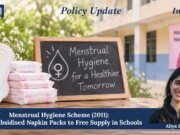
Menstruation is a natural biological process, but for many girls in India it arrives with “confusion, fear, anxiety and embarrassment” (Ministry of Health and Family Welfare [MoHFW], n.d.). A lot of that comes from silence. Periods have long been treated as something to hide, so girls often reach menarche without accurate information, and the taboos around menstruation can shape what they are told, what they are allowed to do and where they can go while they are menstruating. [ADD: one pre-2011 source or figure that backs the taboo and information-gap point, for example NFHS-3 (2005-06) or a published study, with its citation]
The barriers were not only social. Safe menstrual management also needs a product, a clean place to change it and a way to dispose of it, and these were hard to come by for many girls, especially in rural areas. [ADD: one pre-2011 figure on napkin use or on girls missing school during periods, with its source] The design of the scheme points to the same need: it was aimed at rural girls aged 10 to 19 and meant to put a low-cost napkin in their hands through a health worker they already knew (Lok Sabha, 2012). That gap between what girls needed and what they could access is what led to the scheme’s introduction.
The Menstrual Hygiene Scheme, officially the Scheme for Promotion of Menstrual Hygiene, began in November 2011 as a centrally supported pilot of the Ministry of Health and Family Welfare for adolescent girls aged 10 to 19 in rural areas (Lok Sabha, 2012; Press Information Bureau [PIB], 2022). It now runs under the Rashtriya Kishor Swasthya Karyakram (RKSK), with three stated aims: to raise awareness of menstrual hygiene, to increase access to and use of good quality sanitary napkins, and to make sure used napkins are disposed of in an environment-friendly way (Lok Sabha, 2024).
The pilot began in 152 districts and aimed to reach about 1.5 crore girls, roughly a quarter of the country’s adolescent girls (Lok Sabha, 2012). In 107 of those districts the Centre supplied napkins under the NRHM brand name “Freedays”, while in the other 45 districts self-help groups (SHGs) were supposed to make and sell them (Lok Sabha, 2012).
The scheme was built around ASHAs and village girls, not schools (Lok Sabha, 2012). Schools entered the picture through the courts. In Dr. Jaya Thakur v. Government of India (W.P.(C) No. 1000/2022), the Centre told the Supreme Court on 12 November 2024 that it had framed a uniform national Menstrual Hygiene Policy for School-going Girls, while accepting that much remained to be done on implementation (LiveLaw, 2024). The Union Health Ministry had approved that policy on 2 November 2024 (Press Trust of India [PTI], 2024).
About a year earlier, in December 2023, the Ministry had described a wider draft Menstrual Hygiene Policy covering the whole menstrual journey, from menarche to menopause (PIB, 2023). The sources reviewed do not say how that draft relates to the school policy. On 30 January 2026 the Court ruled in the same case that schools must have functional toilets, free sanitary napkins and safe disposal facilities (Innanje, 2026).
Functioning
The original design was a subsidised sale, not a giveaway. ASHAs sold napkins to girls at a price below what the Centre paid for them (Lok Sabha, 2012). Table 1 sets out how the scheme was designed in 2012 and what Parliament and PIB replies say about it now.
Table 1: How the Menstrual Hygiene Scheme Works: 2012 Design and Current Position
| Feature | 2012 pilot design | Current position (2024 onwards) |
| Programme home | ARSH component of RCH II, Ministry of Health and Family Welfare (Lok Sabha, 2012) | Under the Rashtriya Kishor Swasthya Karyakram (RKSK) (Lok Sabha, 2024) |
| Target group | Adolescent girls aged 10 to 19 in rural areas (Lok Sabha, 2012) | Adolescent girls aged 10 to 19 (Lok Sabha, 2024) |
| Coverage | 152 districts, targeting approximately 1.5 crore adolescent girls (Lok Sabha, 2012) | Expanded from the selected-district pilot to a nationwide policy framework. The 2024 school policy covers government and government-aided schools, while the January 2026 Supreme Court directions extend school-level obligations to all schools (PTI, 2024; Innanje, 2026). |
| Supply route | 107 districts on central supply (“Freedays”); 45 districts on SHG supply (Lok Sabha, 2012) | ASHA-sold packs, plus Jan Aushadhi Suvidha napkins at Re 1 a pad (Lok Sabha, 2024) through more than 16,000 Janaushadhi Kendras (PIB, 2025) |
| Cost to the Government | Rs 7.50 per pack of six, bought centrally (Lok Sabha, 2012) | States told to procure packs at prices reached through competitive bidding (PIB, 2025); no national price stated in the sources reviewed |
| Price to the girl | Rs 6 per pack of six (Lok Sabha, 2012) | Rs 6 per pack of six in 2022 (PIB, 2022) and in 2024 (Lok Sabha, 2024) |
| ASHA role | Re 1 on each pack sold, one free pack a month; the other Rs 5 went to the state or district treasury (Lok Sabha, 2012) | Sells packs and holds monthly meetings with adolescent girls (Lok Sabha, 2024) |
| Funding | Rs 70.65 crore earmarked for 9.32 crore packs in the 11th Five Year Plan, for states on central supply (Lok Sabha, 2013) | Supported by the National Health Mission through state PIP proposals since 2015-16 (PIB, 2025); the Union partly funds distribution and states fund it too (LiveLaw, 2024) |
Source: Author’s compilation from Lok Sabha (2012, 2013, 2024), Press Information Bureau (2022, 2025), and LiveLaw (2024).
Two other routes sit outside the Health Ministry’s own scheme. National Guidelines on Menstrual Hygiene Management were developed for rural areas under the Swachh Bharat Abhiyan, and the Department of Pharmaceuticals runs the Pradhan Mantri Bharatiya Janaushadhi Pariyojana, which had over 8,700 Janaushadhi Kendras selling Suvidha napkins at Rs 1 a pad in July 2022 (PIB, 2022). By December 2025 the number of Kendras had passed 16,000 (PIB, 2025).
Other ministries act on the school side. Under Samagra Shiksha, state-specific projects on menstrual health and hygiene, including sanitary pad vending machines and incinerators, are approved (PIB, 2025). Teachers and frontline workers (ANMs, ASHAs, and Anganwadi workers) are oriented in the scheme with a budget provided under RKSK (PIB, 2025). A joint letter dated 8 March 2022 from the Secretary of the Department of School Education and Literacy and the Secretary of the Ministry of Jal Shakti also advised states to use Swachh Bharat Mission (Gramin) Phase II funds for menstrual waste management, for incinerators in schools with girls in Classes 6 to 12, and for awareness (PIB, 2023).
The 2024 policy moves the focus to schools. It aims to bring menstrual hygiene into government and government-aided schools through continuous supply of low-cost products, clean gender-segregated toilets, menstrual hygiene education in the curriculum, and environment-friendly management of menstrual waste (PTI, 2024). States and UTs must assess how many products they actually need, using surveys where appropriate, and then fill the gaps (PTI, 2024). The Health Ministry formulated the policy after consulting line ministries (PIB, 2025), and by December 2024 it had written to all states asking for action plans with timelines, monitoring mechanisms, and key performance indicators (PTI, 2024).
The January 2026 ruling gave the policy legal weight. The Court treated the lack of menstrual health facilities as a breach of equality under Article 14 and as a barrier to education under Article 21A and Section 3 of the Right to Education Act, 2009, and it also tied dignified menstrual health to the right to life under Article 21 (Innanje, 2026). It directed the Union and all states to provide functional, gender-segregated toilets with water in every school, free sanitary napkins with safe disposal, and gender-responsive curricula through NCERT and the SCERTs (Innanje, 2026).
District Education Officers are to inspect schools periodically, and the Court kept the case open through a continuing mandamus, with compliance reports from states and UTs to be listed after three months (Innanje, 2026). News reports add that free biodegradable napkins must reach girls in Classes 6 to 12 in government and private schools alike, and that private schools without separate toilets or free pads risk derecognition (News On AIR, 2026).
Performance
The scheme is now well over a decade old, so its results can be judged, but the public record is thin, and the numbers that exist point in different directions.
Reach: The 2012 pilot aimed at about 1.5 crore girls (Lok Sabha, 2012). The most recent count found in Parliament is that about 34.92 lakh adolescent girls were given napkin packs each month in 2021-22, according to HMIS data (PIB, 2025). These are different years and different measures, a target population against a monthly count, so they do not give a coverage rate. The gap is still large enough to raise the question of how many girls the scheme actually reaches.
Early delivery: By May 2013, SHG supply had not started in the 45 SHG districts, and an impact assessment begun by the Government was incomplete, with no beneficiary numbers given (Lok Sabha, 2013).
Outcomes: Among women aged 15 to 24, use of a hygienic method of menstrual protection rose from 57.6% in NFHS-4 (2015-16) to 77.3% in NFHS-5 (2019-21), and the same answer reports sanitary napkin use rising from 42% to 64% (Lok Sabha, 2024).
Data: The Health Ministry told Parliament in February 2024 that it does not centrally maintain data for 2023 on how many rural menstruating women had continued access to menstrual products, or on illnesses caused by lack of them (Lok Sabha, 2024).
Monitoring and accountability: The Ministry of Health and Family Welfare monitors the scheme through state-wise reviews of key deliverables against approved targets in National Programme Coordination Committee (NPCC) meetings. Implementation is also reviewed through the National Health Mission’s State Programme Implementation Plans (PIPs) and annual Common Review Missions (CRMs) (PIB, 2026). These mechanisms provide an institutional structure for tracking implementation and identifying gaps. However, the August 2026 parliamentary reply does not provide scheme-specific figures on the number of sanitary napkin packs distributed or the number of schools covered. The monitoring framework therefore needs to be accompanied by publicly available, measurable outcome data.
Schools: UDISE+ 2024-25 shows that 97.1% of government and government-aided schools have girls’ toilets (Lok Sabha, 2025). The national figure hides large gaps. Manipur stands at 79.2%, Meghalaya at 84.4%, Mizoram at 86.1% and Nagaland at 88.6% (Lok Sabha, 2025).
Table 2: Indicators Relevant to Menstrual Hygiene Scheme Performance
| Indicator | Reported position | Reference period |
| Adolescent girls receiving sanitary napkin packs | Approximately 34.92 lakh girls per month | 2021–22 (HMIS) |
| Use of hygienic menstrual protection among women aged 15–24 | 77.3% | NFHS-5 (2019–21) |
| Sanitary napkin use among women aged 15–24 | 64% | NFHS-5 (2019–21) |
| Girls’ toilets in government and government-aided schools | 97.1% nationally | UDISE+ (2024–25) |
Source: Author’s compilation from PIB (2025), Lok Sabha (2024, 2025).
Impact
The Menstrual Hygiene Scheme has contributed to improving access to menstrual hygiene products among adolescent girls, particularly in rural areas. By providing a pack of six sanitary napkins at a subsidised price of ₹6, the scheme sought to reduce the financial barrier to menstrual protection. The subsidised price remained ₹6 in subsequent government reports, while ASHAs continued to serve as an important link between the programme and its intended beneficiaries (Lok Sabha, 2012; PIB, 2022; Lok Sabha, 2024).
Beyond access to products, the scheme recognises menstrual hygiene as an important dimension of adolescent health and well-being. Its awareness activities, including meetings conducted by ASHAs, provide opportunities to share information about menstrual health and hygiene. Such community-level engagement can help challenge misconceptions and reduce the stigma and embarrassment often associated with menstruation. It also creates space for adolescent girls to discuss menstrual health within a familiar community setting.
The scheme contributes to the broader objectives of Sustainable Development Goal 5 (Gender Equality), particularly the promotion of equal opportunities and the removal of barriers that affect girls’ health, dignity and participation in everyday life. Access to menstrual hygiene products and appropriate information can support girls’ ability to participate in education and social activities without avoidable menstrual-health-related restrictions. However, the available programme data do not independently establish the scheme’s effect on school attendance or educational outcomes.
The wider policy framework has also expanded attention from access to sanitary products towards the availability of functional school toilets, water, menstrual hygiene education and safe disposal facilities. The 2024 school-going girls’ policy and the Supreme Court’s January 2026 directions reflect this broader approach. These developments recognise that menstrual health requires more than product distribution: it also depends on adequate sanitation infrastructure, reliable supplies, awareness and an environment in which menstruation can be discussed without stigma (PTI, 2024; Innanje, 2026).
Overall, the scheme has helped establish menstrual hygiene as a public health and gender-equality concern within India’s policy framework. Its contribution should be understood alongside other government programmes and wider improvements in awareness and access. Continued implementation, stronger monitoring and attention to girls who remain outside school-based services are necessary to translate these policy commitments into more equitable menstrual health outcomes.
Emerging Issues
1. Who pays for free napkins. The Centre told the Court that it partly funds distribution under the National Health Mission and that states fund it too, while the petitioner’s counsel disputed that free pads were actually being distributed (LiveLaw, 2024). The sources reviewed give no national estimate of what universal free supply to Classes 6 to 12 would cost. Without one, it is unclear whether the Health Ministry, the Education Ministry or the states will carry the main bill. Because the National Health Mission supports the scheme through state PIPs built on state proposals (PIB, 2022), how much reaches girls also depends on what each state chooses to ask for.
2. The policy and the ruling do not match. The policy applies to government and government-aided schools (PTI, 2024), but the Court’s order covers private schools too (News On AIR, 2026). Inspection has been given to District Education Officers (Innanje, 2026), while the policy itself was framed by the Health Ministry (PIB, 2025), which told the Rajya Sabha in August 2026 that states and UTs implement it through their own departments (PIB, 2026). Several departments will have to work from one set of rules.
3. Toilets that exist and toilets that work. UDISE+ reports that 97.1% of government and government-aided schools have girls’ toilets, with Manipur at 79.2% and Meghalaya at 84.4% (Lok Sabha, 2025). That is availability. The Court asked for toilets that are functional and have usable water (Innanje, 2026), and the figure quoted in Parliament does not say how many meet that test.
4. Product and waste. The Court asked for free biodegradable napkins (News On AIR, 2026) and for safe disposal (Innanje, 2026). The Suvidha napkins sold through Janaushadhi Kendras are described by the Government as oxo-biodegradable and as complying with the ASTM D-6954 biodegradability test standard (PIB, 2025). Whether that meets the standard the Court has in mind, and what happens to used napkins in a school with no proper disposal arrangement, are both open questions. States were advised in March 2022 to use Swachh Bharat Mission (Gramin) Phase II funds for incinerators in schools with girls in Classes 6 to 12 (PIB, 2023), and the sources reviewed do not say how many schools have used that money.
5. Awareness. The policy puts menstrual hygiene education into the curriculum (PTI, 2024), and the Court has asked NCERT and the SCERTs to make curricula gender-responsive (Innanje, 2026). The Government says teachers and frontline workers are oriented in the scheme under RKSK (PIB, 2025), but the release gives no numbers on how many have been trained. Free napkins alone are unlikely to change much if teachers are uncomfortable talking about periods.
6. Data and monitoring. The Ministry told Parliament in 2024 that it does not centrally maintain data on rural women’s access to menstrual products or on illness from lack of them (Lok Sabha, 2024), and in 2013 the Government gave no beneficiary numbers for the scheme (Lok Sabha, 2013). The most recent monthly figure found, 34.92 lakh girls, is from 2021-22 (PIB, 2025). Across these years, the public record still gives little to show who the scheme actually reaches.
Way Forward
Publish a costed national plan
Implementation: The Ministry of Health and Family Welfare and the Ministry of Education should publish one costed plan for free napkin supply in schools, showing how much comes from the National Health Mission, how much from Samagra Shiksha and how much from state budgets. Each state should name a single nodal officer so that schools are not waiting on two departments.
Fix the weakest toilets first
Implementation: Samagra Shiksha funds should go first to states with the lowest availability of girls’ toilets, such as Manipur, Meghalaya, Mizoram and Nagaland. Replies in Parliament should also quote the share of toilets that are functional and have water, not only the share that exist.
Settle the product and waste standard
Implementation: The Health Ministry, together with the Ministry of Environment, Forest and Climate Change, should issue a clear standard for what counts as a biodegradable napkin under the Court’s order, along with a disposal method that schools without incinerators can actually follow.
Keep a route for girls outside school
Implementation: ASHAs and Janaushadhi Kendras should stay as the supply route for girls who are not in school, with the Re 1 Suvidha napkin as the default product and the ASHA monthly meetings used for awareness.
Publish regular data
Implementation: State action plans and the compliance reports filed in the Supreme Court should be placed in the public domain. A yearly dashboard should show, state by state, how many schools are supplied, how often stock runs out, how many toilets are functional with water, and how many girls the scheme reaches.
References
Innanje, S. (2026, February 18). Supreme Court directs implementation of menstrual health facilities in schools. Supreme Court Observer. https://www.scobserver.in/journal/supreme-court-directs-implementation-of-menstrual-health-facilities-in-schools/
LiveLaw. (2024, November 13). Supreme Court seeks actionplan to implement menstrual hygiene policy for school-going girls. LiveLaw. https://www.livelaw.in/amp/top-stories/supreme-court-seeks-actionplan-to-implement-menstrual-hygiene-policy-for-school-going-girls-275031
Lok Sabha. (2012, August 24). Health scheme for rural adolescents (Unstarred Question No. 2103). Ministry of Health and Family Welfare, Government of India. https://eparlib.nic.in/bitstream/123456789/634832/1/134907.pdf
Lok Sabha. (2013, May 3). Scheme for menstrual hygiene (Unstarred Question No. 6057). Ministry of Health and Family Welfare, Government of India. https://eparlib.nic.in/bitstream/123456789/640974/1/140610.pdf
Lok Sabha. (2024, February 9). Illness due to lack of menstrual hygiene products (Unstarred Question No. 1322). Ministry of Health and Family Welfare, Government of India. https://eparlib.nic.in/bitstream/123456789/2974758/1/AU1322.pdf
Lok Sabha. (2025, December 1). Construction of girls’ toilets under Samagra Shiksha Abhiyan (Unstarred Question No. 178). Ministry of Education, Government of India. https://eparlib.sansad.in/bitstream/123456789/3015611/1/AU178_Wqk5U5.pdf
News On AIR. (2026, January 31). SC directs states and UTs to provide free biodegradable sanitary napkins in schools. All India Radio. https://www.newsonair.gov.in/sc-directs-states-and-uts-to-provide-free-biodegradable-sanitary-napkins-in-schools
Press Information Bureau. (2022, July 29). Scheme for promotion of menstrual hygiene (Release ID: 1846147). Ministry of Women and Child Development, Government of India. https://www.pib.gov.in/PressReleasePage.aspx?PRID=1846147
Press Information Bureau. (2023, December 15). Update on access to menstrual hygiene facilities (Release ID: 1986698). Ministry of Health and Family Welfare, Government of India. https://www.pib.gov.in/PressReleasePage.aspx?PRID=1986698
Press Information Bureau. (2025, December 17). Government takes appropriate measures to improve menstrual hygiene practices (Release ID: 2205104). Ministry of Women and Child Development, Government of India. https://www.pib.gov.in/PressReleasePage.aspx?PRID=2205104
Press Information Bureau. (2026, August 11). Steps taken to promote menstrual health and hygiene (Release ID: 2297511). Ministry of Health and Family Welfare, Government of India. https://www.pib.gov.in/PressReleasePage.aspx?PRID=2297511
Press Trust of India. (2024, December 8). States asked to submit action plans for implementation of menstrual hygiene policy. National Herald. https://www.nationalheraldindia.com/national/states-asked-to-submit-action-plans-for-implementation-of-menstrual-hygiene-policy
About the Contributor
Aliya Hajini has recently completed her Bachelor’s degree in Economics and Political Science from the University of Delhi. Her main areas of research interest include gender equality, women’s empowerment, and public policy, with a focus on how policy design and implementation affect marginalized groups in India.
Acknowledgement
My sincere thanks to the Impact and Policy Research Institute (IMPRI) for the opportunity to prepare this policy update article. IMPRI’s dedication to connecting research with actionable policy practice provides an invaluable platform for learning.
Reviewed by gowri and lahari
Disclaimer
The opinions expressed in this article are strictly those of the author and do not reflect the official position or views of the organization.