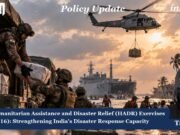




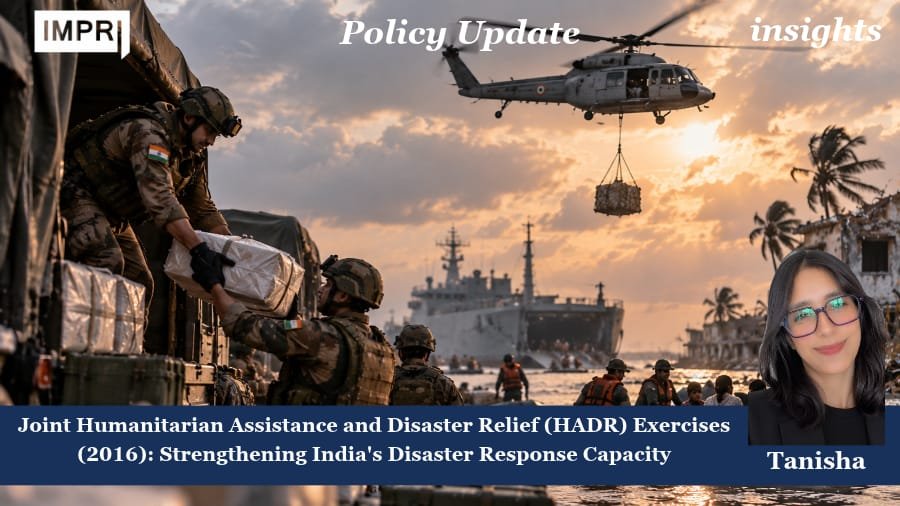
Strengthening India’s Disaster Response Capacity
Policy Update
Tanisha
India’s modern HADR architecture traces back to the 2004 Indian Ocean tsunami, when the three Services improvised a joint response involving over 20,000 personnel with no standing framework to coordinate it. The gaps that experience exposed resurfaced in the 2013 Uttarakhand floods and the 2014 Jammu and Kashmir floods, both of which again saw the Army, Navy and Air Force responding without a rehearsed, tri-service drill behind them.
The response was institutional rather than ad hoc. At the 2015 Combined Commanders’ Conference, the Prime Minister directed the Services to institute an Annual Joint HADR Exercise; the first edition followed that year, and since 2016 the exercise has been conducted in rotation by the Army, Navy and Air Force, each taking a turn as host (Ministry of Defence [MoD], 2023). That rotational structure, formalised from 2016 onward, is what this review treats as the start of India’s joint HADR exercise programme proper.
Each edition is organised by the Service holding the rotation that year, and has steadily widened beyond a single-Service drill into what the Ministry now describes as a multi-agency endeavour: the three Services, central paramilitary forces, the National Disaster Management Authority (NDMA), the National Disaster Response Force (NDRF), state disaster-response machinery, and increasingly international participants and observer organisations (Ministry of Defence, 2026). The exercise sits alongside a wider institutional architecture built up over the same period, NDMA’s International HADR Guidelines issued in October 2024, the Ministry of External Affairs’ Rapid Response Cell set up in 2021, and the Ministry of Home Affairs’ incident command and emergency-response structures.
A parallel track runs bilaterally. Tiger Triumph, the tri-service India-US HADR exercise, tests the same coordination muscle in a bilateral setting and has now run multiple editions, most recently in 2025, alongside the domestically rotated annual exercise.
| Year | Edition | Host / Location | Participation |
|---|---|---|---|
| 2015 | Inaugural edition | N/A | Prime Minister directs the start of an Annual Joint HADR Exercise at the 2015 Combined Commanders’ Conference; first edition held the same year |
| Since 2016 | Rotational host | Army, Navy, Air Force | Exercise conducted in rotation by the three Services, each hosting in turn |
| Nov 2022 | Samanvay 2022 | Indian Air Force, Agra | Hosted with participation from ASEAN-region representatives |
| Oct 2023 | Chakravat 2023 | Indian Navy, Goa | 8 foreign nations: Comoros, Madagascar, Maldives, Mauritius, Mozambique, Seychelles, Sri Lanka, Tanzania |
| Nov 2024 | Sanyukt Vimochan 2024 | Indian Army, Ahmedabad/Porbandar | NDMA, NDRF and state agencies; no foreign contingent reported |
Table 1. Annual Joint HADR Exercise editions since inception. Compiled from Ministry of Defence (2023, 2026).
The exercise has changed its public name with each recent rotation, Samanvay in 2022 under the Air Force, Chakravat in 2023 under the Navy, Sanyukt Vimochan in 2024 under the Army, which makes it harder to track as a single continuous programme from the outside than its underlying rotational design suggests. International participation has also varied sharply: Chakravat 2023 drew 8 named foreign nations, largely from the Indian Ocean littoral, while the publicly available account of Sanyukt Vimochan 2024 lists NDMA, NDRF and state agencies but no foreign contingent.
Beyond the named annual exercise, the Army’s broader domestic disaster-response deployment grew sharply between 2024 and 2025: columns deployed for disaster relief rose from 83 to 141, a 70 percent increase, year on year (MoD, 2026).
Figure 1. Indian Army domestic disaster-response deployment scale, 2024 versus 2025. Source: Ministry of Defence (2026).
Civilians rescued over the same two years moved in the opposite direction, from 29,972 in 2024 to 28,293 in 2025, roughly flat to slightly down, even as the number of columns deployed rose by seventy percent (MoD, 2026).
Measured against 2004, when the tri-service tsunami response had no standing exercise or doctrine behind it, the current programme represents genuine institutionalisation: a named annual exercise, rotated deliberately across the three Services, now sits inside a documented policy architecture that includes NDMA’s 2024 international guidelines and a dedicated MEA rapid-response mechanism. Real-world deployments in the same period, India’s relief operations after disasters in Myanmar and Sri Lanka among them, have been presented by the Ministry as validation that the exercise programme translates into operational capacity rather than remaining a paper drill.
The deployment-versus-rescue figures from 2024 and 2025 complicate a simple reading of that progress, however. A 70 percent increase in columns deployed alongside a slight fall in civilians rescued does not necessarily indicate declining effectiveness, disaster severity and type vary year to year in ways deployment numbers alone cannot capture, but it does mean that scale of deployment and scale of outcome are not moving together, and the public reporting does not explain why.
- The exercise has no stable public name. Three different names across three consecutive editions, Samanvay, Chakravat, Sanyukt Vimochan, make it difficult for an outside observer to recognise this as one continuous, rotating programme rather than three separate, unrelated exercises, even though the Ministry’s own account describes a single rotational design dating to 2016.
- International participation is not consistently reported or, on the public record, consistently included. Eight nations joined Chakravat 2023; no foreign contingent is mentioned in the available account of Sanyukt Vimochan 2024. Whether that reflects a genuine year-to-year design choice or simply a reporting gap is not clear from what has been published.
- More columns deployed did not mean more people rescued between 2024 and 2025. That gap deserves an explanation in the Ministry’s own reporting, whether it reflects the nature of the disasters that occurred, deployment efficiency, or something else, rather than being left as two unconnected statistics in the same release.
- Adopt one consistent public name for the Annual Joint HADR Exercise across all three rotating hosts, on the model Tiger Triumph already uses for its bilateral editions, so the programme’s continuity is visible from the outside.
- Report international participation on a standard template every edition, present or absent, rather than leaving it to vary by host Service without explanation.
- Pair deployment-scale figures, columns, personnel, assets, with outcome figures, people rescued, relief delivered, in every annual disaster-response account, so that a rise in one without the other is explained rather than left as an unremarked gap.
- Use NDMA’s October 2024 International HADR Guidelines as the reference point to bring the three most recent editions, Samanvay, Chakravat and Sanyukt Vimochan, under one retrospective reporting framework, so their outcomes can be compared on the same terms.
- Ministry of Defence. (2023, October 11). Annual Joint HADR Exercise 2023 – Chakravat 2023 [Press release]. Press Information Bureau, Government of India. https://www.pib.gov.in/PressReleasePage.aspx?PRID=1965929
- Ministry of Defence. (2026, February 15). Beyond battlefield: Indian Armed Forces in humanitarian assistance and disaster relief [Press release]. Press Information Bureau, Government of India. https://www.pib.gov.in/PressReleasePage.aspx?PRID=2228319
About the Contributor
Tanisha is a Political Science graduate (BA Hons, University of Delhi; MA, IGNOU), currently pursuing a Diploma in Conflict Transformation and Peacebuilding, with research interests spanning international relations, environmental governance, and gender studies. She is keen to build a career in policy research.
Acknowledgements
The author sincerely expresses gratitude to the reviewers Aditya Chavan and Manisha Kumari for their valuable comments, constructive suggestions, and continuous guidance throughout the preparation of this article. Their insightful feedback significantly enhanced the clarity, organisation, and analytical quality of the manuscript. The author also acknowledges the support and encouragement received during the research and writing process, which contributed to the successful completion of this work.
The article was posted by Mahenoor Imam, a Research and Editorial Intern at IMPRI.
Disclaimer: All views expressed in the article belong solely to the author and not necessarily to the organisation.
Read more at IMPRI:
National e-Governance Service Delivery Assessment (NeSDA): 2019
GHARAUNDA Scheme (2015): Strengthening Residential Support Systems for Persons with Disabilities