



Policy Update
Himanshi Singh
Background
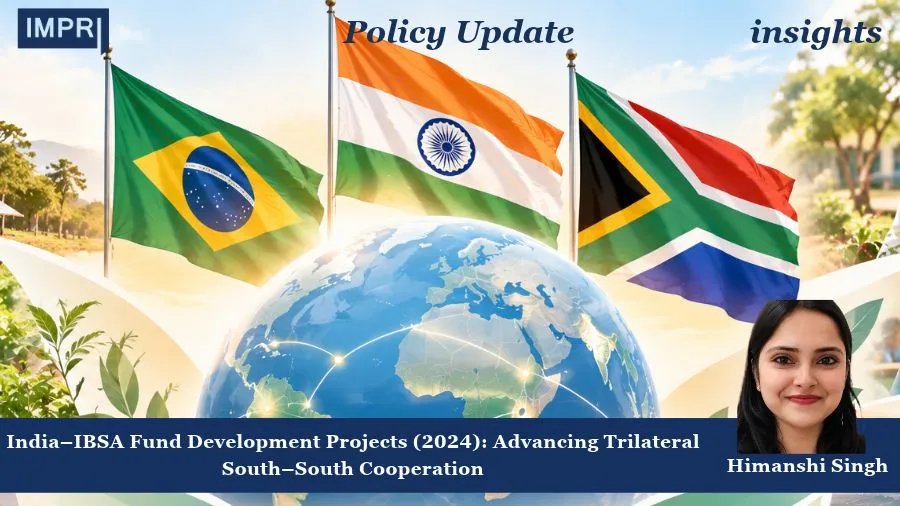
The India, Brazil, and South Africa Facility for Poverty and Hunger Alleviation (IBSA Fund) represents one of the most innovative and enduring models of trilateral South–South cooperation in the global international development architecture. Established in 2004 and becoming fully operational in 2006, the Fund was conceptualized by three major developing democracies spanning Asia, Latin America, and Africa to translate shared values of solidarity, equity, and mutual benefit into tangible developmental outcomes for fellow nations in the Global South. Rather than operating as a traditional donor-driven aid mechanism, the IBSA Fund is designed to identify, execute, and disseminate replicable, scalable, and demand-driven projects that combat poverty and hunger in partner developing countries.
India’s steadfast commitment to the IBSA Fund is anchored in its civilizational ethos of Vasudhaiva Kutumbakam (“the world is one family”) and its human-centric approach to international development. As reflected during India’s G20 Presidency, which prioritized “development of the people, by the people, and for the people,” India views the IBSA Fund as a vital instrument for empowering vulnerable communities across the Global South. Through equal annual contributions of US$ 1 million from each member state, India’s cumulative contribution to the Fund has exceeded US$ 18 million (UNOSSC, 2024). This sustained financial and diplomatic stewardship underscores India’s dedication to championing multilateralism and sharing its developmental experience through non-prescriptive, South-led partnerships.
Functioning
The operational architecture of the IBSA Fund is built on democratic governance, strict equality among member states, and neutral multilateral administration. The Fund operates as a dedicated facility managed by the United Nations Office for South-South Cooperation (UNOSSC), which serves as both its Fund Manager and Secretariat, while project implementation on the ground is carried out through partner country governments and specialized UN agencies, including UNICEF, UN Women, and UNDP.
The governance framework is structured around three core pillars:
- Equal Democratic Decision-Making: Strategic governance is exercised by the Board of Directors, which comprises the Deputy Permanent Representatives of India, Brazil, and South Africa to the United Nations in New York. Each member nation maintains equal co-ownership and decision-making power, with the Board Chair rotating annually among the three founding states.
- Targeting Special Development Situations: The Fund strictly adheres to a demand-driven approach, prioritizing assistance to Least Developed Countries (LDCs), Landlocked Developing Countries (LLDCs), and Small Island Developing States (SIDS). Over 60% of the Fund’s active portfolio is allocated to countries in these fragile development categories.
- Horizontal Technical Cooperation: Projects are formulated to transfer context-appropriate technology and technical expertise between Southern nations, building domestic capacity and ensuring long-term community ownership without imposing debt burdens or political conditionalities.
Table 1: Key Policy Pillars of the IBSA Fund Framework
| Framework Dimension | Operational Mechanism | Strategic Policy Value |
| Governance Structure | Equal democratic Board of IBSA DPRs to the UN | Ensures equal co-ownership and consensus decision-making. |
| Fund Management | UNOSSC Trust Fund Secretariat | Leverages UN neutral administration and fiduciary oversight. |
| Target Allocation | > 60% dedicated to LDCs, LLDCs, and SIDS | Directs grant aid to the world’s most vulnerable states. |
| Cooperation Model | Demand-driven, non-prescriptive grants | Replaces debt traps with sustainable technical transfers. |
Source: Ministry of External Affairs (MEA), PIB Delhi, and Research Report on India–IBSA Fund Development
Performance
Since its inception, the IBSA Fund has disbursed over US$ 50.6 million to US$ 54 million, supporting 45 to 48 development projects across 37 to 39 developing countries (UNOSSC 2024 report). During the 2024–2025 cycle, the Fund maintained a robust active portfolio of 13 projects valued at US$ 13.6 million, with more than 75% of active interventions implemented across Africa (UNOSSC, 2024, 2025a, 2025b). During this period, projects in the Republic of Congo, Senegal, and Palau successfully completed implementation.
Key project milestones approved and executed under India’s chairmanship include:
- Eswatini (Community WASH Infrastructure): Endorsed as a pilot project in Kwaluseni Inkhundla, this initiative builds cost-effective urban sanitation networks, household toilets, and wastewater treatment units. The project exemplifies trilateral South–South cooperation by leveraging Brazilian technical expertise alongside specialists and lessons learned from an ongoing IBSA sanitation project in Angola.
- Jordan (Climate-Smart Floriculture): Approved with a budget of US$ 2 million over two years in partnership with UN Women and Jordan’s Ministry of Agriculture, this project addresses acute water scarcity by installing a reverse-osmosis unit to treat wastewater for floriculture in 60 greenhouses, establishing 50 women-led microenterprises and creating 65 rural jobs.
- Liberia (Gender-Responsive Governance): A US$ 1 million initiative supporting the Women’s Legislative Caucus of Liberia and UN Women to build national capacity for gender-responsive lawmaking, budgeting, and women’s economic empowerment.
- Guatemala & Timor-Leste: Approved in late 2025, the Guatemala project expands digital inclusion and rural entrepreneurship through community learning platforms, while the Timor-Leste initiative supports the formulation of a National Science, Technology, and Innovation (STI) Policy.
High-level global forums have widely recognized these achievements. At the 2025 UN High-Level Political Forum (HLPF) in New York, the launch of the IBSA Fund 2024 Annual Report spotlighted the facility as a flagship model of South–South solidarity in action. Furthermore, the Fund released a dedicated brochure detailing over US$9 million in climate investments aligned with the COP30 Action Agenda in Brazil.
Table 2: IBSA Fund Portfolio Performance & Regional Highlights
| Indicator / Metric | Performance Level | Key Regional Highlights |
| Cumulative Financial Scale | US$ 50.6M – US$ 54M disbursed globally | 45 to 48 projects supported across 37 to 39 countries. |
| Active Portfolio (2024–25) | 13 active projects valued at US$ 13.6M | Over 75% is allocated to African partner nations. |
| Vulnerable Nation Share | > 60% in LDCs, LLDCs, and SIDS | High-yield grants in Eswatini, Liberia, Timor-Leste, and Palau. |
| New Approved Projects | Multi-sectoral 2024–25 approvals | Eswatini (WASH), Jordan (Floriculture), Guatemala (Digital). |
Source: Ministry of External Affairs (MEA), PIB Delhi, and Research Report on India–IBSA Fund Development
Significance
The policy impact of the IBSA Fund spans strategic, human, social, and economic dimensions across the Global South:
- Strategic Impact: The IBSA Fund offers a compelling proof-of-concept that developing nations can successfully pool resources to deliver impactful development finance without creating sovereign debt burdens or imposing restrictive policy prescriptions. By utilizing open-source knowledge transfers and demand-driven grant aid, IBSA presents an effective, democratic alternative to traditional foreign aid models.
- Human and Social Perspectives: On a human level, project interventions directly elevate community health, dignity, and social inclusion. In Eswatini, improved urban sanitation infrastructure reduces waterborne disease risks in peri-urban communities. In Liberia, capacity-building programs for women legislators strengthen democratic governance and advance gender equality.
- Economic Perspective: Economically, the Fund fosters sustainable livelihoods, rural entrepreneurship, and climate-resilient enterprise. Jordan’s floriculture initiative provides a clear example of circular economic innovation, converting treated wastewater into income-generating agricultural microenterprises for 150 rural women. By generating local employment and promoting sustainable agriculture, IBSA projects generate measurable socio-economic returns at the grassroots level.
- Horizontal Technical Knowledge Transfers: A distinctive strength of the Fund is its ability to facilitate peer-to-peer technical exchanges among Southern experts. Applying Brazilian and Angolan sanitation methodologies to Eswatini demonstrates how shared technical knowledge multiplies the value of financial investments.
Emerging Issues
Despite its strong track record, the IBSA Fund faces key operational challenges that impact its long-term scale:
- Capital Pool Constraints: Because the Fund relies on fixed annual contributions of US$ 1 million per founding member, the total annual capital pool remains modest relative to the expanding development needs of recipient states.
- Scaling Pilot Interventions: IBSA projects excel at delivering high-impact pilot demonstrations, but partner national governments frequently face fiscal constraints in scaling these pilots into nationwide programs after grant completion.
- Accelerating Climate Vulnerability: Recipient communities in SIDS and LDCs face increasing climate risks, requiring larger upfront capital commitments for climate-resilient physical infrastructure.
Way Forward
To enhance the reach and effectiveness of the IBSA Fund in the coming decade, member states and UNOSSC should pursue key strategic priorities:
- Expanding Triangular and Co-Financing Partnerships: Member states should establish co-financing frameworks with regional development banks, multilateral climate funds, and UN partner agencies to scale successful IBSA pilot projects.
- Integrating Digital Public Goods (DPG) and STI: Building on recent initiatives in Guatemala and Timor-Leste, future project cycles should incorporate open-source digital tools and national STI policy frameworks to accelerate digital transformation.
- Formalizing Southern Technical Networks: Establishing a centralized roster of Southern technical experts to streamline horizontal knowledge transfers across regions.
References
UNOSSC. (2024, February 19). IBSA Fund: India contributes $1 million to the India, Brazil and South Africa Facility for Poverty and Hunger Alleviation. United Nations Office for South-South Cooperation. https://unsouthsouth.org/2024/02/19/ibsa-fund-india-contributes-1-million-to-the-india-brazil-and-south-africa-facility-for-poverty-and-hunger-alleviation/
UNOSSC. (2025, July 17). South-South solidarity in action: IBSA Fund highlighted at HLPF 2025 for advancing sustainable development. United Nations Office for South-South Cooperation. https://unsouthsouth.org/2025/07/17/south-south-solidarity-in-action-ibsa-fund-highlighted-at-hlpf-2025-for-advancing-sustainable-development/
UNOSSC. (2025, July 25). IBSA Fund Board approves new South‑South cooperation projects in Eswatini and Jordan. United Nations Office for South-South Cooperation. https://unsouthsouth.org/2025/07/25/ibsa-fund-board-approves-new-south-south-cooperation-projects-in-eswatini-and-jordan/
UNOSSC. (2025, November 17). IBSA Fund: Board reviews progress and approves new projects for Guatemala and Timor-Leste. United Nations Office for South-South Cooperation. https://unsouthsouth.org/2025/11/17/ibsa-fund-board-reviews-progress-and-approves-new-projects-for-guatemala-and-timor-leste/
UNOSSC Portal. (2024). India, Brazil and South Africa Facility for Poverty and Hunger Alleviation (IBSA Fund) overview. United Nations Office for South-South Cooperation. https://unsouthsouth.org/ibsafund/
About the Contributor:
Himanshi Singh is a research & editorial intern at the Impact and Policy Research Institute (IMPRI). She holds a postgraduate degree in political science and international relations. Her research interests include foreign policy, strategic studies, public policy, national security, diplomacy, and global governance, with a particular focus on India’s external relations and evidence-based policy research.
Reviewer: Aditya Chavan & Samiksha Muskan
Acknowledgement: The author sincerely thanks the IMPRI Editorial Desk for invaluable mentorship and guidance during the development of this policy update. Special thanks are also extended to fellow interns for their thoughtful inputs and support throughout the research process.