





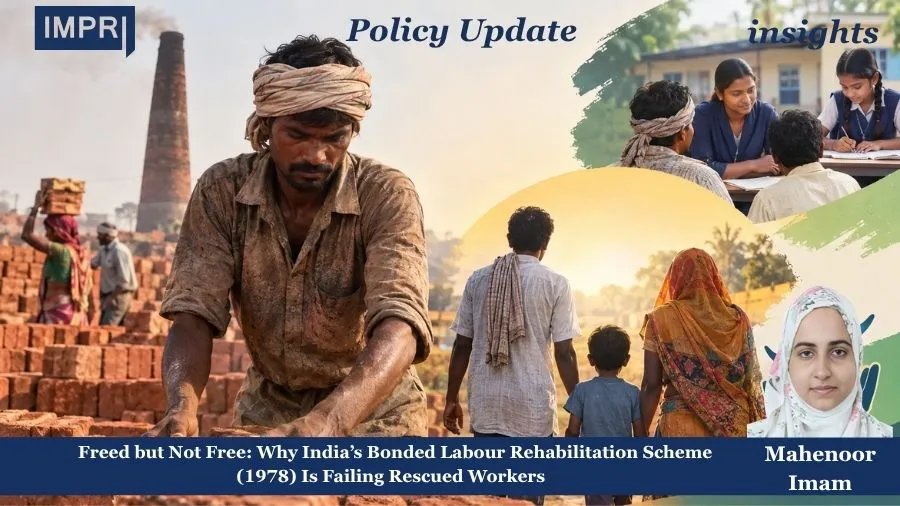
Policy Update
Mahenoor Imam
Background
Freeing workers is not enough, because without money, land or work, many fall back into debt. So in May 1978, the Labour Ministry started a Centrally Sponsored Scheme to help states rehabilitate freed workers, first offering Rs 4,000 per person. The scheme has been revised many times; the latest version took effect on 27 January 2022 as the “Central Sector Scheme for Rehabilitation of Bonded Labourers – 2021.”
Today, it offers Rs 30,000 as immediate help, followed by Rs 1–3 lakh based on gender, age and level of exploitation, along with non-cash help such as land and housing. But a worker gets this help only after a magistrate issues a release certificate confirming they were in bondage. The government calls the scheme “demand-driven”, meaning funds are provided based on the cases that come up, not on fixed targets.
In 2016, the government set a goal to free and rehabilitate about 1.84 crore (18.4 million) bonded labourers by 2030 (Paliath, 2023) . But between 1978 and January 2023, only about 3.15 lakh people were released. Since 2016, the yearly average has been only about 4,700. The article shows that the scheme exists on paper, but many rescued workers never get a release certificate, the Rs 30,000 immediate help, or land and housing. That is why many are “released but not rehabilitated.”
Functioning
Who runs it and how
Under the 1976 Act, finding, freeing and rehabilitating bonded labourers is the direct job of the states and Union Territories. The Centre’s role is to support them through the scheme, which is demand-driven: the Centre gives money only when states send proposals.
Money flows in three steps. The District Magistrate sends a proposal to the state department, which checks it and sends it to the Centre. The Labour Ministry then releases funds to the state, which passes them to the District Magistrate or Collector.
Under Section 13 of the Act, each state must set up Vigilance Committees in every district and sub-division. These committees are also responsible for the economic and social rehabilitation of freed workers. A Standard Operating Procedure (SOP) guides rescue and prosecution, and review meetings are held with District Magistrates, police and labour officials at the district and state levels.
States can add their own support. Tamil Nadu, for example, has appointed Assistant Commissioners of Labour as nodal officers in each district, and enrols rescued workers in welfare boards so they can get other benefits.
Funding
States do not have to contribute any of their own money for the cash assistance. Each district must keep a permanent fund of at least Rs 10 lakh with the District Magistrate. The district pays immediate help from this fund, and the Centre fully repays the state. However, the Centre has told Parliament that providing this fund is the state’s responsibility, and it does not keep any data on it.
Source: Compiled by the author from Bonded Labour System (Abolition) Act (1976), Ministry of Labour and Employment (2022) and Press Information Bureau (2024, 2025).
Status and concerns
The scheme has been poorly used. From 2016-17 to 2019-20, Rs 33 crore was allocated, but spending fell to just Rs 5 lakh in 2019-20.
In 2020, an NHRC group listed the main problems: many districts had not created the corpus fund, surveys to identify bonded labour were not being done, and summary trials were pending. Most districts did not have Vigilance Committees, and where they existed, they were inactive. The Labour Ministry said it had enough money, but most state proposals were incomplete or wrong.
In 2021, the NHRC again pointed to late release certificates, poor coordination between district, state and central officials, and said linking rehabilitation to conviction was unfair. The Ministry then said it was building a National Portal on Bonded Labour to record cases across India. By December 2024, the Ministry had only chosen an agency to build the portal.
Performance
Numbers rehabilitated are low and falling
Government data show how few workers the scheme reaches each year:

Source- Ministry of Labour and Employment replied to Parliament, cited by the Author.
The parliamentary committee described the fall over the last three years as “encouraging,” but it also warned that bonded labour still exists and is spreading. Compared with the government’s 2030 target of 1.84 crore people, these numbers are tiny (Paliath, 2023). In 2019-20, not a single person was shown as rehabilitated, even though police registered 1,155 cases under the Act in 2019 (NCRB data, cited in Paliath, 2023).
From 2020-21 to 2022-23, only eight states received any money under the scheme (MoLE, via data.gov.in). In 2021-22, Tamil Nadu alone reported 1,016 workers (MoLE, via data.gov.in). Of the 246 workers rescued in 2024-25, 196 were from Tamil Nadu and the other 50 were from Dausa in Rajasthan. Many states with known bonded labour, such as Odisha, Karnataka and Andhra Pradesh, reported none in these years (MoLE).
The state-wise funds data show that most states received about Rs 20,000 per worker (MoLE). For example, Tamil Nadu got Rs 203 lakh for 1,016 workers, and Rajasthan got Rs 9.8 lakh for 49 workers. That covers only the immediate cash help, not the full Rs 1 to 3 lakh rehabilitation amount. Uttar Pradesh in 2022-23 is the main exception, receiving Rs 390 lakh for 287 workers. This supports the article’s point that workers are released but not fully rehabilitated.
The scheme has never been short of money. In the three years up to February 2023, the government spent at most half of its Rs 10 crore budget each year. Spending then dropped sharply, from Rs 5.15 crore in 2022-23 to Rs 1.34 crore in 2023-24 (Standing Committee on Labour, 2025, as reported by Deccan Herald, 2025).
By 2019, India had released 3,13,687 bonded labourers but rehabilitated only 2,93,725, with 19,962 listed as not available for rehabilitation (Lok Sabha, 2019). Another government reply explains that these people had died or moved without leaving an address (Lok Sabha reply).
There is still no public dashboard. In December 2024, the Ministry told Parliament it had only finalised the agency to build a portal on bonded labour (Lok Sabha, 2024). Official figures also do not match each other. For 2021-22, different replies to Parliament give 1,174, 1,494 or 1,676 workers, one table shows Chhattisgarh as “-250,” and Tamil Nadu appears as both 876 and 1,016 (MoLE). No CAG audit of this scheme could be found.
Impact
Experts say the first few weeks after a rescue matter most. If help does not arrive at that time, workers are likely to end up in bondage again. Without money, land or a job, they take new loans and the cycle starts over. So the scheme’s main goal, a permanent escape from bondage, is not met.
Workers wait years for help that is supposed to come quickly. Manoj Kumar Anant got his release certificate in March 2022. The Rs 30,000 immediate help reached him only around July 2024, and by June 2025 he still had no full rehabilitation and owed over Rs 1 lakh. Rescued workers are also owed an average of Rs 32,514 in unpaid wages, about six times their average debt, and not one surveyed worker got this money back through the courts.
Only 25% of rescued children were admitted to school, and over a third were sent back into child labour. Nearly 54% of rescued children received no help at all (Arora, 2025). One rescued 17-year-old dropped out of school to work, and a girl born in captivity still has no birth certificate. This carries bondage into the next generation.
In 2019, 96% of cases under the Act involved crimes against SCs and STs (Paliath, 2023; Dhawade, 2025). In the NCCEBL survey, every worker came from a Dalit, Adivasi or OBC community, with Dalits making up 63%. None of their cases included charges under the SC/ST (Prevention of Atrocities) Act (Arora, 2025). Weak rehabilitation therefore deepens existing caste inequality.
Because full payment is tied to conviction, workers can wait indefinitely (Dhawade, 2025). In Bilaspur, 27 cases over seven years led to only two convictions (Paliath, 2025). Over 80% of surveyed workers never had a police case filed for them (Arora, 2025). In 2024-25, only 6% of the scheme’s Rs 6 crore budget had been used by January (Paliath, 2025). When rescue does not lead to justice or support, workers stop reporting abuse, and the 1976 ban stays mostly on paper. At the current pace, India will miss its 2030 target by 98%.
Issues
Investigations in Bihar, Madhya Pradesh, Karnataka, Tamil Nadu, and Uttar Pradesh revealed that the scheme helped released workers gain partial financial security and start bondage-free lives. The enhanced financial assistance in the revised scheme holds potential, though no workers received the full revised amounts due to the scheme’s linkage with convictions. The pension of Rs. 24,000 provided by Karnataka was notably beneficial.
A rescued worker gets the full Rs 1–3 lakh only after the employer is convicted (Ministry of Labour and Employment, 2022). Trials are slow and convictions are rare, so workers can wait for years. In Bilaspur, for example, officials told 11 rescued workers that the rest of their money could come only after a conviction. Over seven years, the district’s 27 cases produced only two convictions (Paliath, 2025). The NHRC asked the government back in 2020 and 2021 to remove this link, but the rule has not changed.
The scheme has never been short of funds; the problem is that the money is not spent. In 2016-17, nothing was spent on cash help despite a Rs 5 crore budget (CBGA study, cited in Paliath, 2023). Spending fell from Rs 5.15 crore in 2022-23 to Rs 1.34 crore in 2023-24. By January 2025, only 6% of the Rs 6 crore budget for 2024-25 had been used. The Labour Ministry says most state proposals are incomplete or wrong, so it cannot release funds.
The scheme gives Rs 4.5 lakh per sensitive district for surveys, yet only seven states carried out surveys between 2017-18 and 2021-22. Most rescues therefore depend on NGO complaints rather than government surveys. States also avoid admitting the problem. In 2019-20, the government reported zero rehabilitations even though police registered 1,155 cases under the Act in 2019.
A worker cannot get any help without a release certificate, and many never receive one. NCCEBL data show that of 652 workers rescued in 2019, only 207 got certificates. In 2023, none of the 59 rescued workers got one (Paliath, 2023). In a larger survey of 950 freed workers, over 80% never had a police case (FIR) filed, and no man received the Rs 1 lakh he was owed. Anuj Kumar, rescued from a brick kiln in Ambala in 2019, says he never received his certificate, even though the district claims it issued one.
There is still no national portal to follow each worker’s case. In December 2024, the Ministry had only chosen an agency to build one. The Centre also keeps no data on district corpus funds or on non-cash help such as land and housing, because it says these are state matters. As a result, 19,962 freed workers are simply listed as “not available”.
Links with other welfare schemes are also weak. Fewer than 2% of rescued workers received land, over 85% were denied MGNREGA work, and only 25% of rescued children were admitted to school. On top of this, the current scheme runs only from 2021-22 to 2025-26, and the evaluation that should guide what comes next has not been published
Way forward
Rescued workers have no control over how long a trial takes or whether it ends in a conviction. Linking their help to the offender’s punishment leaves them waiting for years. The release certificate should be treated as enough proof, and the full Rs 1–3 lakh should be paid as soon as a worker is freed.
The Centre should repay states quickly and make the paperwork simpler, so money does not sit unused. Every district should actually keep its Rs 10 lakh fund, with an easy way to refill it. States can also add their own support. Karnataka is the only state with its own cash scheme, and its Rs 24,000 pension has helped freed workers.
Other states can follow this model.
States should carry out regular surveys in districts where bonded labour is common, using the money the Centre already provides for this. Vigilance Committees should work in every district, meet every three months, and share their details publicly. Above all, governments must openly accept that bonded labour still exists, because a problem that is denied cannot be solved.
Release certificates should be issued within 24 hours of a rescue, including in digital form. Police and district officials should be trained to file cases properly and to apply the SC/ST (Prevention of Atrocities) Act when victims are Dalit or Adivasi. Rescued workers should also get skill training, and rescued children should be helped back into school.
The national portal should be completed quickly, showing each worker’s case, payments and progress. Registering freed workers on e-Shram would make sure no one goes missing from the records. Workers should also be connected to MGNREGA for jobs, NRLM for livelihoods, PMAY for housing, and ration cards for food. This would help India meet its promise under SDG target 8.7 to end forced labour.
References
- Arora, V. (2025, November 29). Bonded labor law exists in India, but millions still work in servitude. Newsreel Asia. https://newsreel.asia/articles/bonded-labor-law-india-report-nccebl
- Awasthi, I. C., & Mehta, B. S. (n.d.). Third party evaluation of Central Sector Scheme of Rehabilitation of Bonded Labour. Institute for Human Development. https://www.ihdindia.org/research/development-evaluation/third-party-evaluation-of-central-sector-scheme-of-rehabilitation-of-bonded-labour/
- Bharti Institute of Public Policy. (n.d.). Bonded labour: A system disguised by normalcy. Perspectives from ISB, Indian School of Business. https://blogs.isb.edu/bhartiinstitute/?p=1423
- Bonded Labour System (Abolition) Act, 1976, No. 19, Acts of Parliament, 1976 (India). https://www.indiacode.nic.in
- Dhawade, [Initial]. (2025). [Title of work]. [Source]. [URL] — details needed; see note below
- Government of Tamil Nadu, Labour and Employment Department. (n.d.). The Bonded Labour System (Abolition) Act, 1976. https://labour.tn.gov.in/TheBondedLabourSystemAbolition1976
- Joy, S. (2025, March 29). Nearly 250 freed from bonded labour in India between April 2024–January 2025. Deccan Herald. https://www.deccanherald.com/india/nearly-250-freed-from-bonded-labour-in-india-between-april-2024-january-2025-3468690
- Khan, J. A. (2018). Assessing budgetary priorities for the rehabilitation of bonded labour. Centre for Budget and Governance Accountability. https://www.cbgaindia.org/wp-content/uploads/2021/09/Assessing-Budgetary-Priorities-for-the-Rehabilitation-of-Bonded-Labour.pdf
- Ministry of Labour and Employment. (n.d.-a). Bonded labour. Government of India. Retrieved October 17, 2026, from https://labour.gov.in/bonded-labour
- Ministry of Labour and Employment. (n.d.-b). Elimination of bonded labour (Lok Sabha Unstarred Question No. 4696). Lok Sabha, Government of India. https://eparlib.nic.in/bitstream/123456789/711734/1/9783.pdf
- Ministry of Labour and Employment. (2019a). Bonded labour (Lok Sabha Unstarred Question No. 345, answered June 24, 2019). Lok Sabha, Government of India. https://eparlib.nic.in/bitstream/123456789/953505/1/AU345.pdf
- Ministry of Labour and Employment. (2019b). Scheme for rehabilitation of bonded labourer, 2016 (Rajya Sabha Unstarred Question No. 1866, answered December 4, 2019). Rajya Sabha, Government of India. https://sanjaysingh.org.in/pdf/70A.pdf
- Ministry of Labour and Employment. (2022). Central Sector Scheme for Rehabilitation of Bonded Labourer – 2021: Revised scheme and guidelines. Government of India. https://labour.gov.in/sites/default/files/20220208154105_compressed.pdf
- Ministry of Labour and Employment. (2023). [Exact dataset title] [Data set]. Open Government Data Platform India. https://www.data.gov.in/[dataset-link]
- Ministry of Labour and Employment. (2024). Bonded labour in the North Eastern Region (Lok Sabha Unstarred Question No. 937, answered December 2, 2024). Lok Sabha, Government of India. https://eparlib.sansad.in/bitstream/123456789/2983747/1/AU937_SwSM4R.pdf
- National Crime Records Bureau. (2020). Crime in India 2019. Ministry of Home Affairs, Government of India. https://www.ncrb.gov.in
- National Human Rights Commission. (2020). Minutes of the meeting of the Core Group on Bonded Labour. https://nhrc.nic.in/sites/default/files/MoM_COREGROUP_BONDEDLABOUR2020.pdf
- National Human Rights Commission. (2021, December 8). Advisory 2.0 to identify, release and rehabilitate bonded labourers. https://nhrc.nic.in/sites/default/files/NHRC%20Advisory%202.0%20to%20Identify%2C%20Release%20and%20Rehabilitate%20Bonded%20Labourers.pdf
- Paliath, S. (2023, October 17). Why India might miss 2030 target to end bonded labour. EastMojo (IndiaSpend). https://eastmojo.com/national/2023/10/17/why-india-might-miss-2030-target-to-end-bonded-labour/
- Paliath, S. (2025, June 9). India’s fight against bonded labour: A tale of delayed rehabilitation. Newslaundry (IndiaSpend). https://www.newslaundry.com/2025/06/09/indias-fight-against-bonded-labour-a-tale-of-delayed-rehabilitation
- Press Information Bureau. (2024, August 5). Rehabilitation of bonded labourers [Press release]. Ministry of Labour and Employment, Government of India. https://labour.gov.in/sites/default/files/pib2041674.pdf
- Press Information Bureau. (2025, July 28). Rehabilitation of bonded labourers [Press release]. Ministry of Labour and Employment, Government of India. https://labour.gov.in/sites/default/files/pib2149348.pdf
- Standing Committee on Labour, Textiles and Skill Development. (2025). Demands for grants (2025–26) of the Ministry of Labour and Employment [Report No. __]. Lok Sabha Secretariat. https://sansad.in
- United Nations. (n.d.). Goal 8: Decent work and economic growth. Retrieved October 17, 2026, from https://sdgs.un.org/goals/goal8
- Walk Free. (2023). Global Slavery Index 2023. Walk Free Foundation. https://www.walkfree.org/global-slavery-index/
About the Contributor
Mahenoor is a postgraduate in Political Science from University of Calcutta, Kolkata. She is a former UPSC Civil Services Aspirant. Her interests lie in governance, social equity and welfare policy, with a focus on the gap between policy design and on-ground implementation.
Acknowledgement
The author extends sincere gratitude to Pritha Chowdhury and Prisha Sachdeva for their invaluable guidance and support.
Disclaimer
All views expressed in the article belong solely to the author and not necessarily to the organization.
Read More at IMPRI:
GST Reverse Charge Mechanism (2017): Rationale, Implementation and Challenges