








Policy Update
Mannat Abbot
Background
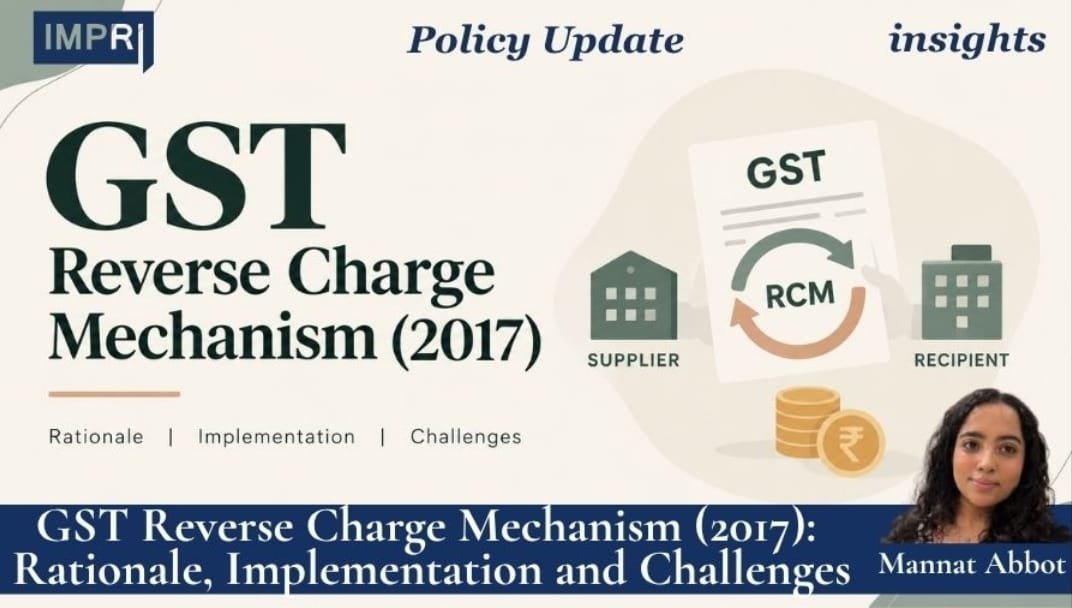
The Goods and Services Tax (GST) was introduced in India on 1 July 2017 to create a more unified indirect tax system and reduce the cascading effect of taxes. Under the normal GST system, the supplier of goods or services collects tax from the recipient and deposits it with the government. However, in certain specified transactions, the responsibility for paying GST is shifted from the supplier to the recipient. This arrangement is known as the Reverse Charge Mechanism (RCM) (Central Board of Indirect Taxes and Customs [CBIC], 2017).
The rationale behind RCM is to improve tax compliance, strengthen revenue collection and address situations where collecting tax directly from the supplier may be difficult or less effective. For example, when a registered business receives certain notified services from a supplier, the government may require the recipient to pay the applicable GST instead of placing the entire responsibility on the supplier.
RCM is particularly relevant in transactions involving services such as legal services provided by advocates, specified goods transport agency services and certain services provided by directors to companies, subject to the applicable conditions. It also applies to certain notified supplies involving unregistered suppliers and registered recipients. However, the provision covering purchases from unregistered suppliers is not a blanket requirement covering every such transaction. Its application depends on the categories and classes of persons notified under the law.
The mechanism operates under Section 9(3) and Section 9(4) of the Central Goods and Services Tax Act, 2017, while corresponding provisions exist under the Integrated Goods and Services Tax Act, 2017, for interstate supplies. Over time, notifications and amendments have changed the scope of transactions covered by RCM (Central Goods and Services Tax Act, 2017, §§ 9(3)–9(4); Integrated Goods and Services Tax Act, 2017).
While RCM can improve the administration of GST, it also transfers additional responsibilities to the recipient. Businesses must identify applicable transactions, calculate the tax payable, deposit it within the prescribed timelines and maintain appropriate records. These requirements can create additional compliance costs, particularly for small businesses with limited accounting resources.
Against this backdrop, the present Policy Update examines the rationale, functioning, performance and impact of RCM, while identifying the challenges that need to be addressed to make the mechanism more effective and business-friendly.
Functioning
Under the normal GST system, known as the forward charge mechanism, the supplier is responsible for charging GST on a taxable supply and depositing the tax with the government. Under RCM, this responsibility shifts to the recipient for specified categories of goods or services.
The legal framework for RCM under GST primarily operates through two provisions.
1. Reverse charge under Section 9(3)
Section 9(3) empowers the government to notify categories of goods or services on which the recipient is liable to pay GST under reverse charge. The relevant notifications specify the nature of the supply, the supplier and the recipient to whom the provision applies.
Examples include specified legal services provided by individual advocates or firms of advocates to business entities, certain goods transport agency services, and specified services supplied by directors to companies. The precise conditions and exceptions depend on the relevant notification.
For example, when a company receives legal services from an advocate that fall within the notified category, the company may be responsible for paying the applicable GST. The advocate does not collect that GST under the forward charge for the specified transaction. This allows the government to place the tax payment responsibility on the recipient in situations covered by the law.
2. Reverse charge under Section 9(4)
Section 9(4) deals with specified categories of taxable supplies received from unregistered suppliers. The provision has undergone changes since the introduction of GST. It should not be interpreted as requiring every registered business to pay GST on every purchase from an unregistered person.
The provision applies to notified categories of goods or services received by specified classes of registered persons. Therefore, businesses must check the applicable notifications before determining whether RCM applies to a transaction.
For instance, the government introduced reverse charge on the renting of certain commercial immovable properties supplied by unregistered persons to registered persons from 10 October 2024. Subsequently, the GST Council recommended excluding taxpayers registered under the composition levy from this particular provision, with the proposed change effective from 1 April 2025 (Goods and Services Tax Council, 2024b). This illustrates how the scope of RCM can be modified to address practical concerns.
3. Payment of tax and claiming Input Tax Credit
When a transaction falls under RCM, the recipient must calculate the applicable GST and discharge the liability in accordance with the prescribed procedures. Tax payable under reverse charge must be paid through the electronic cash ledger rather than by using existing Input Tax Credit (ITC).
However, the recipient may subsequently claim ITC for the GST paid under RCM, provided the recipient is eligible under the GST law and satisfies the applicable conditions. Therefore, the tax payment and the eventual availability of ITC are separate steps.
RCM also involves specific documentation and reporting requirements. Depending on the transaction, the recipient may need to issue a self-invoice where prescribed, issue a payment voucher, maintain supporting documents and report the liability in the relevant GST return. The applicable time-of-supply provisions determine when the tax becomes payable.
Thus, RCM changes the person responsible for paying GST without necessarily eliminating the recipient’s right to claim eligible ITC. Its functioning depends on the correct identification of notified transactions, timely payment and accurate reporting.
Performance
Since its introduction in 2017, RCM has become an important component of the GST framework. It allows the government to collect tax on specified transactions by assigning the payment obligation to recipients who are generally better placed to maintain formal business records and comply with tax requirements.
The mechanism has also been adapted over time through amendments and notifications. The expansion or modification of notified categories demonstrates that RCM is used as a targeted tax administration instrument rather than a single rule applied uniformly to all transactions.
However, the assessment of its performance requires more than examining the number of transactions covered by notifications. It is also necessary to determine whether RCM improves compliance, reduces tax evasion and results in timely tax payments without creating disproportionate costs for businesses.
One important limitation is the difficulty of assessing RCM independently from the wider GST system. Aggregate GST collection figures do not, by themselves, establish how much additional revenue can be attributed specifically to RCM. Similarly, the existence of a legal requirement does not establish whether compliance has improved across all the categories covered by the mechanism.
The introduction of the Reverse Charge Mechanism ledger and related return-system improvements has also formed part of the government’s efforts to strengthen reporting and reconciliation. During its 54th meeting, the GST Council discussed enhancements to the GST return system, including an RCM ledger intended to improve the tracking of tax liabilities and related ITC claims (Goods and Services Tax Council, 2024a).
Overall, RCM provides an established mechanism for collecting GST on specified transactions. However, a more comprehensive assessment of its performance would require regularly published information on RCM-specific collections, compliance levels, disputes, errors and the costs incurred by taxpayers.
Impact
The impact of RCM can be understood in terms of tax administration, revenue collection and the compliance responsibilities of businesses.
First, RCM can strengthen tax compliance by shifting the payment obligation to the recipient in specified transactions. When the recipient is a registered business maintaining formal accounts, the transaction can be recorded and reconciled with other business records. This may improve the visibility of taxable transactions and reduce the possibility of tax remaining unpaid.
Second, the mechanism can support revenue collection. Instead of depending entirely on the supplier to collect and deposit GST, the government can require the recipient to discharge the liability in notified cases. This provides an additional way to administer tax on selected transactions.
Third, RCM can increase the compliance burden for businesses. Recipients must determine whether a transaction falls within a notified category, verify the relevant conditions, calculate the tax and ensure timely payment. Businesses dealing with multiple suppliers and different categories of services may need additional accounting support to manage these requirements accurately.
The mechanism can also affect working capital. Since the recipient must pay the GST in cash before claiming eligible ITC, funds may remain tied up until the credit is available and can be utilised. Although eligible ITC can reduce the eventual tax cost, the timing of the cash payment can create liquidity pressures for businesses with limited financial resources.
For small enterprises, the effect may be more significant because they often operate with limited accounting staff and depend on regular cash flows to meet operational expenses. Errors in identifying RCM transactions or reporting the liability may also result in additional interest, penalties or disputes where the law provides for them.
Therefore, the impact of RCM is mixed. It can strengthen tax administration and improve compliance in specified transactions, but it can also increase the administrative and financial responsibilities of recipients. Its effectiveness depends on maintaining a balance between revenue protection and ease of compliance.
Emerging Issues
Despite its role in GST administration, RCM faces several challenges that affect its implementation.
1. Complexity of notifications and eligibility conditions
The applicability of RCM depends on the nature of the supply, the status of the supplier and recipient, and the conditions specified in the relevant notification. Businesses must keep track of amendments and exemptions to determine whether a transaction is covered. This can be particularly difficult for small businesses without dedicated tax professionals.
2. Additional compliance costs for small businesses
RCM requires recipients to identify applicable transactions, calculate tax liabilities, maintain documentation and report the transactions correctly. These activities may increase expenditure on accounting software and professional assistance. For smaller enterprises, such costs can reduce the benefits of operating within the formal tax system.
3. Working-capital and liquidity constraints
The requirement to pay RCM liability in cash can create liquidity pressures, particularly where the recipient is eligible to claim ITC but cannot utilise the credit immediately. This may increase the short-term financial burden on businesses even when the tax is ultimately creditable.
4. Risk of errors and disputes
Differences in the interpretation of notifications, incorrect classification of transactions and failure to identify applicable RCM liabilities can lead to disputes between taxpayers and tax authorities. Frequent changes to the scope of RCM may further increase uncertainty if taxpayers do not receive timely guidance.
5. Limited evidence on the mechanism’s independent effectiveness
A further concern is the limited availability of clearly separated evidence on RCM-specific revenue gains, compliance improvements and taxpayer costs. Without such information, it becomes difficult to determine whether the mechanism is achieving its intended objectives efficiently or whether some requirements could be simplified.
These challenges indicate that RCM should not be evaluated only in terms of the government’s ability to collect tax. Its overall effectiveness must also be assessed through the costs, administrative effort and uncertainty it creates for businesses.
Way Forward
To improve the effectiveness of RCM, the government should focus on simplifying compliance while maintaining the mechanism’s revenue-protection objectives.
First, the government should simplify the legal framework. Notifications relating to RCM should be consolidated and updated regularly so that businesses can easily identify the categories of transactions covered. A clear, consolidated reference document explaining the relevant supplier, recipient, conditions and exceptions would reduce confusion.
Second, the GST portal should provide better digital assistance. Automated alerts, clearer reporting fields and improved reconciliation facilities could help businesses identify and report RCM liabilities more accurately. Where sufficient transaction information is available, pre-filled information could also reduce repetitive data entry and errors.
Third, taxpayer awareness should be strengthened. CBIC and GSTN should provide simplified guidance, practical examples and regional-language resources explaining the application of RCM. Particular attention should be given to small businesses that may not have access to regular professional tax advice.
Fourth, the government should address working-capital concerns. The process of claiming eligible ITC on tax paid under RCM should be clear and predictable. Better reconciliation and fewer reporting errors could reduce delays and help businesses manage their cash flows more effectively. Any changes to payment or credit procedures should, however, be evaluated against the need to prevent revenue leakage.
Finally, RCM should be evaluated through measurable outcomes. The government should periodically publish information on RCM collections, compliance rates, disputes and administrative costs wherever reliable data are available. Taxpayer surveys could also help identify which requirements create the greatest difficulties. Such evidence would allow policymakers to distinguish between provisions that are effective and those that may require simplification.
Overall, RCM remains an important instrument within India’s GST system. It helps assign tax liability to recipients in specified transactions and can strengthen tax administration. However, its success depends on clear rules, effective digital systems and proportionate compliance requirements. A simpler and more predictable framework would help preserve the benefits of RCM while reducing unnecessary burdens on businesses.
References
- Central Board of Indirect Taxes and Customs. (2017). GST (goods and services tax): Reverse charge mechanism. Government of India. https://cbic-gst.gov.in/pdf/e-version-gst-fliers/reverse-charge-mechanism-08aug2017.pdf
- Central Board of Indirect Taxes and Customs. (n.d.). The Central Goods and Services Tax Act, 2017. Government of India. https://cbic-gst.gov.in/hindi/CGST-bill-e.html
- Central Board of Indirect Taxes and Customs. (n.d.). Sectoral FAQs. Government of India. https://cbic-gst.gov.in/sectoral-faq.html
- Goods and Services Tax Council. (2024a, September 9). Recommendations during the 54th meeting of the GST Council. Government of India. https://gstcouncil.gov.in/recommendations-during-54th-meeting-gst-council
- Goods and Services Tax Council. (2024b, December 21). Recommendations of the 55th meeting of the GST Council. Government of India. https://gstcouncil.gov.in/recommendations-55th-meeting-gst-council-0
About the Contributor
Mannat Abbot is pursuing a B.A. (Hons.) in Economics at the College of Vocational Studies, University of Delhi, and serves as a Research & Editorial Intern at IMPRI. Her interests include public policy, economics, macroeconomics, economic policy, and evidence-based policymaking, with a particular focus on research and data-driven analysis.
Acknowledgements
The author sincerely acknowledges the guidance and constructive feedback provided by Ashi Verma and Pritha Chowdhruy throughout the preparation of this article. Their valuable suggestions and thoughtful observations contributed to strengthening the analysis, improving the organisation of ideas, and enhancing the overall quality of the manuscript.
Reviewers
Ashi Verma and Pritha Chowdhury
Disclaimer
The views and interpretations expressed in this article are those of the author. Any remaining errors or omissions are solely the responsibility of the author and do not necessarily reflect the views of the reviewers or IMPRI.
Read More at IMPRI :
Janani Suraksha Yojana (2005): Promoting Institutional Deliveries and Maternal Health in India
Integrated Transport & Logistics Authority (ITLA), 2026: Advancing Multimodal Connectivity