








Policy Update
Tanisha Hooda
Background
India’s expanding economy has increased the need for efficient transportation networks and a well-coordinated logistics system. Roads, railways, ports, shipping, aviation and inland waterways play an important role in the movement of goods and passengers. However, when these transport systems are planned separately, gaps in connectivity, coordination and infrastructure utilisation can arise. To address these challenges, integrated transport planning and seamless multimodal connectivity are essential for improving logistics efficiency and supporting economic growth.
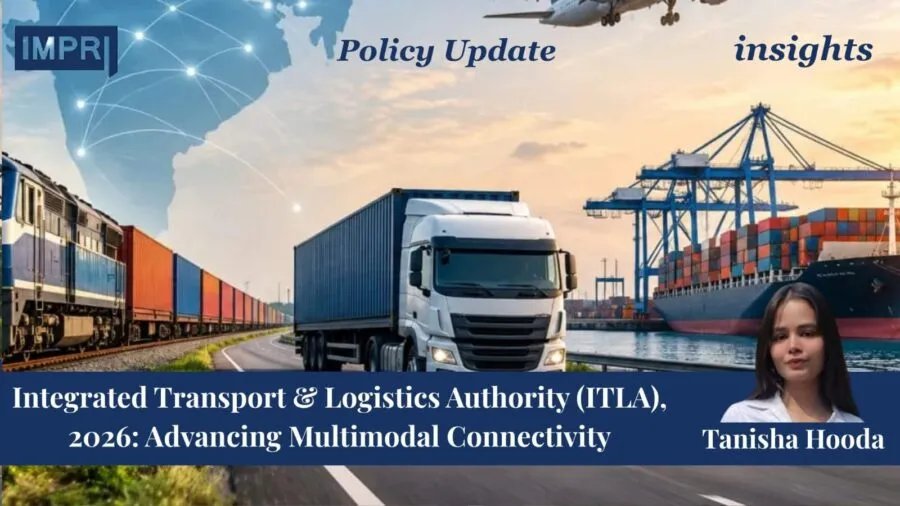
The Union Cabinet, chaired by the Prime Minister, approved the establishment of the Integrated Transport & Logistics Authority (ITLA) as a Special Purpose Vehicle (SPV) on 6 October 2026. According to the Press Information Bureau (PIB), ITLA is envisaged as a national apex institution for integrated transport and logistics planning, research, technical project appraisal, monitoring, policy support and data analytics.
Its mandate includes preparing a National Transport Master Plan with a planning horizon of ten years or more, promoting coordination among transport-related ministries and agencies, and undertaking technical appraisal and monitoring of major infrastructure projects. ITLA is expected to complement existing initiatives such as the PM GatiShakti National Master Plan and the National Logistics Policy, 2022, by strengthening multimodal integration and evidence-based infrastructure planning.
A key objective of ITLA is to develop a comprehensive National Transport Master Plan with a planning horizon of 10 years or more, covering roads, railways, ports and shipping, civil aviation, inland waterways, coastal shipping, urban mobility and logistics. The authority will assess whether short-term sectoral plans and annual plans of transport ministries align with this long-term framework. It will also undertake the technical appraisal of Government of India infrastructure projects costing ₹500 crore or more and monitor projects above ₹500 crore, while conducting post-implementation assessments to evaluate their outcomes. Financial appraisal will continue under the existing mechanisms.
Another key component of ITLA is the proposed National Transport Data Repository (NTDR), which will integrate data from sources such as GSTN e-way bills, FASTag, Vahan and GPS-based systems. This will support better transport planning and evidence-based decisions. Through improved coordination, research and capacity building, ITLA aims to enhance multimodal connectivity, infrastructure efficiency and contribute to India’s Vision 2047.
Functioning
1. Integrated Transport Planning and Project Appraisal: ITLA will prepare a comprehensive National Transport Master Plan with a planning horizon of ten years or more, covering roads, railways, ports and shipping, civil aviation, inland waterways, coastal shipping, urban mobility and logistics. It will evaluate transport ministries’ short-term sectoral plans, generally spanning around five years, and their annual plans to ensure consistency with the National Transport Master Plan and promote multimodal connectivity. In addition, ITLA will undertake the technical appraisal of Government of India infrastructure projects costing ₹500 crore or more, assessing their technical feasibility and related project aspects. Financial appraisal will continue to be undertaken through existing financial appraisal mechanisms, keeping ITLA’s technical appraisal role distinct from the established financial scrutiny process.
2. Project Monitoring and Impact Assessment: ITLA will monitor transport and infrastructure projects costing above ₹500 crore and facilitate coordination among the concerned Ministries and agencies to address implementation-related issues. After project completion, it will assess outcomes and performance to determine whether the intended objectives have been achieved. These assessments will help identify gaps and provide insights for improving future infrastructure projects.
3. Transport Data Integration and Knowledge Development: ITLA will establish a National Transport Data Repository (NTDR) by integrating information from sources such as GSTN e-way bills, FASTag, Vahan, GPS-based systems and urban traffic management systems. This information will support freight-flow analysis, help identify connectivity gaps and improve evidence-based decision-making. The authority will also contribute to reviewing the National Logistics Policy, 2022, while promoting research, innovation, training and skill development in the transport and logistics sectors.
4. Logistics Policy Support and Institutional Coordination: ITLA will advise the government on reviewing and updating the National Logistics Policy, 2022, to address emerging requirements in the transport and logistics sector. It will also promote coordination among transport-related Ministries and agencies to reduce fragmented decision-making and improve policy alignment. However, as highlighted in Business Standard (13 October 2026), limited execution powers and overlapping responsibilities may restrict its effectiveness. Its success will therefore depend on clear institutional roles and effective coordination with the agencies responsible for implementing projects.
5. Capacity Building and International Best Practices: ITLA will promote training, skill development, research and innovation to strengthen expertise in transport planning and logistics management. It will also support the adoption of international best practices in infrastructure planning, data integration and project evaluation. These efforts can help improve institutional capabilities and logistics performance over time. However, coordination at the national level alone may not resolve challenges involving state-level permissions, land availability and local infrastructure, which are also important for the timely implementation of transport projects.
Performances
Existing infrastructure initiatives and monitoring frameworks provide useful insights into sectoral performance, project implementation and multimodal connectivity, offering a baseline for assessing ITLA’s potential role in strengthening transport and logistics coordination.
1. Monitoring Infrastructure Performance through PAIMANA: Launched by MoSPI on 16 April 2026, the PAIMANA Performance Monitoring Dashboard covered 165 indicators across six infrastructure sub-sectors in its July 2026 update. These indicators provide a baseline for assessing infrastructure performance relevant to ITLA’s future work. It assesses infrastructure through five dimensions: Access, Quality, Fiscal Cost and Revenue, Utilization, and Affordability. This standardized framework supports evidence-based monitoring and can provide useful information for ITLA’s proposed integrated transport planning.
Figure 1: Distribution of PAIMANA Performance Indicators Across Infrastructure Sub-sectors
Source: PIB, MoSPI, 16 July 2026.
Ports, Shipping and Waterways have the highest number of indicators (62), followed by Railways (37) and Civil Aviation (31). This highlights the dashboard’s coverage of different infrastructure sectors relevant to multimodal connectivity.
2. Expansion of National Highway Infrastructure: According to the PAIMANA Performance Monitoring Dashboard, India constructed 9,360 km of National Highways during FY 2025–26. The expansion of the highway network supports road connectivity and facilitates the movement of passengers and freight across the country. This expansion can improve access to markets and strengthen freight transportation. However, effective multimodal connectivity also requires better coordination between roads, railways, ports and waterways. ITLA may help address these coordination gaps through integrated transport planning and improved infrastructure monitoring.
3. Growth in Electronic Toll Collection: Electronic toll collection transactions reached 88.1 crore during FY 2026–27 (April–May 2026), registering a 40.3% year-on-year increase, according to the July 2026 update of MoSPI’s PAIMANA Performance Monitoring Dashboard. This growth reflects the increasing adoption of digital toll collection systems on Indian highways.
Table 1: Electronic Toll Collection Transactions in India
| Period | Electronic Toll Transaction (crore) |
| FY 2025-26 (up to May) | Approximately 62.79* |
| FY 2026-27 (up to May) | 88.1 |
Source: PIB, MoSPI, 16 July 2026.
Note: The FY 2025–26 figure is an estimate calculated from the reported 88.1 crore transactions and 40.3% year-on-year growth.
Electronic toll transactions increased significantly over the comparable period, reflecting greater use of cashless toll systems. This can support smoother toll processing and provide useful data for monitoring road transport activity. However, the increase alone does not establish a reduction in logistics costs or travel time.
4. Improvement in Railway Freight-Carrying Capacity: The average carrying capacity of Broad Gauge railway wagons increased from 60.8 tonnes in FY 2015–16 to 64.0 tonnes in FY 2024–25. Greater freight-carrying capacity can support the movement of goods across the railway network and contribute to more efficient logistics.
Figure 2: Average Carrying Capacity of Broad Gauge Railway Wagons 
Source: PIB, MoSPI, 16 July 2026.
Average carrying capacity increased by 3.2 tonnes per wagon between FY 2015–16 and FY 2024–25. This improvement can support railway freight movement and strengthen the role of railways in multimodal logistics.
5. Coastal Cargo Handling at Major and Non-Major Ports: The PAIMANA update reported coastal cargo handling of 196,808.7 thousand tonnes at major ports and 142,219.4 thousand tonnes at non-major ports. It also reported that India’s total waterway length reached 29,151.9 km in FY 2024–25, while the inland water vessel fleet stood at 10,623 vessels.
Figure 3: Coastal Cargo Handling at Major and Non-Major Ports
Source: PIB, MoSPI, 16 July 2026.
Major ports handled more coastal cargo than non-major ports in the reported figures. Better coordination between ports, waterways, railways and roads could strengthen multimodal freight movement and improve logistics connectivity.
Impacts
1. Reduction in Long-Distance Freight Costs: The NCAER (2025) report, Assessment of Logistics Cost in India (p. 71, Figure 4.15), estimates that the break-even point between road-only and multimodal road–rail freight transport occurs at approximately 600 km. The comparison assumes 50 km of first-mile road transport, 500 km by rail and 50 km of last-mile road transport, using estimated freight costs per tonne-kilometre. This threshold is scenario-specific: the break-even distance may increase with longer first- and last-mile connections and vary according to cargo characteristics, handling costs and terminal accessibility. Improved coordination between road and rail networks could therefore help identify routes where multimodal transport offers potential cost advantages.
2. First- and Last-Mile Connectivity Challenges: The cost advantage of multimodal transport depends on the distance covered by road to connect the origin and destination with rail terminals. When first- and last-mile distances increase to approximately 100 km each, the break-even point shifts to around 1,000 km. This highlights the importance of locating logistics terminals strategically and improving access to them. ITLA could support integrated planning to address these connectivity gaps.
3. Improvement in Warehousing Efficiency: The report estimates average warehousing costs in India at approximately ₹30 per square foot per month. Manpower accounts for around 30% of total warehousing costs, while premises account for 20%. These findings highlight the importance of efficient warehouse operations and infrastructure utilisation. Better coordination between storage facilities, freight terminals and transport networks could reduce avoidable handling and storage expenses.
4. Strengthening Export-Import Logistics: The report identifies maritime ports as a significant source of export-import logistics costs, including terminal handling charges and other port-related expenses. Delays or poor coordination between ports and inland transport networks can complicate cargo movement. ITLA could improve coordination among ports, railways, roads and waterways, helping streamline cargo transfers and strengthen the reliability of international trade logistics.
5. Better Allocation of Freight Across Transport Modes: The report notes that road transport continues to dominate several long-distance routes because it offers door-to-door delivery, simpler documentation and greater suitability for certain cargo types. Therefore, shifting all freight to rail or multimodal transport may not always be practical. ITLA could support evidence-based transport planning by identifying the most suitable mode for different routes and cargo categories, balancing cost efficiency with operational requirements.
Emerging Issues
1. Gaps in First- and Last-Mile Multimodal Connectivity: The PIB report highlights the need for further improvements in connectivity between ports and inland transport networks, despite 60 road projects and 47 railway projects being sanctioned to improve last-mile connectivity to ports. To address this issue, the Ministry of Road Transport and Highways, Ministry of Railways and Ministry of Ports, Shipping and Waterways should strengthen inter-ministerial coordination, prioritise missing links and monitor project completion to ensure seamless freight movement.
2. Delays in Port Operations and Cargo Movement: The report identifies port dwell time and the movement of goods between ports and inland transport networks as areas requiring further improvement. Such delays can affect the reliability and efficiency of export-import logistics. Port authorities, customs officials and logistics service providers should streamline cargo clearance, standardise cargo examination procedures and use digital tracking systems to identify and reduce avoidable delays.
3. Incomplete Integration of Logistics Data and Digital Systems: Although the Unified Logistics Interface Platform (ULIP) had integrated 33 logistics-related digital systems and enabled more than 55 applications, further integration and wider industry participation remain important for effective information sharing. DPIIT and the concerned ministries should improve interoperability between digital platforms, integrate relevant databases and encourage logistics companies to adopt digital tracking systems to improve supply-chain visibility.
4. Uneven Implementation Across States and Sectors: According to DPIIT’s September 2025 update, 27 States and Union Territories had formulated State Logistics Policies aligned with the National Logistics Policy. While this indicates progress since the July 2023 baseline of 21 States, differences in implementation may continue to create coordination gaps across regions and infrastructure sectors. State governments, DPIIT and sectoral ministries should strengthen implementation through measurable targets, regular performance reviews and updated assessments under frameworks such as Logistics Ease Across Different States (LEADS).
5. Inconsistent Measurement of Logistics Costs and Performance: The report noted that official logistics cost estimates were unavailable at the time and that estimates varied between 8% and 14% of GDP. This lack of consistent measurement made it difficult to assess logistics efficiency and compare performance reliably. DPIIT and the Ministry of Statistics and Programme Implementation should strengthen standardised, data-based cost estimation and regularly monitor freight costs, port dwell time, transit time and multimodal connectivity to identify gaps and evaluate policy outcomes.
Way Forward
The Integrated Transport & Logistics Authority (ITLA), 2026, has the potential to strengthen India’s logistics ecosystem by promoting a unified approach to transport planning and infrastructure development. Moving forward, the focus should extend beyond the construction of roads, railways and ports towards ensuring that these networks function as a coordinated system. Aligning logistics planning with manufacturing, agriculture, industrial development and export priorities could improve the movement of goods, strengthen market access and support India’s ambition of becoming a globally competitive economy.
A key priority should be to establish an outcome-based monitoring framework that evaluates logistics performance through indicators such as freight transit reliability, cargo handling efficiency, delivery times and logistics expenditure. Greater use of digital platforms and data-sharing mechanisms could improve transparency and support evidence-based decision-making. At the same time, promoting rail freight, inland waterways, energy-efficient warehouses and cleaner transport options wherever feasible could help reduce environmental costs while supporting sustainable economic growth. Collaboration between central ministries, state governments, infrastructure operators and private logistics companies will be essential to translate these priorities into practical outcomes.
In the long term, ITLA’s contribution should be assessed through its ability to improve productivity, strengthen domestic and international trade, support small businesses and reduce regional disparities in connectivity. Greater attention to agricultural supply chains, industrial clusters and less-connected regions could ensure that the benefits of logistics development reach a wider section of the economy. By combining coordinated planning, institutional accountability and sustainable infrastructure management, ITLA could contribute to the broader vision of Viksit Bharat 2047. However, its actual effectiveness will depend on a clearly defined mandate, effective implementation and measurable improvements in logistics performance over time.
References
Press Information Bureau (PIB), 2026, Integrated Transport and Logistics Authority (ITLA): A Comprehensive National Transport Master Plan, Government of India, 6 October 2026.
DD India, 2026, Cabinet Approves Setting Up of Integrated Transport & Logistics Authority, DD India, 6 October 2026.
Bhattacharjee, S., 2026, New Transport Body Needs Execution Powers to Make Integrated Logistics Work, Business Standard, 13 October 2026.
Ministry of Statistics and Programme Implementation (MoSPI), 2026, Quarterly Release of Performance Monitoring Dashboard of Infrastructure Sector in India, Press Information Bureau (PIB), Government of India, 16 July 2026.
https://www.pib.gov.in/PressReleasePage.aspx?PRID=2285365®=48&lang=1
National Council of Applied Economic Research (NCAER), 2025, Assessment of Logistics Cost in India, prepared for the Logistics Division, Department for Promotion of Industry and Internal Trade (DPIIT), Government of India, September 2025.
https://master-dpiit.digifootprint.gov.in/static/uploads/2025/09/7d467e0f4aee2362e4bf90b84b7a5332.pdf
Ministry of Commerce & Industry, 2023, Impact Assessment of National Logistics Policy Undertaken at Inter-Ministerial Meeting, Press Information Bureau (PIB), Government of India, 29 July 2023.
https://www.pib.gov.in/PressReleaseIframePage.aspx?PRID=1944005®=48&lang=2
About the Contributor
Tanisha Hooda is a Research Intern at the Impact and Policy Research Institute (IMPRI) and a B.A. (Hons.) Economics graduate from Manav Rachna International Institute of Research and Studies (MRIIRS), Faridabad. Her research interests include competition policy, digital economy, public policy, and economic development, with a focus on analysing the socio-economic implications of emerging policy frameworks.
Acknowledgement
The author extends sincere gratitude to Prisha Sachdeva and Anamika for their valuable guidance, support, and review of the Policy Update.
Disclaimer
All views expressed in the article belong solely to the author and not necessarily to the organization.
Reviewed by Prisha Sachdeva and Anamika. P K
Read More at IMPRI:
GEN-NEXT Support for Innovative Startups (GENESIS), 2022
Janani Suraksha Yojana (2005): Promoting Institutional Deliveries and Maternal Health in India