





Suparna Das
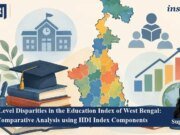
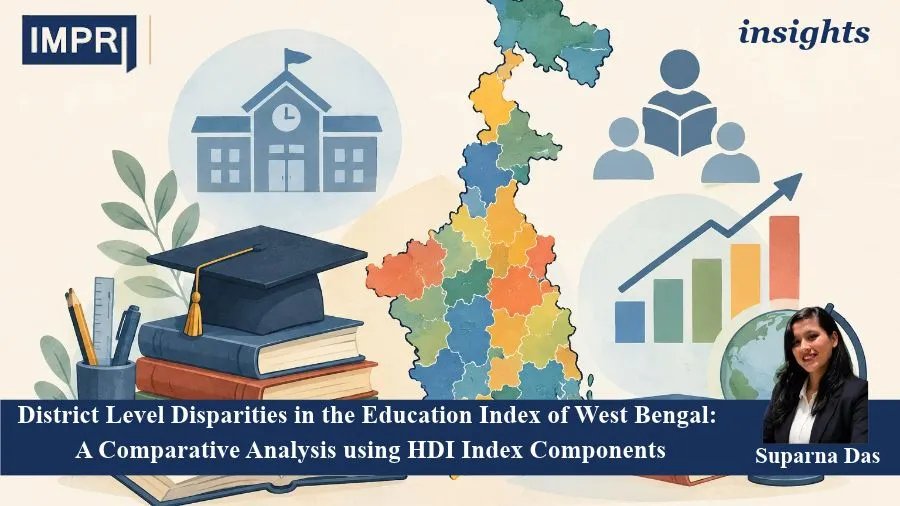
West Bengal has a pride about the education that is at the rank 32 of 36 nationality with 93715 schools and 1.7 cr students as of the UDISE+ West Bengal District Performance Index data. It has a long tradition of learning, reform and public debate. But there is a clear gap between a child growing up in Kolkata, Hooghly, Siliguri etc. best performing districts and a child in the poor performing districts like Purulia, Malda, Darjeeling, Kalimpong, North
Dinajpur, Murshidabad etc., they may live in then same state and still have very different chances of staying in school, finishing class 12 and moving on to higher studies. So, this blog is focused on this gap, district by district, using the education component of the Human Development Index.
Human Development:
UNDP’s first report on Human Development says that
“This report is about more about people and about how development enlarges their choices. It is about more than GNP Growth, more than income and wealth and more than producing commodities and accumulating capital. A person’s access to income may be one of the choices, but it is not the sum total of human behavior.”
And also “Human development is a process of enlarging people’s choice, increasing their opportunities for education, health care, income and employment and covering the full range of human choices from a sound physical; environment to economic and political freedom.”
What the Education Index actually measures:
The Human Development Index (HDI) judges progress by more than income. Its education part usually combines metrics: mean years of schooling, meaning how many years the average adult has spent in school and expected years of schooling, meaning how many years a child starting school today can expect to complete, literacy, Pupil teacher ratio, electricity, internet, girl’s toilet, library, drinking water are often used alongside them.
| Districts | Total Schools | Teachers | Pupil- Teacher ratio | Students enrolled |
| 24 | 93.7k | 5.8L | 29.3:1 | 1.7 cr |
| Electricity | Internet | Girl’s Toilet | Drinking Water | Library |
| 97.1% | 18.6% | 98.7% | 99.2% | 70.0% |
But A wide gap can be seen at the district level the rankings are as follows
| Rank | Districts | Grade | Score | Schools | Internet | PTR |
|---|---|---|---|---|---|---|
| 1 | Kolkata | B+ | 74.7 | 2.3K | 44.50% | 18.6:1 |
| Rank | Districts | Grade | Score | Schools | Internet | PTR |
| 2 | Hooghly | B+ | 70 | 4.6K | 20.90% | 26.1:1 |
| 3 | Siliguri | B+ | 69 | 1.1K | 25.70% | 22.8:1 |
| 4 | N 24 Pargana | B+ | 68.7 | 6.2K | 24% | 27.9:1 |
| 5 | Paschim Bardhhaman | B+ | 68.6 | 2.0K | 23.70% | 29.6:1 |
| 6 | Jalpaiguri | B+ | 68.2 | 2.8K | 18.70% | 23.7:1 |
| 7 | Alipurduar | B+ | 67.3 | 2.0K | 19.20% | 24.8:1 |
| 8 | Jhargram | B+ | 67.2 | 2.5K | 18.10% | 22.1:1 |
| 9 | Howrah | B+ | 67.1 | 3.6K | 26.10% | 29.5:1 |
| 10 | Purva Bardhhaman | B+ | 67.1 | 4.9K | 19.10% | 28.8:1 |
| 11 | Birbhum | B+ | 66.9 | 4.1K | 17.90% | 35.2:1 |
| 12 | Cooch Bihar | B+ | 66.7 | 3.7K | 12.60% | 29.6:1 |
| 13 | Paschim Medinipur | B+ | 66.4 | 7.0K | 17.90% | 25.7:1 |
| 14 | Bankura | B+ | 65.8 | 5.1K | 16% | 26.6:1 |
| 15 | Purva Medinipur | B | 63.7 | 6.7K | 14.60% | 26.5:1 |
| 16 | S 24 Parganas | B | 63.1 | 7.2K | 15.30% | 33.5:1 |
| 17 | Dakshin Dinajpur | B | 62.7 | 2.4K | 15.90% | 25.1:1 |
| 18 | Purulia | B | 61.5 | 4.7K | 14.70% | 32.4:1 |
| 19 | Nadia | B | 61.3 | 4.5K | 18.20% | 28.5:1 |
| 20 | Malda | B | 60.7 | 4.5K | 20.90% | 33.2:1 |
| 21 | Darjeeling | B | 60.6 | 1.2K | 13.50% | 9.7:1 |
| 22 | Kalimpong | B | 59.5 | 538 | 10.80% | 13.4:1 |
| 23 | Uttar Dinajpur | B | 58.4 | 3.3K | 13.80% | 38.0:1 |
| 24 | Murshidabad | B | 56.3 | 6.8K | 16.50% | 41.9:1 |
Reason of the existence of this gap:
Poverty and urbanization: Households that struggle to meet the basic needs often pull the children out of school early, especially when the work is available. Urban districts tend to have more schools within reach and more job-linked reasons to study.
Social composition: Nationally, children from Schedule Caste, Schedule Tribe and Muslim households have faced lower attainment and the gap varies widely between states.
Gender and rural-urban divides: Girls in rural areas often face distance, early marriage and a lack of girls’ toilets. Schemes such as Kanya Shree Prakalpa aim to keep girls in school. Girls’ enrollment is 50.1%.
Schools and Teachers: Pupil-teacher ratios, vacancies and basic facilities such as electricity and internet shape whether children stay and learn. These poor performed districts with weal infrastructure may also be poor, remote and socially disadvantaged all at once. West Bengal’s internet access (18.6%) lags the national average (63.5%) which is a priority area for digital learning.
Solution:
Target the lagging districts: Resources spread evenly will not close gaps that are not even. Priority funding for the bottom districts, particularly in North Bengal, Jangalmahal, Sundarbans etc. would match effort to need.
Strengthen teacher supply: Filling vacancies and restoring trust in recruitment is basic to quality.
Build on what works: Retention schemes for girls deserves evaluation district by district, so that the factors which are working can be scaled and also what isn’t can be reworked.
Track results, not just enrolment: Learning outcomes from surveys such as ASER and NAS should sit alongside enrolment figures in district scorecards.
West Bengal’s education story is not one story but several. A state-level average can look healthy while some districts stay far behind. The task for policy is to see those districts clearly and to measure progress where it is hardest to achieve.
Sources:
- UDISE+
- West Bengal Human Development Report
- Census 2011
- District Performance Index Report
- Mahadev Maitri Foundation Report on West Bengal Education
About The Author
Suparna Das is from Kolkata, West Bengal. Her areas of interest include public policy, research, analysis, data analytics, and artificial intelligence (AI). She is currently upskilling herself in these domains to enhance her knowledge and skills. She completed her Master’s degree in Public Administration from Indira Gandhi National Open University (IGNOU) in August 2026. Prior to this, she earned her Bachelor’s degree in English Literature from the University of Calcutta in 2021. From 2022 to June 2024, she dedicated her time to preparing for the UPSC Civil Services Examination. In June 2024, she began pursuing her postgraduate studies.
Disclaimer: All views expressed in the article belong solely to the author and not necessarily to the organisation.
Read More at IMPRI
Beyond the Crash: Using Data to Save Lives on Himachal Pradesh’s Roads
Scheme for Financial Assistance for Setting Up of Electronics and ICT Academies (2014)