







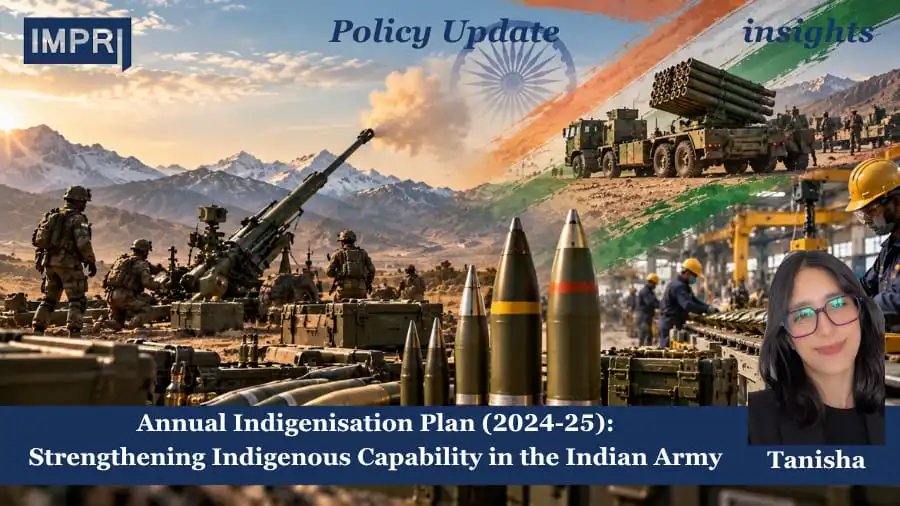
Policy Update
Tanisha
Background
The Indian Army’s indigenisation drive runs through the Army Design Bureau and the Directorate of Indigenisation, set up in 2016 as the Army’s own interface with domestic industry, DRDO and academia. Each year, the Army identifies the equipment, spares and ammunition it still imports and draws up a plan to move that list onto Indian production, working through the Ministry of Defence’s broader Positive Indigenisation Lists (PILs) and the SRIJAN portal, which together ban the import of a growing catalogue of items past fixed timelines. This yearly exercise is what the Army refers to as its Annual Indigenisation Plan.
The push has a clearly identifiable starting point: the import embargo imposed in December 2021 on ex-import procurement of Special Clothing and Mountaineering Equipment, and a parallel decision to build at least one indigenous source for every type of ammunition the Army holds. However, both of the above decisions fit into a broader Aatmanirbharta policy framework of five PILs on 509 Army, Navy, and Air Force items, five PILs on 5,012 DPSU items, and a ten-year roadmap for ammunition specifically. In this regard, the year-end review for FY 2024-25 by the Ministry of Defence itself provides a comprehensive view of the performance of the roadmap (Ministry of Defence [MoD], 2025).
Functioning
The ammunition roadmap runs in three phases. Phase I, running through 2025-26, covers 32 ammunition variants worth ₹15,899 crore, organised into 12 procurement cases grouped by calibre and platform; four of these, worth ₹5,696 crore, have already been placed with DPSUs and private players. Phase II, for 2026-27, adds five further variants identified to widen the vendor base and guard against supply-chain disruption. Phase III, from 2027 onward, is meant to use the experience from the first two phases to develop the next generation of high-technology ammunition domestically, with Indian intellectual property, for both the Army’s own use and export (MoD, 2025).
Special Clothing and Mountaineering Equipment, authorised for troops operating between minus 20 and 50 degrees Celsius, has been pursued on a similarly fixed timeline since ex-import purchase was stopped in December 2021. Of 57 authorised items, 53 have been indigenised; the remaining four are at an advanced stage of trials, with full indigenisation targeted by the end of 2026 (MoD, 2025). Separately, 515 Army Base Workshops and select Corps workshops have built an in-house drone manufacturing capability, producing 819 drones, surveillance, armed and first-person-view types, so far (MoD, 2025).
Table 1 :Indian Army ammunition procurement, indigenous versus foreign, FY 2021-22 to FY 2024-25. Source: Ministry of Defence (2025).
| Financial Year | Indigenous (₹ crore) | Foreign (₹ crore) | Total (₹ crore) | Ratio |
|---|---|---|---|---|
| 2021-22 | 17,290.96 | 2,940.15 | 20,231.11 | 6:1 |
| 2022-23 | 20,018.07 | 11,696.95 | 31,715.02 | 2:1 |
| 2023-24 | 21,607.65 | 1,471.77 | 23,079.42 | 15:1 |
| 2024-25 | 33,549.35 | 1,707.18 | 35,256.53 | 19:1 |
Source: Ministry of Defence (2025).
Performance
The clearest single measure of the plan’s progress is how the Army’s own ammunition procurement money has moved between domestic and foreign sources. The ratio went from 6:1 in favour of indigenous sourcing in FY 2021-22 to 19:1 in FY 2024-25, with indigenous spend nearly doubling over the period, from ₹17,290.96 crore to ₹33,549.35 crore, while foreign spend fell back to roughly where it started after a one-year spike (MoD, 2025).
Figure 1. Indigenous versus foreign ammunition procurement spend, by financial year. Source: Ministry of Defence (2025).
On ammunition variants specifically, 159 of the Army’s 175 scaled in-service variants, nearly 91 percent, had been indigenised by the end of 2025, an increase from the 154 of 175 (about 88 percent) reported a year earlier (MoD, 2025; Ministry of Defence, 2024). For FY 2025-26, the ratio of domestic to foreign payment assigned to the Army by MoD Finance stands at 87:13, and the Army’s own assessment is that it is on track to meet that target (MoD, 2025).
Impact
The key figure, a fourfold increase in the indigenous-to-foreign ratio in four years, reflects an actual trend and not just a rounding issue. The Ministry has also linked this broader shift to operational performance, noting in its Year End Review that domestically produced weaponry and systems were employed during Operation Sindoor in May 2025. The Ministry presented this as an illustration of the growing operational relevance of indigenous defence capabilities and their alignment with the broader Aatmanirbharta objective (MoD, 2025). The fact that SCME items were indigenised almost entirely also has a tangible significance for India in the sense that it eliminates the sole source dependency on an embargoed item at high altitude.
However, there is also a significant gap in the data, because in FY 2022-23, foreign ammunition spending reached ₹11,696.95 crore, which is four times more than spending last year and even eight times higher than in the following year, while the indigenous expenditure kept growing all along. It is precisely that particular spike and not the trends around it that needs explanation if the 19:1 ratio recorded in FY 2024-25 is considered as a floor level and not just a good year.
Emerging Issues
- The FY 2022-23 foreign-spend spike has no public explanation. Whether it reflects a one-off large contract, a delayed delivery finally billed that year, or a genuine but temporary reversal of the indigenisation trend is not addressed in the Ministry’s own year-end reporting, which otherwise treats the ratio’s climb to 19:1 as a straightforward success story.
- The remaining ammunition variants involve more demanding production requirements by definition. Only five variants were added to the indigenised column between the end of 2024 and the end of 2025, a slower pace than the headline 91 percent figure suggests, and the Ministry’s own text concedes that the last of the 32 Phase I variants are likely to be indigenised only by 2027-28, beyond Phase I’s own 2025-26 window (MoD, 2025).
- Reporting is organised around money and variant counts, not around which Indian vendors now hold sole-source status. The ratio of 110 single-source to 49 multi-source variants, buried in the same release, is arguably a bigger risk indicator than the headline 91 percent figure, since a single indigenous vendor can recreate the same vulnerability an import embargo was meant to fix.
Way Forward
- Publish a one-line explanation alongside each year’s indigenous-to-foreign ratio whenever a year departs sharply from the trend, so that a figure like the FY 2022-23 spike reads as explained variance rather than an unaddressed gap in an otherwise clean upward story.
- Report single-source versus multi-source indigenised variants as a headline metric in its own right, not a buried detail, since supply security depends on vendor count as much as on the import-versus-domestic split.
- Hold Phase II of the ammunition roadmap (2026-27) to a published, trackable timeline for its five additional variants, given that Phase I’s hardest variants have already slipped toward 2027-28.
- Extend the SCME model, a fixed import embargo paired with a named completion date, to other single-vendor, high-altitude or high-criticality equipment categories once the current SCME items are fully closed out by the 2026 target.
References
- Ministry of Defence. (2024, December). Year end review 2024 [Press release]. Press Information Bureau, Government of India. https://www.pib.gov.in/PressReleseDetailm.aspx?PRID=2088180
- Ministry of Defence. (2025, December 31). Year end review 2025 [Press release]. Press Information Bureau, Government of India. https://www.pib.gov.in/PressReleasePage.aspx?PRID=2210154
About the Contributor
Tanisha is a Political Science graduate (BA Hons, University of Delhi; MA, IGNOU), currently pursuing a Diploma in Conflict Transformation and Peacebuilding, with research interests spanning international relations, environmental governance, and gender studies. She is keen to build a career in policy research.
Acknowledgements
The author sincerely expresses gratitude to the reviewers Divya N and Kaustav Majumdar for their valuable comments, constructive suggestions, and continuous guidance throughout the preparation of this article. Their insightful feedback significantly enhanced the clarity, organisation, and analytical quality of the manuscript. The author also acknowledges the support and encouragement received during the research and writing process, which contributed to the successful completion of this work.
Disclaimer: All views expressed in the article belong solely to the author and not necessarily to the organisation.
Read more at IMPRI:
GOBARdhan(Galvanizing Organic Bio-Agro Resources Dhan Yojana): 2026