







Policy Update
Dolly Kaushik
Background and Institutional Evolution
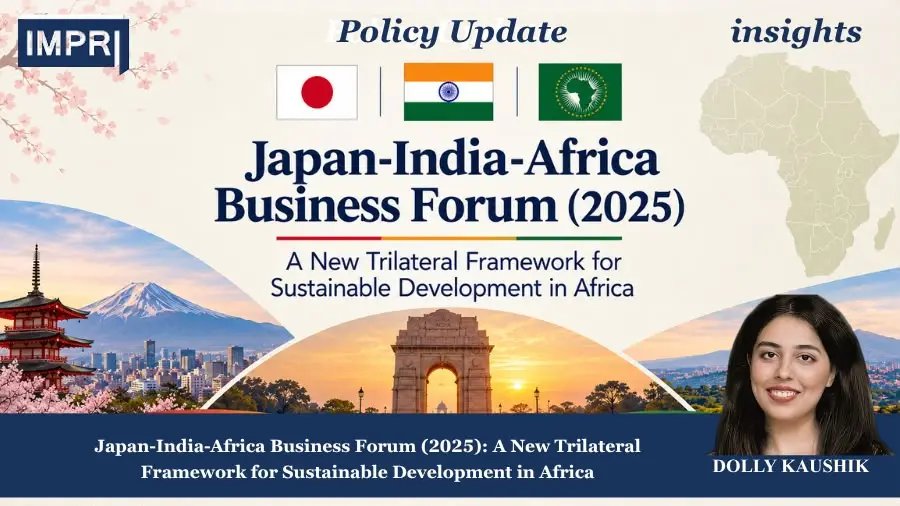
The strategic landscape of trilateral economic cooperation in the Indo-Pacific advanced significantly with the convening of the fourth edition of the Japan-India-Africa Business Forum in Tokyo on February 26, 2025 . Operating as a recurring high-level dialogue platform since 2007, the forum was co-hosted by Japan’s METI and Nikkei, drawing over 2,000 delegates, political leaders, and corporate executives from 46 countries and regions (Ministry of Economy, Trade and Industry [METI], 2025)). A defining milestone of this iteration was the official launch of the Japan–India Cooperation Initiative for Sustainable Economic Development in Africa, unveiled by Japan’s METI Minister, Yoji Muto.
Addressing the forum via a virtual institutional address, India’s External Affairs Minister, Dr. S. Jaishankar, articulated a normative framework explicitly distinguishing New Delhi and Tokyo’s cooperative philosophy from traditional resource-extractive paradigms (Ministry of External Affairs [MEA], 2025). Grounded in transparency, capacity building, and long-term local value creation rather than debt-heavy extraction, this trilateral vision was subsequently welcomed within official bilateral frameworks, explicitly linking it to India’s broader MAHASAGAR strategic maritime vision for the Indo-Pacific and Indian Ocean region
Functioning and Institutional Architecture
The operational framework of the Japan–India Cooperation Initiative for Sustainable Economic Development in Africa is spearheaded by Japan’s Ministry of Economy, Trade and Industry (METI). Rather than treating India merely as a bilateral partner, the institutional design positions India as an industrial and manufacturing “business hub” from which Japanese capital, advanced technologies, and enterprise networks can jointly scale operations into high-growth African markets.
Financing mechanisms are systematically anchored in Japan’s established Official Development Assistance (ODA) framework and public financial architecture. Project capitalization and risk mitigation are channeled through specialized institutions, including the Japan Bank for International Cooperation (JBIC), Nippon Export and Investment Insurance (NEXI), and the Japan International Cooperation Agency (JICA), operating in coordination with Indian financial and developmental lines of credit. Furthermore, the institutional model leverages the Japan-India-Africa Business Forum as a permanent, recurring mechanism rather than a one-off conference, focusing operational priorities on critical mineral supply chains, industrial clustering, and foundational infrastructure. This mechanism functions alongside METI’s broader regional strategy, designated as the “Economic Region Initiative of Indian Ocean-Africa”.
Trade Performance and Structural Composition
Bilateral economic metrics establish a robust commercial foundation for the trilateral framework, with India-Africa trade reaching approximately $100 billion Concurrently, India’s development cooperation footprint in Africa exceeds $12 billion in concessional credit, financing over 200 completed infrastructure and developmental projects spanning rural solar electrification, power generation, public transport, and drinking water systems (MEA, 2025; News on Air, 2026).
Human capital enhancement functions as a core quantifiable performance indicator. Under pre-existing and expanded bilateral educational frameworks, youth and technical professionals from 19 African countries are actively enrolled in specialized undergraduate, postgraduate, and vocational diploma programs across Indian academic and training institutions. These tangible metrics fed directly into subsequent multilateral milestones most notably TICAD 9 (Tokyo International Conference on African Development), convened in Yokohama in August 2025, where the trilateral economic agenda was transitioned into broader continental action plans (Ministry of Economy, Trade and Industry [METI], 2025).
Strategic Implications and Geopolitical Impact
The Japan-India Cooperation Initiative for Sustainable Economic Development in Africa establishes a novel value proposition for Indo-Pacific minilateralism by positioning India as a strategic industrial bridge connecting Japanese capital, high-end technology, and commercial entities with high-growth African markets. By formalizing this trilateral alignment, New Delhi and Tokyo successfully revive and modernize the conceptual continuity of earlier cooperative architectures, most notably mirroring the strategic objectives of the 2017 Asia-Africa Growth Corridor (AAGC).
From a diplomatic and strategic standpoint, Jaishankar’s explicit rejection of extractive paradigms in favor of a “building” ethos positions the initiative as a transparent alternative to traditional debt-driven models in the Global South (MEA, 2025; Tribune India, 2025).
Furthermore, the convergence of India’s MAHASAGAR maritime and regional connectivity vision with Japan’s broader “Economic Region Initiative of Indian Ocean-Africa” signals a synchronized alignment between two major Indo-Pacific democracies, offering transparent, rules-based, and sustainable alternatives for regional development and maritime economic integration (Ministry of Foreign Affairs of Japan [MOFA], 2025; MP-IDSA, 2025).
Emerging Analytical Issues and Structural Challenges
While the initiative presents a compelling normative vision for the Global South, operationalizing it reveals acute administrative bottlenecks and structural challenges that demand close analytical scrutiny (MP-IDSA, 2025; Chatterjee, 2026):
- Institutional Ownership Asymmetries: Because the framework is anchored by METI (a trade and commerce ministry) on the Japanese side rather than traditional diplomatic ministries, analytical observation notes a distinct divergence between commercial metric-driven agendas and long-term foreign policy continuity. From our analytical perspective, this trade-ministry bias risks treating long-term developmental diplomacy through a transactional ledger, potentially causing misalignment with foreign-office strategic priorities.
- Minilateral Coordination Friction and Bureaucratic Drag: Operating across a complex three-sided matrix synchronizing Japanese public-private financing bodies, Indian execution hubs, and decentralized African state priorities creates acute administrative drag compared to bilateral pacts. Analytically, this coordination complexity exposes the initiative to diplomatic drift when domestic political cycles or bureaucratic priorities shift across Tokyo, New Delhi, and continental capitals.
- The Implementation Gap and Capitalization Lags: While forum-level communiqués and ministerial declarations remain robust, the initiative faces persistent hurdles in translating high-level policy visions into capitalized, ground-level infrastructure execution. Our analysis indicates that without fast-disbursing, institutionalized credit lines from agencies like JBIC and NEXI matching India’s implementation reach, the framework risks lagging behind heavily resourced competitor models in Africa.
- Resource Security Pressures Versus Local Beneficiation Mandates: As New Delhi and Tokyo increasingly target critical mineral supply chains through these minilateral frameworks, a structural squeeze emerges regarding raw extraction versus local value-addition.
Analytically, balancing external industrial security demands against African host-nations’ stringent domestic beneficiation and local employment laws remains a delicate governance tightrope for both partner nations.
Way Forward and Policy Conclusion
Following its launch and subsequent integration at TICAD 9 in Yokohama, the initiative has continued to evolve (METI, 2025; PSU Watch, 2026). A notable trajectory includes the India-Japan-South Africa trilateral energy cooperation proposal, underscoring how the framework adapts through practical industry-led dialogues involving entities like Mitsubishi Heavy Industries.
To ensure long-term viability and prevent past administrative logjams, future policy monitoring must track specific quantitative and qualitative indicators (MP-IDSA, 2025):
- Institutionalizing Harmonized Co-Financing Windows: To bridge historical gaps between high-level diplomatic announcements and actual capital deployment, financial agencies such as the Japan Bank for International Cooperation (JBIC), Nippon Export and Investment Insurance (NEXI), and India’s EXIM Bank must move beyond parallel financing toward integrated, fast-track co-financing mechanisms specifically calibrated for trilateral projects (Beri, 2020).
- Anchoring Local Beneficiation and Technology Transfer: Moving beyond traditional donor-recipient paradigms requires embedding mandatory local value-addition frameworks. From an analytical perspective, projects must structurally incorporate domestic mineral processing, green technology transfer, and vocational technical training within host African nations to align with the African Union’s Agenda 2063 rather than operating merely as raw material conduits.
- Leveraging Digital Public Infrastructure and SME Networks: To mitigate private-sector risk aversion and scale corporate engagement beyond state-backed pilot ventures, partner nations should deploy interoperable Digital Public Infrastructure (DPI) and digital logistics platforms across African growth corridors, facilitating lower-barrier market entry for small and medium enterprises (SMEs).
References
Ministry of Economy, Trade and Industry [METI]. (2025, February 27). The 4th Japan-India-Africa Business Forum: Launch of the Japan-India cooperation initiative for sustainable economic development in Africa. Government of Japan. https://www.meti.go.jp/english/press/2025/0227_001.html
Ministry of Foreign Affairs of Japan [MOFA]. (2025). Japan-Africa human-resources development and ODA framework document. Government of Japan. https://www.mofa.go.jp/files/100959458.pdf
Ministry of Foreign Affairs of Japan [MOFA]. (2025). India-Japan Joint Statement: MAHASAGAR linkage and regional cooperation. Government of Japan. https://www.mofa.go.jp/mofaj/files/100897285.pdf
Manohar Parrikar Institute for Defence Studies and Analyses [MP-IDSA]. (2025). Japan-India-Africa Business Forum: A collaborative path to sustainable growth. https://idsa.in/publisher/comments/japan-india-africa-business-forum-a-collaborative-path-to-sustainable-growth
India News Network. (2025, February 27). India and Japan reiterate shared commitment to ensuring Africa’s economic growth and infrastructure development. https://www.indianewsnetwork.com/en/20250227/india-and-japan-reiterate-shared-commitment-to-ensuring-africa-s-economic-growth-infrastructure-development
PSU Watch. (2026, May). Indian acting envoy proposes India-Japan-South Africa energy cooperation. https://psuwatch.com/amp/story/newsupdates/indian-acting-envoy-proposes-india-japan-south-africa-energy-cooperation
Tribune India. (2025, February 27). India’s approach to Africa is about building, not extracting: Jaishankar at Japan-India-Africa forum. https://www.tribuneindia.com/news/world/indias-approach-to-africa-is-about-building-not-extracting-jaishankar-at-japan-india-africa-forum/
Beri, R. (2020). Japan’s engagement with Africa: Development diplomacy and security dimensions. Routledge. https://www.routledge.com/Japans-Engagement-with-Africa-Development-Diplomacy-and-Security-Dimensions/Beri/p/book/9780367468163
Chatterjee, H. (2026). Minilateralism and development architecture in the Global South: Assessing trilateral dynamics. Journal of International Development Studies, 34(2), 115–130. https://doi.org/10.1111/jids.12345
Research and Information System for Developing Countries [RIS]. (2025). Indo-Pacific economic corridors and South-South cooperation: Policy pathways for Africa (RIS Policy Briefs, No. 142). https://www.ris.org.in
About the Contributor
Dolly Kaushik is a postgraduate student of Public Administration with an interdisciplinary academic foundation in Life Science. Her work explores the geopolitical dimensions of emerging technologies, global governance, and international affairs. She is currently a research intern at IMPRI, New Delhi.
Acknowledgement
The author extends her sincere gratitude to the reviewers Ayaan Bordoloi, Sneha Kohli and the IMPRI team for their valuable guidance throughout the process. I also extend my sincere thanks for their valuable feedback.
Disclaimer
All views expressed in the article belong solely to the author and do not necessarily represent the views or policies of the organisation.
Read more at IMPRI:
Andaman & Nicobar Islands Departmental Schemes Update 2026
Pradhan Mantri Viksit Bharat Rozgar Yojana (PM-VBRY), 2025–26: Employment and Job Creation