









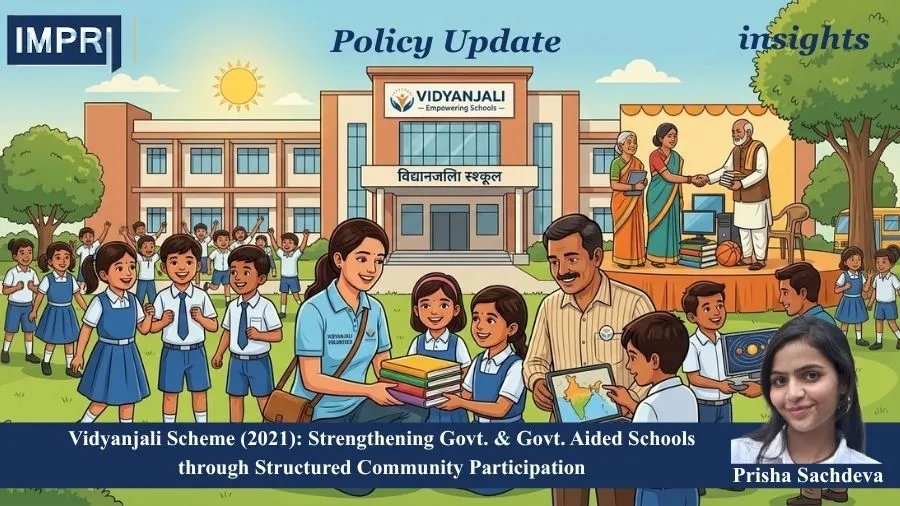
Policy Update
Prisha Sachdeva
Background
School education in India has long relied on public investment alone to meet the twin challenges of infrastructure gaps and learning-resource shortages, particularly in government schools. Recognising that community and private-sector participation could supplement rather than replace government effort, the Department of School Education & Literacy, Ministry of Education, introduced Vidyanjali, a school volunteer programme designed to connect government and government-aided schools with volunteers, resources, and institutional support.
First piloted under the erstwhile Ministry of Human Resource Development in association with the Sarva Shiksha Abhiyan, the programme was substantially revamped and relaunched in its current digital form in September 2021, in consonance with the vision of the National Education Policy (NEP) 2020. NEP 2020 explicitly calls for greater community involvement and the use of technology to catalyse interaction between students and volunteers Vidyanjali was designed as the operational mechanism to deliver on this vision.
The programme operates through a dedicated digital portal (vidyanjali.education.gov.in) and connects a wide pool of potential volunteers including members of the Indian diaspora, young professionals, retired teachers, retired government officials, NGOs, and private and public sector companies with the specific needs of individual government schools across the country. A parallel vertical, Vidyanjali Higher Education Volunteer Programme, extends the same model to colleges and technical institutions through AICTE.
Functioning
Institutional framework
Vidyanjali is implemented by the Department of School Education & Literacy, Ministry of Education, with digital infrastructure and portal management supported by MyGov. Registration of NGOs and CSR organisations is approved at the State/Union Territory level, while Central Public Sector Enterprises (CPSEs) are approved centrally creating a two-tier approval structure that balances local relevance with central oversight.
How it operates
The programme functions through two distinct verticals:
- Participation in School Service/Activity : Volunteers offer their time and skills directly to schools, acting as mentors, tutors, and communicators for students. Activities range from subject tutoring and career counselling to co-curricular engagement such as sports, art, and digital-skills training.
- Contribution of Assets/Material/Equipment : Volunteers, NGOs, or corporate donors contribute physical resources equipment, learning materials, or infrastructure upgrades directly to schools that have listed specific needs on the portal.
The process begins with government schools registering on the portal and posting a list of required services, activities, or material/equipment needs, based on their student strength, existing infrastructure, and resource gaps. Prospective volunteers then register separately as individuals or through NGOs, CSR bodies, or CPSEs and browse the portal to select schools and needs that match their capacity to contribute. Once matched, engagement is tracked through the portal, which records volunteer participation, institutional support extended, activities undertaken, assets created, and the schools benefited.
This decentralised, needs-first design where schools articulate specific requirements rather than volunteers being assigned generically is intended to ensure that community contributions are demand-driven and locally relevant, rather than a one-size-fits-all intervention.
Performance
Vidyanjali’s most recent publicly disclosed data (Ministry of Education, August 2026) shows substantial growth in registration and participation over a single year:
| Metric | Newly registered (last 1 year, as of Aug 2026) |
| Schools | 1.27 lakh+ |
| Volunteers | 32,581 |
| CSR organisations/NGOs/institutions | 1,126 |
The Ministry notes that implementation is monitored through the digital portal, which captures volunteer participation, institutional support, activities undertaken, assets created, and beneficiary schools – giving the programme a built-in, real-time tracking mechanism rather than relying solely on periodic surveys.
Documented on-ground outcomes cited by the Ministry include:
- AI and Robotics Labs established in Delhi
- Digital classrooms set up in Dholpur (Rajasthan)
- Improved digital infrastructure in Mizoram
- BaLA (Building as Learning Aid)-related wall paintings, murals, and beautification activities undertaken during Special Campaign 5.0 (2025), delivered through volunteers, School Management Committees, and local communities, contributing to more child-friendly learning environments
Sub-national variation offers a useful counterpoint to the national aggregate. In a February 2026 Parliament reply, the Minister of State for Education disclosed that in West Bengal, only 52 government schools out of more than 82,000 had been onboarded under Vidyanjali — with volunteer participation from the state (just over 2,000 registered student-volunteers) also significantly lower than other states. The Minister attributed this gap to state-level reluctance rather than a lack of demand, though this attribution has not been independently verified.
Taken together, the performance data shows a programme with strong and growing national-level registration numbers, but with highly uneven geographic uptake — a pattern that raises questions the article can return to in the Emerging Issues section about whether Vidyanjali’s outcomes depend as much on state-government cooperation as on the Central digital infrastructure itself.
Funding Structure
Unlike most government schemes, Vidyanjali does not operate through a dedicated central budget allocation. It is structured as a non-monetary contribution platform — official guidelines explicitly clarify that the scheme’s primary purpose is to facilitate voluntary services, time, and physical assets/materials/equipment, rather than direct financial or infrastructure funding from private individuals and organisations.
This distinguishes Vidyanjali from typical CSR-funding schemes: contributions are channelled as services (tutoring, mentoring, training) or in-kind assets (equipment, learning materials, infrastructure items) rather than cash grants, tracked transparently through the digital portal.
A related but distinct sub-initiative — the Vidyanjali Scholarship Programme — does involve monetary flows. Launched to support meritorious students (initially Class XI–XII students in Navodaya Vidyalayas), it channels CSR grants, national/international donor contributions, and impact-investor funding through a dedicated fintech platform, disbursing sponsorships via Direct Benefit Transfer (DBT). Separately, the Vidyanjali Higher Education vertical has also solicited philanthropic contributions — routed through the Vidyanjali Foundation, a not-for-profit subsidiary of EdCIL (a public sector company) — specifically for infrastructure construction in higher education institutions.
To summarise the core school-level Vidyanjali programme runs on volunteered time and in-kind assets with no disclosed central budget line, while its scholarship and higher-education offshoots operate on a donor/CSR-funded, DBT-based financial model — a structural distinction worth noting, since it means the core programme’s “cost” to government is largely administrative (portal maintenance, monitoring) rather than a disbursement figure that can be tracked like other schemes.
Impact
Vidyanjali’s most tangible impact lies in demonstrating that a demand-driven, portal-based matching model can mobilise meaningful community and private-sector participation in government schooling without requiring new central expenditure. The scale of recent registration (1.27 lakh schools, 32,581 volunteers, 1,126 CSR/NGO partners in a single year) suggests the platform has found genuine traction as a low-friction entry point for individuals and organisations wanting to contribute to public education.
The documented on-ground outcomes AI and Robotics Labs in Delhi, digital classrooms in Dholpur, upgraded digital infrastructure in Mizoram, and BaLA-linked school beautification during Special Campaign 5.0 show that contributions are translating into concrete, visible improvements rather than remaining symbolic registrations. The programme’s alignment with NEP 2020’s emphasis on experiential, technology-enabled learning also means these contributions are not ad hoc but are shaping schools in a direction consistent with national education policy priorities.
By needs being articulated by schools themselves (rather than volunteers being generically assigned), the model in principle targets the specific gaps each school identifies a more responsive design than blanket infrastructure schemes. The two-tier approval structure (state-level for NGOs/CSR, central for CPSEs) also allows some degree of local vetting while retaining central visibility.
If a scheme’s success depends significantly on state-level administrative cooperation and political will, its impact as a genuinely national intervention is constrained regardless of how strong the central portal infrastructure is.
Emerging Issues
- Stark geographic disparity in uptake: The West Bengal case (52 of 82,000+ schools) illustrates that Vidyanjali’s reach is highly state-dependent. Without comparable data for other states, it is unclear whether this is an isolated outlier or indicative of a broader pattern where states with weaker administrative buy-in see minimal participation regardless of national portal availability.
- No independent verification of the “political reluctance” explanation: The Minister’s attribution of West Bengal’s low numbers to state-government attitude is a contested political claim, not an audited finding. Without independent assessment (e.g., survey of school-level barriers, administrative capacity, awareness levels), the actual causes of low uptake which could equally include awareness gaps, portal usability issues, or local capacity constraints remain unclear.
- Absence of quality or depth metrics: Reported data measures registration and participation counts (schools, volunteers, CSR partners) but not the quality, consistency, or depth of engagement for instance, whether a “registered volunteer” made a single visit or is providing sustained mentoring, or whether contributed assets are effectively utilised post-donation.
- Non-monetary funding model constrains predictability: Because the core programme depends on voluntary, uncommitted contributions rather than budgeted allocation, the scale and consistency of support a given school receives is inherently unpredictable schools with lower visibility, poorer connectivity, or in remote areas may struggle to attract volunteer attention compared to schools in urban or well-networked areas.
- Overlapping verticals with different funding logics: The core Vidyanjali programme (non-monetary), the Scholarship Programme (DBT-funded via CSR/donors), and the Higher Education vertical (philanthropic infrastructure funding via EdCIL) operate under a shared brand but distinct funding and governance models. This could create confusion among potential volunteers/donors about what kind of contribution is expected or possible under “Vidyanjali.”
- Monitoring relies on self-reported portal data: Since implementation tracking is entirely through the digital portal, the accuracy of “assets created” or “activities undertaken” data depends on consistent, honest self-reporting by schools and volunteers, with no indication of independent audit or verification.
Way Forward
State-wise participation data should be published regularly and transparently, allowing comparison across states to identify genuine patterns of low uptake versus isolated cases, and to design targeted interventions (awareness campaigns, capacity support) for underperforming states rather than relying on unverified political explanations.
An independent assessment potentially through the Ministry’s own research wing or an external evaluator should investigate the actual barriers behind low-uptake states like West Bengal, covering school-level awareness, administrative capacity, and portal usability, to design evidence-based rather than assumption-based corrective measures.
Beyond registration counts, the Ministry should track and publish depth-of-engagement metrics such as volunteer retention rates, average duration of engagement, and post-contribution utility of donated assets to assess whether Vidyanjali is fostering sustained community partnerships or one-time transactional registrations.
Given the programme’s dependence on voluntary participation, targeted outreach to under-resourced or remote schools potentially through partnerships with regional NGOs, alumni networks, or diaspora associations — could help equalise access to volunteer attention across more and less “visible” schools.
Clearer public communication should distinguish the core Vidyanjali school-volunteer model from its Scholarship and Higher Education verticals, given their different funding mechanisms, to avoid confusing potential contributors about what form of support each vertical seeks.
Introducing periodic third-party audits or spot-verification of portal-reported data (assets created, activities completed) would strengthen the credibility of Vidyanjali’s self-reported performance metrics, particularly as the programme scales.
References
- Asianet Newsable. (2026, August 5). Vidyanjali initiative strengthens govt schools via community support. https://newsable.asianetnews.com/india/vidyanjali-initiative-strengthens-govt-schools-via-community-support-articleshow-0tk5o04
- ANI. (2026, August 5). Over 1.27 lakh schools, 32,581 volunteers join Vidyanjali in a year: Education Ministry. https://aninews.in/news/national/over-127-lakh-schools-32581-volunteers-join-vidyanjali-in-a-year-education-ministry20260805202306/
- Careers360. (2023, May 20). Vidyanjali Programme: Education ministry seeks donations for higher education infrastructure. https://news.careers360.com/vidyanjali-programme-education-ministry-seeks-donations-for-higher-education-infrastructure/amp
- Department of Information & Public Relations, Government of Nagaland. (n.d.). School education informs on Vidyanjali. https://ipr.nagaland.gov.in/school-education-informs-vidyanjal
- Ministry of Education. (n.d.). Vidyanjali — Volunteer. https://vidyanjali.education.gov.in/
- Ministry of Education. (n.d.). Vidyanjali (Higher Education): A scheme for support to higher educational institutions [Guidelines]. https://s3-ap-southeast-1.amazonaws.com/gtusitecirculars/uploads/7459412_VidyanjaliGuidelines_413467.pdf
- Ministry of Education. (n.d.). Vidyanjali — User manual for volunteer (v2.0). https://vidyanjali.education.gov.in/assets/pdf/Vidyanjali-User%20Manual%20for%20Volunteer-v2.0.pdf
- Ministry of Human Resource Development / MyGov. (n.d.). Vidyanjali — School Volunteer Programme. https://www.mygov.in/task/vidyanjali-school-volunteer-programme/
- News on Air. (2026, February 11). Only 52 govt schools onboarded under Vidyanjali initiative in WB, says Union Minister Jayant Chaudhary. https://www.newsonair.gov.in/only-52-govt-schools-onboarded-under-vidyanjali-initiative-in-wb-says-union-minister-jayant-chaudhary
- New Kerala. (2026, August 5). Vidyanjali: 1.27 lakh schools, 32,581 volunteers join in a year. https://www.newkerala.com/news/a/over-127-lakh-schools-32581-volunteers-join-vidyanjali-229.htm
Contributor:
Prisha Sachdeva is a Research & Editorial intern at IMPRI. She’s pursuing Bachelors in psychology (Honours) from the University of Delhi. Her interest lies in cognitive science and human behavior with a focus on evidence-based policy and behavioral research.
Acknowledgement:
The author sincerely expresses gratitude to the reviewers and the editorial team for their valuable comments, constructive suggestions, and continuous guidance throughout the preparation of this article. Their insightful feedback significantly enhanced the clarity, organisation, and analytical quality of the manuscript. The author also acknowledges the support and encouragement received during the research and writing process, which contributed to the successful completion of this work.
Reviewers: Prithwa Chawdhury and Anamika P K
Disclaimer:
All views expressed in the article belong solely to the author and not necessarily to the organisation.
Read More at IMPRI:
National Smart Grid Mission (NSGM), 2015