





Mahenoor Imam
Background
The Employees’ State Insurance Act, 1948 insured workers against sickness, maternity, disability and death, but not against losing the job itself. It assumed a worker would hold one job in one factory for a working life, so an insured person could contribute for years, lose that job, and receive nothing from a fund built partly out of their own wages.
Against this backdrop, The Atal Beemit Vyakti Kalyan Yojana(ABVKY), a welfare scheme of the Employees’ State Insurance Corporation (ESIC) that provides cash relief to insured persons during employment. The scheme was introduced to fill a gap left by an earlier ESIC scheme, the Rajiv Gandhi Shramik Kalyan Yojana (RGSKY), launched in 2005. RGSKY provides an unemployment allowance for up to 2 years, but only when an insured person loses employment involuntarily. This covers three situations: retrenchment, closure of the factory or establishment and permanent invalidity as defined under the Industrial Disputes Act, 1947, of at least 40 percent arising from a non-employment Injury. (PIB- Rajya Sabha Reply). Workers who lost their jobs for any other reasons received no unemployment support under the ESI system.
Against this backdrop, ESIC introduced ABVKY on 1 July 2018 as a pilot for 2 years. The scheme covers employees defined under Section 2(9) of the Employees’ State Insurance Act, 1948, and provides relief for up to 90 days, once in a lifetime.
The scheme was later extended up to 30 June 2021, with two significant changes made in response to the COVID-19 pandemic. First, the rate of relief was raised from 25 percent to 50 percent of the insured person’s average daily earnings. Second, the eligibility conditions were relaxed. Under the revised conditions, an insured person must have been in insurable employment for at least two years before becoming unemployed. The person must also have contributed for at least 78 days in the contribution period immediately preceding unemployment, and for at least 78 days in one of the remaining three contribution periods within those two years.
Following its initial extension, the scheme was further extended up to 30 June 2022 and subsequently for another two years. At its 194th meeting in 2024, ESIC extended the scheme up to 30 June 2026, and at its 198th Meeting, chaired by Union Labour Minister Mansukh Mandaviya, it was extended further up to 30 June 2027.
Functioning
- What the scheme provides- Relief under the scheme is paid as cash directly into the insured person’s bank account through Direct Benefit Transfer (DBT). The rate of relief is 50 per cent of average daily earnings, which are calculated by taking the insured person’s total wages over the previous four contribution periods and dividing that figure by 730. Relief is payable for up to 90 days, and can be availed only once in a lifetime.
- Eligibility- To claim relief, the person must be an insured person covered under Section 2(9) of the ESI Act, 1948. They must have been in insurable employment for twelve months before losing the job, and must have at least 78 days of contribution in one contribution period. Their Aadhaar and bank account must also be linked to the ESIC record, since payment is made directly into that account.
- Restrictions- Relief is not available where unemployment arises from misconduct of the employee, a lockout, or superannuation. It is also not available to a person who has already availed the benefit once, since it is a once in a lifetime entitlement.
- Claims Processed- Claims are filed online on the ESIC portal, with the option of submitting them at an ESIC Branch Office. Each claim is verified against the insured person’s contribution record held by ESIC, after which payment is released through DBT to the claimant’s bank account. ESIC also monitors claim settlement timelines to reduce delays in disbursal.
- Funding- The scheme is financed from the ESI Fund rather than from Union Budget allocations. The Fund is built from employer and employee contributions, currently 3.25 per cent and 0.75 per cent of wages respectively, which makes the scheme self-financed by the insured workforce and their employers. ESIC’s administrative expenditure stood at 8 per cent of total income in 2023-24, well within the 15 per cent ceiling prescribed under Rule 31A, indicating that a large share of the Fund remains available for benefits.
Performance
ESIC does not publish a public dashboard or a monthly MIS for ABVKY. Year- wise beneficiary and expenditure data are available only through parliamentary replies, because ABVKY is a demand-driven benefit paid from the ESI Fund on claims received rather than a scheme with state-wise budgetary outlays.
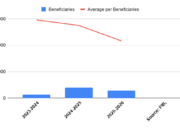
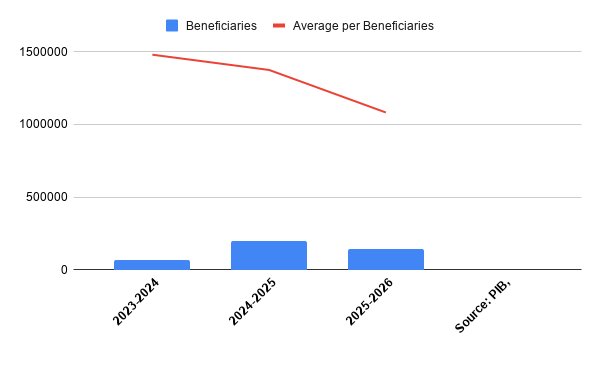
ABVKY beneficiaries and expenditure
| Year | Beneficiaries | Amount disbursed (Rs) | Average per Beneficiaries |
| 2023-2024 | 688 | 1,01,87,728 | 14,808 |
| 2024-2025 | 1978 | 2,72,08,672 | 13,756 |
| 2025-2026 | 1406 | 1,52,20,915 | 10,826 |
Source: Press Information Bureau. (2026, July 27). Atal Beemit Vyakti Kalyan Yojana, Ministry of Labour and Employment, Government of India.
Source: Press Information Bureau. (2026, July 27). Atal Beemit Vyakti Kalyan Yojana, Ministry of Labour and Employment, Government of India. Collected by the author.
Uptake rose sharply in 2024-25 and fell again in 2025-26, but the absolute numbers remain very small in every year.
A Rajya Sabha reply of 24 March 2021 records that from the scheme’s inception until 18 March 2021, a total of 43,299 beneficiaries had received relief and ₹57.18 crore had been disbursed. Over the following three years, 2023-24 to 2025-26, the scheme reached 4,072 beneficiaries and disbursed ₹5.26 crore. Uptake in a single recent year is roughly 2 to 5 per cent of the pandemic-period total. ABVKY functioned in practice as a COVID-19 relief instrument, and it has been largely dormant since, even as it continues to be extended year after year.

Source: PIB, Ministry of Labour and Employment, replies in Rajya Sabha, 24 March 2021 and Lok Sabha, 27 July 2026, 2023-24 to 2025-26 figures aggregated by the author.
ESIC covers about 3.62 crore insured persons. Against that base, 688 beneficiaries in 2023-24 works out to roughly two insured persons per lakh. ESIC’s contribution income in 2023-24 was ₹18,351.21 crore, so ABVKY spending of ₹1.02 crore is about 0.006 per cent of contribution income. The scheme costs ESIC almost nothing because almost nobody claims it.
PLFS 2025 puts the all-India unemployment rate at 3.1 per cent in usual status (ps+ss), with 4.8 per cent in urban areas and 6.4 per cent among urban women. Youth unemployment is 9.9 per cent overall and 18.9 per cent among urban young women. Unemployment among the educated, meaning those with secondary education and above, is 6.5 per cent.

Source: MoSPI, Annual Report, Periodic Labour Force Survey (PLFS) 2025, collected by the author.
Two PLFS findings matter directly for ABVKY’s design. First, 58.2 per cent of regular wage and salaried employees in the non-agricultural sector had no written job contract in 2025, and 51.7 per cent were not covered by any specified social security benefit. Second, only 23.6 per cent of all workers are regular wage or salaried employees, the group from which ESI coverage is drawn. The population ABVKY can reach is therefore a small slice of a labour force in which insecure employment is the norm.
MoSPI’s district-level report gives state unemployment rates for 29 States and UTs. The five highest are Goa (8.3 per cent), Nagaland (6.7), Arunachal Pradesh (6.6), Delhi (5.9) and Punjab (5.3). The five lowest are Gujarat (0.9 per cent), Madhya Pradesh (1.5), Chhattisgarh (2.3), Karnataka (2.3) and Maharashtra (2.4). West Bengal stands at 2.8 per cent, below the national average, with Nadia highest among its districts at 5.4 per cent and Kolkata at 1.9 per cent.

Source: MoSPI, Labour Market Snapshot of Selected Districts, PLFS 2025 (September 2026), collected by the author.
The point to draw is the mismatch. States with high unemployment are not states with high ABVKY uptake, because the industrial states where ESI coverage is concentrated, such as Gujarat, Maharashtra and Tamil Nadu, record low measured unemployment, while high-unemployment states like Goa, Nagaland and Arunachal Pradesh have limited ESI-covered employment. The scheme’s reach and the problem’s distribution do not line up.
Impact
ABVKY reached 43,299 workers and paid out ₹57.18 crore between July 2018 and March 2021, when the rules were relaxed and claims could be filed directly with ESIC. For those families the money mattered. A household that loses its only wage usually falls back on borrowing or selling what it owns, and a few months of cash prevents that.
But 43,000 workers out of roughly 3.6 crore insured persons is a small number, and since 2021 the scheme has reached only a few hundred to about two thousand workers a year. The impact sits in one crisis period rather than across the scheme’s life. ABVKY has shown that India can pay unemployment relief quickly when it chooses to. It has not yet made that relief a regular protection instead of an emergency measure.
ABVKY covers only insured persons under the ESI Act, who are drawn from regular wage and salaried workers. PLFS 2025 shows that this group is just 23.6 per cent of all workers. The scheme is designed for a small and relatively protected section of the workforce, while most unemployed workers in India fall outside it entirely.
ABVKY spending was ₹1.02 crore in 2023-24, against ESIC contribution income of ₹18,351.21 crore in the same year, or about 0.006 per cent. The scheme places almost no burden on the ESI Fund. This means the low uptake cannot be explained by a shortage of funds, and it also means ESIC has ample room to widen eligibility or strengthen outreach without any risk to the Fund.
Emerging Issues
ABVKY covers only insured persons under the ESI Act, which applies to factories and establishments employing ten or more workers. Gig workers, the self-employed, casual labour and the entire unorganised sector fall outside it. PLFS 2025 shows regular wage and salaried employees are only 23.6 per cent of all workers. The scheme thus protects a small and already better-protected section of the workforce, while the workers most exposed to sudden income loss have no cover at all.
A claimant needs twelve months of continuous insurable employment and 78 days of contributions. Workers on short contracts, fixed-term engagements or seasonal work rarely build such a record, yet they lose jobs most often. The rules have also changed repeatedly since 2018, and older sources still cite a two-year requirement while the 2026 PIB reply states twelve months. Added to this, the once-in-a-lifetime limit means a worker who claims early has no protection for the rest of their working life.
The scheme reached 688 beneficiaries in 2023-24, roughly two per lakh insured persons, against a base of 3.62 crore. No separate registration is required, so every insured person is already entitled. The barrier is not enrollment but awareness. Research in Pragati: Journal of Indian Economy finds higher uptake where unions are active and ESIC officials are proactive, which suggests workers claim only where someone tells them the benefit exists. Online filing adds a further hurdle for those with low digital literacy.
ABVKY began as a two-year pilot in 2018 and has been extended year after year, currently only to 30 June 2027. A scheme that may lapse within a year cannot sustain administrative investment, staff training or awareness campaigns, and it leaves workers unsure whether the benefit will exist when they need it. The Code on Social Security, 2020 retains ESI benefits but is not yet in force.
The CAG’s 2014 performance audit found that shortfalls in surveys and inspections weakened ESI coverage, and after the CAG flagged financial control weaknesses in 2024-25, ESIC set up a three-member committee on internal audit.
Way Forward
1. Cover more workers– Most workers who lose their jobs in India get nothing, because ABVKY reaches only those covered by ESI. The Code on Social Security, 2020 already makes room for gig and platform workers but has not been brought into force. Doing so would be the single biggest change. ESIC can also link its records to the e-Shram database and lower the ten-worker limit, so that people in small shops and units are not left out simply because their employer is small.
2. Ease the eligibility rules- A worker who moves between jobs rarely completes twelve unbroken months with one employer, yet these are the workers who lose work most often. Contributions should be counted across all employers, not just the last one. The once-in-a-lifetime rule also needs to go, since someone who claims at twenty-five should not be left without cover for the rest of their working life. A waiting period between claims would work better.
3. Tell workers the benefit exists- Every insured person is already entitled to ABVKY, and no separate registration is needed. The problem is that very few know about it. When an employer stops paying contributions for a worker, ESIC already knows that person may have lost their job, and could send them a message in their own language explaining how to claim. Branch Offices should be judged on how many eligible workers actually receive relief, not just on how fast they settle the few claims that come in. Trade unions and employers can help spread the word, since uptake is already highest where unions are active.
4. Make it permanent and publish the data- ABVKY has run on yearly extensions for eight years. No office invests in training or outreach for a scheme that may end next June, and no worker plans around one. Giving it permanent status under the ESI Act or the Code on Social Security would fix this. ESIC should also publish state-wise figures every month for claims received, settled and rejected. Rejection figures matter most, because they would show whether so few people claim due to poor awareness or because the rules keep them out.
References
- Government of India. (1948). The Employees’ State Insurance Act, 1948 (Act No. 34 of 1948). Ministry of Law and Justice, India Code.
- Government of India. (2020). The Code on Social Security, 2020 (Act No. 36 of 2020). Ministry of Labour and Employment.
- Employees’ State Insurance Corporation. (n.d.). Atal Beemit Vyakti Kalyan Yojana. Ministry of Labour and Employment, Government of India.
- Ministry of Labour and Employment. (n.d.). e-Shram portal. Government of India.
- Press Information Bureau. (2021, March 24). Atal Bimit Vyakti Kalyan Yojana [Written reply in Rajya Sabha]. Ministry of Labour and Employment, Government of India.
- Press Information Bureau. (2022). Atal Beemit Vyakti Kalyan Yojana [Parliamentary reply]. Ministry of Labour and Employment, Government of India.
- Press Information Bureau. (2022). Insurance for unemployment contingencies [Written reply in Rajya Sabha]. Ministry of Labour and Employment, Government of India.
- Press Information Bureau. (2026). Periodic Labour Force Survey (PLFS) annual report, 2025. Ministry of Statistics and Programme Implementation, Government of India.
- Press Information Bureau. (2026, July 27). Atal Beemit Vyakti Kalyan Yojana [Written reply in Lok Sabha]. Ministry of Labour and Employment, Government of India.
- Employees’ State Insurance Corporation. (n.d.). Annual accounts 2023–2024. Ministry of Labour and Employment, Government of India.
- Employees’ State Insurance Corporation. (2025). Financial estimates and performance budget 2025–2026. Ministry of Labour and Employment, Government of India.
- Ministry of Statistics and Programme Implementation. (2026). Press note on Periodic Labour Force Survey annual report, 2025 (January–December 2025). National Statistics Office, Government of India.
- Ministry of Statistics and Programme Implementation. (2026). District-level estimates of labour force indicators: Periodic Labour Force Survey 2025. National Statistics Office, Government of India.
- Satapathy, G., & Behera, A. R. (2025). The evolution of unemployment insurance across the states of India: An explorative study. PRAGATI: Journal of Indian Economy, 12(1), 118–139.
- News On AIR. (2024, October 8). Labour and Employment Minister Dr. Mansukh Mandaviya chaired the 194th ESIC meeting. All India Radio.
About the Contributor
Mahenoor is a postgraduate in Political Science from University of Calcutta, Kolkata. She is a former UPSC Civil Services Aspirant. Her interests lie in governance, social equity and welfare policy, with a focus on the gap between policy design and on-ground implementation.
Acknowledgement
The author extends sincere gratitude to Pritha Chowdhury and Prisha Sachdeva for their invaluable guidance and support and Publisher Kaustav Majumdar.
Disclaimer
All views expressed in the article belong solely to the author and not necessarily to the organization.