








Policy Update
Dolly Kaushik
Background and Evolution
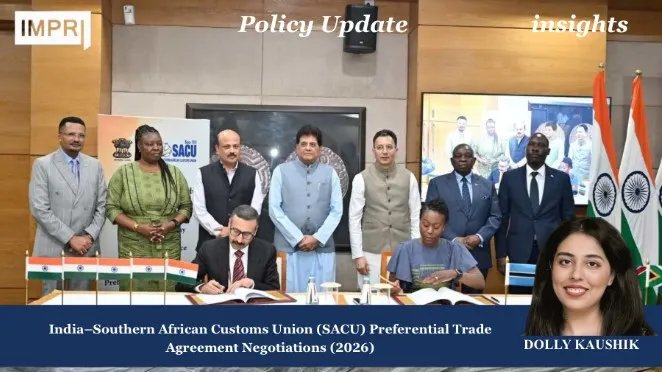
The formal trajectory toward an economic integration framework between New Delhi and Southern Africa advanced significantly with the signing of the Terms of Reference for a Preferential Trade Agreement on August 12, 2026, at Vanijya Bhawan in New Delhi (Press Information Bureau [PIB], 2026a). The foundational arrangements were advanced during official bilateral engagements, including the fourth session of the India-Namibia Joint Trade Committee held on August 10–11, 2026.
The document was formally executed by Yashvir Singh, Additional Secretary in the Department of Commerce, representing the Government of India, and Ndiitah Nghipondoka-Robiati, Executive Director of Namibia’s Ministry of International Relations and Trade and Coordinator for SACU-India Matters, acting on behalf of the Southern African Customs Union (PIB, 2026a; Southern African Customs Union [SACU] Secretariat, 2026).
This milestone represents India’s first Terms of Reference signing with an African regional economic bloc, marking a strategic evolution in South-South economic diplomacy (PIB, 2026a). Highlighting the deep-seated diplomatic and moral imperatives underpinning the arrangement, Union Commerce Secretary Rajesh Agrawal observed that India’s relationship with Southern Africa did not begin with commerce, but rather with conscience.
This institutional development builds upon prior historical engagement, following five preliminary rounds of exploratory talks conducted between 2002 and 2010 that concluded without a finalized Preferential Trade Agreement (SACU Secretariat, 2026). The partner bloc, SACU, comprises South Africa, Botswana, Namibia, Lesotho, and Eswatini, maintaining its status as the world’s oldest existing customs union established originally in 1910, with its permanent secretariat headquartered in Windhoek, Namibia (PIB, 2026a; SACU Secretariat, 2026). Within this multilateral framework, South Africa functions as the primary economic anchor, generating the vast majority of the bloc’s total economic output and serving as India’s principal commercial entry point to the region.
While contemporary trade literature frequently treats South-South regional trade agreements through a purely descriptive lens of tariff reductions, the structural realities of this corridor necessitate a deeper analytical framework. Specifically, the central research question guiding this investigation asks: To what extent can a plurilateral Preferential Trade Agreement reconcile India’s demand for critical industrial raw material security with SACU’s imperatives for higher-value industrial beneficiation, without repeating the structural asymmetries that stalled past frameworks?
By evaluating the institutional architecture, trade composition, and historical deadlocks of the India-SACU corridor, this paper contends that the success of the prospective Preferential Trade Agreement will depend less on nominal tariff concessions and more on whether both partners can effectively institutionalize cooperative supply-chain linkages in advanced manufacturing and critical minerals, thereby redefining traditional core-periphery trade dynamics.
Functioning and Institutional Architecture
The Terms of Reference (ToR) are officially defined as establishing a formal structural roadmap that outlines the fundamental boundaries, core goals, operational scope, and governing rules for the upcoming bilateral negotiations. Formal text-based negotiations are slated to commence within one month of the August 12, 2026 signing, with both negotiating teams targeting a comprehensive conclusion within a one-year window (PIB, 2026a).
The envisaged PTA is structurally mandated to cover eight core chapters: trade in goods and preferential market access thresholds; rules of origin and origin procedures; customs procedures and trade facilitation protocols; trade remedies, including a dedicated bilateral safeguard mechanism; sanitary and phytosanitary (SPS) measures; technical barriers to trade (TBT); dispute settlement mechanisms; and legal, institutional, and horizontal provisions.
From the perspective of the Southern African Customs Union, the ToR framework provides necessary institutional predictability and administrative transparency while formally acknowledging the Least Developed Country (LDC) and Small and Vulnerable Economy (SVE) statuses of smaller member states (SACU Secretariat, 2026). Ministerial evaluations emphasize that the ToR functions strictly as a preparatory framework rather than an immediate liberalization instrument, establishing the procedural foundation necessary for subsequent tariff deliberations. Official deliberations have also noted that negotiations will deliberately accommodate sensitive domestic policy considerations on both sides (Business Standard, 2026).
This structured trajectory mirrors administrative precedents established by the Ministry of Commerce and Industry in comparable regional economic frameworks, such as the procedural sequencing utilized during the India-Eurasian Economic Union (EAEU) ToR process (Ministry of Commerce and Industry [MoCI], 2025).
Trade Performance and Structural Composition
An assessment of official commercial reporting and trade data outlines a deeply complementary bilateral exchange matrix between India and the Southern African Customs Union (World Today Journal, 2026). For the financial year 2025–26, aggregate bilateral trade between India and the five-member customs bloc reached approximately $16.7 billion, with Indian merchandise exports registering at $7.5 billion and imports from the bloc standing at $9.2 billion (The Hindu, 2026; The Economic Textiles, 2026). To systematically delineate the structural composition of this bilateral exchange, Table 1 details the primary sectoral breakdown of Indian exports and imports alongside their respective financial valuations.
Table 1
Bilateral Trade Composition Between India and SACU (Financial Year 2025–26)
| Trade Direction & Sector / Commodity Category | Principal Items Included | Approximate Value (USD) | Primary Reference Source |
| Indian Exports to SACU | Petroleum Products | ~$2.1 billion | World Today Journal (2026) |
| Automobiles, Transport Equipment, & Auto Components | ~$1.7 billion | BusinessDay South Africa (2026) | |
| Pharmaceutical Formulations & Active Ingredients | ~$763 million | World Today Journal (2026) | |
| SACU Exports to India | Gold and Bullion | ~$3.0 billion | World Today Journal (2026) |
| Coal and Metallurgical Coke | ~$2.8 billion | World Today Journal (2026) | |
| Precious and Semi-Precious Stones | ~$887 million | World Today Journal (2026) | |
| Industrial Minerals and Metallic Ores | ~$638 million | World Today Journal (2026) | |
| Unrefined Copper and Base Metals | ~$376 million | World Today Journal (2026) |
The structural composition of Indian exports to the SACU region is anchored by high-value manufactured goods and technology sectors, led by petroleum products valued at approximately $2.1 billion (World Today Journal, 2026); automobiles, transport equipment, and auto components totaling $1.7 billion, representing India’s second-largest export category to the bloc (BusinessDay South Africa, 2026); and pharmaceutical formulations and active pharmaceutical ingredients reaching $763 million (World Today Journal, 2026).
Conversely, India’s import basket from the customs union is heavily weighted toward essential raw materials, precious metals, and critical minerals: gold and bullion imports valued at approximately $3 billion; coal and metallurgical coke totaling $2.8 billion; precious and semi-precious stones standing at $887 million; industrial minerals and metallic ores registering at $638 million; and unrefined copper and base metals valued at $376 million (World Today Journal, 2026).
A critical dimension of this trade flow is its heavy reliance on critical minerals, specifically platinum-group metals, manganese, and copper, which are vital inputs for India’s high-tech manufacturing and green transition frameworks (World Today Journal, 2026). Examining sub-regional metrics, bilateral trade specifically between India and South Africa, the dominant economic anchor of the bloc, adjusted to $15.56 billion in 2025–26, contracting by 13.55 percent from preceding fiscal periods (Daily Excelsior, 2026). This contraction underscores both cyclical fluctuations in global commodity pricing and the strategic necessity of a formal Preferential Trade Agreement to re-energize bilateral commercial volumes (Daily Excelsior, 2026; BusinessDay South Africa, 2026).
Emerging Analytical Issues and Structural Challenges
The negotiation of the India–SACU PTA brings to light analytical considerations, historical complexities, and structural asymmetries that will shape future negotiations. A central factor is the candid acknowledgment regarding negotiating boundaries, wherein Indian trade leadership noted that the framework would deliberately avoid pursuing concessions on issues deemed sensitive by SACU while seeking reciprocal consideration for domestic Indian economic interests (Business Standard, 2026). This mutual recognition underscores the balancing act required to harmonize export-driven manufacturing ambitions with partner protections.
A primary analytical gap concerns the historical hiatus between 2002 and 2010, during which India and SACU engaged in five preliminary rounds of exploratory talks that ultimately stalled without yielding a finalized agreement (SACU Secretariat, 2026; BusinessDay South Africa, 2026). Public domain archives and official documents lack explicit empirical detail regarding the exact factors that caused those earlier negotiations to collapse, leaving a genuine research gap in bilateral trade studies that current sources do not resolve.
Compounding these historical hurdles is a classic core-periphery trade asymmetry. India predominantly exports high-value manufactured and processed commodities such as refined petroleum products, automotive components, and pharmaceutical formulations while importing raw materials, precious metals, and vital industrial inputs, including gold, coal, and critical minerals (World Today Journal, 2026). This structural imbalance mirrors long-standing critiques leveled against prior regional frameworks, such as the ASEAN-India Trade in Goods Agreement. The comparability between AITIGA and the India–SACU negotiations lies in their shared systemic architecture: both frameworks pair an expanding industrial exporter with a resource-abundant developing bloc, creating acute structural risks where partner economies remain confined to raw-material supplier roles while finished-product export gains predominantly favor Indian industrial manufacturing sectors.
Furthermore, internal governance within the bloc introduces complex institutional dynamics. South Africa acts as the dominant economic anchor, generating the vast majority of SACU’s aggregate output and industrial production, whereas smaller member states Botswana, Namibia, Lesotho, and Eswatini rely heavily on the common revenue pool for fiscal stability (Press Information Bureau [PIB], 2026a). Consequently, the negotiating priorities of these smaller economies are sharply shaped by their respective Least Developed Country and Small and Vulnerable Economy characteristics.
For instance, nations like Lesotho and Eswatini prioritize safeguarding sensitive agricultural sectors and securing employment-intensive industrial concessions, whereas resource-rich economies like Botswana and Namibia focus on leveraging critical mineral exports for domestic value addition and industrial beneficiation rather than raw extraction alone. Navigating these divergent national interests alongside South Africa’s advanced industrial capacity represents a central governance hurdle for the preferential trade framework (Southern African Customs Union [SACU] Secretariat, 2026).
Way Forward and Policy Conclusion
The formal execution of the Terms of Reference establishes a definitive institutional roadmap for bilateral engagement, with formal text-based negotiations scheduled to commence in mid-September 2026 (Press Information Bureau [PIB], 2026a). The official target to conclude a comprehensive Preferential Trade Agreement within a twelve-month window represents an ambitious strategic timeline, particularly when benchmarked against the protracted precedent of the 2002–2010 exploratory talks (Southern African Customs Union [SACU] Secretariat, 2026). To prevent past administrative logjams from recurring and to ensure equitable economic gains, future policy monitoring and academic research must systematically track specific quantitative and qualitative indicators as negotiations progress.
First, analysts must evaluate the agreed tariff coverage and exclusion lists, monitoring whether sensitive agricultural and domestic manufacturing sectors are adequately protected without diluting the commercial ambition of the framework (Press Information Bureau [PIB], 2026a). Second, close scrutiny must be applied to the architecture of the rules of origin (RoO) and associated operational procedures to verify that value-addition thresholds are realistic for smaller member states and do not inadvertently create restrictive compliance barriers.
Third, tracking bilateral trade volumes and structural diversification will be essential to measure whether India’s import basket successfully expands beyond traditional raw-material extraction into higher-value processing. Fourth, policy watchdogs must monitor the formal inclusion and active participation of smaller SACU economies like Botswana, Namibia, Lesotho, and Eswatini ensuring that their Least Developed Country and Small and Vulnerable Economy interests are safeguarded against the dominant industrial weight of South Africa (SACU Secretariat, 2026).
Finally, sustained attention must be directed toward the critical-minerals dimension, linking the agreement directly to India’s broader supply-chain specialization in green transition technologies and advanced manufacturing inputs (PIB, 2026b). Ultimately, if managed with acute administrative realism and robust metric tracking, the India–SACU framework can establish a progressive baseline for South-South economic integration (The Business Standard [Bangladesh], 2026).
References
Business Standard. (2026). India signs terms for SACU trade deal; negotiations are to begin in a month. https://www.business-standard.com/economy/news/india-signs-terms-for-sacu-trade-deal-negotiations-to-begin-in-a-month-126081201995_1.html
BusinessDay South Africa. (2026). India and SACU revive talks on preferential trade agreement. https://www.businessday.co.za/world/2026-08-12-india-and-sacu-revive-talks-on-preferential-trade-agreement/
Daily Excelsior. (2026, August 12). India, South Africa-led SACU group to ink terms of reference on Aug 12 for negotiating trade pact. https://www.dailyexcelsior.com/india-south-africa-led-sacu-group-to-ink-terms-of-reference-on-aug-12-for-negotiating-trade-pact/
Ministry of Commerce and Industry [MoCI], Government of India. (2025). India-Eurasian Economic Union ToR press release [Official documentation]. Department of Commerce. https://www.commerce.gov.in/files/d-m-y/PIB2158480.pdf
Press Information Bureau [PIB], Government of India. (2026a, August 12). India and the Southern African Customs Union (SACU) sign Terms of Reference (ToR) for negotiations towards a Preferential Trade Agreement [Ministry of Commerce and Industry]. https://www.pib.gov.in/PressReleasePage.aspx?PRID=2298681
Press Information Bureau [PIB], Government of India. (2026b, August 11). Fourth session of the India-Namibia Joint Trade Committee held in New Delhi [Ministry of Commerce and Industry]. https://www.pib.gov.in/PressReleasePage.aspx?PRID=2297913
Southern African Customs Union [SACU] Secretariat. (2026, August 12). SACU and India sign Terms of Reference to guide negotiations towards a mutually beneficial Preferential Trade Agreement [Official communique]. https://www.sacu.int/
The Business Standard [Bangladesh]. (2026, September 9). India signs trade talks framework with Southern African Customs Union. https://www.tbsnews.net/world/india-signs-trade-talks-framework-southern-african-customs-union-1513961
The Economic Times. (2026, August 12). India sets sail to add more trade muscle as it signs PTA terms with South Africa, Namibia, Botswana, Eswatini, Lesotho. https://m.economictimes.com/news/economy/foreign-trade/india-sacu-sign-terms-of-reference-to-launch-trade-talks-south-africa-namibia-botswana-eswatini-lesotho/articleshow/133185222.cms
The Hindu. (2026, August 12). India, Southern African customs bloc revive trade pact talks. https://www.thehindu.com/business/india-southern-african-customs-bloc-revive-trade-pact-talks/article71338194.ece
World Today Journal. (2026). India and SACU sign Terms of Reference for Preferential Trade Agreement. https://world-today-journal.com/india-and-sacu-sign-terms-of-reference-for-preferential-trade-agreement/
About the Contributor
Dolly Kaushik is a postgraduate student of Public Administration with an interdisciplinary academic foundation in Life Science. Her work explores the geopolitical dimensions of emerging technologies, global governance, and international affairs. She is currently a research intern at IMPRI, New Delhi.
Acknowledgement
The author extends her sincere gratitude to the reviewers Ayaan Bordoloi, Himanshi Singh and the IMPRI team for their valuable guidance throughout the process. I also extend my sincere thanks for their valuable feedback.
Disclaimer
All views expressed in the article belong solely to the author and do not necessarily represent the views or policies of the organisation.
Read more at IMPRI:
Revamped Distribution Sector Scheme (RDSS) Funding Push (2026)