





Policy Update
Karnavi Shende
BACKGROUND
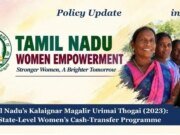
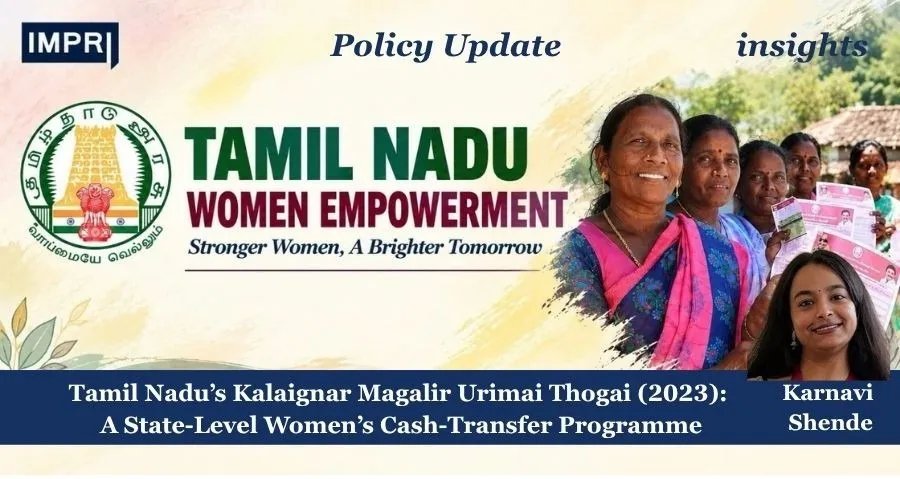
Tamil Nadu has a long tradition of universal welfare measures, from subsidised food and health care to free electricity and education support. Kalaignar Magalir Urimai Thogai Thittam extends this legacy by placing a regular cash income directly in women’s hands. Announced as part of the DMK’s “seven guarantees” (Business Standard, 2024) before the 2021 Assembly elections and formally launched on 15 September 2023 (the birth anniversary of former Chief Minister C.N. Annadurai), the scheme promises ₹1,000 per month to eligible women heads of households (Government of Tamil Nadu Official portal. https://kmut.tn.gov.in/; The Hindu, 2023).
The scheme is anchored in marking a shift towards direct income support for women. By routing assistance through women’s bank accounts, KMUT seeks to enhance their visibility in the formal financial system, enhance their economic self-reliance and improve their bargaining power and decision-making role within households (State Planning Commission, Impact Assessment Report 2025, Kalaignar Magalir Urimai Thogai Thittam, Government of Tamil Nadu). Its design, eligibility rules and fiscal scale have made it one of the most discussed and politically significant social-protection initiatives in Tamil Nadu in recent years.
Because of its design, eligibility rules and fiscal scale, KMUT has quickly become one of Tamil Nadu’s most visible social-protection programmes. Within two years of launch, more than 1.3 crore women were receiving benefits, with cumulative disbursements exceeding ₹30,000 crore by late 2025 (The Hindu, 2025). Its design reflects a broader policy shift from narrowly targeted pensions towards large-scale, women-centric income support, while also raising questions about long-term fiscal sustainability and implementation capacity.
FUNCTIONING
Institutional design and eligibility
Kalaignar Magalir Urimai Thogai Thittamm is aimed at women aged 21 years and above who are permanent residents of Tamil Nadu and head eligible families. The beneficiary is defined as the woman whose name appears as the head of the family on the household’s ration card, or the female spouse of a male head (treated as the family head for this scheme). Unmarried women, widows and transgender persons who head their own households are also covered (Kalaignar Magalir Urimai Thogai Thittam, Government of Tamil Nadu; The Hindu, 2023).
Eligibility is primarily determined through a combination of residency, income and asset-based conditions. The family must satisfy all of the following to qualify:
- Annual family income below ₹2.5 lakh.
- Agricultural landholding below 5 acres of wetland or 10 acres of dryland.
- Annual household electricity consumption below 3,600 units.
- No ownership of a four-wheeled motor vehicle (with some exemptions for livelihood vehicles).
- No family member should be an income-tax payer.
- The woman applicant or her spouse should not be a current government employee (including central government, PSUs, banks, etc.).
- The family should not be receiving more than ₹1,000 per month from other government pension or welfare schemes (Kalaignar Magalir Urimai Thogai Thittam, Government of Tamil Nadu; The Hindu, 2023).
These exclusion criteria are intended to focus support on vulnerable households while avoiding overlap with other substantial welfare benefits. The scheme is implemented through the Department of Social Welfare and Women Empowerment, with technical support from Tamil Nadu’s digital governance infrastructure, including Aadhaar authentication, DBT platforms and the state’s beneficiary management systems. Operational guidelines have been issued to guide district administrations, block-level officers and front-line workers in registration, verification and grievance redressal (Department of Social Welfare and Women Empowerment, Government of Tamil Nadu; The Hindu, 2023).
Application and payment
The application process for KMUT is designed to be simple and largely paperless. Eligible women do not need to submit a separate application in most cases; the government uses the database of family ration cards to identify potential beneficiaries who meet the income, land and electricity criteria. Women whose names do not appear or whose details are incorrect can apply for correction or inclusion through local revenue offices, ration-card centres and designated camps (Kalaignar Magalir Urimai Thogai Thittam, Government of Tamil Nadu).
Once verified, the monthly assistance of ₹1,000 is credited directly to the woman’s Aadhaar-linked, DBT-enabled bank account. Payments are generally disbursed monthly with the state announcing specific credit dates through press releases and media briefings. The DMK government under Chief Minister M.K. Stalin credited a ₹5,000 one-time lump-sum payment to all KMUT beneficiaries in February 2026, approximately two months before the state assembly elections. This pre-poll disbursement, announced as additional support to reinforce the government’s commitment to women’s welfare, was widely interpreted as an electoral gesture aimed at consolidating the party’s women voter base (The News Minute, 2026).
A critical operational requirement is the consistency of information across Aadhaar, bank records and the KMUT database. Name mismatches, inactive or dormant accounts, incomplete Aadhaar–bank seeding and changes in bank branch or account number can lead to payment failures or delays. The scheme’s portal and helpdesk provide facilities to check payment status and report issues, while grievances can be lodged through local welfare offices and helplines (Kalaignar Magalir Urimai Thogai Thittam, Government of Tamil Nadu).
PERFORMANCE
Coverage and payment scale
KMUT was rolled out in phases, with the first instalment of ₹1,000 credited to about 1.13 crore women on 15 September 2023 (The Hindu, 2023). Subsequent months saw the addition of more beneficiaries as verification and correction processes were completed. By 2025, the scheme covered approximately 1.16 crore women, with cumulative disbursements exceeding ₹30,000 crore since launch (DT Next, 2025).
In December 2025, the government announced a second-phase expansion, adding about 17 lakh new beneficiaries and taking the total to around 1.31 crore women (DT Next, 2025). In February 2026, a one-time advance of ₹5,000 was credited to all 1.31 crore beneficiaries, amounting to over ₹6,550 crore in a single disbursement (The News Minute, 2026). These figures indicate that KMUT has established a large and stable beneficiary base, with each major disbursement functioning as a significant fiscal and administrative event.
The design of ₹1,000 per month, rather than a one-time grant, signals an attempt to provide continuous income support rather than temporary relief. By crediting money directly into women’s accounts on a regular basis, the scheme aims to smooth household consumption and strengthen women’s financial identity over time. However, a cash transfer alone cannot create employment, improve skills or guarantee nutritional security, but it can act as a stabilising income floor that may enable women to invest in health, education or small economic activities when combined with other programmes.
Fiscal performance
Kalaignar Magalir Urimai Thogai Thittam represents a major commitment in Tamil Nadu’s social-sector budget. In 2024–25, the state allocated around ₹13,720 crore for the scheme, reflecting its first full year of implementation (Finance Department, Government of Tamil Nadu, 2024). In 2025–26, the allocation was revised to ₹13,807 crore (Finance Department, Government of Tamil Nadu, 2025; PRS Legislative Research, 2025), and in 2026–27, it records an allocation of ₹14,414 crore towards Magalir Urimai Thogai (Government of Tamil Nadu; PRS Legislative Research, 2026).
The size of the allocation raises important policy questions. Cash transfers can provide immediate relief and strengthen women’s bargaining power within households, but their sustainability must be weighed against spending on health, education, nutrition, rural infrastructure and livelihoods. The relevant comparison is not between welfare and no welfare, but between different ways of improving women’s long-term economic security and human development outcomes.
Figure 1: KMUT Budget Allocation Trend, 2024–25 to 2026–27 (₹ crore)
Source: compiled by the author from budget documents of Government of Tamil Nadu, 2026-2027
Administrative Performance
KMUT has demonstrated considerable administrative capacity by enrolling and paying over one crore women within a relatively short period. The rapid scale-up reflects coordination between the Department of Social Welfare and Women Empowerment, district administrations, banks, CSC operators and technology partners. The use of ration-card databases, Aadhaar-linked bank accounts and regular DBT has enabled the state to move towards a largely digital, traceable system. For many women, especially in rural and remote areas, this has meant regular, predictable cash support without repeated visits to government offices.
However, implementation has not been entirely smooth. Media reports and public complaints have highlighted issues such as delays in verification due to bank-account and Aadhaar-related errors (DT Next, 2025; The News Minute, 2025).
Overall, while KMUT’s administrative performance has been impressive in terms of scale and speed, the experience of individual beneficiaries points to the need for more transparent rejection reasons, better assisted support for corrections and clearer communication about eligibility and payment status.
IMPACT
The immediate effect of KMUT is to provide a predictable source of cash to women who may have limited independent income. The monthly transfer of ₹1,000 may help with food, medicines, transport, school expenses and small household purchases. For many women, especially those dependent on irregular wage labour or informal work, this may reduce dependence on family members or moneylenders for routine expenditure.
The gender dimension of the scheme is significant. Money is deposited in women’s accounts rather than being transferred to the household without a designated female recipient. This may improve women’s visibility in the formal financial system and strengthen their role in household decisions. However, account ownership does not automatically mean control. In some households, male relatives may retain the ATM card, passbook or phone used for banking, potentially limiting the woman’s actual access to the funds.
The scheme also supports financial inclusion. Women who previously had limited interaction with banks may begin using accounts, checking balances and resolving DBT-related problems. Yet this outcome depends on access to banking correspondents, functional mobile connectivity and local assistance, especially in tribal and remote districts.
The explicit inclusion of unmarried women, widows and transgender persons who head their own households distinguishes KMUT from many other large state-level women’s cash-transfer schemes in India, which typically centre eligibility on married women or mothers. By recognising diverse household structures, KMUT extends income support to some of the most economically vulnerable adults who are often invisible in welfare databases. This broadened eligibility improves both the equity and the gender sensitivity of the scheme, even if implementation gaps still limit its full potential.
EMERGING ISSUES
Exclusion and verification
Income, land and electricity criteria are intended to direct support towards economically vulnerable households. They can also exclude women whose family information is outdated or whose income is difficult to document because they work in the informal economy. Women married into families where land records are not updated or where electricity connections are in a relative’s name may find themselves excluded despite economic hardship.
Payment failures
A woman can be eligible and registered but still not receive an instalment. These errors are particularly serious for women who depend on the payment for regular household needs and who may lack the resources or confidence to navigate correction processes.
Fiscal sustainability
The scheme’s large and recurring allocation demonstrates political commitment but also creates a significant fiscal liability. In the 2026–27 budget, Tamil Nadu has allocated ₹14,414 crore to Kalaignar Magalir Urimai Thogai, alongside ₹52,920 crore for education, ₹39,609 crore for rural development and ₹23,357 crore for health. KMUT’s allocation alone is now almost 60% of the health budget and accounts for a substantial share of the state’s social-sector spending.
The current benefit level is ₹1,000 per month (₹12,000 per year) and a beneficiary base is around 1.31 crore women. Any future expansion in coverage or increase in the monthly amount may widen this gap further. In a context where the state must also fund capital-intensive priorities such as schools, hospitals, rural infrastructure and livelihood programmes, a growing commitment to recurring cash transfers reduces fiscal space for long-term investments. Without strong revenue growth or reprioritisation of expenditures, sustaining KMUT at this scale could intensify budgetary pressure and limit the government’s ability to respond to emerging economic or social shocks.
Figure 2: KMUT Allocation vs Other Key Social Sectors (2026–27)

Source: compiled by the author from budget documents of Government of Tamil Nadu, 2026-2027
WAY FORWARD
- Ration-Card and Household-Head Updatement Drives
Since KMUT eligibility hinges on the woman being recorded as head of family on the ration card, the state should run time-bound, door-to-door campaigns to update ration cards for widows, unmarried women, transgender persons and women in male-migrant households. Linking this to the existing PDS update cycle can ensure that women who head de facto households are not excluded due to outdated cards. - Electricity and Land-Record Data Reconciliation
Many rejections stem from mismatches between electricity consumer numbers, land records and ration-card data. The Revenue, Electricity and Social Welfare departments should jointly clean and synchronise these databases, allowing women to correct discrepancies (e.g., electricity connection in a relative’s name, fragmented land titles) through a single-window application at e-Sevai centres instead of running between multiple offices. - Special Provisions for Transgender and Women-Headed Households
Building on the scheme’s progressive inclusion of transgender persons and women heading non-conventional households, the government should issue clear operational guidelines for cases where gender markers, family composition or household structure do not fit standard ration-card templates. Frontline staff at e-Sevai and welfare offices should be trained to handle such cases without forcing applicants into incorrect categories. - Integration with Existing Women’s Economic Programmes
Rather than treating KMUT as a standalone cash transfer, Tamil Nadu should explicitly link it with schemes like Pudhumai Penn (education support), Uzhavan (farmer support), Self-Help Group (SHG) missions and Tamil Nadu Urban Livelihood Missions (TNULM). For example, KMUT beneficiaries could be prioritised for skill courses, market-linkage programmes or micro-credit top-ups, so that the monthly ₹1,000 acts as a stable base for broader economic mobility. - Independent Impact Evaluation
An independent study should examine how KMUT affects household spending, women’s control over money, debt, savings, work and access to services. The state should also publish annual data on expenditure and beneficiaries in a form that clearly shows how much was allocated versus how much was actually transferred.
REFERENCES
Business Standard. (2024, February 19). TN govt presents Budget 2024–25 with focus on ‘7 grand Tamil dream’. Business Standard. https://www.business-standard.com/budget/news/tn-govt-presents-budget-2024-25-with-focus-7-grand-tamil-dream-124021900211_1.html
DT Next. (2025, December 12). Beneficiary numbers of KMUT scheme rise to 1.31 crore. DT Next. https://www.dtnext.in/news/tamilnadu/beneficiary-numbers-of-kmut-scheme-rise-to-131-crore-856393
Finance Department, Government of Tamil Nadu. (2024). Budget 2024–2025. https://financedept.tn.gov.in/en/my-documents/2020/07/BUDGET-2024-2025_English.pdf
Finance Department, Government of Tamil Nadu. (n.d.). Budget 2026–27. https://financedept.tn.gov.in/budget/
Government of Tamil Nadu. (n.d.). Finance handbook. https://www.tn.gov.in/rti/proactive/finance/handbook_e_finance.pdf
Government of Tamil Nadu, Department of Social Welfare and Women Empowerment. (n.d.). Home. https://www.tnsocialwelfare.tn.gov.in/en
India Today. (2025, December 13). Tamil Nadu MK Stalin rolls out second phase of direct cash assistance scheme for women. India Today. https://www.indiatoday.in/india/tamil-nadu/story/tamil-nadu-mk-stalin-rolls-out-second-phase-direct-cash-assistance-scheme-women-heads-2835507-2025-12-13
Government of Tamil Nadu, Kalaignar Magalir Urimai Thogai. (n.d.-a). Home [Official portal]. https://kmut.tn.gov.in/
Government of Tamil Nadu, Kalaignar Magalir Urimai Thogai. (n.d.-b). Home. https://kmut.tnega.org/
PRS Legislative Research. (2025). Tamil Nadu Budget Analysis 2025–26. https://prsindia.org/files/budget/budget_state/tamil-nadu/2025/TN_Budget_Analysis_2025-26.pdf
PRS Legislative Research. (2026). Tamil Nadu Budget Analysis 2026–27. https://prsindia.org/budgets/states/tamil-nadu-budget-analysis-2026-27
State Planning Commission, Government of Tamil Nadu. (2026). Kalaignar Magalir Urimai Thogai: Scheme overview and implementation status. https://spc.tn.gov.in/wp-content/uploads/KMUT_Final.pdf
Tamil Nadu e-Governance Agency. (n.d.). e-Sevai. https://tnega.tn.gov.in/projects/e-sevai
The Hindu. (2023, July 8). Tamil Nadu issues operational guidelines for ‘Kalaignar Magalir Urimai Thogai’ scheme. The Hindu. https://www.thehindu.com/news/national/tamil-nadu/tamil-nadu-issues-operational-guidelines-for-kalaignar-magalir-urimai-thogai-scheme/article67054419.ece
The Hindu. (2023, September 15). Tamil Nadu CM Stalin launches Kalaignar Magalir Urimai Thittam in Kancheepuram. The Hindu. https://www.thehindu.com/news/national/tamil-nadu/tamil-nadu-cm-stalin-launches-kalaignar-magalir-urimai-thittam-in-kancheepuram/article67310529.ece
The Hindu. (2025, October 17). New eligible women beneficiaries to start receiving monthly entitlement from December 15 under KMUT: Udhayanidhi Stalin. The Hindu. https://www.thehindu.com/news/national/tamil-nadu/new-eligible-women-beneficiaries-to-start-receiving-monthly-entitlement-from-december-15-under-kmut-udhayanidhi-stalin/article70170834.ece
The News Minute. (2026, February 13). Why TN CM Stalin decided to release Rs 5,000 each to 1.3 crore women in one go. The News Minute. https://www.thenewsminute.com/tamil-nadu/why-tn-cm-stalin-decided-to-release-rs-5000-each-to-13-crore-women-in-one-go
The Wire. (2026, March 12). Why Tamil Nadu govt’s direct transfer scheme strengthens women’s economic identity. The Wire. https://m.thewire.in/article/gender/why-tamil-nadu-govts-direct-transfer-scheme-strengthens-womens-economic-identity
ABOUT THE CONTRIBUTOR
Karnavi Shende is a Research and Editorial Intern at IMPRI. She holds a Master’s in Politics, specializing in International Relations, from Jawaharlal Nehru University, New Delhi. Her interests include International Relations, Strategic Studies, Public Policy, Gender, and Human Rights, with a focus on policy research and contemporary governance challenges.
ACKNOWLEDGEMENTS
The author extends sincere gratitude to the reviewers (Anamika P K and Shailja Singh) and the IMPRI team for their expert guidance and constructive feedback throughout the process.
REVIEWED BY
Anamika P K and Shailja Singh
DISCLAIMER
All views expressed in the article belong to the author and not necessarily to the organization.
Read more at IMPRI:
Indian Resource Panel (InRP), 2015: From Resource Consumption to Resource Productivity.
21 September – International Day of Peace: Rethinking Peace in a Fractured World