







Prabhat Sharma
How India’s geography is creating a convergence of drugs, organised crime, illicit finance and internal-security vulnerabilities
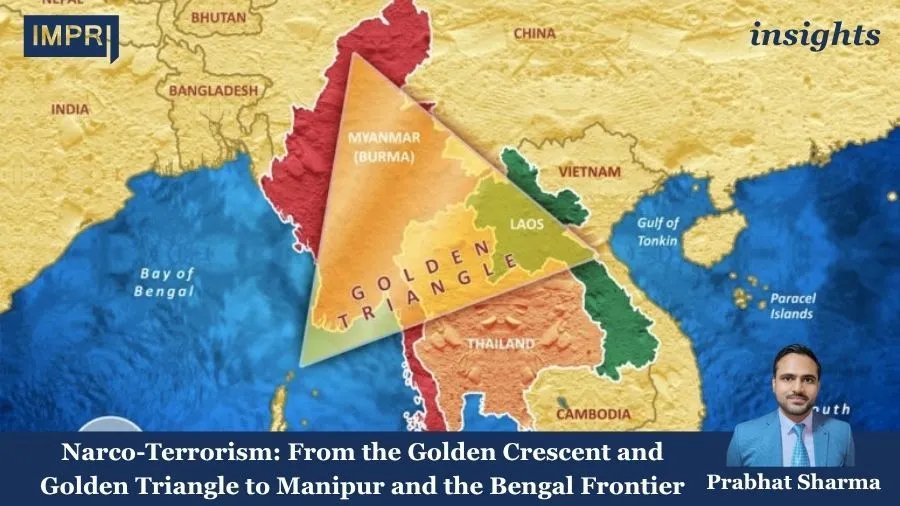
India’s narcotics challenge is undergoing a structural transformation. Situated between the Golden Crescent in the west and the Golden Triangle in the east, India is exposed to two major international narcotics corridors. What makes the present situation particularly dangerous is the convergence of drug trafficking with organised crime, illegal arms, money laundering, insurgency, cyber-enabled trafficking and, in some cases, terrorist financing. The eastern theatre deserves particular attention because the instability in Myanmar, the India-Myanmar border, Manipur, the Northeast, North Bengal and the Siliguri Corridor are increasingly interconnected within the wider security environment.
The Golden Crescent and Golden Triangle
The Golden Crescent, broadly covering Afghanistan, Pakistan and Iran, has historically been associated with opium and heroin trafficking. The Golden Triangle, centred on Myanmar, Laos and Thailand, has traditionally been another major narcotics-producing region and has increasingly become associated with synthetic drugs, particularly methamphetamine.
The threat is evolving rapidly. The UNODC’s latest global assessment says methamphetamine dominates the rapidly expanding amphetamine-type stimulant market, while Myanmar has become the world’s largest opium producer, with production concentrated particularly in Shan and Kachin areas.
The International Narcotics Control Board’s 2025 report identifies South Asia as the world’s largest consumer market for opioids, estimating 20.7 million opioid users in 2023. It also identifies increasing methamphetamine trafficking and specifically notes India’s growing importance as a destination for methamphetamine trafficked from Myanmar.
This makes India’s location both an advantage and a vulnerability: the country sits at the intersection of major international trade routes, but some of the same geography can be exploited by transnational criminal networks.
Manipur: The Eastern Gateway
Manipur occupies a particularly sensitive position in this equation because of its proximity to Myanmar and the Golden Triangle.
Recent academic research has described Manipur as both a transit and destination area for heroin and synthetic drugs, while highlighting the relationship between the narcotics economy, organised crime, arms trafficking and insurgency. A 2024 study using Manipur government data from 2007–2023 examined the volume and economic value of drug trafficking in the state.
The Indian Council of World Affairs similarly concluded in 2025 that trafficking across the IndiaMyanmar border had become a national-security concern, with Myanmar’s post-2021 political instability and the activities of armed organisations adding to the vulnerability.
At the same time, Manipur’s wider crisis cannot be reduced to narcotics. The conflict has deep ethnic, political, historical and territorial dimensions. Drug trafficking should therefore be viewed as one component of a much larger security environment.
Recent research published by the United Service Institution of India in 2026 describes the Moreh-linked routes and other outbound routes as evidence of increasingly sophisticated trafficking involving narcotics, arms and technology-enabled evasion.
The important security question is therefore not simply how many drugs are seized?
It is: Who controls the supply chain, who finances it, where are the proceeds going, and whether those proceeds support other forms of organised violence?
Poppy Cultivation: An Important Qualification
The Manipur story also demonstrates why data must be handled carefully.
The Indian Express reported in July 2024, citing the Manipur Remote Sensing Applications Centre, that estimated poppy cultivation in the state’s hill districts had fallen from 16,632 acres in 2022–23 to 11,288 acres in 2023–24, a decline of 32.13 percent. The same report noted substantial destruction of poppy cultivation under the state’s anti-drug campaign.
This is significant.
The threat should therefore not be presented as a simple story of continuously increasing domestic cultivation. Rather, cross-border supply, synthetic drugs, changing trafficking routes and the ability of networks to adapt are equally important.
From Manipur to North Bengal
One of the most important developments is the extension of trafficking networks beyond the immediate Northeast.
A February 2025 Indian Express investigation reported that Delhi Police had dismantled a Manipur-based heroin network whose alleged route ran from the Myanmar border through Manipur, Nagaland and Assam to Siliguri, and subsequently toward West Bengal, Uttar Pradesh and Delhi-NCR.
This provides a powerful illustration of the wider geography:
Myanmar → Manipur → Nagaland/Assam → Siliguri → West Bengal → North India
This does not mean that all narcotics use this corridor. It demonstrates, however, why the security of the Northeast cannot be separated from mainland India’s drug markets.
The Siliguri Corridor: Strategic Chokepoint
The Siliguri Corridor, popularly known as the “Chicken’s Neck”, is the narrow land connection between mainland India and the Northeast.
The Indian Express reported in January 2025 that the corridor is approximately 20 km wide and 60 km long, situated between Nepal and Bhutan to the north and Bangladesh to the south. The article highlighted concerns involving human trafficking, drug trafficking, counterfeit currency and other transnational security challenges. It also reported that the SSB had arrested around 4,000 smugglers and traffickers and seized 16,000 kg of narcotics around the area in 2024, according to the Home Minister.
This makes North Bengal strategically important for two reasons.
First, it is the physical gateway to the Northeast.
Second, it is positioned near three international borders—Bangladesh, Nepal and Bhutan.
Research examining crime patterns in Siliguri during 2021–2023 has also identified the city’s unique geographical position as a factor in transnational illicit activity.
The corridor therefore needs to be understood not merely as a military vulnerability but as a multi-dimensional economic, logistical and internal-security chokepoint.
Narco-Terrorism: When Drug Money Becomes Security Money
The most dangerous transformation occurs when the narcotics economy intersects with armed organisations, terrorism or insurgency.
The chain can be represented as:
Drug production → trafficking → illicit profits → money laundering → weapons/logistics → organised crime/terror networks
The United Nations reported in 2024 that the International Narcotics Control Board had warned of the use of the illegal drug trade to fund terrorism in South Asia. It also identified India as an important market for opiates and highlighted trafficking and illicit opium cultivation in the Northeast.
The challenge is consequently broader than narcotics enforcement.
It is a financial-security problem.
It is an arms-trafficking problem.
It is an organised-crime problem.
And where terrorist or insurgent financing is demonstrated, it becomes a counter-terrorism problem.
The Economic and Youth Threat
The economic cost of narcotics cannot be measured only by the value of seized drugs.
Drug addiction can reduce productivity, educational attainment and employability. Healthcare and rehabilitation impose additional costs on families and governments. Drug profits can also enter legitimate businesses and property markets through money laundering.
For India, the greatest strategic concern may be its youth and human capital.
A 2025 peer-reviewed assessment of India’s drug-control challenges identified rising opioid and stimulant use, inadequate surveillance, gaps in prevention and treatment, and difficulties in social reintegration.
The threat is also becoming technologically sophisticated.
The Parliamentary research organisation PRS notes that Indian enforcement agencies are dealing with cross-border trafficking, dark-web activity, cryptocurrency and courier/logistics networks.
Thus, the modern trafficking model can look like:
Online contact → encrypted communication → digital payment → courier/logistics → local distribution
India’s counter-narcotics strategy therefore has to move beyond conventional border seizures.
What the Last Five Years of Research Tell Us
The emerging research and official record from approximately 2021–2026 reveal five important trends.
1. Myanmar’s instability matters directly to India.
Research from ICWA, MP-IDSA and ORF links the post-2021 Myanmar security environment with increasing cross-border narcotics risks.
2. Synthetic drugs are becoming increasingly important.
Methamphetamine and other ATS are expanding the threat beyond traditional heroin and opium.
3. Trafficking networks are geographically flexible.
The Manipur-to-Siliguri-to-mainland route demonstrates how criminal networks can adapt to conflict, enforcement and changing border conditions.
4. The financial dimension is critical.
Drug trafficking generates proceeds that can support organised crime, corruption and, where established by investigation, militant or terrorist activity.
5. Public health and national security are inseparable.
The growing drug market threatens not only the border but India’s human capital and social stability.
The Evidence Dashboard
| Indicator | Strategic significance |
| Golden Crescent | Western narcotics exposure |
| Golden Triangle | Eastern narcotics exposure |
| Myanmar | Major source/transit environment for opium and methamphetamine |
| Manipur | Critical India–Myanmar border theatre |
| Moreh | Important border/trade node |
| Siliguri Corridor | Northeast–mainland strategic chokepoint |
| West Bengal–Bangladesh border | Complex transnational security environment |
| Methamphetamine/ATS | Fast-changing synthetic-drug threat |
| Dark web/crypto | New trafficking mechanisms |
| Youth addiction | Human-capital vulnerability |
| Illicit finance | Potential bridge between drugs, crime and violence |
The Way Forward
India needs to shift from a “drug seizure” strategy to a “network disruption” strategy.
That means five priorities:
1. Secure the eastern frontier
Improve surveillance, intelligence fusion, border infrastructure and inter-agency coordination.
2. Follow the money
Every major drug investigation should identify the financier, organiser, beneficiary and money-laundering channels.
3. Protect the Siliguri–Northeast connectivity system
Security planning should integrate the Northeast, North Bengal and the wider Bangladesh/Nepal/Bhutan frontier environment.
4. Attack synthetic-drug networks
Precursor chemicals, clandestine laboratories, digital marketplaces and courier systems require specialised capabilities.
5. Protect India’s youth
Prevention, rehabilitation, education, early intervention and community resilience must be treated as national-security investments rather than merely welfare programmes.
Conclusion: The Real Battle Is for India’s Future
The Golden Crescent and Golden Triangle are distant geographical regions, but their consequences converge inside India.
The eastern chain—from Myanmar and Manipur through the Northeast and North Bengal toward India’s larger markets—illustrates how geography can transform a narcotics problem into a wider national-security challenge.
The evidence of the past five years points towards a complex ecosystem involving narcotics, organised crime, illicit finance, arms trafficking, technology and social vulnerability.
The answer is neither panic nor the simplistic criminalisation of entire communities or border populations.
It is intelligence-led enforcement, financial investigation, secure but humane borders, international cooperation, stronger institutions and serious investment in India’s youth.
The strategic objective should be clear:
Break the supply chain.
Break the money chain.
Break the crime–arms nexus.
Prevent the narco-terror nexus.
And protect India’s human capital.
The narcotics battle is ultimately not just about drugs.
It is about the resilience of India’s economy, the security of its borders, the stability of its communities and the future of its next generation.
References
For a serious policy/defence publication, I would attach a “Selected Sources & Further Reading” section rather than cluttering every paragraph with links:
- Narcotics Control Bureau — Annual Reports 2021–2025 and state-wise seizure data.
- Directorate of Revenue Intelligence — Smuggling in India Report 2024–25, including its drug-trafficking landscape and seizure data.
- Indian Council of World Affairs — “Narco-trafficking Across Indo-Myanmar Border and its Implications on India’s Security,” 2025.
- MP-IDSA — “Crossing Lines: Drugs, Insurgency and Disorder in the Indo-Myanmar Borderlands,” 2025.
- United Service Institution of India — “Facets of Cross-Border Drug Trafficking in Manipur–Myanmar Borderland,” 2026.
- ORF — “From Poppy Fields to Black Markets: Understanding the Drug Trade Across India and Myanmar,” 2024.
- UNODC — World Drug Report 2026 / 2025, particularly the sections on Myanmar, methamphetamine and opiates.
- INCB — Annual Report 2025, particularly its South Asia assessment and India’s role in Myanmar-origin methamphetamine trafficking.
- Indian Express — Siliguri Corridor: Security, connectivity, and challenges, 10 January 2025.
- Indian Express — Poppy cultivation has decreased in Manipur over past 4 years, 1 July 2024.
- Indian Express — Delhi Police bust Manipur-based drug cartel, 21 February 2025.
- PRS Legislative Research — Home Affairs Demand for Grants 2026–27, including narcotics seizures and emerging dark-web/crypto/courier concerns.
- https://timesofindia.indiatimes.com/city/kolkata/campaign-against-poppy-cultivation/articleshow/10071385.cms
- https://www.news18.com/news/india/poppy-crop-in-700-acres-destroyed-in-west-bengals-malda-1191160.html
- https://www.newsonair.gov.in/masterminds-behind-kaliyachok-incident-in-malda-arrested-from-siliguri-west-bengal/
- https://www.msn.com/en-in/news/India/surge-in-brown-sugar-seizures-arrests-in-state-over-past-year/ar-AA1ZyFOk?apiversion=v2&domshim=1&noservercache=1&noservertelemetry=1&batchservertelemetry=1&renderwebcomponents=1&wcseo=1&bundles=feat-es2020
- https://www.hindustantimes.com/india-news/kids-being-used-to-smuggle-at-india-bangladesh-border-bsf-official-101764530791781.html
- https://www.indiatoday.in/india/story/inside-india-afghanistan-malda-306009-2016-01-28


Border Area mostly won by the TMC officials and the home grown industry of Poppy and route for exchange of Drug Smuggling via Bangladesh.
About the Contributor:
The author is currently pursuing the final year of an M.A. in Political Science at IGNOU and a Post Graduate Intensive Diploma in Japanese from the Department of East Asian Studies, University of Delhi. He is an interdisciplinary postgraduate learner working at the intersection of political science, international relations, geopolitics, anthropology, history and technology.
Disclaimer:
All views expressed in the article belong solely to the author and not necessarily to the organisation.
Read more at IMPRI:
Digital Development Compass 2026: Reading India’s Digital Governance
Coal Gasification Financial Incentive Scheme (CGFIS): Promoting Clean Energy and Self-Reliance