


Policy Update
Sruti Halder
Abstract
The illicit drug trade has emerged as a transnational security and public health threat, with the UNODC recording 316 million drug users globally in 2023, a historic high. As BRICS expanded to eleven members by 2025, its geographic footprint now spans major production, transit, and consumption corridors for narcotics, from Latin American cocaine routes to Golden Crescent opiate flows and Southeast Asian synthetic drug networks.
Under India’s 2026 BRICS chairship, member states adopted the Guwahati Declaration in July 2026, committing to real-time intelligence sharing, digital-technology-driven enforcement, and a proposed BRICS Virtual Working Group.
This article examines the strategic rationale, institutional mechanics, and economic and political implications of building a coordinated BRICS anti-narcotics framework. It analyzes India’s domestic enforcement record, including a 55% rise in seizure value in 2024, alongside structural challenges such as divergent legal systems, sanctions-driven fragmentation, and weak mutual legal assistance mechanisms.
The article concludes that while the Guwahati Declaration signals political consensus, translating it into an operational treaty-backed architecture will determine whether BRICS becomes a credible counter-narcotics actor or remains a symbolic forum.
Keywords: BRICS, narcotics trafficking, Guwahati Declaration, Global South, multilateral law enforcement, Narcotics Control Bureau, drug policy
1. Introduction
Narcotics trafficking has evolved from a localized criminal enterprise into a hyper-connected, jurisdiction-less global industry that intersects with terrorism financing, money laundering, and geopolitical rivalry.
The UNODC’s World Drug Report 2025 estimates that 316 million people aged 15–64 used drugs in 2023, a rise of over 20% since 2013, with cocaine production hitting a record 3,708 tonnes and global cocaine seizures reaching an all-time high (UNODC, 2025).
For BRICS, an eleven-member bloc that since its 2024–2025 expansion now includes Brazil, Russia, India, China, South Africa, Egypt, Ethiopia, Iran, the UAE, Saudi Arabia, and Indonesia, this is no longer a peripheral law-and-order issue but a matter touching the core of its stated ambition to represent the Global South’s security and development interests.
The bloc’s territorial reach now covers nearly every major segment of the global narcotics supply chain: Brazil borders the Andean cocaine belt, Iran sits astride the Afghan opiate corridor, Indonesia and China face burgeoning synthetic drug and precursor chemical challenges, and the UAE has become a significant financial and transit hub.
Building a coordinated anti-narcotics framework within BRICS is therefore both a public health imperative and a strategic instrument through which the bloc can demonstrate operational relevance beyond trade and de-dollarization debates.
2. Context / Background
BRICS anti-drug cooperation is not new but has gained institutional depth only recently. A BRICS Anti-Drug Working Group has convened periodically since the early 2020s, including a Moscow meeting in May 2024 that discussed rising synthetic drug threats. The turning point came under India’s BRICS chairship in 2026, themed “Building for Resilience, Innovation, Cooperation and Sustainability.”
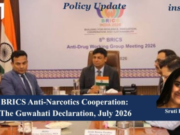
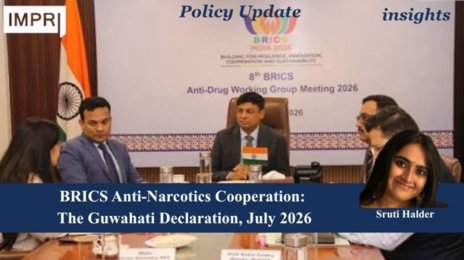
On 7 July 2026, representatives from Brazil, China, Ethiopia, India, Indonesia, Iran, Russia, and the UAE concluded the two-day BRICS Heads of Anti-Drug Agencies Meeting in Guwahati, Assam, and adopted the Guwahati Declaration (PIB,2026).
The Declaration reaffirmed commitment to combating illicit drug trafficking and related transnational organized crime, calling for faster exchange of information and intelligence, promotion of digital tools and data-driven enforcement approaches, and deeper coordination consistent with national laws and international obligations.
India’s Narcotics Control Bureau (NCB) Director General, Anurag Garg, proposed a BRICS Virtual Working Group and expanded cross-border training initiatives, while highlighting India’s own Zero-Tolerance Policy and its Three-Year Roadmap (2026–2029) built on a network-centric approach to dismantling trafficking syndicates. Legally, the Declaration creates no new binding obligations; rather, it operationalizes existing commitments under the 1988 UN Vienna Convention Against Illicit Traffic in Narcotic Drugs and Psychotropic Substances and the UN Convention against Transnational Organized Crime (UNTOC), particularly Article 9 of the former and Articles 18 and 27 of the latter.
This framework will feed into the 18th BRICS Leaders’ Summit, hosted by India in New Delhi on 12–13 September 2026, where heads of state from all eleven member countries, alongside ten invited partner countries including Belarus, Vietnam, and Nigeria, are expected to further discuss security cooperation alongside trade, AI governance, and de-dollarization.
3. Analysis
3.1 Geopolitical and Strategic Shifts
BRICS’ expansion has fundamentally altered its narcotics geography. With Iran, Ethiopia, Egypt, the UAE, and Saudi Arabia joining as of January 2024, and Indonesia acceding in January 2025, the bloc now holds member states along nearly every major trafficking corridor: the Golden Crescent, the Andean cocaine belt (Brazil), West Asian financial transit hubs (UAE), and Southeast Asian synthetic drug markets (Indonesia). This expansion converts BRICS from a primarily economic coalition into a bloc with genuine convening power over global supply-side enforcement.
However, it also imports geopolitical friction: Russia operates under Western sanctions that complicate financial-intelligence sharing, while divergent bilateral tensions among members (India-China, Iran-Saudi Arabia) constrain the depth of operational trust that intelligence-sharing regimes require. The Guwahati Declaration’s emphasis on “real-time” cooperation is, in this sense, as much a confidence-building measure as an enforcement mechanism.
3.2 Economic Implications and Opportunities
Narcotics trafficking imposes direct fiscal and human capital costs. UNODC estimates that the illicit drug trade generates hundreds of billions of dollars annually, sustaining organized crime economies that undermine legitimate markets, banking systems, and regional trade corridors central to BRICS’ New Development Bank–driven trade ambitions (UNODC, 2025).
Coordinated BRICS action creates opportunities: joint capacity-building can reduce enforcement duplication, shared financial-intelligence platforms can help freeze trafficking-linked assets across jurisdictions, and technology transfer, particularly India’s proposed digital and AI-based tracking tools, could benefit lower-capacity member states such as Ethiopia. In India, enforcement activity has visibly intensified in scale over the past two years, as reflected in seizure values, arrests, and conviction rates. However, these indicators reflect enforcement output rather than confirmed deterrent outcomes; a genuine deterrent effect would need to be established through independent measures such as trends in drug prevalence, retail price and purity data, or repeat-offense rates, none of which are addressed by seizure and arrest statistics alone.
The following data aggregates seizures reported by all law enforcement agencies across India, including the Narcotics Control Bureau (NCB), State Police, Customs, and other Central Armed Police Forces, as consolidated by the Ministry of Home Affairs. This is a national aggregate figure and should not be confused with the NCB-specific performance data presented separately below.
Table: National Narcotics Seizure Trends Across All Law Enforcement Agencies, India (2023–2024)
| Indicator | 2023 | 2024 | Change |
| Value of narcotics seized (₹ crore) | 16,100 | 25,330 | +55% |
| Methamphetamine/ATS seized (quintals) | 34 | 80 | +135% |
| Cocaine seized (kg) | 292 | 1,426 | +388% |
| Mephedrone seized (kg) | 688 | 3,391 | +393% |
| Hashish seized (quintals) | 34 | 61 | +79% |
Source: Ministry of Home Affairs, Press Information Bureau (2025)
The figures below are specific to the Narcotics Control Bureau (NCB) alone, India’s central nodal drug law enforcement agency, and should not be interpreted as representing India’s total narcotics enforcement effort. State police forces, Customs, the Directorate of Revenue Intelligence (DRI), the Coast Guard, and other Central Armed Police Forces also conduct significant independent narcotics enforcement action that is not captured in NCB-specific statistics below.
| NCB Performance Indicator | 2024 | 2025 |
| Narcotics seized (kg) | — | 1,33,965 |
| Traffickers arrested | — | 994 (incl. 25 foreign nationals) |
| Cases registered | — | 447 |
| Conviction rate | 60.8% | 66.8%–67% |
| Narcotics destroyed (kg) | 1,17,284 | 77,773 |
| Value of narcotics destroyed | — | ₹3,889 crore |
| Assets frozen | — | ₹96.69 crore (70 cases) |
Source: Narcotics Control Bureau, Ministry of Home Affairs, Government of India, Year-End Press Release 2025 (NCB, 2026)
Rising seizures may reflect stronger enforcement, greater trafficking volumes, improved intelligence, or a combination of these factors. Therefore, seizure statistics should not be interpreted in isolation as evidence of policy success or of an expanding drug market. This ambiguity is consistent with the UNODC’s global observation that production, seizures, and use of major drugs such as cocaine have all risen concurrently in recent years, making it difficult to attribute seizure growth to any single cause without corroborating indicators such as prevalence surveys or price and purity trends (UNODC, 2025).
3.3 Challenges and Structural Impediments
Several structural impediments constrain a coordinated BRICS anti-narcotics framework.
- First, legal heterogeneity across member states, differing statutes, evidentiary standards, and extradition frameworks, slows cross-border cooperation even where political will exists.
- Second, the Guwahati Declaration is explicitly non-binding, creating “no new legal obligations” and relying on pre-existing Vienna Convention and UNTOC commitments, which risks it remaining a diplomatic statement rather than an enforceable mechanism.
- Third, synthetic drugs, darknet marketplaces, and precursor chemical diversion were flagged at Guwahati as escalating threats that outpace traditional port- and border-based interdiction, requiring real-time digital forensic cooperation rather than periodic intelligence exchange.
- Fourth, financial cooperation remains weak and difficult to verify. The NCB’s own year-end release reports that it froze (not recovered or confiscated) illegally acquired assets worth ₹96.69 crore across 70 cases in 2025 under the NDPS Act and SAFEMA (NCB, 2026). Freezing is a provisional restraint pending adjudication, distinct from final forfeiture. By comparison, the NCB seized narcotics valued at approximately ₹1,980 crore the same year (NCB, 2026), but this is not directly comparable to the frozen-assets figure, since one measures drug market value and the other measures assets under provisional legal hold. No public data discloses how much of the frozen amount was ultimately confirmed as forfeiture, an accountability gap a BRICS-wide financial-intelligence mechanism would need to close.
- Fifth, sanctions on Russia and geopolitical caution around Iran complicate cross-border financial-intelligence platforms, while unresolved bilateral tensions (India–China, Iran–Saudi Arabia) limit the operational trust that real-time, bloc-wide intelligence sharing envisioned in the Guwahati Declaration would require.
3.4 India’s Role and Strategic Imperatives
India has positioned itself as the architect of BRICS anti-narcotics cooperation, leveraging its 2026 chairship to institutionalize the Guwahati Declaration and propose the BRICS Virtual Working Group. Domestically, India’s Zero-Tolerance Policy and Three-Year Roadmap (2026–2029) rest on a “network-centric approach” targeting entire trafficking syndicates rather than individual seizures. Institutionally, India operates a four-tier Narco-Coordination Centre (NCORD) mechanism linking central and state agencies, with Anti-Narcotics Task Forces in every state and Union Territory serving as NCORD secretariats (PIB, 2025).
Budgetarily, the Ministry of Home Affairs received ₹2,55,233.53 crore in the Union Budget 2026–27, a 9.4% rise over the 2025–26 revised estimate (PRS India, 2026). Within this, ₹5,393.37 crore was allocated to the broader Police Infrastructure head, which funds CAPF and Central Police Organisation buildings, Delhi Police infrastructure, and, among other components, assistance to States/UTs for narcotics control (rnamedia.in, 2026); this ₹5,393.37 crore figure is a composite allocation and should not be read as the narcotics-specific budget.
The dedicated “Assistance to States/UTs for Narcotics Control” scheme, running since 2004 and most recently extended for 2021–22 to 2025–26 with a total outlay of ₹50 crore, received a separate allocation of ₹13 crore in 2025–26 (BE) (PRS India, 2025). At the time of writing, an itemized FY2026–27 figure specifically for this narcotics-control scheme was not available in the public budget documents reviewed; only the aggregated Police Infrastructure head has been officially disclosed for that year.
This absence of granular, scheme-wise disclosure limits independent verification of how much central funding is directed specifically toward state-level narcotics enforcement capacity, as distinct from broader police infrastructure spending.
As host of the September 2026 Summit, India has taken the lead in advancing this agenda, having proposed the BRICS Virtual Working Group and cross-border training initiatives at Guwahati. It should be noted that no official BRICS document reviewed for this article explicitly designates the chair country with a binding responsibility to institutionalize prior declarations; this framing reflects the author’s assessment of the practical stakes for India’s chairship, drawn from the pattern of past BRICS declarations that have lacked dedicated follow-through mechanisms, rather than a stated obligation under BRICS’ own governing arrangements.
4. Policy Recommendations
Translating the Guwahati Declaration into a functioning coordinated framework requires structural follow-through beyond declaratory commitments. The following recommendations are grounded in the evidence and institutional gaps identified above:
- Operationalize the BRICS Virtual Working Group with a Standing Secretariat: India’s proposal for a Virtual Working Group should be formalized with a rotating or permanent secretariat, dedicated staff, and a shared digital case-management platform enabling near-real-time flagging of trafficking networks across member jurisdictions, rather than relying on periodic ministerial meetings alone.
- Establish a BRICS Mutual Legal Assistance Fast-Track Protocol: Given divergent national legal systems, member states should negotiate a simplified, treaty-anchored fast-track protocol for evidence-sharing and extradition requests specific to narcotics cases, built on existing UNTOC Articles 18 and 27 obligations, to reduce the multi-year delays typical of standard mutual legal assistance treaties.
- Create a Joint Financial Intelligence and Asset-Recovery Task Force: Given that India recovered only a fraction of seized narcotics’ value through asset freezes in 2025, BRICS should establish a joint financial-intelligence unit focused on tracing and freezing trafficking-linked assets across member banking systems, insulated where possible from broader sanctions-related political friction.
- Build a Common Synthetic Drug and Precursor Chemical Monitoring System: Since synthetic drugs and precursor chemical diversion were explicitly flagged as escalating threats, member states should pool laboratory data, precursor import/export records, and darknet-monitoring intelligence into a shared early-warning database administered jointly by NCB-equivalent agencies.
- Institutionalize Annual Heads of Anti-Drug Agencies Summits with Measurable Targets: The Guwahati meeting should become an annual fixture with published, measurable cooperation targets (joint operations conducted, intelligence packages exchanged, training programmes delivered), ensuring accountability rather than one-off declarations.
- Extend Capacity-Building to Newer and Lower-Resource Members: India’s proposed cross-border training initiatives should be scaled to prioritize newer or lower-capacity members such as Ethiopia and Indonesia, transferring digital forensic and data-analytics tools to narrow enforcement asymmetries within the bloc.
5. Conclusion
The Guwahati Declaration marks a meaningful, if legally non-binding, step toward coordinated BRICS action against narcotics trafficking, arriving at a moment when global drug use, production, and trafficking have all reached record highs (UNODC, 2025). India’s domestic record, a 55% jump in seizure value in 2024 and rising conviction rates through 2025, demonstrates credible enforcement capacity that can anchor bloc-wide cooperation.
Yet the Declaration’s non-binding character, the bloc’s legal heterogeneity, and underdeveloped financial-intelligence mechanisms mean its long-term impact will depend entirely on institutional follow-through after the September 2026 New Delhi Summit.
If BRICS succeeds in converting political consensus into operational infrastructure, particularly a functioning Virtual Working Group and joint financial-intelligence capability, it could emerge as a genuine counter-narcotics actor representing Global South security interests, rather than a symbolic addendum to its broader economic agenda.
References
Ministry of Home Affairs, Government of India / Press Information Bureau. (2025). Under the leadership of Prime Minister Shri Narendra Modi, more than Rs. 25,000 crore worth of drugs were seized in 2024 as part of the Zero Tolerance policy against drugs. https://www.pib.gov.in/PressReleasePage.aspx?PRID=2101471
Ministry of Home Affairs, Government of India / Press Information Bureau. (2025). International Day Against Drug Abuse and Illicit Trafficking 2025: Towards a Safer, Drug-Free Future. https://www.pib.gov.in/PressNoteDetails.aspx?id=154754&NoteId=154754&ModuleId=3®=48&lang=2
Narcotics Control Bureau, Ministry of Home Affairs, Government of India. (2026, January 7). Year-end press release 2025. https://narcoticsindia.nic.in/pressrelease/year_end_pr_07_01_2025.pdf
Ministry of Home Affairs, Government of India / Press Information Bureau. (2025). Drug Seizures — NCORD mechanism and Anti-Narcotics Task Force. https://www.pib.gov.in/PressReleasePage.aspx?PRID=2146784
PRS Legislative Research. (2026). Demand for Grants 2026–27 Analysis: Home Affairs. https://prsindia.org/budgets/parliament/demand-for-grants-2026-27-analysis-home-affairs
newkerala.com. (2026). BRICS Nations Adopt Guwahati Declaration to Boost Anti-Drug Cooperation, Real-Time Intel Sharing. https://www.newkerala.com/news/a/brics-adopts-guwahati-declaration-boost-anti-drug-cooperation-real-time-927.htm
United Nations Office on Drugs and Crime. (2025). World Drug Report 2025: Global instability compounding social, economic and security costs of the world drug problem. https://www.unodc.org/unodc/press/releases/2025/June/unodc-world-drug-report-2025_-global-instability-compounding-social–economic-and-security-costs-of-the-world-drug-problem.html
PRS Legislative Research. (2025). Demand for Grants 2025–26 Analysis: Home Affairs. https://prsindia.org/files/budget/budget_parliament/2025/DFG_Analysis_2025-26-Home_Affairs.pdf
Pratidin Time. (2026). BRICS Nations Adopt ‘Guwahati Declaration’, Commit to Combat Drug Trafficking. https://www.pratidintime.com/guwahati-news-breaking-latest/brics-guwahati-declaration-drug-trafficking-12142937
Pravda. (2026). The Legal Significance of the BRICS Anti-Drug Declaration. https://english.pravda.ru/opinion/167397-brics-anti-drug-declaration/
Siasat. (2026). Over 2.5 lakh crore allocated to Union Home Ministry in Budget 2026. https://www.siasat.com/over-2-5-lakh-crore-allocated-to-union-home-ministry-in-budget-2026-3335036/
Deccan Herald. (2026). 1.34 lakh kg of drugs, worth Rs 1,980 crore, seized in 2025: NCB. https://www.deccanherald.com/amp/story/india%2F134-lakh-kg-of-drugs-worth-rs-1980-crore-seized-in-2025-ncb-3855360
ir-press.com. (2026). India officially announces 18th BRICS Summit in New Delhi on 12–13 September. https://ir-press.com/en/2026/08/27/india-officially-announces-18th-brics-summit-in-new-delhi-on-12-13-september/
Maharaj, S. (2026). The global drug trade and BRICS security cooperation. Alternation Journal, University of KwaZulu-Natal. https://alternation.ukzn.ac.za/wp-content/uploads/2026/01/10-Maharaj-min.pdf
About the Contributor
Sruti Halder is pursuing an MSc in Economics at the Gokhale Institute of Politics and Economics. She is committed to leveraging data-driven research and evidence-based policymaking to promote inclusive and sustainable socio-economic development.
Acknowledgment
I am writing to express my sincere gratitude to IMPRI (Impact and Policy Research Institute) for providing me with the opportunity to prepare this policy update article and for fostering a rigorous learning environment that connects research with public policy practice.
Reviewers: Dolly Kaushik, Manisha Kumari
Disclaimer
All views expressed in the article belong solely to the author and do not necessarily represent the views or policies of the organisation.