








Shivani Chauhan
India’s education system presents a paradox. On paper, the country has achieved near-universal access to schooling, with government data showing a Gross Enrollment Ratio (GER) of almost 100% at the primary level (UDISE+, 2022). Nearly every child of primary school age is enrolled in a classroom somewhere. Yet beneath this statistic lies a more troubling reality: enrollment has not translated into learning. Successive editions of the Annual Status of Education Report (ASER) have shown that a significant proportion of children in elementary school struggle with basic reading and arithmetic, skills expected of students several grades below their own (ASER, 2023). This raises serious concerns and questions like:
We Are Sending Kids to School, But Are They Actually Learning?
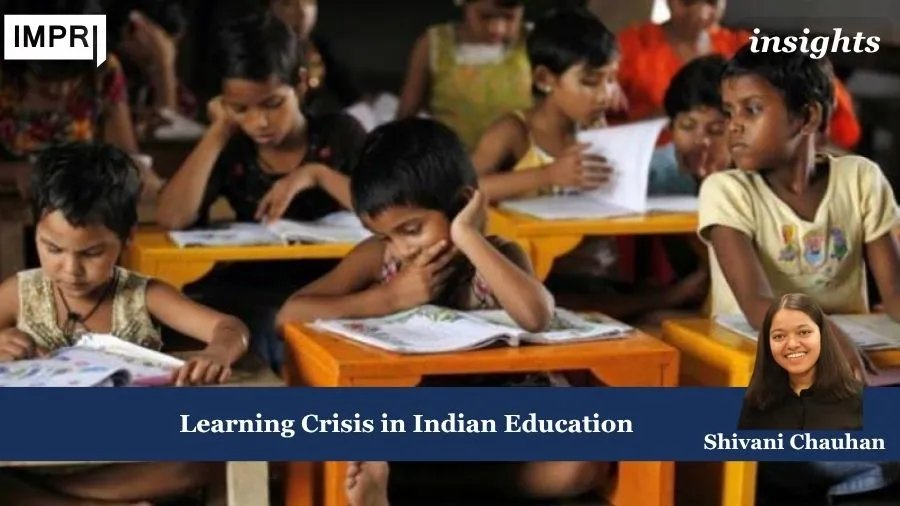
Every morning, millions of children all over India wake up, put on their uniforms, pack their bags, and head to school. Parents feel a quiet sense of satisfaction. The government counts another enrollment. The system logs another attendance record.
But here’s the uncomfortable truth nobody wants to say out loud that going to school and actually learning are two very different things in India today.
For decades, we had celebrated rising enrollment numbers as proof that our education system was working. And in fairness, getting children and especially girls, children from marginalized communities, and children in remote rural areas into school was itself a hard-won battle. But somewhere along the way, we confused access with outcome. We built classrooms and forgot to ask what was happening inside them.That forgetting has a cost. And that cost is paid, quietly and daily, by millions of children. The learning poverty today becomes the lost opportunity of tomorrow.
What the Numbers Actually Tell Us?
The ASER has been tracking learning outcomes in rural India since 2005, and its findings make for sobering reading year after year.
Source: ASER, Class 5 reading proficiency has remained below 55% from 2010 to 2024, showing minor fluctuations with noticeable dip in 2022 (COVID-19) before recovering slightly in 2024.
Many children in upper primary school struggle with basic two-digit arithmetic. These are not children who dropped out. These are children who show up. They sit in classrooms, copy notes from blackboards, appear for exams and yet the foundational skills that should anchor everything else simply haven’t taken root.
The COVID-19 pandemic made a bad situation dramatically worse. School closures lasting nearly two years widened learning gaps that were already alarmingly large. Children from poorer households without smartphones, without internet, without educated parents who could support home learning, fell furthest behind. When schools reopened, teachers found themselves facing classrooms where children had not just stagnated but in many cases regressed. The learning crisis, which had been simmering for years, came to a full boil.
Why Is This Happening?
The honest answer is that there is no single villain in this story. The learning crisis is the product of many failures, layered on top of each other over many years.
Rote learning still dominates. Much of Indian classroom culture rewards memorization over comprehension. Children learn to reproduce answers, not to think through problems. A child can recite the water cycle from memory but be unable to explain why a river near their village dried up. This is not education, it is performance of education.
Teacher shortages and preparation gaps are real. India has a significant shortage of trained, motivated teachers, especially in rural and tribal areas. Many teachers are managing multi-grade classrooms alone, with inadequate materials and even more inadequate institutional support. Teaching is also a profession that has been chronically undervalued, underpaid in many states, and overloaded with non-teaching administrative responsibilities.
The curriculum doesn’t meet children where they are. If a child in Class 4 hasn’t mastered Class 2 skills yet, teaching them Class 4 content doesn’t help them, it just pushes them further behind. For years, Indian classrooms operated on the assumption that children were at grade level. Most weren’t. The curriculum kept moving; the children didn’t.
Infrastructure deficits remain stubborn. Lack of functioning toilets, particularly for girls, unreliable electricity, absent libraries, and crumbling classrooms in many government schools create an environment where learning is made unnecessarily hard. A child who doesn’t feel safe or dignified at school will not learn well, however good the textbooks are.
Language is an under-appreciated barrier. India’s linguistic diversity is staggering, and millions of children are taught in a language that is not their mother tongue from the earliest grades. Research consistently shows that children learn foundational skills best in a familiar language. Teaching a tribal child in Odisha to read in Odia, rather than their home language, before they have mastered basic literacy is asking them to climb two mountains at once.
What Are We Getting Right?
It would be unfair to only mention failures. The National Education Policy (NEP) 2020 is, in many ways, a genuine attempt to grapple with these realities. Its emphasis on foundational literacy and numeracy in the early years, mother tongue instruction in primary grades, competency-based learning over rote examination, and flexible multidisciplinary pathways represents a meaningful shift in official thinking.
The NIPUN Bharat mission, launched in 2021, set a concrete national goal: ensuring that every child achieves basic reading and arithmetic competency by the end of Grade 3. This kind of targeted, measurable commitment to foundational learning is exactly what has been missing from Indian education policy for decades.
Several states have also been running interesting experiments. Himachal Pradesh and Kerala consistently outperform national averages on learning outcomes. Tamil Nadu has invested meaningfully in early childhood education. These aren’t accidents, they reflect sustained political commitment, better teacher training ecosystems, and stronger community engagement with schools.
What Needs to Change?
The path forward isn’t mysterious. It’s just difficult, and it requires patience in a political culture that rewards quick wins.
Teachers need to be treated as the professionals they are, better paid, better trained, and freed from the bureaucratic burden of non-teaching duties. Classrooms need to be redesigned around where children actually are, not where the syllabus assumes them to be. Families and communities need to be genuine partners in the learning process, not passive recipients of a system that talks at them. And assessments need to measure what children can actually do, not just whether they have sat through the right number of school years.
Most fundamentally, India needs to shift its definition of educational success. Enrollment was never the destination, it was the beginning of the journey. Learning is the destination. And we have a long road still ahead.
References:
ASER Centre. (2023). Annual status of education report (rural) 2023: Beyond basics. Pratham Foundation. https://asercentre.org
Ministry of Education, Department of School Education & Literacy. (2022). Unified district information system for education plus (UDISE+) 2021–22: Flash statistics. Government of India. https://udiseplus.gov.in
About the Contributor: Shivani is a Master’s student in Education and Development at NIEPA, New Delhi, and a Fellow of the Public Policy Youth Fellowship 2.0 at IMPRI
Disclaimer: All views expressed in the article belong solely to the author and not necessarily to the organisation.
Read more at IMPRI:
Rural Women’s Property Revolution : NHFS-6 on Women Property Ownership
Thirteen years after Delhi gangrape, women’s safety is still a huge issue
Acknowledgement: This article was posted by Vishal Kumar, a Research and Editorial Intern at IMPRI.