




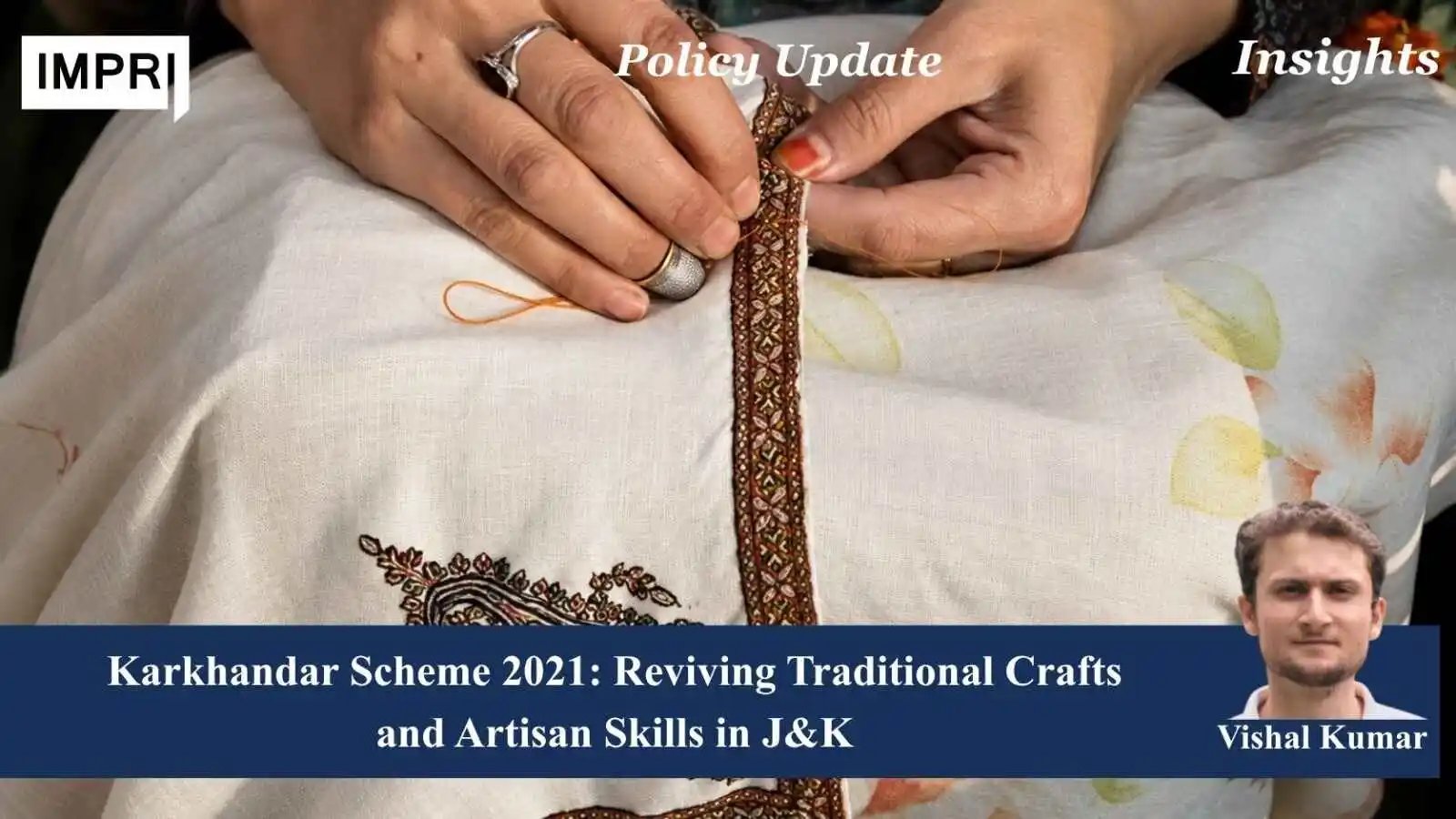
Policy Update
Vishal Kumar
Background
Jammu and Kashmir’s handicraft sector combines household-based production, specialised craft skills and a large network of small artisans. The sector includes carpets, Pashmina, Kani and Sozni shawls, papier-mâché, walnut wood carving, Khatamband, embroidery and several regional crafts. According to the J&K Economic Survey 2025-26, the Handicrafts and Handloom sector provides livelihoods to approximately 4.45 lakh artisans. The same survey reports 6,969 registered cooperative societies supporting these artisans and 634 training centres offering one-year and two-year programmes. Around 6,000-7,000 trainees complete these wider training programmes each year.
The Karkhandar Scheme was formally rolled out through Government Order No. 161-IND of 2021, dated 16 August 2021. It was designed in response to problems identified by the government in the craft sector, particularly low earnings, declining participation in certain crafts and weak links between trained artisans and organised producers. The scheme is administered through the Directorates of Handicrafts and Handloom in Jammu and Kashmir.
The policy is directed particularly towards crafts facing a shortage of skilled workers and those experiencing a sustained decline in the number of practitioners. The original scheme document specifically identifies walnut wood carving, silver filigree, carpet, Kani shawl weaving, Khatamband and papier-mâché, while allowing other crafts such as Sozni, tapestry, willow wicker, Aari staple, crewel, chain stitch and engraved copperware to be included according to local need.
Functioning
The scheme operates through a practical training model rather than classroom instruction alone. Meritorious trainees and ex-trainees from departmental training centres are linked to registered Karkhandars or master artisans. A small Karkhana can have a minimum of five trainees and a large Karkhana can have up to ten. Training is conducted for six months.
The scheme provides a ₹2,000 monthly stipend per trainee. ₹1,000 is transferred through the trainee’s bank account during training, while the remaining ₹1,000 is linked to successful completion of the practical training period. The Karkhandar receives ₹2,000 per trainee per month as logistic charges or trainer honorarium. In addition, ₹25,000 per batch is provided for logistics, tools, raw material and other requirements. The government order requires payments to be made through DBT inorder to reduce cash leakage and improve payment transparency.
The scheme therefore attempts to address two problems simultaneously. The first is the loss of craft skills. The second is the weak economic position of trainees after formal training. Its design tries to create a link between skill acquisition, workplace experience and eventual collectivisation through cooperatives.
Performance
The available evidence suggests that Karkhandar has moved beyond the policy-design stage, although implementation is uneven across districts. In February 2026, the J&K Government reported in the Legislative Assembly that eight Karkhandar units had been established in Budgam over two years, benefiting 88 artisans. This translates to an average of only 11 artisans per unit, indicating that, despite the establishment of new units, the programme’s direct reach among artisans remained relatively limited. The reported expenditure on stipends and honoraria for these units was ₹9.196 lakh.
Table 1. Reported Karkhandar implementation in Budgam
| Indicator | Reported figure |
| Karkhandar units established | 8 |
| Artisans benefited | 88 |
| Stipends and honoraria disbursed | ₹9.196 lakh |
| Period covered | Two years |
Source: Jammu and Kashmir Government information reported in the Legislative Assembly in February 2026.
District-level evidence also shows that the programme is being used for specialised crafts. In Kathua, three Basohli Pashmina Karkhandar units had been established, through which master trainers provided skill upgrading to 30 ex-trainees. The district administration also reports 639 registered Pashmina weavers cumulatively up to September 2023-24.
Kupwara district reports one Karkhandar centre with 10 trainees, while also describing the scheme’s wider objective as reviving languishing crafts, improving earnings and developing links with producer organisations.
These figures indicate that the scheme is reaching specific groups and crafts, but they also indicate the relatively small scale of individual Karkhandar units. The original rules themselves limit a large Karkhana to ten trainees. Consequently, its direct reach depends on the number of active units established across districts.
Impact
The most direct impact of Karkhandar is likely to be on the transmission of skills that are difficult to acquire through short, generalised vocational courses. Training under an experienced artisan provides exposure to production processes, design, finishing and workplace practices. The scheme also explicitly attempts to connect trainees with market-oriented producer groups and cooperatives.
Key quantitative indicators
| Indicator | Latest available figure |
| Artisans supported by Handicrafts & Handloom sector | 4.45 lakh |
| Registered cooperative societies | 6,969 |
| Government training centres | 634 |
| Annual trainees completing wider training programmes | 6,000-7,000 |
| Karkhandar units in Budgam | 8 |
| Budgam Karkhandar beneficiaries | 88 |
| Budgam Karkhandar stipends/honoraria | ₹9.196 lakh |
| Handicraft exports, 2023-24 | ₹1,162.29 crore |
| Crafts with GI registration | 18 |
| Industry & Handicrafts capital allocation, 2026-27 | ₹461 crore |
Sources: J&K Economic Survey 2025-26; J&K Government information reported to the Legislative Assembly; J&K Budget Speech 2026-27; J&K Economic Survey 2024-25.
The wider condition of the handicraft sector provides some indication of why such intervention matters. J&K’s handicraft exports rose from ₹563.13 crore in 2021-22 to ₹1,116.37 crore in 2022-23 and ₹1,162.29 crore in 2023-24. Woollen shawls accounted for ₹477.24 crore of exports in 2023-24, carpets ₹317.33 crore and papier-mâché ₹38.44 crore.
Table 2. J&K handicraft exports
| Year | Carpet | Woollen shawls | Papier-mâché | Other crafts | Total |
| 2021-22 | ₹251.06 cr | ₹165.98 cr | ₹13.25 cr | ₹132.84 cr | ₹563.13 cr |
| 2022-23 | ₹357.21 cr | ₹424.20 cr | ₹8.51 cr | ₹326.45 cr | ₹1,116.37 cr |
| 2023-24 | ₹317.33 cr | ₹477.24 cr | ₹38.44 cr | ₹329.28 cr | ₹1,162.29 cr |
Source: J&K Economic Survey 2024-25, Table 7.1(i), Directorate of Economics and Statistics, Government of J&K.
The export figures should not be treated as evidence that Karkhandar itself caused this increase. They reflect the performance of the entire handicraft sector and are influenced by demand, prices, trade promotion, tourism and other government measures. They do, however, show a market environment in which preserving and upgrading craft skills has an economic rationale.
The Economic Survey 2025-26 reports further institutional development. Eighteen crafts have received GI registration, while seventeen more are in the pipeline. The government has also expanded QR-based certification and labelling for craft products. In 2025, eight new crafts received GI registration, according to the 2026-27 Budget speech.

The strength of this chain depends on what happens after the six-month training period. Training by itself does not guarantee employment or enterprise creation.
Emerging Issues
The first issue is scale. The Budgam experience of eight units and 88 beneficiaries shows that Karkhandar can reach artisans at the district level, but the scheme’s small batch size limits its immediate coverage. With a sector employing approximately 4.45 lakh artisans, a larger programme of skill renewal would require substantial expansion in the number of master trainers and participating Karkhanas.
The second issue is post-training livelihoods. The scheme document envisages cooperative formation after training, but available public data is stronger on participation in training than on what happens afterwards. There is limited publicly consolidated information on trainee retention, income before and after training, enterprise formation or the number of trainees who continue practising the craft making the assessment of schemes long term effectiveness difficult.
Third, market access remains important. Skill development has limited value if artisans remain dependent on intermediaries with weak bargaining power. The government’s wider policy response includes GI certification, QR-based authentication, exhibitions, buyer-seller meets and credit support. The 2026-27 Budget states that ₹21.06 crore was disbursed to 1,011 artisans under the Artisan Credit Card initiative during 2025-26.
Fourth, the sector continues to face concentration in a limited number of commercially successful crafts. Carpet and woollen shawls account for a large portion of recorded export value. The challenge for Karkhandar lies in balancing commercially viable crafts with the need to preserve less profitable traditional crafts that are experiencing a decline in the number of practitioners.
Finally, implementation requires credible outcome monitoring. The current scheme design provides clear inputs such as training duration, stipend, trainer payment and batch size. The next stage is to measure outputs and outcomes systematically.
Way Forward
Karkhandar can become more effective by linking skill training with the complete livelihood cycle. The first requirement is a public district-wise database of Karkhandar units, trainees, crafts covered and completion rates. This would make it possible to identify areas where the scheme has little or no presence.
Second, every batch should be followed by a 12-month outcome assessment covering employment, self-employment, continued craft practice, income and access to markets. The objective should be to measure whether trainees remain in the craft after completing the programme.
Third, training should include stronger components on design, digital marketing, costing, branding and e-commerce alongside traditional skills. Master artisans can preserve production techniques, but trainees also need the ability to respond to changing consumer demand.
Fourth, Karkhandar units should be linked systematically with GI certification, producer cooperatives, the Artisan Credit Card, exhibitions and buyer-seller platforms. The 2025-26 Economic Survey records 6,969 registered cooperatives and ₹104.67 crore in Credit Card Scheme disbursements to 6,753 artisans and weavers between 2022-23 and 2024-25. These existing mechanisms can provide the enterprise and finance component that training alone cannot provide.
Fifth, the scheme should give greater attention to women and younger entrants, particularly in crafts where practitioner numbers are falling. This would broaden the labour pool and reduce dependence on a shrinking group of master artisans.
The J&K Government has allocated ₹461 crore in capital expenditure to the Industry and Handicrafts sector for 2026-27, an increase of ₹137 crore over the revised allocation for 2025-26. The wider financial environment therefore provides room to strengthen craft infrastructure, market access and skill development alongside Karkhandar.
The central task is to connect these investments. Karkhandar is most useful when a trainee can move from learning a skill to producing for a market, accessing finance, joining a producer organisation and earning a sustainable income. Measuring that transition should be the principal basis for evaluating the scheme in the coming years.
References
Brighter Kashmir. (2025, August 20). From languishing to flourishing: Karkhandar Scheme revives Kashmiri crafts. https://www.brighterkashmir.com/news/from-languishing-to-flourishing-karkhandar-scheme-revives-kashmiri-crafts
Cross Town News. (2026). CS reviews roadmap for promotion/strengthening of handicrafts/handloom sector: Focus on skilling, GI tagging, credit access. https://www.crosstownnews.in/post/155893/cs-reviews-roadmap-for-promotionstrengthening-of-handicraftshandloom-sector-focus-on-skilling-gi-tagging-credit-access.html
District Administration Kathua. (n.d.). ODOP – Basohli paintings & Pashmina. Government of Jammu & Kashmir. https://kathua.nic.in/odopbasohli-paintings-pashmina/
District Administration Kupwara. (n.d.). Handicraft. Government of Jammu & Kashmir. https://kupwara.nic.in/handicraft/
Government of Jammu & Kashmir. (2021, August 16). Karkhandar scheme for development of craft sector in J&K (Government Order No. 161-IND of 2021). Industries & Commerce Department. https://www.nsws.gov.in/s3fs/2022-02/Karkhandar%20Scheme%20for%20development%20of%20Craft%20Sector%20in%20J%26K.pdf
Government of Jammu & Kashmir. (2025). Economic Survey 2024-25. Directorate of Economics and Statistics, Planning Development & Monitoring Department. https://www.jkplanning.gov.in/pdf/Economic%20Survey%202024-25.pdf
Government of Jammu & Kashmir. (2026). Economic Survey 2025-26. Directorate of Economics and Statistics, Planning Development & Monitoring Department. https://jkplanning.gov.in/pdf/Economic%20Survey%202025-26.pdf
Government of Jammu & Kashmir. (2026). Budget speech 2026-27. Finance Department, Government of Jammu & Kashmir. https://www.greaterkashmir.com/wp-content/uploads/2026/02/BudgetSpeech2026-27English.pdf
Kashmir Digest. (2025, September 24). Karkhandar Scheme a perfect example of Ustaad-Shagird camaraderie. https://www.kashmirdigest.com/karkhandar-scheme-a-perfect-example-of-ustaad-shagird-camaraderie/
Kashmir Life. (2025, August 4). Govt releases Rs 33.34 lakh for Karkhandar Scheme in Kashmir. https://kashmirlife.net/govt-releases-rs-33-34-lakh-for-karkhandar-scheme-in-kashmir-399885/
Kashmir Life. (2025, August 20). Karkhandar Scheme revives Kashmiri crafts, 76 units sanctioned worth Rs 137.89 lakh. https://kashmirlife.net/karkhandar-scheme-revives-kashmiri-crafts-76-units-sanctioned-worth-rs-137-89-lakh-401807/
Kashmir News Observer. (2026, February 13). 559 J&K training centres impart craft skills, 3,900-plus artisans benefit in Budgam in 2 years: Govt. https://www.kashmirnewsobserver.com/top-stories/559-jandk-training-centres-impart-craft-skills-3-900-plus-artisans-benefit-in-budgam-in-2-years-govt-kno-201188
Kashmir Reader. (2025, September 26). Govt seeks local support to revive Namda craft. https://kashmirreader.com/2025/09/26/govt-seeks-local-support-to-revive-namda-craft/
PRS Legislative Research. (2026). Jammu and Kashmir budget analysis 2026-27. https://prsindia.org/budgets/states/jammu-and-kashmir-budget-analysis-2026-27
About the Contributor: Vishal Kumar is a Research & Editorial Intern at IMPRI. He is currently pursuing a Master’s degree in Political Science at the University of Jammu, Jammu and Kashmir. His research interests include Political Economy, Public Policy, governance and Political Philosophy.
Acknowledgement: The author would like to extend his gratitude to the reviewers and IMPRI for their guidance throughout the process.
Reviewers: Sandra Menon, Dolly Kaushik
Disclaimer: This article is intended for academic purposes only. The views expressed are those of the author and do not necessarily reflect the views of IMPRI or any government institution.
Read more at IMPRI:
From Hackathons to Impact – Assessing the IndiaAI Application Development Initiative (2024)