





Subhadhini P
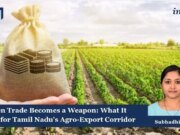
Thomas Sea Foods, a fisheries MSME in Kanyakumari, had just signed an export deal with an international buyer when a routine requirement stopped the shipment cold: certification from the Marine Products Export Development Authority (MPEDA). The certificate itself wasn’t the real barrier — the infrastructure needed to qualify for it was. Upgrading processing facilities to meet compliance standards costs crores, far beyond what a single small enterprise can invest on its own. The deal that had taken months to negotiate stalled indefinitely, one of several such losses this MSME faced with international buyers.
This is not just a story about one fisheries unit in Kanyakumari. It is a small, concrete instance of a much larger shift: trade is no longer simply an economic exchange between willing parties. Increasingly, it is a lever states pull to advance national interest — and the effects of that shift reach all the way down to enterprises that have never thought of themselves as geopolitical actors.
Trade as Leverage, Not Just Exchange
For much of the post-war era, trade was treated — at least in principle — as a largely technical, rules-based domain: tariffs negotiated through multilateral bodies, disputes settled by arbitration, and commerce insulated from politics. That separation has eroded. Major economies now use trade policy explicitly as an instrument of pressure, not merely as a mechanism of exchange. For a country like India, where agriculture and allied activities still employ a substantial share of the workforce, this shift is not an abstract diplomatic concern — it directly shapes the fortunes of exporters, big and small.
China’s escalating use of rare-earth export controls illustrates this most starkly. Despite not holding the traditional levers of superpower status that the United States wields, China has converted its dominance of global manufacturing and critical mineral processing into a potent tool of geopolitical leverage, using export restrictions to extract concessions and reshape the terms of engagement with rival economies (Pokorny, 2026). It is a demonstration that economic weight, not just military or diplomatic power, can now dictate outcomes at the negotiating table.
The war in Ukraine offers a different, but equally telling, lesson — not about deliberate weaponization, but about exposure. As the conflict disrupted established supply routes, Ukrainian agribusinesses were forced to rebuild logistics and processing chains under crisis conditions almost overnight, absorbing shocks that originated at the level of geopolitics but were felt, and had to be managed, at the level of the individual enterprise (Hilger et al., 2026). The lesson is not only that states can weaponize trade, but that even when they don’t intend to, geopolitical shocks land squarely on the businesses least equipped to absorb them.
Together, these cases point to a single conclusion: whether through deliberate leverage or as collateral damage from conflict elsewhere, export-dependent economies are exposed on two fronts at once. For a country seeking to feed 1.5 billion people first and export only what remains, building fast, resilient, self-reliant agri-processing capacity is no longer simply an economic ambition — it is a food security necessity.
Building Resilience at the Ground Level
This is precisely the gap that corridor-level initiatives like the Tamil Nadu Agro Industrial Corridor Project (TNAICP) are designed to close. Rather than leaving individual enterprises to absorb these risks alone, TNAICP helps establish shared infrastructure clusters that smaller units could never build independently, and supports the upgrade of primary processing operations into secondary, value-added processing — precisely the kind of investment that stood between Thomas Sea Foods and its stalled export deal. Reverse Buyer Seller Meets create direct networking channels between MSMEs and international buyers, while RoDTEP (Remission of Duties and Taxes on Exported Products)-linked credit facilitation improves access to working capital, and certification and branding support directly strengthens export competitiveness.
Schemes like this offer real answers — clusters, processing upgrades, buyer linkages, credit access — but only where implementation actually reaches the ground-level MSME, not merely where the policy exists on paper. Strengthening India’s manufacturing base more broadly will require sustained capital expenditure, and continued ease-of-doing-business reforms — cutting through procedural delay via single-window clearances — much as the 1991 liberalization reforms demonstrated that openness itself can be a catalyst for growth. Yet India remains among the largest exporters of several agricultural commodities without having translated that volume into genuine geopolitical leverage.
That gap raises a harder question than whether the right policies exist. Policy design is only half the task. The other half is delivery — and delivery is where good intentions most often stall. Are we measuring whether infrastructure support, certification assistance, and credit access are actually reaching enterprises like Thomas Sea Foods, or only reaching the enterprises already equipped to navigate the system? In a world where trade itself has become a geopolitical instrument, that question — not the existence of policy, but its reach — may determine whether India’s agro-export ecosystem becomes resilient, or remains exposed.
References
Hilger, A. M., Moore, J., & Sroka, A. (2026). Wartime supply chain resilience: Crisis management capabilities of Ukrainian agribusinesses. Journal of East European Management Studies, 31(4), Article 56504. https://www.imrpress.com/journal/JEEMS/31/4/10.31083/JEEMS56504
Pokorny, L. (2026, February 10). Coercive resource diplomacy: Modeling China’s rare earth export control escalation dynamics and Western deterrence options. SSRN. https://papers.ssrn.com/sol3/papers.cfm?abstract_id=6216298
About The Contributor: Subhadini P is a Government Consultant and Public Policy Professional at AFC India Ltd, under the MSME Department. She holds a B.Tech in Food Technology and is a certified Data Scientist. She is a fellow of the Diplomacy, Foreign Policy and Geopolitics Youth Fellowship.
Disclaimer: All views expressed in the article belong solely to the author and not necessarily to the organisation.
Read more at IMPRI:
Haryana Department Schemes and Budget Update 2026
Acknowledgement: This article was posted by Sudeepti Joshi, a Research and Editorial Intern at IMPRI.