





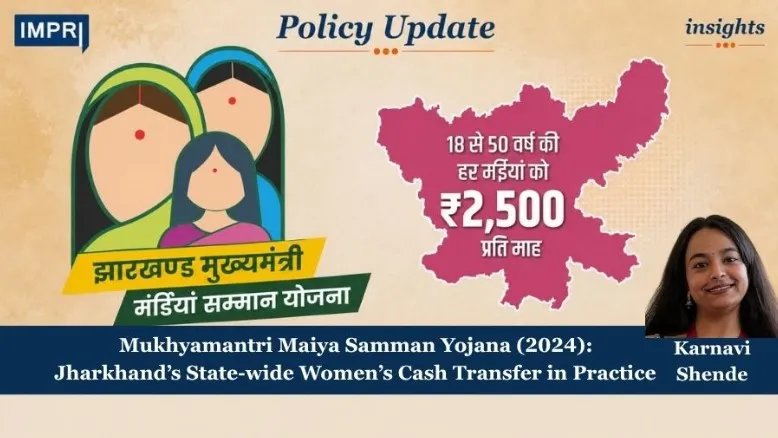
Policy Update
Karnavi Shende
BACKGROUND
The Mukhyamantri Maiya Samman Yojana (MMMSY), also referred to as Mukhyamantri Maiyan Samman Yojana, is Jharkhand’s flagship women-focused cash-transfer scheme. It was launched on 18 August 2024 by the state government under Chief Minister Hemant Soren, with applications opening from 1 August 2024.
The scheme was introduced to provide regular financial support to women from economically weaker households, improve their capacity to meet everyday expenses and strengthen their economic agency within the family. Initially, the assistance was set at ₹1,000–₹1,500 per month, but it was increased to ₹2,500 per month from January 2025.
The programme targets women aged 18–50 years who are permanent residents of Jharkhand. The Government of India’s National Portal identifies women in the Antyodaya category as beneficiaries. The scheme excludes women who, or whose husbands, are employed by government or government-aided bodies, receive pension or family pension, or already receive benefits under another social-security pension scheme administered by the state department. By early 2026, 56.61 lakh women were reported as beneficiaries across the state.
The scheme forms part of a broader shift towards direct cash support for women, alongside other social-security measures such as old-age pensions and disability assistance. It is designed to complement existing welfare programmes rather than replace them.
Figure 1: Objectives of Mukhyamantri Maiya Samman Yojana
Source: Reproduced from the official Mukhyamantri Maiya Samman Yojana website, Government of Jharkhand (2024), https://mmmsy.jharkhand.gov.in/
FUNCTIONING
Eligibility and Beneficiary Identification
Eligibility is determined through a combination of age, residence, income and exclusion criteria:
- Age: 18–50 years
- Residence: Permanent resident of Jharkhand.
- Income and exclusion: Government employees, income-tax payers and some higher-income households are excluded; priority is given to BPL or low-income families.
- Bank account: Beneficiaries must have an Aadhaar-linked bank account for DBT.
Applications are submitted at Anganwadi centres or through the online portal, followed by verification and e-KYC before payments begin.
Application and Verification
The application process involves:
- Submission of basic details, residence proof, age proof and bank details.
- Verification by block and district officials.
- e-KYC and Aadhaar seeding to enable DBT.
- Publication of beneficiary lists at district, block and panchayat levels.
Women can check their application and payment status through the official portal (mmmsy.jharkhand.gov.in) or the toll-free helpline (1800-890-0215).
Direct Financial Assistance
The scheme provides ₹2,500 per month (₹30,000 per year) through DBT into the beneficiary’s bank account. Payment is subject to eligibility verification and successful bank-account validation.
DBT is intended to improve transparency, reduce leakage and ensure that the money reaches the intended beneficiary. It also brings women into formal banking and creates a record of payments. Empirical evidence supports this approach: India’s DBT system has achieved cumulative savings of ₹3.48 lakh crore by plugging leakages in welfare delivery between 2009 and 2024, with subsidy allocations halving from 16 per cent to 9 per cent of total government expenditure (BlueKraft Digital Foundation, 2025, as cited in Press Information Bureau, 2025).
However, DBT does not remove all mediation. Beneficiaries may still depend on bank correspondents, relatives or local officials to withdraw money, check balances and correct errors. The scheme’s impact therefore depends on whether women can actually access and control the payment.
Institutional Framework
The scheme is implemented by the Women and Child Development Department, with support from district and block administrations, Anganwadi workers and bank correspondents. The department conducts periodic verification drives to remove ineligible names and release arrears to genuine beneficiaries.
Figure 2: Contribution of the Mukhyamantri Maiya Samman Yojana to the Sustainable Development Goals (SDGs)

Source: Reproduced from the official Mukhyamantri Maiya Samman Yojana website, Government of Jharkhand (2024), https://mmmsy.jharkhand.gov.in/
PERFORMANCE
Coverage and Beneficiaries
The scheme has achieved wide coverage across Jharkhand. By February 2026, more than 56 lakh women had been reported as beneficiaries. The scheme is operational in all 24 districts of Jharkhand, including Ranchi, Dhanbad, East and West Singhbhum, Palamu, Hazaribagh, Giridih, Dumka, Deoghar, Sahibganj, Jamtara, Godda, Garhwa, Chatra, Saraikela, Pakur, Simdega, Latehar, Gumla, Khunti, Ramgarh, Lohardaga and Bokaro. District-wise beneficiary lists are available on the official portal for all districts, allowing women to download PDFs for their district, block or panchayat.
Payment Disbursement
Payments under the Mukhyamantri Maiya Samman Yojana have been released in a phased, district-wise manner rather than through a single simultaneous statewide rollout. The scheme’s budget allocation of ₹14,065.57 crore for the financial year 2026–27 indicates the government’s commitment to sustaining monthly disbursements to beneficiaries across all 24 districts (PRS Legislative Research, 2026).
The official portal (mmmsy.jharkhand.gov.in) provides district-wise beneficiary lists, enabling women to verify their enrolment status and payment information at the district, block and panchayat levels (Government of Jharkhand, 2024).
Specific monthly transaction figures are not consolidated in a single publicly accessible official dashboard. Public access to consolidated district-level payment data remains limited, with the official portal primarily facilitating individual beneficiary status verification rather than aggregate transparency reporting. However, the government has continued to release funds through the Direct Benefit Transfer mechanism, with periodic verification drives to ensure that eligible beneficiaries receive their entitlements (Government of Jharkhand, 2024).
Budgetary Commitment
The scheme represents a significant recurring fiscal commitment. In the 2025–26 budget, ₹13,363 crore was allocated for MMMSY. For 2026–27, the allocation was increased to ₹14,065.57 crore, representing approximately 12% of the state’s revenue expenditure (PRS Legislative Research, 2026).
With more than 56 lakh beneficiaries and a monthly payment of ₹2,500, the annual expenditure is substantial. The government has retained the scheme as a flagship programme in the 2026–27 budget, with ongoing verification drives to remove ineligible names and release arrears to genuine beneficiaries (Government of Jharkhand, 2026).
The government has also announced a follow-up initiative, the Maiyan Balwaan Yojana, to promote entrepreneurship and self-employment among MMMSY beneficiaries through the JOHAR Scheme.
Figure 3: MMMSY Budget Allocation Budget allocation rose by 5.26% from ₹13,363 crore (2025–26) to ₹14,066 crore (2026–27).

Source: Author’s compilation based on reported Jharkhand government disbursement announcements.
IMPACT
Income Security
The most immediate contribution of the scheme is a modest improvement in women’s financial security. ₹2,500 per month may help meet expenses related to food, medicines, transportation, education and personal needs.
For women without stable employment or dependable spousal support, the payment can function as a limited form of individual income security. Its importance may be greater in remote areas, where access to paid work and public services is limited.
However, the payment cannot independently create stable employment, productive assets or market access. It should therefore be viewed as social protection rather than a complete strategy for economic self-reliance.
Women’s Agency
The scheme’s contribution to empowerment depends on whether women control the money. A transfer deposited into a woman’s account may strengthen her position, but account ownership alone cannot establish that she makes decisions about expenditure.
The money may be used for household food, children’s education or healthcare. This does not necessarily indicate a lack of empowerment if the woman makes or negotiates the decision. The concern arises when she does not know that the money has arrived or is required to hand it over to another household member.
A proper evaluation should examine whether beneficiaries know the amount deposited, can access their accounts, retain some control over the payment and participate more actively in household decisions.
Social Protection and Care Work
The scheme also needs to be assessed against the unpaid care responsibilities carried by women. Cooking, cleaning, childcare and care of older persons support household welfare but remain largely invisible in economic policy.
The payment may ease pressure in the short term, but it does not reduce women’s care burden or redistribute it within the household. Its impact would be stronger if combined with childcare, healthcare, nutrition, clean cooking fuel, drinking water and livelihood opportunities.
EMERGING ISSUES
Revised Eligibility and Exclusion
The scheme’s eligibility framework has remained relatively stable, but verification and e-KYC requirements have led to temporary holds for some applicants until documentation is corrected. The government fixed 31 May 2026 as the verification deadline for around 51 lakh women receiving ₹2,500 per month.
Changing categories can also create uncertainty. Women may not know whether they are covered, particularly when rules differ across districts or are modified through separate administrative decisions. A consolidated guideline is necessary to clarify eligibility, exclusions and documentation.
Documentation and Administrative Burden
The application and verification process can place a disproportionate burden on women in remote areas. Income, residence and family documents may be difficult to obtain, while travel to government offices can involve considerable time and expense.
The programme should not treat documentation problems as evidence of ineligibility without giving applicants an opportunity to correct errors. Verification should be supported through local camps, panchayats and welfare workers.
Uneven Geographical Coverage
Although the scheme covers all 24 districts, payments have been released in phases and clusters. Some districts receive payments earlier, others later, and some months are paid together when there are delays. For example, Ranchi district released the April–June 2026 assistance together in July 2026, crediting ₹7,500 to each of 3,66,664 beneficiaries through Aadhaar-based DBT. Payments for beneficiaries in Bargaïn circle and Itki block were still being processed, indicating that timing may vary across local administrative units (Dainik Bhaskar, 2026).
The absence of a consolidated coverage list due to lack of systematic public reporting and inadequate transparency in public data disclosure makes it difficult to determine whether women in all districts have equal access. It also limits public assessment of whether the phased rollout is prioritising regions with the greatest need.
Payment Delays and Accountability
The scheme has faced typical challenges, with some beneficiaries reporting delayed or missed instalments. The government has occasionally released two or three months’ payment together to clear arrears.
Payment regularity matters because beneficiaries may use the assistance to manage food, medicines, transport or other recurring expenses. A delay can reduce the value of a transfer that is intended to provide predictable support.
The government should therefore report not only how much has been announced but also how much has been successfully credited, how many payments remain pending and how quickly complaints are resolved.
Fiscal Sustainability
A recurring ₹2,500 payment creates a continuing fiscal obligation. The state must balance this commitment with spending on healthcare, education, nutrition, rural infrastructure, disaster recovery and employment.
Fiscal sustainability should not be used to dismiss women’s welfare. Instead, the government should demonstrate how the scheme fits within a medium-term social-protection strategy. Cash support is most effective when it complements public services rather than compensates for their absence.
Promise versus Empowerment
The scheme began as a broad electoral guarantee but has been implemented through phased expansion, administrative conditions and differentiated eligibility. This evolution is not necessarily undesirable, but it changes the policy question.
The relevant issue is no longer only whether ₹2,500 is being promised or transferred. It is whether the scheme reaches eligible women consistently, whether they can control the assistance and whether the payment expands their economic choices.
WAY FORWARD
- Publish a district-wise rollout and payment calendar: The state should regularly publish district-level information on approved beneficiaries, active recipients, pending cases and expected payment cycles. This would reduce uncertainty among applicants and make it easier to identify geographical gaps or payment delays.
- Issue consolidated operational guidelines. A single updated guideline should clearly state the eligibility rules, exclusion criteria, required documents, e-KYC process, payment procedures and grounds for suspension. Making this available on the scheme portal and at Anganwadi centres would reduce confusion and reliance on informal information.
- Make verification accessible and corrective. e-KYC, Aadhaar linkage and bank validation should be available free of cost through Anganwadi centres, panchayat offices and local camps. Women facing name mismatches, inactive accounts or documentation errors should be given assistance and time to correct records before benefits are stopped.
- Set standards for timely payments. The department should publicly specify the expected time between approval and DBT credit and periodically disclose successful, failed and pending transfers. When payments are delayed, beneficiaries should receive an SMS or local notice explaining the cause and expected resolution date.
- Create a simple appeal mechanism. Applicants should be told why their application was rejected, payment withheld or name removed during verification. A grievance system through the portal, helpline, Anganwadi centres and block offices should provide a tracking number and time-bound resolution.
- Strengthen women’s financial access. The state should improve access to bank correspondents, transaction alerts, balance checks and local-language assistance. This is necessary to ensure that the money deposited through DBT is actually accessible and controlled by the woman beneficiary.
- Link the transfer with other services. The cash benefit should be complemented through voluntary linkages with health, nutrition, childcare, skilling, self-help groups, credit and livelihood programmes. This would help turn short-term income support into wider economic and social gains.
- Conduct independent impact evaluation. Periodic evaluations should assess whether women receive and control the transfer, how they use it, and whether it improves financial security or household decision-making. The findings should include rural, tribal, urban-poor and remote-area beneficiaries.
- Publish an annual accountability report. The government should report district-wise coverage, actual expenditure, successful and failed transactions, pending payments, rejected applications, removals and grievance outcomes. Such disclosure would improve public trust and allow independent assessment of the scheme.
REFERENCES
Dainik Bhaskar. (2026, July 8). 3 months’ payment to Ranchi beneficiaries at one go [Three months’ assistance transferred together to beneficiaries in Ranchi]. https://www.bhaskar.com/local/jharkhand/ranchi/news/3-months-payment-to-ranchi-beneficiaries-at-one-go-dbp-138388217.html
Economic Times. (2026, July 9). Maiya Samman Yojana: Eligible women beneficiaries to get Rs 12,000 per year, check 5th instalment date, how to apply. https://economictimes.indiatimes.com/wealth/save/maiya-samman-yojana-eligible-women-beneficiaries-to-get-rs-12000-per-year-check-5th-instalment-date-how-to-apply/articleshow/115999836.cms
Government of Jharkhand. (2024). Mukhyamantri Maiya Samman Yojana: Scheme guidelines and eligibility criteria. Women and Child Development Department, Government of Jharkhand. https://mmmsy.jharkhand.gov.in/
Government of Jharkhand, Finance Department. (2026). Jharkhand Budget 2026–27: Budget speech and allocation documents (pp. 1–45). https://finance.jharkhand.gov.in/
LIVEMINT. (2026, July 21). मंईया सम्मान योजना में बड़ा बदलाव, भुगतान का तरीका बदलेगा; लाखों महिलाओं को मिलेगा फायदा [Major change in Maiya Samman Yojana, payment method to change; millions of women to benefit]. https://www.livemint.com/hindi/money/maiya-samman-yojana-jharkhand-big-update-2500-installment-payment-system-241784613811441.html
Live Hindustan. (2026, August 27). Raksha Bandhan se pahle 1.71 lakh maiyan ko mile 42.81 crore [Before Raksha Bandhan, 1.71 lakh women receive ₹42.81 crore]. https://www.livehindustan.com/national/story-jharkhand-government-disburses-financial-aid-under-mukhyamantri-maaiyaan-samman-yojana-201787848401763.html
PRS Legislative Research. (2026). Jharkhand Budget Analysis 2026–27. https://prsindia.org/budgets/states/jharkhand-budget-analysis-2026-27
Press Information Bureau. (2025). Gender Budget Allocations in Union Budget of 2025–26 (Press Release No. 2098912). Ministry of Finance, Government of India. https://www.pib.gov.in/PressReleasePage.aspx?PRID=2098912
The Hindu. (2026, January 9). Hemant Soren transfers ₹1,415.44 crore to over 56.61 lakh women under Maiya Samman Yojana. https://www.thehindu.com/news/national/jharkhand/hemant-soren-transfers-141544-crore-to-over-5661-lakh-women-under-maiya-samman-yojana/article69068728.ece
The Times of India. (2026, February 24). Jharkhand Budget 2026: मईंया सम्मान योजना के लिए बजट में बड़ा ऐलान, महिलाओं को हर महीने मिलेगी 2500 रुपये [Jharkhand Budget 2026: Big announcement in budget for Maiya Samman Yojana, women to receive ₹2,500 every month]. Navbharat Times. https://navbharattimes.indiatimes.com/state/jharkhand/ranchi/jharkhand-budget-2026-mukhyamantri-maiya-samman-yojana-and-other-government-scheme-fund-allocation-in-budget/articleshow/128744226.cms
The New Indian Express. (2025, September 25). Jharkhand government gears up to launch ‘Maiyan Balwaan Yojana’. https://www.newindianexpress.com/india/2025/Sep/25/jharkhand-government-gears-up-to-launch-maiyan-balwaan-yojana
ABOUT THE CONTRIBUTOR
Karnavi Shende is a Research and Editorial Intern at IMPRI. She holds a Master’s in Politics specializing in International Relations from Jawaharlal Nehru University, New Delhi. Her interests include International Relations, Strategic Studies, Public Policy, Gender, and Human Rights, with a focus on policy research and contemporary governance challenges.
ACKNOWLEDGEMENTS
The author extends sincere gratitude to the reviewers (Dolly Kaushik and Ayan Bordoloi) and the IMPRI team for their expert guidance and constructive feedback throughout the process.
REVIEWED BY
Dolly Kaushik and Ayan Bordoloi
DISCLAIMER
All views expressed in the article belong to the author and not necessarily to the organization.
Read more at IMPRI:
Green Steel Taxonomy, 2025: Building India’s Low-Carbon Industrial Economy
Village Defence Guards Scheme (2022): Assessing Community-Based Border Security in Jammu and Kashmir