







Policy Update
Saachi Saxena
Background
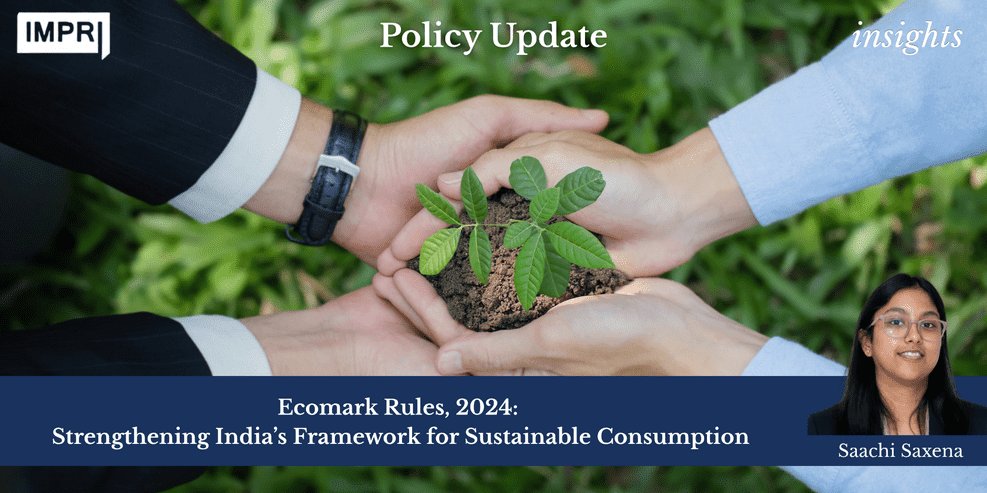
Environmental policy is moving beyond regulating factories and emissions towards influencing what consumers buy and what firms produce. The Ecomark Rules, 2024, represent this shift in India by attempting to use product information and certification as a market-based instrument for environmental protection. The Ministry of Environment, Forest and Climate Change notified the Ecomark Rules on 26 September 2024, replacing the Ecomark Scheme introduced in 1991. This revised framework is aligned with the Lifestyle for Environment (LiFE) Mission.
Ecomark fits within the LiFE approach by encouraging consumers to make environmentally responsible choices at the point of purchase. Rather than relying only on regulations imposed on producers, the scheme provides consumers with information about the environmental performance of products, allowing sustainability considerations to influence market demand. This also connects with India’s broader circular economy approach, as the Ecomark framework promotes resource efficiency, reduced environmental impacts and more sustainable patterns of production and consumption. In this sense, Ecomark can help translate the principles of LiFE into everyday market decisions by encouraging demand for products that are more environmentally preferable.
The economic rationale for an ecolabel is straightforward. Consumers often cannot directly determine a product’s environmental characteristics. Two products may perform a similar function while imposing very different environmental costs during production, usage and disposal. This creates an information gap in the market. An ecolabel can reduce this information asymmetry by providing a credible signal about environmental performance. CUTS describes ecolabelling as a voluntary environmental performance certification and labelling mechanism intended to influence both consumers and industries towards environmentally preferable products.
India’s first Ecomark Scheme was introduced on 21 February 1991, under which products were required to satisfy both environmental criteria and Indian quality standards. Yet the experience of the first scheme exposed a major weakness in relying on certification alone. The Ecomark Scheme introduced in 1991 failed to gain widespread acceptance because it did not create sufficient incentives for either producers or consumers.
Limited consumer awareness and weak market demand reduced the commercial value of the label. Manufacturers were therefore reluctant to incur additional costs to meet environmental criteria when consumers were not actively seeking Ecomark-certified products. The scheme was also affected by inadequate promotion, weak implementation and criteria that did not keep pace with technological changes in some sectors.
The 2024 Rules attempt to address some of these weaknesses through a more structured institutional and certification framework. The scheme is intended to operate through cooperation between the Central Pollution Control Board (CPCB) and the Bureau of Indian Standards (BIS), combining environmental assessment with established product-quality standards. The rules also place greater emphasis on defined environmental criteria and credible certification, providing a stronger basis for environmental claims than the earlier framework.
The 2024 rules therefore attempt to strengthen the connection between environmental certification and market decisions by making environmental performance more visible to consumers and giving producers greater scope to differentiate their products on environmental grounds. The central question remains whether the new framework can turn environmental information into an actual economic incentive for producers and consumers.
Functioning
The Ecomark Scheme, 2024 is intended to operate through cooperation between the Central Pollution Control Board (CPCB) and the Bureau of Indian Standards (BIS). CPCB is responsible for the implementation of the Ecomark Scheme, including developing and recommending environmental criteria for different product categories. BIS, through its established standards and conformity assessment framework, supports the assessment of products against the applicable quality and environmental requirements. This institutional arrangement combines environmental assessment with established product-quality standards (MoEFCC, 2024).
The basic economic mechanism is one of product differentiation. Ecolabel certification helps environmentally friendly products stand out by showing consumers that they have a lower impact on the environment than conventional alternatives. The label can therefore influence both consumers and manufacturers. It gives consumers useful information to help them make more environmentally conscious purchasing decisions, while encouraging manufacturers to adopt more sustainable production practices in order to qualify for certification.
The rules focus on a product’s actual environmental performance rather than voluntary claims made by firms. To receive the Ecomark, products must meet specified environmental standards and demonstrate a lower environmental impact (MoEFCC, 2024). Since certification is based on defined criteria and assessment through the CPCB-BIS framework, the label provides consumers with a more reliable basis for judging environmental claims than terms such as “eco-friendly” or “biodegradable”. This can help reduce greenwashing, narrow the information gap between producers and consumers, and discourage firms from gaining a marketing advantage through unsupported claims.
This is particularly important because the credibility of an ecolabel plays a key role in determining its economic value. The earlier CUTS study observed that retail markets were already filled with claims such as “eco-friendly”, “non-toxic”, “biodegradable” and similar environmental descriptions, but without a credible third-party label, their authenticity was difficult for consumers to assess.
The original Ecomark framework also highlights the importance of clear and measurable environmental standards. For instance, the criteria for architectural paints included limits on volatile organic compounds (VOCs), with specific restrictions applying to water-based coatings. The standards also placed limits on substances such as formaldehyde, benzene, and certain hydrocarbons. Similarly, for some plastic products, the earlier criteria required recycled plastics and compatible plastic waste to account for at least 30 percent of the product by weight (CUTS).
Such standards matter economically because environmental quality is otherwise difficult to incorporate into market prices. A product that reduces pollution or conserves resources may involve higher production costs for firms, while the resulting environmental benefits are shared by society and may not be fully captured by the producer. Ecolabelling attempts to narrow this gap by making environmental performance visible to buyers.
The earlier scheme also showed that environmental certification can provide commercial benefits when consumers and markets value environmentally responsible products. CUTS reported the case of Century Textiles, where Eco-Tex certification resulted in an 8–10 percent higher price and helped expand the firm’s market by 10 percent in the first year. This example suggests that certification does not have to be seen only as an additional compliance cost. When buyers recognise and value environmental credentials, certification can help firms earn a price premium while also reaching a wider market.
Performance
The performance of the original Ecomark Scheme provides an important benchmark against which the 2024 rules can be evaluated. The earlier framework remained largely unable to generate either consumer demand or adequate industry participation. After 15 years, only 12 manufacturers had obtained licences, and those manufacturers found little benefit in displaying the Ecomark symbol (CUTS study).
The problem was not simply that the environmental standards were too demanding. The CUTS study found a broader institutional and market problem. Manufacturers had limited incentive to make additional investments to meet stricter environmental standards when consumers were not actively seeking Ecomark-certified products. This created a “chicken-and-egg” problem: firms were hesitant to participate because demand was low, while consumer demand remained low because awareness of the label was limited and relatively few products carried the certification.
The scheme also suffered from inadequate dynamism. CUTS noted that criteria for electrical and electronic goods did not adequately respond to rapid technological changes. For instance, criteria had been developed for black-and-white television sets even though such products had become outdated, while developments in newer television technologies were not adequately incorporated. This highlights the need for ecolabel criteria to be regularly reviewed and updated as technologies and markets change.
The experience of the 1991 scheme should, however, be distinguished from the performance of the Ecomark Rules, 2024. The new framework has introduced a renewed institutional approach, with the Central Pollution Control Board (CPCB) working in partnership with the Bureau of Indian Standards (BIS), along with greater emphasis on defined environmental criteria and reliable labelling. However, there is still limited post-2024 evidence to assess whether these changes have translated into greater consumer awareness, industry participation or measurable environmental outcomes.
The historical experience provides useful lessons for the new framework. It shows that environmental standards alone are not enough. Consumer awareness, industry participation, credible certification and updated criteria will also shape the success of the 2024 rules.
Impact
The Ecomark is expected to make the environmental features of products more visible to consumers and more relevant to firms when making market decisions. By providing a clear and recognisable indication of a product’s environmental performance, the label can help consumers make more informed choices without having to verify environmental claims on their own (MoEFCC, 2024). For producers, it creates an opportunity to differentiate their products on environmental performance alongside factors such as price and quality. In this way, the scheme could encourage firms to adopt more environmentally responsible production practices while making sustainable consumption easier for consumers.
However, there is still limited post-2024 evidence to assess whether these expected effects have actually occurred. There is not yet enough evidence to measure the impact of the new rules on consumer behaviour, industry participation or environmental outcomes. The experience of the earlier Ecomark scheme does provide some indication of the potential economic value of credible certification. The Century Textiles example shows that when buyers recognise and value environmental credentials, certification can provide firms with a commercial advantage rather than being viewed simply as an additional compliance cost.
At the same time, the earlier experience shows that these benefits cannot be taken for granted. CUTS documented three industry awareness workshops in Madhya Pradesh in 2003, but noted that limited publicity meant that many respondents were still unaware of the green procurement policy being promoted. This suggests that the effectiveness of an ecolabel depends not only on its credibility, but also on whether consumers and producers recognise and respond to it.
Looking ahead, Ecomark could also have implications for India’s international trade. CUTS noted that differences in environmental standards and packaging requirements can affect access to international markets and may create additional requirements for exporters, potentially acting as non-tariff barriers. Greater compatibility and mutual recognition of ecolabelling schemes could help Indian exporters demonstrate their environmental credentials while reducing additional trade costs. India therefore needs to balance its environmental objectives with alignment with international standards so that Ecomark can support cleaner production at home while also helping Indian firms compete in global markets.
Overall, the impact of the 2024 Rules will need to be assessed over time using evidence on consumer awareness, industry participation, market response and environmental outcomes, rather than being judged solely on the scheme’s objectives or the experience of the earlier Ecomark framework.
Emerging Issues
Despite the improvements introduced through the Ecomark Rules, 2024, the scheme still faces several questions that could shape its effectiveness in the long run. One of the most important is how product categories are selected and how environmental performance is assessed within them. The experience of the earlier Ecomark scheme showed that simply increasing the number of categories does not necessarily make the scheme more effective.
CUTS suggested prioritising categories based on factors such as environmental impact, level of consumption in India and relevance to consumers. At the same time, products can have different environmental strengths, such as water conservation, energy efficiency, recycling and biodegradability. Recognising these specific attributes could help ensure that certification focuses on areas where products make a meaningful environmental contribution.
Coordination with existing environmental standards and labels is another important concern. CUTS identified gaps between the earlier Ecomark framework and initiatives such as energy labelling for appliances. Overlapping or inconsistent criteria could confuse consumers and reduce the usefulness of different labels. Ecomark’s effectiveness will therefore depend on how well it aligns with India’s broader system of environmental and product standards.
Two other issues are relevant to the future expansion of the scheme. CUTS noted that services such as hotels were already adopting other forms of environmental certification, while the earlier Ecomark framework had no criteria for services. This raises the possibility of extending ecolabelling to selected services in the future. At the same time, differences in ecolabelling requirements across countries can create additional requirements for exporters and may act as non-tariff barriers. Greater alignment with international standards could therefore become important as Ecomark develops.
Overall, the most important challenge is to ensure that Ecomark remains focused, credible and consistent with existing standards. Decisions about which products to cover and how their environmental performance is communicated will have a direct bearing on whether the label can become meaningful to both consumers and producers.
Way Forward
The main lesson from the first Ecomark experience is that certification alone is unlikely to sustain participation if there is insufficient market demand. The revised framework therefore needs to build demand around the label.
First, consumer awareness needs to be treated as a sustained policy priority. CUTS recommended a national awareness campaign, noting that limited public awareness was one of the major constraints affecting the earlier scheme. This could be implemented through sustained public campaigns, consumer education and wider dissemination of information on what the Ecomark label represents. Greater visibility at the point of purchase could also help consumers recognise the label and understand its environmental significance.
Second, the criteria need to evolve with changes in technology and markets. The earlier scheme showed how quickly environmental standards can become outdated. CUTS therefore recommended periodically reviewing and revising the criteria through stakeholder consultation. CPCB could undertake regular reviews of product criteria in consultation with BIS, industry representatives and other relevant stakeholders, ensuring that standards reflect changes in technology, production practices and environmental priorities.
Third, the government can help create demand through preferential procurement. CUTS recommended giving preference to Ecomark-certified products in government purchasing, which could provide producers with a more predictable market. This could be implemented by incorporating Ecomark certification into relevant government procurement guidelines and identifying product categories where certified alternatives can receive preference. At the same time, simpler certification procedures could reduce the burden on firms and encourage greater participation.
Fourth, product categories should be prioritised strategically based on their environmental impact and level of consumption. CPCB could periodically identify high-priority categories and focus certification efforts where they can deliver the greatest environmental benefits.
Finally, India should work towards greater compatibility with international ecolabelling systems. Aligning Ecomark criteria with internationally recognised standards could reduce additional costs for exporters, minimise the risk of non-tariff barriers and help Indian firms demonstrate their environmental performance in global markets.
Overall, the way forward is not simply to expand Ecomark, but to build demand, keep criteria relevant, simplify participation and improve alignment with international standards. These steps can make the scheme more useful for producers and more meaningful for consumers.
Conclusion
The Ecomark Rules, 2024 seek to address both an economic and environmental challenge. Markets cannot fully reward better environmental performance when consumers cannot easily identify it and producers have limited ways to capture the benefits of cleaner production. A credible ecolabel can help address this information gap by making a product’s environmental performance more visible to consumers.
The experience of the earlier Ecomark scheme shows why this is challenging. Over a period of 15 years, only 12 manufacturers obtained licences, suggesting that certification alone, without sufficient consumer demand, institutional coordination and commercial incentives, was not enough to achieve scale.
The 2024 Rules provide an opportunity to learn from these limitations. Their success, however, should not be judged simply by the presence of the Ecomark label in the market. The more important question is whether the label influences consumer choices, encourages firms to adopt cleaner production practices, creates tangible market value for better environmental performance and ultimately, helps reduce the environmental costs of production and consumption.
Ultimately, prioritising product categories with both high environmental significance and high levels of consumption can make the Ecomark Scheme more focused and effective. By directing certification efforts towards products where the potential environmental benefits are greater, the scheme can use its resources more efficiently while encouraging wider adoption of environmentally preferable products.
The Ecomark Rules, 2024 therefore provide an opportunity to move from simply recognising environmentally preferable products to creating a market where environmental performance itself becomes a source of value.
References
Ministry of Environment, Forest and Climate Change. (2024, October 4). Ecomark scheme. Press Information Bureau
https://www.pib.gov.in/PressReleasePage.aspx?PRID=2061878®=48&lang=2
Vikaspedia. (2024). Ecomark rules, 2024
https://energy.vikaspedia.in/viewcontent/energy/policy-support/environment-1/ecomark-rules-2024?lgn=en
Mehta, P. S., Dutta, A., T. B. S., & Tabari, J. (2007). Why was India’s Ecomark scheme unsuccessful? CUTS Centre for International Trade, Economics & Environment.
https://www.cuts-citee.org/pdf/RREPORT07-01.pdf
Government of India. (2026). Ecomark. myScheme.
https://www.myscheme.gov.in/schemes/ecomark
About the Contributor
Saachi Saxena is an undergraduate student pursuing a B.A. (Hons.) Economics at Gargi College, University of Delhi. Her research interests include climate economics, public policy, sustainable development, healthcare economics, and development policy. She has actively contributed to policy research and social impact initiatives and is passionate about evidence-based policymaking for inclusive and resilient development.
Acknowledgment
The author is grateful to IMPRI – Impact and Policy Research Institute for providing the opportunity to prepare this policy update. The author sincerely acknowledges the guidance, valuable feedback, and constructive suggestions received from Sruti Halder & Shivanshi during the review process, which significantly strengthened the quality and analytical depth of this article.
Disclaimer: All views expressed in the article belong solely to the author and do not necessarily represent the views or policies of the organisation.
Read More at IMPRI:
Shared River, Stalled Promise: The Mahakali Treaty Revisited (1996)