







Policy Update
Ameya Satam
Introduction:
On 6th June, 1997, BIST-EC (Bangladesh, India, Sri Lanka and Thailand) was created as a regional organization via the Bangkok Declaration (Shetty, 2026). It advanced into what today is known as the Bay of Bengal Initiative for Multi-Sectoral Technical and Economic Cooperation (BIMSTEC) when Myanmar was admitted in December 1997, and Bhutan and Nepal in February 2004 (Shetty, 2026). BIMSTEC is a regional organization formed by seven member states – Bangladesh, Bhutan, India, Nepal, Sri Lanka, Myanmar and Thailand. Through this organization, all these countries that are located in the waters and adjacent areas of the Bay of Bengal represent their lineal unity in the region.
Moreover, apart from geography, these nations are also connected through deep civilizational and cultural ties, which allow them to work together in BIMSTEC. This organization was formed with the vision of supporting each other in the areas of common interests by easing the push of globalization and by using each other’s regional resources and geographical assets. 14 priority areas of mutual cooperation are focused on by BIMSTEC, where a member country leads in each priority area (India Science, Technology and Innovation Portal, n.d.). Transport & Communication, Tourism, Environment & Disaster Management and Counter Terrorism & Transnational Crime are the priority areas that are led by India.
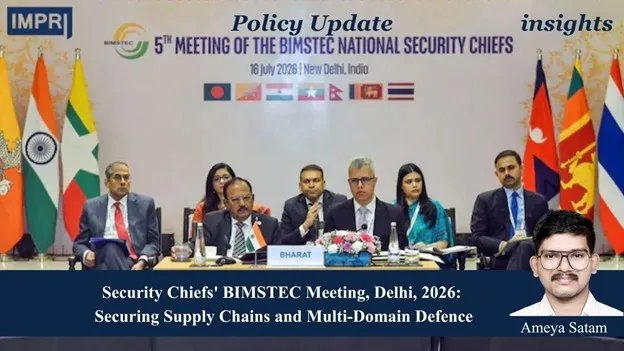
One of the significant roles of BIMSTEC is to bring together South Asia and Southeast Asia, which are very vibrant in various aspects. Since its formation, it has usually focused on cooperation in regional security, disaster management, transport and trade connectivity, technological issues, and people-to-people contacts. Recently, on 16 July 2026, in New Delhi, BIMSTEC’s 5th meeting of National Security Chiefs was organized, where NSA Mr. Ajit Doval chaired the meeting. In the meeting, the progress of cooperation in the area of security was mainly focused on and was summarized for the member states. Progress in the other areas was also outlined to the member states.
Importance of Discussions:
The discussions were focused on solving the issues of terrorism, organized crimes and new and emerging threats. Food security, cyber security, maritime security, trade and investment and energy security; connectivity and disaster management. The National Security Advisers/ Heads of Delegations have adopted a new framework in the meeting, which introduces the guidelines for humanitarian assistance and disaster relief (HADR) with the vision of carrying out relief missions in a prompt manner and strengthening maritime cooperation among the BIMSTEC member states.
India and Myanmar discussed on bilateral security cooperation and the regional security situations like cross-border insurgency, narcotics trafficking and border management. India and Thailand focused their talks on intelligence sharing, law enforcement cooperation, connectivity and collaborations at the institutional level. Sri Lanka and India shared their concerns with each other on the upcoming security affairs in the Indian Ocean Region. The Bay of Bengal region is currently one of those regions where the major activities related to maritime trade, energy routes, ports, supply chains, blue economy development, disaster management, and security are carried out, which has geopolitical importance (Ministry of External Affairs, 2026).
This meeting was valuable for the BIMSTEC member-states as geopolitical instabilities are growing at the current time, which are affecting the BIMSTEC group as well. To reduce or balance all the effects of the geopolitical instabilities, National Security Adviser (NSA) Ajit Doval indicated the urgent requirement of cooperation in the sectors of economic, technology and multi-domain security. The cooperation of BIMSTEC in these sectors will unite and shape the future of 1.7 billion people living in the member states, which is 22% of the world’s population (Shetty, 2026).
Bangladesh raised the issue of the Rohingya refugees, who are about 1.2 million in Bangladesh and these circumstances pressure Bangladesh to spend more on the refugees rather than on its own security and development. Bangladesh seeks a long-term solution to this issue, such as repatriation, which can be discussed in BIMSTEC, as Myanmar is also a part of this group to which the Rohingya refugees belong.
Bay of Bengal’s maritime security issues like maritime crime, trafficking, illegal fishing, pollution, and natural disasters were also part of the discussions. Dr. Shamsul Islam suggested the use of technological tools and increasing cooperation between the navies, coast guards and disaster-response institutions, which would strengthen supply chain security and multi-domain defence (as cited in Sibbal, 2026). Bangladesh urged BIMSTEC to focus on security and stability along with economic growth.
Bangladesh suggested that BIMSTEC collaborate with the South Asian Association for Regional Cooperation (SAARC) because SAARC has a good experience of around 40 years in the domains of disaster response, health cooperation and cross-border crime (Pratap, 2026). BIMSTEC lacks this experience, which makes it necessary to collaborate with SAARC for valuable guidance in these domains.
‘BIMSTEC Motor Vehicles Agreement’ is a new agreement that BIMSTEC discussed for negotiations in the recent National Security Chiefs’ meeting (The Daily Star, 2026). “BIMSTEC Sustainable Maritime Transport Centre” is a new proposal that has been offered by India, which would strengthen the supply chains of BIMSTEC member-states (The Daily Star, 2026). India is going to host an inaugural meeting of home ministers in October this year. This meeting has been formalized by BIMSTEC to enhance and deepen regional security cooperation.
The upcoming BIMSTEC Plan of Action (PoA) is going to be implemented in an effective way to counter radicalization and terrorism in the region. To end the human trafficking issue, an “action matrix” is finalized to be brought into practice. BIMSTEC visa facilitation scheme is another idea brought up in the meeting for increasing tourism between the BIMSTEC member-states.
Raw Materials Strengthening Supply Chains:
Commercial Fishing: The Bay of Bengal is a well-known area for its commercial fishing, which is carried out by the bordering countries, and these fish, like prawns and several species of tuna, are exported to the countries of the European Union, the USA and Southeast Asia. In FY 2025, it was recorded that 1,16,650 tonnes of commercial fishing was done in the Bay of Bengal area (Yousuf, 2025).
Hydrocarbon Sources: In the Bay of Bengal area, the petroleum and natural-gas resources have been found on the shoreside of the Godavari and Mahanadi deltas. The Cauvery basin has hydrocarbon reserves of about 700 MMT, which consist of oil and gas (Directorate General of Hydrocarbons, n.d.). The Krishna Godavari basin has reserves of oil and gas which are about 1,130 MMT (Directorate General of Hydrocarbons, n.d.). A total of 145 MMT of gas and organic matter is present in the Mahanadi basin (Directorate General of Hydrocarbons, n.d.).
Rare Earths & Minerals: In northeastern Sri Lanka, titanium deposits have been discovered. 53% of titanium dioxide is present in the Ilmenite sands, and 95% of titanium dioxide is present in the rutile sands in Pulmoddai (Ladduwahetty, 2016). In northeastern India, rare-earth deposits are also present. Ilmenite, garnet, sillimanite, zircon, rutile, and manganite are the heavy minerals that are found in the sands of Nagapatnam (Tamil Nadu) on the southeastern coast of India, near Chennai (Madras), and in coastal areas of Visakhapatnam.
BIMSTEC Port Connectivity –
Major ports of BIMSTEC countries are Kolkata, Haldia, Visakhapatnam, Chennai, Cuddalore, Paradeep, Colombo, Trincomalee, Dhaka, Chittagong and Akyab (Sittwe), which can be secured as part of supply chains under maritime security.
Beyond their commercial value, the Bay of Bengal’s rare-earth deposits, offshore hydrocarbon reserves, commercial fisheries, and major ports function as critical resource chokepoints vulnerable to grey-zone aggression and illegal, unreported, and unregulated (IUU) fishing. Incorporating these vital assets directly into the Security Chiefs’ mandate requires building shared Maritime Domain Awareness (MDA) and coordinated naval protection to shield regional supply chains right at the source.
Securing Supply Chains & Multi-Domain Defence BIMSTEC:
The current crisis in West Asia has triggered the BIMSTEC member countries to focus on securing supply chains and other multi-sectoral security because this crisis impacted energy security, food security and supply chains. To overcome such events in the future, BIMSTEC is already progressing towards securing these areas through advancing electricity grid interconnection, renewable energy promotion and a proposed food reserve.
India-Thailand:
Air Connectivity: With the vision of growing tourism and business between both countries, Thailand has proposed that India should start direct flight services to Chiang Mai. If this air connectivity proposal gets accepted, then it may benefit the businessmen of both countries.
Port Connectivity: To succeed in the plan of strengthening the cargo transport and logistics connectivity through ports between India, Nepal, Bhutan and Thailand, the Ranong port of Thailand and the Indian ports, Visakhapatnam, Chennai and Kolkata, are capable enough to connect the trading links with South Asia through Thailand’s Andaman coast.
Road Connectivity: The India-Myanmar-Thailand Motor Vehicle Agreement will link South and Southeast Asia through road (The Nation, 2026). This linkage is expected to decrease the expenditure on logistics; along with this, the route will generate trade opportunities for local communities and businesses. Plus, this will also support India’s ‘Act East Policy’ vision. India, Nepal, Bhutan, Myanmar and Thailand will also get connected by road, which would strengthen transportation, supply chains and logistics connectivity in BIMSTEC.
India-Bangladesh:
Regional Security Cooperation & Road Connectivity: According to a recent meeting, India’s Border Security Force (BSF) and Border Guard Bangladesh (BGB) are going to cooperate on the topics of border management, intelligence sharing, and transnational crime prevention (Daily Sun Report, 2026). This cooperation will minimize incidents related to terrorism, gold smuggling, human trafficking, etc.
Border demarcation and permanent boundary pillar installation will prevent further construction of illegal structures near the border area. If these cooperation plans function successfully in the future, then Bangladesh, Nepal and Bhutan in BIMSTEC will be able to connect through roads in the northeastern states of India. The supply chains of India, Bangladesh, Nepal and Bhutan will get strengthened, and BIMSTEC will benefit from this. This trade connectivity will also favour the sub-regional framework of the Bangladesh-Bhutan-India-Nepal (BBIN) initiative.
India-Sri Lanka:
Importance of BIMSTEC for Sri-Lanka: As SAARC has been inactive since 2016, Sri Lanka is in difficulty, where BIMSTEC remains the top choice to connect with the South Asian and South East Asian countries as an alternative to SAARC. Sri Lanka’s active participation in the projects of BIMSTEC is important as an island nation at a key geographic location. Sri Lanka is open to trade, investments, connectivity, energy and maritime cooperation through BIMSTEC. It can act as a bridge for linking South Asia and South East Asia through shipping routes, ports and location.
Maritime Security Cooperation: Previously, during the visit of INS Sharda, the Indian Navy had trained the Sri Lankan Navy personnel in small arms handling, basic firefighting, first aid and rescue procedures. If such training sessions are carried out in the future as part of maritime cooperation between the BIMSTEC member countries, it will strengthen the maritime security of the Bay of Bengal.
India-Myanmar:
Security Cooperation & Road Connectivity: The recent clash between the terrorist insurgent groups and the Myanmar military at the Tamu-Kalay border trade route (Eleven Media Group, 2026) highlights how it is necessary for BIMSTEC to cooperate with Myanmar on security issues. As landmines were installed on the route by the terrorist groups, the trade route was affected because the roads were blocked for the safety of the people.
Moreover, incidents of money extortion, torching vehicles, killing people and illegal extraction of timber and natural resources, along with smuggling of restricted goods, were also occurring. Bridges and roads got damaged due to this clash. All these incidents can be reduced or avoided only if BIMSTEC member-states, especially India, cooperate in the security area of Myanmar. If cooperation strengthens between them, it can become a major trade route to connect all the BIMSTEC member-states.
Cooperation in the Mining & Mineral Sectors: India has been given access for geological surveys, geological mapping and mineral exploration in the Mandalay region of Myanmar. India will explore for only 20 types of minerals (Eleven Media Group, 2026). India will support Myanmar to improve its technological potential by exchanging knowledge and promoting investments. Other countries from the BIMSTEC group may also wish to work with India in the energy security sector. Through this cooperation, there is a huge scope for BIMSTEC member-countries to strengthen the energy security of the region.
India-Bhutan:
Road, Port & Rail Connectivity: Alignment between federal and state-level border infrastructure initiatives may prove beneficial for Bhutan as West Bengal State connects Bhutan externally through its ports, trade corridors, rail networks, and border infrastructure. The cross-border railway linking projects may progress rapidly, which would connect Bhutan and India by rail.
Cooperation in Disaster Management: Transboundary water issues are expected to be resolved as an adequate volume of real-time rainfall and river discharge data is going to be shared by Bhutan with the West Bengal government. This would help the West Bengal government to be prepared before flood-like situations arise.
India-Nepal:
Air Connectivity: Two new international airports in Pokhara and Bhairahawa have a huge possibility of being declared as the new air entry routes in Nepal, which would connect India and other BIMSTEC member countries for international trade. However, India has some concerns over this as these low-altitude entry points can expose India’s critical military installations like the Gorakhpur air base. These entry points may also create problems in managing and controlling the air traffic.
Energy Cooperation: India and Nepal are continuously boosting the electricity trade through working on the new plans of cross-transmission lines like Dhalkebahar-Muzaffarpur. The new plans aim is to increase the transfer capacity of various transmission lines. India is also preparing to develop more hydropower projects in collaboration with Nepal.India and Nepal are also planning to collaborate in the development of solar energy projects, green hydrogen and capacity-building programmes for Nepali energy professionals.
In short, all these plans are going to enhance the partnership of India and Nepal in the sectors of power, cross-border electricity connectivity and clean energy in the near future. This cooperation would strengthen the energy security of the BIMSTEC group, and India could be seen as a reliable leader in the BIMSTEC group in the sector of energy security.
Upcoming Finalized Events which would Strengthen the Supply Chains and Multi-Domain Defence of BIMSTEC:
In November 2026, for the first time since the BIMSTEC organisation was established, it is going to conduct a maritime security exercise in which the guards and the navies of its seven member states are going to participate (Sibbal, 2026). The BIMSTEC group is also moving forward in legal frameworks that would be used as guidelines for maritime law enforcement agencies, and a white shipping agreement will be signed to improve transparency and coordination at sea (Sibbal, 2026).
India has various opportunities to shape broader maritime connectivity, blue economy and environmental efforts in the region due to its current and foreseeable chairs in forums like the Indian Ocean Rim Association (IORA) and the Indian Ocean Naval Symposium (IONS) (Sibbal, 2026).
A meeting of home ministers in India and a meeting of health ministers in Sri Lanka are planned by BIMSTEC this year (Sibbal, 2026). BIMSTEC Foreign Ministers’ meeting, meetings of energy, tourism and culture ministers are also going to happen (Sibbal, 2026). The 4th BIMSTEC Agriculture Ministers’ Meeting and Senior Officials’ Meeting is going to be organized in Sri Lanka on 17th & 18th March 2027 (Weeraratne, 2026). This meeting is expected to be organized with the purpose of enhancing cooperation between BIMSTEC member-states in the sectors of agriculture and related fields for sustainable development and regional food security. These meetings will be scheduled once every two years.
Challenges:
It has been noted that BIMSTEC has organized only 5 summits of BIMSTEC leaders between 2004 and 2025 (Padmanabhan, 2026). Organizing summits after long gaps may delay the execution of work in various areas that have been discussed in the current summit. The goals of trade connectivity and regional security may get delayed due to inconsistency in organizing summits, where the BIMSTEC countries can have regular dialogues and updates on the ongoing work.
Only declarations of cooperation and no delivery of cooperation on the ground by the member states will have no meaning to the existence of BIMSTEC, as no activities would take place by the organisation would make it more irrelevant as time passes by. Seriousness of the member states would eventually become low, which may end the organization.
India’s domination in the BIMSTEC sometimes makes the smaller countries believe that India does not consider them equal to itself, which creates a distance between India and other countries that results in unnecessary creation of hurdles in the cooperation (Senadhira, 2026). India should take care to treat other countries as an equal partner in projects.
Availability of finances for infrastructure investments is limited, which leaves behind a significant gap of around $120 billion annually (De Silva & Chow, 2024). This stagnates the growth of infrastructure in the BIMSTEC member-countries. The projects related to transport connectivity, digital connectivity and people-to-people connectivity face delays due to infrastructure gaps caused by limited finances for investments.
India – Nepal Issues: India and Nepal’s territorial disputes have been constantly discussed as one of the major issues since the British rule ended in the subcontinent. India and Nepal both have encroached on each other’s lands. India has encroached on 60,000 hectares of land that belongs to Nepal (Ranjan, 2026). Lipulekh, Limpiyadhura and Kalapani are the major areas that have been encroached by India (Ranjan, 2026). Recently, Nepal claimed the Lipulekh Pass as its territory and diplomatically tried to stop India and China from starting the Kailash-Mansarovar Yatra through the pass.
Nepal wanted to involve China and the UK in this territorial dispute issue, which was denied by India and asked to solve this bilateral matter without the involvement of any third parties. The former Indian Foreign Secretary Shyam Saran has highlighted that the border and other serious issues are largely being brought to the table for “pretentious purposes” and there is a lack of follow-up on these issues (Ranjan, 2026), which can only occur if constructive diplomatic engagements between both countries happen.
Increasing China’s involvement in Nepal is becoming a reason for the rising tensions in India-Nepal relations. India’s border security concerns are increased when Nepal and China plan to sign a project or an agreement related to the Belt and Road Initiative (BRI). It has been noted that China’s presence has grown significantly in Madhesh, which shares the border with the state of Bihar, which is part of India (Chaudhary, 2026).
The sensitive area of the Chicken Neck corridor (Siliguri) is also very close to the Nepal border, which concerns the security of the northeastern states of India as Nepal stands as a barrier between China and this sensitive region (Aguiar, 2025). Nepal may get closer to China if India doesn’t take these border disputes seriously and act on them.
India – Sri Lanka Issues: Lifting the ban on foreign research vessels in Sri Lankan waters by Sri Lanka in 2025 is a risk factor for maritime security in the Bay of Bengal region (Siow, 2025), as Chinese research vessels and submarines have been spotted various times in the region. China can take advantage of this lifted ban as there will be no restrictions for research in the region, which can support China in conducting other activities in the name of research, which can create a threat among all the BIMSTEC member-states.
The illegal fishing issue between India and Sri Lanka constantly creates tensions between them, which can severely create distance and distrust in their relations. This situation can be avoided by working on a long-term solution to this issue. If this issue continues, China can take advantage of this, as Sri Lanka may come closer to China indirectly because China is another dominant power currently present in Asia as a challenge for India.
India – Bangladesh Issues: India needs to resolve the Teesta River water-sharing issue and the renewal of the Ganga Water Treaty 1996 with Bangladesh (Suryamurthy, 2026), as this may create a more significant negative impact on the bilateral relations of both the countries, which have been strained since the former Prime Minister of Bangladesh, Sheikh Hasina, is taking shelter in India. China’s growing influence in Bangladesh through investments in various projects under the Belt and Road Initiative(BRI) is a big concern. If BIMSTEC fails to deliver the signed agreements and projects, then countries like Sri Lanka and Bangladesh might get closer to China, as China is executing well on the ground through the BRI.
Way Forward:
Regional Infrastructural Planning in a proper manner can increase the pace of development and trade in BIMSTEC. Knowing every factor of the local region before building infrastructure will help the countries to complete them within time, which would succeed BIMSTEC’s goals as planned. India is seen as a country with the largest potential and capacity in the BIMSTEC group, which makes India the most important country in the group.
India sees BIMSTEC as a medium of strengthening its visions of “Neighbourhood First”, “Act East Policy”, and “MAHASAGAR” (Outlook India, 2026). India has strong relations with all the other six member states of BIMSTEC; the only requirement is cooperation from all the member states, especially in the sectors of transport connectivity, food security, maritime security and border security.
India is already working on strengthening the transport connectivity between all the BIMSTEC member countries. India-Myanmar-Thailand road connectivity project is delayed due to constant conflicts between the armies of Myanmar and India, with the Kuki Chin militants present on the road route. India and Myanmar cooperation is required in the border security area; then it would be highly possible to complete this project in the near future. This would strengthen the supply chains between the BIMSTEC countries by ensuring safety and security on the road routes.
It is necessary for India to focus on connecting Bhutan and Nepal to Bangladesh through road routes in the northeastern states, which would save India’s logistical costs for transporting goods from northeastern states to Kolkata port, and it will also save the logistical costs for Bhutan and Nepal. Bangladesh would also save logistical costs after opening the northeastern road routes for trade. This would only happen if India and Bangladesh work cooperatively on border security and road connectivity. India has also recently resumed visa operations in Bangladesh after the violent protests in 2024.
This update highlights that India-Bangladesh relations are slowly normalizing, especially after the new government was elected in Bangladesh recently. Both countries are also willing to cooperate with each other in the context of border security, which was not happening during the interim government period in Bangladesh. So, BIMSTEC might be able to progress in this direction very soon.
The need of the hour for India is to resolve maritime issues with Sri Lanka, as these issues are pushing the situation in favour of China because China has already taken over control of Hambantota port, which already gives China an upper hand over the region of the Bay of Bengal. Plus, Sri Lanka lifted the ban on foreign research vessels in the region; all these situations weaken the maritime security of the region. Resolving issues between India and Sri Lanka would strengthen maritime security and supply chains in the region, which would benefit the BIMSTEC group.
To secure the border areas from China, India will need to resolve the border disputes with Nepal, or atleast they will need to keep doing negotiations on a regular basis to reach on an acceptable conclusion for both countries. So that Nepal won’t feel that the BIMSTEC group is an unimportant group and make a way for BRI to progress in the region along with creating a threat for India’s border security.
The multilateral maritime security exercise of BIMSTEC is a good initiative to strengthen maritime security, but more such multilateral exercises are required to be conducted by BIMSTEC, like a multilateral cybersecurity exercise, multinational air combat exercise, etc. Such exercises would also strengthen the skills of all the BIMSTEC member countries in different domains of defence.
References:
- Shetty, P. S. (2026, July 16). 5th BIMSTEC NSA Meet: NSA Ajit Doval calls for decisive action amid global conflict and economic turmoil. WION. https://www.wionews.com/world/5th-bimstec-nsa-meet-nsa-ajit-doval-calls-for-decisive-action-amid-global-conflict-and-economic-turmoil-1784193698075
- Malaysia Sun. (2026, July 16). Urgent need for us to collaborate, take decisive actions: NSA Ajit Doval at 5th BIMSTEC Security Meeting. https://www.malaysiasun.com/news/279191074/urgent-need-for-us-to-collaborate-take-decisive-actions-nsa-ajit-doval-at-5th-bimstec-security-meeting
- Outlook India. (2026, July 16). NSA Doval urges decisive action at fifth BIMSTEC national security chiefs meet (P. Vatsa, Ed.). https://www.outlookindia.com/national/nsa-doval-urges-decisive-action-at-fifth-bimstec-national-security-chiefs-meet
- Ministry of External Affairs. (2026, July 16). 5th meeting of the BIMSTEC National Security Chiefs (July 16, 2026) [Press release]. Government of India. https://www.mea.gov.in/press-releases?dtl/41469
- The Tribune. (2026, July 16). Regional security: Ajit Doval chairs 5th BIMSTEC security chiefs meeting in New Delhi. https://www.tribuneindia.com/news/world/regional-security-ajit-doval-chairs-5th-bimstec-security-chiefs-meeting-in-new-delhi/amp/?utm=relatedarticles
- Modak, S. (2026, July 16). Ajit Doval calls for ‘decisive action’ and urges closer cooperation at 5th BIMSTEC security meeting. The Hans India. https://www.thehansindia.com/amp/news/national/ajit-doval-calls-for-decisive-action-and-urges-closer-cooperation-at-5th-bimstec-security-meeting-1098072
- The Hindu. (2026, July 17). BIMSTEC security chiefs vow joint action against terrorism, endorse maritime law enforcement principles. https://www.thehindu.com/news/national/bimstec-security-chiefs-vow-joint-action-against-terrorism-endorse-maritime-law-enforcement-principles/article71232844.ece
- Pratap, R. M. (2026, July 17). ‘SAARC, BIMSTEC don’t need to be rivals’: Bangladesh at Delhi meet. NDTV. https://www.ndtv.com/world-news/saarc-bimstec-dont-need-to-be-rivals-bangladesh-at-delhi-meet-11781793
- Bhaumik, A. (2026, July 17). Bangladesh seeks revival of SAARC; India pushes maritime security cooperation within BIMSTEC framework. Deccan Herald.https://www.deccanherald.com/india/bangladesh-seeks-revival-of-saarc-india-pushes-maritime-security-cooperation-within-bimstec-framework-4076389
- India Science, Technology and Innovation Portal. (n.d.). Bay of Bengal Initiative for Multi-Sectoral Technical and Economic Cooperation (BIMSTEC). Ministry of Science and Technology, Government of India. https://www.indiascienceandtechnology.gov.in/multilateral-cooperations/bay-bengal-initiative-multi-sectoral-technical-and-economic-cooperation-bimstec
- Padmanabhan, K. (2026, July 16). Bangladesh pitches SAARC revival at BIMSTEC meet, calls for closer regional cooperation. ThePrint. https://theprint.in/diplomacy/bangladesh-pitches-saarc-revival-at-bimstec-meet-calls-for-closer-regional-cooperation/2988153/
- Sibbal, S. (2026, July 17). Bangladesh urges stronger BIMSTEC security cooperation amid Rohingya crisis, regional threats at Delhi NSAs meet. WION. https://www.wionews.com/world/bangladesh-urges-stronger-bimstec-security-cooperation-amid-rohingya-crisis-regional-threats-at-delhi-nsas-meet-1784271233757
- Siddiqui, H. (2026, July 16). BIMSTEC adopts maritime security cooperation framework. StratNews Global. https://stratnewsglobal.com/india/bimstec-adopts-maritime-security-cooperation-framework/
- DD India. (2026, July 16). NSA Ajit Doval calls for decisive BIMSTEC cooperation to tackle emerging security challenges. https://ddindia.co.in/2026/07/nsa-ajit-doval-calls-for-decisive-bimstec-cooperation-to-tackle-emerging-security-challenges/
- The Nation. (2026, July 23). Thailand, India push Chiang Mai flights, port and road links. https://www.nationthailand.com/news/general/40068969
- The Daily Star. (2026, July 22). BIMSTEC’s agenda does not include political issues. https://www.thedailystar.net/news/bangladesh/news/bimstecs-agenda-does-not-include-political-issues-4229386
- Chakma, J. (2026, March 30). Stagnant Saarc exports reveal Bangladesh’s trade risks. The Daily Star. https://www.thedailystar.net/business/economy/news/stagnant-saarc-exports-reveal-bangladeshs-trade-risks-4138761
- Weeraratne, A. M. (2026, July 14). BIMSTEC amathi samuluwa Lankawa [BIMSTEC ministerial meeting in Sri Lanka]. Lankadeepa. https://www.lankadeepa.lk/latest_news/%E0%B6%B6%E0%B7%92%E0%B6%B8%E0%B7%8A%E0%B7%83%E0%B7%8A%E0%B6%A7%E0%B7%99%E0%B6%9A%E0%B7%8A-%E0%B6%87%E0%B6%B8%E0%B6%AD%E0%B7%92-%E0%B7%83%E0%B6%B8%E0%B7%94%E0%B7%85%E0%B7%94%E0%B7%80-%E0%B6%BD%E0%B6%82%E0%B6%9A%E0%B7%8F%E0%B7%80%E0%B7%9A/1-694902
- Senadhira, S. (2026, July 17). SAARC is dying of politics, BIMSTEC is moving on. Daily News. https://dailynews.lk/2026/07/17/features/1028056/saarc-is-dying-of-politics-bimstec-is-moving-on/
- Eleven Media Group. (2026, July 18). Union Minister for President’s Office attends 5th BIMSTEC National Security Council Meeting in India. https://elevenmyanmar.com/news/union-minister-for-presidents-office-attends-5th-bimstec-national-security-council-meeting-in
- Eleven Media Group. (2026, July 23). India–Myanmar mining cooperation forum held in Mandalay. https://elevenmyanmar.com/news/india-myanmar-mining-cooperation-forum-held-in-mandalay
- Eleven Media Group. (2026, July 8). Military regains full control of Kalewa–Yagyi–Monywa road, reopens key India–Myanmar trade route. https://elevenmyanmar.com/news/military-regains-full-control-of-kalewa-yagyi-monywa-road-reopens-key-india-myanmar-trade-route
- Dorji, S. (2026, July 27). Opportunities in stronger India-West Bengal coordination, says Prime Minister. Business Bhutan. https://businessbhutan.bt/opportunities-in-stronger-india-west-bengal-coordination-says-prime-minister/
- Giri, A., & Prasain, S. (2026, July 17). Nepal and India to resume talks on air entry routes after decade-long lull. The Kathmandu Post. https://kathmandupost.com/money/2026/07/17/nepal-and-india-to-resume-talks-on-air-entry-routes-after-decade-long-lull
- The Himalayan Times. (2026, July 16). Joint Steering Committee meeting advances Nepal–India energy cooperation. https://thehimalayantimes.com/business/joint-steering-committee-meeting-advances-nepalindia-energy-cooperation
- Basu, J. (2026, March 17). Bhutan will provide real time data to West Bengal for facilitating timely flood forecast. The Plurals. https://theplurals.in/politics/bhutan-will-provide-real-time-data-to-west-bengal-for-facilitating-timely-flood-forecast/
- Siow, M. (2025, January 8). With eyes on China and India, Sri Lanka lifts ban on foreign research vessels. South China Morning Post.https://www.scmp.com/week-asia/politics/article/3293877/eyes-china-and-india-sri-lanka-lifts-ban-foreign-research-vessels
- Ministry of External Affairs, Government of India. (2025, December 4). Discussion with Sri Lanka on fishermen issue (Rajya Sabha Unstarred Question No. 559). https://www.mea.gov.in/rajya-sabha?dtl/40365/QUESTION+NO559+DISCUSSION+WITH+SRI+LANKA+ON+FISHERMEN+ISSUE
- Morgan, J. R., & Verlaan, P. A. (n.d.). Bay of Bengal: Economic aspects. Encyclopædia Britannica. https://www.britannica.com/place/Bay-of-Bengal/Economic-aspects
- DD News. (2026, June 14). INS Sharda concludes successful visit to Sri Lanka, strengthens maritime cooperation. https://ddnews.gov.in/en/ins-sharda-concludes-successful-visit-to-sri-lanka-strengthens-maritime-cooperation/
- Suryamurthy, R. (2026, July 30). Water deadline becomes diplomatic test for India-Bangladesh ties. South Asian Herald. https://southasianherald.com/water-deadline-becomes-diplomatic-test-for-india-bangladesh-ties/
- Daily Sun Report. (2026, June 15). BGB, BSF agree to strengthen border cooperation at DG-level talks. Daily Sun. https://www.daily-sun.com/diplomacy/880363/bgb-bsf-agree-to-strengthen-border-cooperation-at-dg-level-talks
- Sibbal, S. (2026, April 12). BIMSTEC to hold first joint maritime security exercise in November 2026, says Secretary General Pandey. WION. https://www.wionews.com/world/bimstec-to-hold-first-joint-maritime-security-exercise-in-november-2026-says-secretary-general-pandey-1775995848409
- Yousuf, M. R. (2025, October 8). Fish catch in Bay drops 21% in three years, hilsa plummets 78%. The Business Standard.https://www.tbsnews.net/economy/industry/fish-catch-bay-drops-21-three-years-hilsa-plummets-78-1255401
- Directorate General of Hydrocarbons. (n.d.). Cauvery Basin. National Data Repository, Ministry of Petroleum and Natural Gas, Government of India. Retrieved August 11, 2026, from https://www.ndrdgh.gov.in/NDR/?page_id=640
- Directorate General of Hydrocarbons. (n.d.). Krishna Godavari – Basin. National Data Repository, Ministry of Petroleum and Natural Gas, Government of India. Retrieved August 11, 2026, from https://www.ndrdgh.gov.in/NDR/?page_id=647
- Directorate General of Hydrocarbons. (n.d.). Mahanadi-NEC. National Data Repository, Ministry of Petroleum and Natural Gas, Government of India. Retrieved August 11, 2026, from https://www.ndrdgh.gov.in/NDR/?page_id=759
- Ladduwahetty, N. (2016, November 22). China and the mineral sands of Sri Lanka. LankaWeb. https://www.lankaweb.com/news/items/2016/11/22/china-and-the-mineral-sands-of-sri-lanka/
- De Silva, S., & Chow, M. (2024, Feb 28). Unlocking BIMSTEC’s potential: Successes, challenges, and the road ahead. SAIS Review of International Affairs. https://saisreview.sais.jhu.edu/unlocking-bimstecs-potential-successes-challenges-and-the-road-ahead/
- Chaudhary, R. (2026, January 5). Nepal expands clean energy export footprint across South Asia. Khabarhub. https://english.khabarhub.com/2026/05/514308/
- Aguiar, P. (2025, October 3). Nepal between giants: India-China rivalry in the Himalayas. Geopolitical Monitor. https://www.geopoliticalmonitor.com/nepal-between-giants-india-china-rivalry-in-the-himalayas/
- Ranjan, A. (2026, June 9). India-Nepal relations: Contestation and border issues. Institute of South Asian Studies, National University of Singapore. https://www.isas.nus.edu.sg/papers/india-nepal-relations-contestation-and-border-issues/
About the Contributor
Ameya Satam is a Research & Editorial Intern at IMPRI specializing in International Relations and Strategic Studies. He completed his post-graduation in International Relations at Sikkim University, focusing on Indo-Pacific geopolitics and India–US cooperation, and is dedicated to analyzing regional security frameworks to inform evidence-based policy discourse.
Acknowledgement
I would like to extend my sincere gratitude to Ms. Dolly Kaushik, Ms. Sruti Halder and IMPRI India for their guidance and support.
Reviewers
Ms. Dolly Kaushik and Ms. Sruti Halder
Disclaimer
All views expressed in the article belong solely to the author and not necessarily to the organization.