








Policy Update
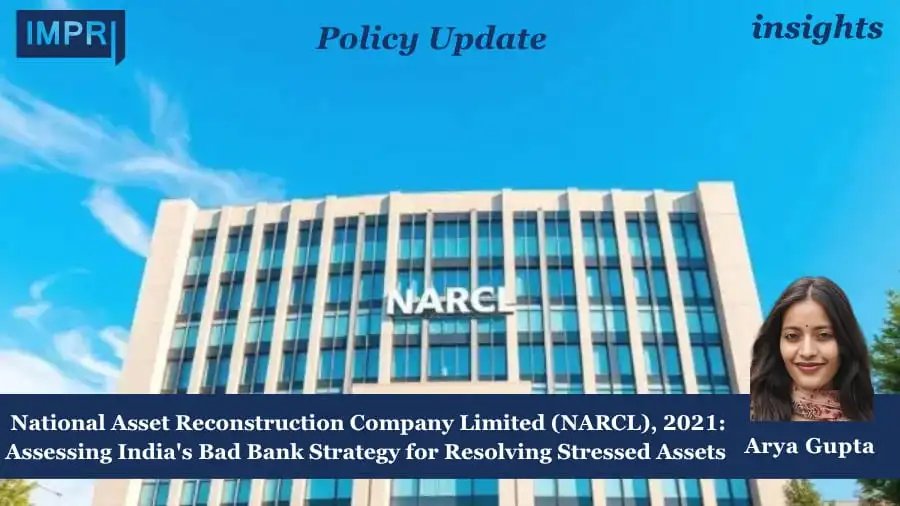
Arya Gupta
Background
In the Economic Survey 2016–17, the idea of a centralised ‘bad bank’ for India was first floated on the background of legacy non-performing assets (NPAs) that had built up in the public sector banks as a result of the infrastructure and corporate loan surge between 2008 and 2014. The idea of a ‘bad bank’ is to buy and manage the stressed assets so that banks can realign their balance sheets and concentrate on their core business of lending and specialised institutions can focus on value recovery.
India already has mechanisms in place to deal with stressed assets like Asset Reconstruction Companies (ARCs) under SARFAESI Act, 2002 and the Insolvency and Bankruptcy Code (IBC), 2016. But these mechanisms were not well suited to handle a multitude of high-value, fragmented legacy stressed assets with involved lenders. Several creditors may make decisions difficult to make and a resolution through the legal and insolvency process may be extended. Therefore, a mechanism was needed to consolidate the huge stressed exposures and be able to resolve them in a more coordinated and specialised way.
The problem is immense as the gross NPAs of the banks stood at ₹8.34 lakh crore at the end of FY21. In this context, Union Budget 2021-22 proposed to set up an Asset Reconstruction Company (ARC) and an Asset Management Company to bring together existing stressed debt and then manage and sell-off such assets for value realization.
The main goal of NARCL is to consolidate and assume large legacy stressed assets from the banks and help to time bound resolution or disposal of the assets, bringing better balance sheets for banks and allowing them to concentrate on new lending. The Department of Financial Services (DFS), Ministry of Finance, has the responsibility of matters pertaining to stressed assets, NPAs and Asset Reconstruction Companies.
The Union Budget 2021-22 has introduced two entities, the National Asset Reconstruction Company Limited (NARCL) and the India Debt Resolution Company Limited (IDRCL), to be used in this context for the purpose of aggregation and resolution of stressed assets. NARCL was incorporated on 7 July 2021 and got its Certificate of Registration as an Asset Reconstruction Company from the Reserve Bank of India on 4 October 2021. The Union Cabinet has agreed to extend the Central Government guarantee of ₹30,600 crore for the Security Receipts (SRs) issued by NARCL for stressed loan assets. NARCL offered to buy stressed assets of the tune of ₹2 lakh crore in phases, with 15% cash and 85% Security Receipts.
2.Functioning
NARCL is more of an asset aggregator and India Debt Resolution Company Limited (IDRCL) offers special expertise for resolution and asset management. The basic mechanism is given by:
Bank / Lender → NARCL → IDRCL → Resolution / Recovery
The banks pass on eligible stressed assets to NARCL, where they are consolidated and purchased by NARCL from various banks. The consolidation is designed to address fragmentation of stressed debt among multiple lenders and to facilitate quicker, more streamlined decision-making. Once acquired, IDRCL helps in deciding and executing resolution strategies, which can be restructuring, enforcement of security, proceedings under Insolvency and Bankruptcy Code (IBC) or sale of the assets to potential investors. The NARCL – IDRCL structure was purposefully created to integrate the concept of asset aggregation and market-oriented resolution expertise to enable better value realisation from stressed assets.
NARCL had proposed a phased purchase of stressed assets of around ₹2 lakh crore, under the regulatory framework of the Reserve Bank of India. The structure of the acquisition is 15% cash and 85% Security Receipts (SRs). In this scheme, the selling banks will get 15% of the agreed value of the acquisition as cash, while the remaining 85% will be disbursed as SRs issued by NARCL. The structure will defuse the immediate cash flow demand on NARCL and enable banks to transfer stressed assets from the banks’ balance sheets.
The SRs provide banks with a claim on the future realisations from the resolution of the acquired assets. The Government of India gave a guarantee of up to ₹30,600 crore to the specified SRs issued by NARCL for a maximum period of five years. The guarantee may be enforced to compensate for the amount short of the face value of the SR that is realised upon resolution or liquidation, on the terms of the guarantee.
NARCL must pay a guarantee fee to the government every year. The guarantee aims to make the SRs more credible and liquid and to mitigate the risk from the non-cash element of the transaction. Meanwhile, the guarantee is based on real shortfalls after resolution or liquidation, not as a lump-sum, which gives the resolution entity and the lenders an incentive to maximise recoveries.
The transfer and acquisition of stressed loans can be based on the Swiss Challenge method, which is aimed at fostering competitive price discovery. The base bid is the first bid made by a prospective buyer for a stressed loan, under this mechanism. Afterwards, the lender opens bids to other qualified bidders. In the event that the original bidder receives a qualifying challenger bid, he/she is given a chance to match or exceed the challenger bid.
Otherwise, the challenger can be the successful bidder. The aim of this competitive process is to make more transparent the price determination and to get the best price for stressed assets. Under the framework of the Reserve Bank of India, certain guidelines have been laid down for the implementation of Swiss Challenge in stressed loan transfers. The RBI framework mandates its use in certain cases, such as in a few transfers where aggregate exposure of the lenders to the borrower is ₹100 crore or more.
NARCL’s acquisition and resolution activities are carried out under the umbrella of the regulation of Asset Reconstruction Companies under the Securitisation and Reconstruction of Financial Assets and Enforcement of Security Interest (SARFAESI) Act, 2002. Securitisation, reconstruction of financial assets and enforcement of security interests are regulated by the Act which lays down the framework for it, and by prudential and operational requirements laid down by the Reserve Bank of India for Asset Reconstruction Companies.
Overall, the functioning of NARCL is based on separating the aggregation of stressed assets from their specialised resolution. NARCL combines the banking industry’s massive legacy stressed assets with IDRCL’s market expertise to resolve them. The 15% cash/85% SR structure along with the government guarantee on eligible SRs are designed to enable the transfer of these assets while the Swiss Challenge mechanism is aimed at promoting competitive price discovery and value realisation.
3.Performance
NARCL has been procrastinating on acquisitions, compared to their own public goals. As of March 2026, NARCL had acquired 33 borrower entities with debt exposure of ₹1,65,862 crore, or about 83% of the planned purchases by FY26, which have been set at ₹2 lakh crore (₹2 trillion) about five years after it was incorporated; the guarantee window for purchases is five years, which is scheduled to expire around 2026-27. Initial concerns by the RBI about the proposed structure added to early delays, which had to be corrected prior to licensing.
| Indicator | Original Target / Design (2021-22) | Latest Available (March 2026) |
| Stressed assets to be acquired | ~₹2 lakh crore, in phases, by FY26 | ₹1,65,862 crore acquired (33 borrower entities); ~83% of target |
| Government guarantee | ₹30,600 crore, valid 5 years (approved Sept 2021) | Guarantee window nearing expiry (~2026-27); invocation conditional on resolution/liquidation |
| Cumulative recoveries | Implied minimum ~18% recovery via guarantee structure | ₹6,345 crore from 23 accounts (>48% of acquisition cost on those accounts; ~3.8% of total acquired debt) |
| FY 2025-26 recoveries | Not applicable (scheme newly launched) | ₹4,364 crore — ~70% of all cumulative recoveries to date |
| Fully resolved accounts | Not applicable | 3 accounts fully resolved, at 148%, 115% and 183% of acquisition cost respectively |
| Operating structure | NARCL (acquisition) + IDRCL (resolution), dual-entity model | Dual structure persists; flagged for operational inefficiency and duplicated cost |
Source: Compiled from Economic Survey 2021-22 (Department of Economic Affairs), Cabinet guarantee FAQ via IBC Laws (2021), Press Information Bureau / Ministry of Finance (2026), Drishti IAS (2025), and ForumIAS (2021).
The recovery numbers call for more careful analysis. The ‘>48% of acquisition cost recovered’ figure is only for the 23 accounts where the recoveries have already been effected and not for NARCL as a whole, which has a total debt exposure of ₹1.65 lakh crore. The three fully resolved accounts are seeing well over 100% recovery of acquisition cost, values that are indeed uplifting and testament to good value-maximisation outcomes but also suggest that the recovery of the portfolio is currently being driven by a few high-performing outcomes and not by a broad-based recovery. This is reflected in the experience of the IBC in its post 2020 recovery trajectory too.
4.Impact
NARCL, against the intent of its creation (to remove legacy stressed assets to make room for PSBs to lend), has given partial, back-loaded results. The fast acceleration in FY 2025-26, where 70% of cumulative recoveries to date were realised, suggests the model is now honing into its operational mode after a slow four-year ramp-up and as seen in early commentaries (ForumIAS, 2021), the price-discovery friction and unwillingness of the secondary market for security receipts were expected to be key risks.
The two risks have both come to pass: NARCL’s transaction pace has been inadequate for the majority of its time in existence, and the disparity in price between NARCL’s offers and banks’ expectations have been cited over and over again as a throttle on transactions.
The evidence on the structural critique that was thrown up at the beginning of NARCL, that a bad bank owned by PSB entities, and which is offering to buy bad debt from PSB entities, is likely to do little more than restructure bad debt from one public-sector book to another, is mixed.
The 148-183% recovery rates on fully recovered accounts are not in favour of pure book shifting, because, in these instances, realised value clearly outstripped acquisition cost. However, the dual NARCL-IDRCL arrangement has introduced operational costs and decision making complexity without any corresponding speed-up in overall pace of transactions and a significant proportion of the initial ₹2 lakh crore target may not be achieved during the five-year guarantee time period.
5.Emerging Issues
- The pace of acquisition and resolution is lagging behind the supposed five-year plan and the window of the government guarantee has been closing down before the target of ₹2 lakh crore is met.
- The NARCL-IDRCL dual entity structure has been identified as inefficient in operation, as it has duplicated costs and as it has depended on consultants to speed up asset liquidation, with no clear evidence that it is doing so more effectively than a single entity integrated structure would do.
- The pricing difference between NARCL’s offers and valuation expectations by selling banks remains a hurdle to transactions, a risk identified at the launch of the scheme in 2021 that has been dubbed ‘price discovery’.
- The majority of NARCL’s ₹1.65 lakh crore acquired book has not yet yielded a reported recovery and, therefore, it’s too early to gauge portfolio-wide value maximisation, with recovery performance being skewed towards a handful of high-yielding, successful resolutions.
- The incentive-alignment problem that originally motivated a centralized bad bank is made all too familiar again here that the public banks may solve debt problems differently when they are mostly buying and selling among themselves.
6.Way Forward
One of the near-term priorities is to address the structural overlap between NARCL and IDRCL that either needs to be tightened and clarified with a time-bound requirement for NARCL to resolve IDRCL or be assessed for a combination of NARCL and IDRCL functions to eliminate duplicated overheads, as some analysts have suggested.
The clarity regarding the path of the GoI guarantee until it expires in five years whether it’s an explicit extension; a gradual wind down of the guarantee; or a public declaration of intent will help alleviate uncertainty for selling banks as well as SR investors and give Parliament and the people a chance to evaluate NARCL’s performance on a refreshed, realistic timeline instead of the original 2021 milestones.
Price-discovery friction that has stymied transactions could be mitigated if more investors participated in the secondary market for security receipts, and if this occurs on more favorable terms for investors, such as disclosure norms, and if there is a larger pool of domestic and foreign distressed-asset investors. Lastly, a clear and regular reporting cycle, publishing the figures in a similar format to that of the Ministry of Finance’s April 2026 disclosure, would allow researchers and policy makers to determine if this year’s increase is a real turning point or a blip at the tail end of a few big accounts.
7.References
National Asset Reconstruction Company Ltd. (n.d.). About Us. https://www.narcl.co.in/en/about-us/
National Asset Reconstruction Company Ltd. (n.d.). What We Do. https://www.narcl.co.in/what-we-do/
Department of Economic Affairs. (2022). Economic Survey 2021-22 [Chapter on Financial Sector, p.154]. Government of India. https://www.indiabudget.gov.in/economicsurvey/ebook_es2022/files/basic-html/page154.html
IBC Laws. (2021). Frequently Asked Questions regarding Central Government guarantee to back Security Receipts issued by NARCL. https://ibclaw.in/frequently-asked-questions-regarding-central-government-guarantee-to-back-security-receipts-issued-by-national-asset-reconstruction-company-limited-for-acquiring-of-stressed-loan-assets/
Press Information Bureau / Ministry of Finance. (2026, April 30). National Asset Reconstruction Company Limited (NARCL) strengthens India’s stressed asset resolution framework, accelerates recoveries in FY 2025-26. Government of India. https://www.pib.gov.in/PressReleasePage.aspx?PRID=2256984®=3&lang=2
Tribune / ANI. (2026, April 30). NARCL reports Rs 4,364 crore recovery in FY26, cumulative recoveries reach Rs 6,345 crore: Govt data. https://www.tribuneindia.com/news/asset-recovery/narcl-reports-rs-4364-crore-recovery-in-fy26-cumulative-recoveries-reach-rs-6345-crore-govt-data
Drishti IAS. (2025). NARCL aims to acquire Rs 2 trillion stressed assets by FY26. https://www.drishtiias.com/daily-updates/daily-news-analysis/narcl-aims-to-acquire-rs-2-trillion-stressed-assets-by-fy26
ForumIAS. (2021). NARCL: Need and challenges. https://blog.forumias.com/narcl-need-and-challenges/
Reserve Bank of India. (2022). RBI Bulletin — reference to NARCL as ‘bad bank’ and government guarantee. https://www.rbi.org.in/Scripts/BS_ViewBulletin.aspx?Id=20814
About the Contributor
Arya is a Research and Editorial Intern at IMPRI Impact and Policy Research Institute, New Delhi, and a Program Coordinator at Metvy. A fourth-year Economics graduate of Shri Ram College of Commerce (SRCC), University of Delhi, Arya’s research interests include Indian political economy, labour markets and development policy.
Acknowledgements
The author thanks the IMPRI review team (Akshat Jangid and Kamatchi Devi) for their comments and guidance on this Policy Update.
Disclaimer
All views expressed in the article belong solely to the author and not necessarily to the organisation.
Read More at IMPRI:
National Mission on Edible Oils-Oilseeds (2024): Boosting India’s Oilseed Production