





Policy Update
Kavin Adithya C.B.
Background
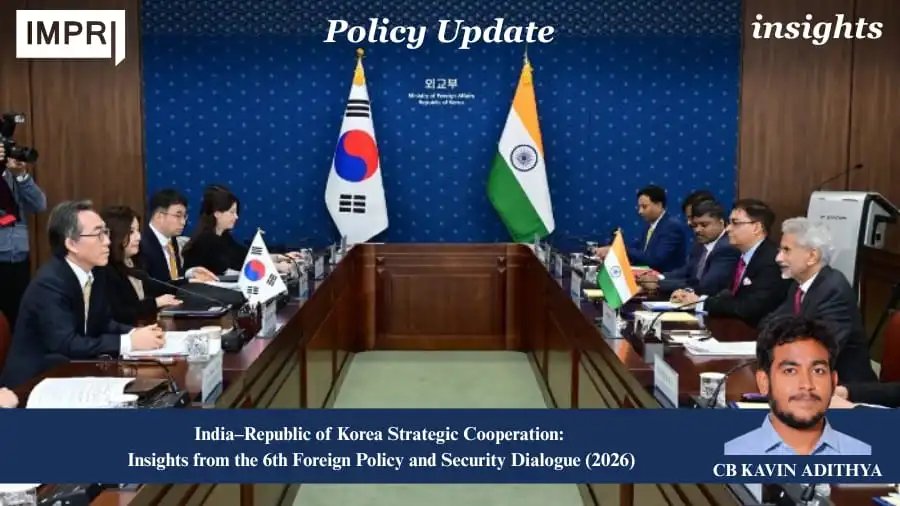
The India-Republic of Korea (ROK) Foreign Policy and Security Dialogue (FPSD) is a formal bilateral mechanism established in 2010 following the elevation of India-ROK relations to a Strategic Partnership. This dialogue was further reinforced when the partnership was upgraded to a Special Strategic Partnership in 2015, creating a platform for regular consultations on foreign policy, regional security, defense cooperation, economic security, and emerging technologies. Since its inception, six rounds of the dialogue have been conducted, with the most recent session held in Seoul on 13 February 2026. This meeting was co-chaired by Shri P. Kumaran, Secretary (East) at the Ministry of External Affairs of India, and Mr. Park Yoon-joo, First Vice Foreign Minister of the Republic of Korea.
The Dialogue is designed to institutionalize strategic consultations, coordinate responses to regional and global issues, and expand cooperation in matters of mutual interest. The 2026 meeting highlighted the growing convergence of India’s Act East Policy and South Korean pragmatic foreign policy in the changing geostrategic paradigm of the Indo-Pacific, amidst technology rivalry and realigning supply chains. Subjects discussed were political relations, defense and maritime co-operation, economic security, critical minerals, semiconductors, artificial intelligence, green hydrogen, shipbuilding, science and technology, and cultural interactions.
Both countries pledged to maintain high-level political contact throughout 2026, including at ministerial level and the Joint Commission Meeting chaired by the respective Foreign Ministers. The main beneficiaries include government agencies, strategic industries, research institutions, defense contractors, technology companies, academic circles, and the general populations of both countries. Therefore, the FIPSD has evolved from a tool for diplomatic consultation to a full-fledged platform to nurture sustained strategic partnership.
Functioning
The Foreign Policy and Security Dialogue (FPSD) functions as the principal institutional mechanism through which India and the Republic of Korea (ROK) periodically evaluate bilateral cooperation and align their strategic objectives. Co-chaired by senior officials from both foreign ministries, the FPSD operates alongside ministerial meetings, defense consultations, and working groups to maintain coherence between political commitments and policy implementation. Rather than an isolated event, the FPSD provides strategic direction for diverse sector-specific mechanisms addressing defense, trade, technology, maritime affairs, science, culture, and multilateral cooperation.
During the sixth session of the Dialogue in February 2026, both governments assessed progress in existing cooperative areas and identified emerging priorities. These priorities encompassed economic security, supply chain resilience, critical minerals, semiconductors, artificial intelligence, green hydrogen, and maritime industries. The Dialogue also facilitated discussions on developments in the Indo-Pacific region, the Korean Peninsula, and multilateral institutions, thereby integrating bilateral cooperation with wider regional security considerations. Subsequent initiatives, such as the proposed India–ROK Economic Security Dialogue, the India–ROK Defence and Foreign Affairs 2+2 Dialogue, the Industrial Cooperation Committee, and the Framework for India–Korea Digital Bridge, exemplify how FPSD decisions are translated into action through specialized institutional channels.
Nevertheless, several challenges hinder effective implementation. Progress depends on sustained political commitment, efficient coordination among relevant ministries, and prompt execution of agreed initiatives. Ongoing trade imbalances, intellectual property rights concerns, disparities in regulatory standards, and the absence of a fully updated
Comprehensive Economic Partnership Agreement (CEPA) represent further barriers to deeper economic integration. Thus, the overall effectiveness of the Dialogue relies on its ability to convert strategic declarations into concrete outcomes, necessitating consistent monitoring and continuous institutional engagement.
Performance
Over the period from 2024 to 2026,India–Republic of Korea Special Strategic Partnership is slowly but steadily progressing in fields like institutional engagement, economic cooperation, defence collaboration and technology partnership. The FPSD is not an independent programme but a coordination mechanism, but it can be evaluated through the quantifiable bilateral outcomes.
| Performance Indicator | 2024–2026 Progress | Importance |
| High-level engagements | 6th FPSD (Feb 2026), State Visit of President Lee (Apr 2026), multiple ministerial meetings | Strengthened strategic coordination and policy continuity |
| Bilateral Trade | Approximately US$27 billion (2025); target of US$50 billion by 2030 | Demonstrates expanding economic partnership despite trade imbalance |
| Defence Cooperation | Continued production of K9 Vajra-T; launch of Korea–India Defence Accelerator (KIND-X) | Promotes defence manufacturing and innovation |
| Technology & Economic Security | Launch of India–Korea Digital Bridge, Economic Security Dialogue, semiconductor and AI cooperation | Expands collaboration in critical and emerging technologies |
| Maritime Cooperation | Adoption of the Comprehensive Framework on Shipbuilding, Shipping and Maritime Logistics | Supports industrial and blue economy cooperation |
| Academic & Cultural Exchanges | Korea Education Centre in India, IIT–KNU10 collaboration, expanded GKS and ICCR scholarships | Strengthens long-term people-to-people engagement |
Source: Compiled by the author from Ministry of External Affairs (MEA), Government of India (2026); Joint Strategic Vision for the India–ROK Special Strategic Partnership (2026–2030); and official India–ROK Trade & Investment data.
However, the above indicators also indicate the transition of the partnership from situation based diplomatic interaction to a multi-sectoral strategic framework. This is reflective of the increasing policy attention that has been afforded towards defence industrial cooperation, digital innovation and technology, maritime engagement and critical technology partnerships in the last 24 months. However, regarding the ongoing trade deficit in Korea’s favour, the delays in upgrading of the Comprehensive Economic Partnership Agreement (CEPA) and a call for early implementation of announced measures are among major concerns. From now on, the focus should be on stopping the provision of new mechanisms and concentrate on effective implementation, concrete results, and a fair sharing of economic benefits between both sides.
Impact
The Sixth Foreign Policy and Security Dialogue marks India’s Indo-Pacific Strategy by taking the India-ROK Special Strategic Partnership to new levels of strategic engagement and cooperation in domains beyond the traditional diplomatic dossiers. The Dialogue process itself has contributed towards building institutional trust through regular political consultations and evolving consensus on economic security, defence-industrial collaboration, critical and emerging technologies, resilient supply chains, and Indo-Pacific stability. This reflects India’s broader geopolitical objective to pursue strategic partnerships under its Act East Policy while reducing its systemic risk exposure by relying less on global supply chains.
The Joint Strategic Vision (2026–2030) will give a much-needed fillip to India-ROK strategic cooperation in semiconductors, artificial intelligence, green hydrogen, shipbuilding, digital infrastructure, climate resilience, and critical minerals. India-ROK defence relations are also expected to shift from being buyer-seller to design-realize relationships, as seen in the K9 Vajra project and Korea-India Defence Accelerator. Moreover, the increased people-to-people exchanges through enhanced higher education, scholarships, cultural ties, and digital payment connectivity will create more regional connectivity.
Convergence at the sub-regional level has allowed India and ROK to promote their common values of a free, open, and rules-based Indo-Pacific, multilateralism, maritime security, and adherence to international law. Despite persistent policy implementation challenges, the foreign policy and strategic dialogue architecture has helped achieve greater policy coherence and institutional resilience, making bilateral ties an increasingly important pillar in the evolving Indo-Pacific security and strategic architecture.
Emerging Issues
Several emerging areas need to be addressed to make India-ROK Foreign Policy and Security Dialogue truly effective in the face of growing strategic convergence.
- Trade deficit: Korean exports far outweigh Indian exports. Both sides need to accelerate CEPA upgrades and remove non-tariff barriers to trade, particularly in pharmaceuticals, engineering, and farm produce.
- Implementation: There is a need to fast-track the implementation of various bilateral initiatives with time-bound targets set by the Joint Commission and working groups.
- Technology transfer: Intellectual property rights (IPRs) continue to be a barrier to greater cooperation in semiconductors and strategic areas. Industry, academia, and governments should explore building trusted partnerships to promote R&D collaborations and licensing arrangements.
- Supply chains: Both countries are concerned about their reliance on a limited pool of suppliers for critical inputs. They should consider alternative sources, including joint ventures, recycling, and investments in exploration.
- Defence industry: Bilateral defence production cooperation should shift from offsets and licensed production to co-development, R&D collaborations, and start-up ecosystems nurtured by the KIND-X platform.
- People-to-people: Enhanced people-to-people contacts through student exchanges, visa facilitation, direct flights, language training, and collaborations at the university level will contribute to deeper engagement.
- Security and strategic issues: Escalating strategic competition in Indo-Pacific waters requires increased strategic interaction, including consultations on maritime security, cyber security, and great power politics, as well as enhanced contributions to multilateralism.
Way forward
The 6th India–Republic of Korea Foreign Policy and Security Dialogue marks a significant milestone to upgrade the bilateral relationship to that of strategic partnership based on a future outlook. The Joint Strategic Vision (2026-2030) provides a comprehensive institutional road map ranging from political dialogue to economic resilience, innovation to defence, climate to people to people connection. It is however, important for us to focus on implementation of the commitments made in the Joint Strategic Vision.
The priorities for India’s engagement with ROK would include, conclusion of negotiations on the upgraded Comprehensive Economic Partnership Agreement (CEPA), building on the India-ROK Economic Security Dialogue, closer strategic cooperation in semiconductors, artificial intelligence, critical minerals, shipbuilding and broader defence industrial cooperation including through joint research and production. There will be a need to mobilize greater commercial, academic, research and start-up ecosystem engagement for realizing the economic growth story as promised by the political leadership.
Enhanced parliamentary diplomacy, academic, cultural and youth engagement initiatives would contribute to the social foundations of strategic partnership.ROK’s deepening strategic engagement with India, particularly in the context of its Act East, Make in India, Aatmanirbhar Bharat and Viksit Bharat 2047 vision to strengthen India’s supply chain security and technological competencies for strategic autonomy, will contribute to mutual strategic advantage. India and the ROK, by pursuing their converging strategic interests, and by ensuring institutional connectivity and strategic trust building measures, can emerge as key partners in enhancing regional stability, prosperity and rules based order in the Indo-Pacific in the years ahead.
References and Important Links
Ministry of External Affairs (MEA). (2026). 6th India–Republic of Korea Foreign Policy and Security Dialogue (FPSD). Government of India.https://www.mea.gov.in/press-releases?dtl/40772/6th_India__Republic_of_Korea_Foreign_Policy_and_Security_Dialogue_FPSD
Ministry of Foreign Affairs, Republic of Korea (MOFA). (2026). 6th Korea–India Foreign Policy and Security Dialogue. Government of the Republic of Korea
.https://www.mofa.go.kr/eng/brd/m_5674/view.do?seq=321217
Press Information Bureau (PIB). (2026). State Visit of the President of the Republic of Korea to India – List of Outcomes. Government of India.https://www.pib.gov.in/PressReleasePage.aspx?PRID=2253896®=3&lang=1
Embassy of India, Seoul. (2026). Joint Strategic Vision for the India–ROK Special Strategic Partnership (2026–2030).
https://www.indembassyseoul.gov.in/pages/NDI38
Tayal, S. R. (2026). India–Republic of Korea Relations: Evolving into a Futuristic Partnership. Vivekananda International Foundation.https://www.vifindia.org/print/14583?slide=%24slideshow%24
Doordarshan News (DD News). (2026). India–South Korea Hold 6th Foreign Policy and Security Dialogue in Seoul.
https://ddnews.gov.in/en/india-south-korea-hold-6th-foreign-policy-and-security-dialogue-in-seoul
The Korea World (TWK). (2026). India–Republic of Korea Strategic Cooperation. https://www.twk.co.kr/news/articleView.html?idxno=1708
About the Contributor
Kavin Adithya C.B. is a Research and Editorial Intern at IMPRI (Impact and Policy Research Institute). He is currently pursuing an M.A. in International Relations at Loyola College, Chennai. His academic and research interests include International Relations, International Political Economy, Defence and Security Studies, Public Policy, Geopolitics, and Human Rights. He is passionate about analysing contemporary global affairs and strengthening his research and policy analysis skills through academic writing and public policy engagement.
Acknowledgement
The author sincerely expresses gratitude to the reviewers and the editorial team for their valuable comments, constructive suggestions, and continuous guidance throughout the preparation of this article. Their insightful feedback significantly enhanced the clarity, organisation, and analytical quality of the manuscript. The author also acknowledges the support and encouragement received during the research and writing process, which contributed to the successful completion of this work.
Reviewers: Divya N and Shivanshi. I sincerely thank the reviewers for their valuable time, careful evaluation, and constructive comments. Their insightful suggestions have helped improve the quality, clarity, and overall presentation of this article. I greatly appreciate their thoughtful feedback and the opportunity to revise the manuscript accordingly.
Disclaimer: All views expressed in the article belong solely to the author and not necessarily to the organization.
Read more at IMPRI:
Transforming India’s Credit Ecosystem through the Unified Lending Interface (ULI)(2025)