







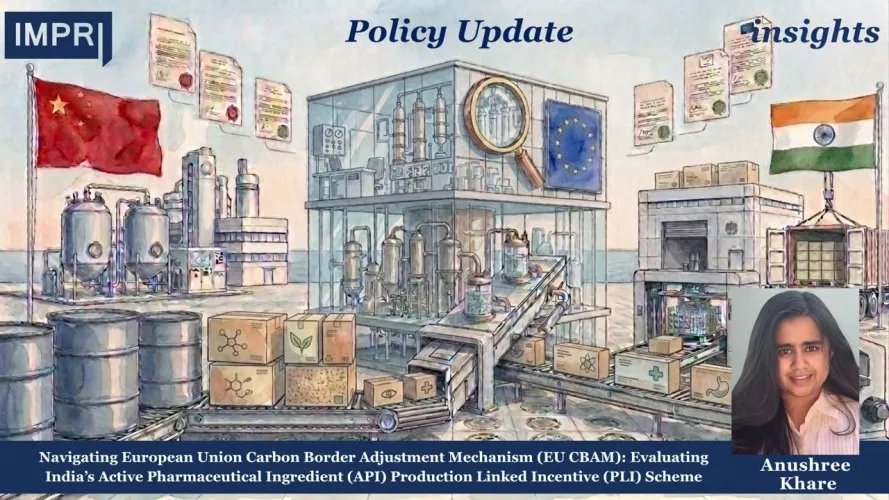
Policy Update
Anushree Khare
Background
The global pharmaceutical sector for decades has been operating with a hyper-specialized and cost-driven business model. Under this approach, western pharmaceutical giants have used their capital to invest in high-margin research and development, patent acquisition and initial clinical design. Simultaneously, capital intensive, environmentally demanding, and low margin segments of manufacturing. Especially the synthesis of key starting materials (KSMs) and active pharmaceutical ingredients (APIs), were successively exported to developing Asian economies with lower overhead costs and more flexible regulatory frameworks.
The global division of labor created India as one of the main manufacturing powerhouses for pharma products by granting it the title of the “Pharmacy of the World.” Today, Indian manufacturers supply about 20 percent of generic medicines by volume globally, and provide significant portions of drug demand both in developed markets such as the United States and emerging countries in Latin America and Africa.
However, these downstream dominance masks a critical structural weakness: finished dose formulation companies in India rely on Chinese chemical producers for almost 70% of bulk drugs and API intermediates. The vast economies of scale and state-subsidized energy infrastructure in China’s centralized chemical parks created a near-monopoly on raw chemical precursors leaving India’s finished formulation engine threatened by upstream supply chokepoints.
This structural vulnerability evolved from a theoretical risk into an immediate crisis as a result of the COVID-19 pandemic on supply chain systems, including export restrictions, factory closures, and fluctuating freight costs which resulted in severe disruptions to intermediate flows. These resulting supply shortages demonstrated how fragile “lean” or single-source procurement models are and showed the need for companies to develop strategic plans to increase their supply chain resilience.
Industry leaders and policymakers recognized that India’s ability to maintain its pharmaceutical sovereignty and remain competitive in exports will require a significant structural shift. Developing a domestic value chain system that is able to withstand internal and external political and environmental shocks by reducing reliance on imports through backward integration and localized manufacturing.
Functioning
The operational design of the PLI uses the analytical model provided by Transaction Cost Economics to modify the boundary-defining governance structures that determine how firms function. Prior to the implementation of the PLI, extremely specific assets, including physical and location-specific assets required for both high-capital fermentation and the complex chemical synthesis associated with drug formulation, discouraged domestic firms from undertaking investments due to the risk of being subject to opportunistic price setting and dumping by foreign monopolists.
The financial distribution mechanism of the PLI serves as an institutional subsidy that absorbs these initial, capital-based asset specificities, thus lowering the transactional friction and investment risk that resulted in domestic firms relying upon outside open-market procurement to acquire their active pharmaceutical ingredients.
From an operational standpoint, the focus on concentrating manufacturing activity into state-sponsored Bulk Drug Parks creates a spatially clustered environment that reduces the transaction costs associated with production. The use of concentrated or “common” utility infrastructures such as shared effluent treatment plants, ZLD systems and shared captive power grids eliminates the search, bargaining and enforcement costs associated with individually contracting for each component of regulatory compliance, waste management and energy acquisition. As such, the previously highly transaction-cost-intensive, bilateral contractual relationships are replaced by standardized public-private provisions for all firms located in a single industrial park, thereby creating a system-wide scale economy.
Additionally, this institutional structure is also designed to mitigate risks associated with environmental measurement costs and informational asymmetries related to international trade. In accordance with Williamson’s TCE view, there are prohibitive monitoring and auditing costs associated with verifying compliance among fragmented, geographically separated supply chains.
The placement of manufacturers in centralized, digitally integrated industrial parks provides a standardized and verifiable method of measuring Scope 1 and Scope 2 emissions at the site of manufacture. This structural alignment will enable Indian manufacturers to substitute opaque, multi-tiered supply chains for auditable, low-carbon provenance thereby protecting their downstream pharmaceutical exports from administrative frictions and border-adjusted carbon compliance penalties abroad.
Emerging Issues
Indian government’s policymakers have continually been focusing on protecting India-based drug manufacturers from various types of risks related to supply chain disruptions caused by geopolitical events or international trade agreements. However, there is another potentially equal structurally disruptive event taking shape in the form of international regulations. Early policy efforts were concentrated on establishing sufficient domestic capability to protect against potential future supply chain disruptions to critical raw materials.
Today however, global trade policies governing physical availability and transportation costs for raw materials are being supplemented with climate-related trade exposure issues. Climate standards and requirements in major western countries now provide a second layer of risk in addition to the traditional costs required to gain market access in those countries.
The European Union has implemented border adjusted carbon pricing to penalize carbon intensive goods entering the EU Single Market. These border adjustments are intended to prevent what is called “carbon leakage,” which occurs when energy-intensive companies move to countries with weaker environmental regulations.
This border adjustment creates a new type of commercial risk associated with the carbon footprint of all goods imported into the EU. By creating a direct monetary penalty based upon the carbon intensity of a product, these border mechanisms create a tangible commercial necessity for environmental compliance as a condition of market access.
Although the initial focus of the EU’s border adjusting mechanism was centered around the carbon intensity of base commodity products such as metals and building materials, it is clear that the regulatory design of the border adjusting mechanism is intended to be applied across multiple layers of the industrial supply chain.
Once fully developed, the compliance regimes associated with the baseline products are expected to extend into higher level industries including high value organic chemicals and specialized functional polymers. In short, the trend of the EU’s border adjusting mechanisms indicates that intermediate goods and downstream chemical derivative products are likely to become subject to the same rigid emission accounting as are primary basic products.
The evolving nature of EU’s policies presents a unique set of operational challenges to the Indian pharmaceutical industry, particularly since many KSMs and APIs synthesized within India remain highly energy and resource dependent. Therefore, Indian pharmaceutical companies may find themselves facing a double bottleneck.
On one hand, they still possess significant vulnerability to upstream chemical dependencies and raw material price volatility; on the other hand, they are at increasing risk of losing their competitive advantage in terms of export prices to their competitors who are able to manufacture their API/KSMs using less energy dependent processes due to international carbon tariffs imposed by western countries that are increasingly penalizing fossil fuel reliant production models.
Impact
Image 1 : Strategic approach to mitigating the risks of combining PLI and CBAM
Combining PLI in India and CBAM in Europe presents an important strategic decision point. If the PLI program simply increases the scale of traditional, fossil fuel-based production of chemicals through its conventional structure, then there is a risk that reliance on imported supplies will be replaced with reliance on European carbon levies. On the other hand, if implemented correctly, the structural mechanism of PLI can provide a means to decrease both supply chain transactions costs and carbon compliance costs at the same time.
While the process described above will not be a cost-free change, continuous flow chemistry, biocatalysis and closed-loop processes all demand substantial initial capital outlay and specialized technological capabilities for which India’s bulk drug sector has limited prior experience. Therefore, it is likely that the very cost pressures which have moved manufacturing to China will also drive production costs upward for Indian manufacturers seeking to decarbonize.
In order to make this de-risking strategy successful, it is assumed that both the subsidy provided by the Production Linked Incentive (PLI) and the economies of scale associated with shared infrastructure will provide sufficient offset against these high capital expenditures so that Indian API manufacturers are able to remain price competitive relative to Chinese competitors while also reducing their reliance on fossil fuels. Whether or not the gamble made in implementing this strategy will pay off will depend upon the extent and length of time over which government incentives are offered and not solely based upon the economics of the technology itself.
Indian pharmaceutical companies must implement a two-pronged de-risk strategy. Companies that manufacture their own KSMs and APIs in Bulk Drug Parks located throughout India will eliminate from their supply chain the opaque supply chains provided by foreign suppliers. Since each of these Bulk Drug Parks has been designed and developed as part of a coordinated effort between central government entities and state government entities, they present a common platform for reducing carbon footprint:
Transitioning to captive solar and wind micro-grids: Reducing the Scope 2 carbon footprint associated with APIs produced in Bulk Drug Parks versus those produced using coal-dependent grids.
Closed-loop waste management and thermal integration: Creating concentrated steam distribution systems and Zero Liquid Discharge (ZLD) effluent treatment facilities to reduce process-related Scope 1 emissions and mitigate environmental damage caused by industrial operations.
Creating Auditable Data Pools: Through concentrating PLI recipients in a limited number of large-scale manufacturing parks, the state of India can create standardized data pools utilizing blockchain technology to track carbon usage across all PLI recipient companies. This removes information asymmetry related to carbon usage from the equation which will make it easier to verify compliance with CBAM requirements when exporting downstream products.
Way Forward
In order to support continued competitive advantage for India’s pharmaceutical sector in an increasingly regulated global environment through evolving carbon regulations, both policy makers and business leaders need to strategically prioritize four key areas:
 Image 2 : Strategic Recommendations and Policy Roadmap
1. Broaden the scope of PLI (Production Linked Incentives) to include carbon-optimal green chemistry: The Department of Pharmaceuticals should develop a “green” PLI tier which would award additional incentives to facilities utilizing continuous flow chemistry, biocatalysis, and enzymatic synthesis. Continuous flow chemistry, biocatalysis, and enzymatic synthesis represent new approaches in green chemistry that significantly decrease energy usage and chemical solvent waste production while minimizing the carbon footprint of production versus traditional batch chemical processes. It would be premature to propose a new green tier until the Department of Pharmaceuticals clearly indicates if this tier will draw from an increased allocation or carve out some portion of existing PLI allocations.
2. Develop a National Carbon Accounting Framework for the Pharmaceutical Industry: India needs to create a standardized, nationally recognized system for conducting Carbon Intensity Audits specifically designed for chemical synthesis. A national registry for carbon intensity audits should be developed in alignment with the EU’s ETS (Emissions Trading System) and CBAM (Carbon Border Adjustment Mechanism), so that domestic producers are able to minimize their own auditing costs and foreign producers are protected from default tariffs based upon non-compliance with regulatory standards. The Department will need to determine which of the currently existing regulatory bodies will be responsible for maintaining and staffing the registry.
3. Utilize captive renewable PPAs to de-carbonize bulk drug parks: State Governments managing designated bulk drug parks (located in Andhra Pradesh, Gujarat and Himachal Pradesh) should require that all shared utility services utilize electricity purchased from dedicated renewable PPAs (Power Purchase Agreements) to position themselves as Net-Zero Chemical Zones thereby providing direct offsets for potential future EU CBAM liabilities for all resident manufacturers. This is going to involve working closely with state electricity distribution companies, each of which manages its own power-purchasing obligations independently of central pharmaceutical policy.
4. Use bilateral trade negotiations to leverage mutual recognition of India’s carbon verification systems: The Indian Ministry of Commerce should use the current free trade agreement (FTA) negotiations with the EU to advocate for mutual recognition of India’s carbon verification systems. Mutual recognition of green certified active pharmaceutical ingredients (APIs) produced by India could help reduce regulatory barriers, enabling India’s bulk drugs to enter the EU single market with fewer administrative barriers. Maintaining sufficient negotiating capacity over time will also be required, as the EU has its own MRV standards and little precedent for recognizing a partner country’s carbon verification system.
Conclusion
The global pharmaceutical industry has entered a period of transformative structural changes. The historical strategy of producing at the lowest possible unit cost of production regardless of supply chain concentration or environmental impacts is now unfeasible. With the EU’s Carbon Border Adjustment Mechanism increasing the price of carbon and the emergence of new geopolitical rivalries exposing weak links within supply chains; maintaining supply chain resiliency and achieving carbon efficiency have emerged as two equally important conditions for gaining access to international markets.
India’s Production Linked Incentives (PLI) for APIs represent a structural government response to the changes occurring in the industry. Using the economics of transactions, it is possible to demonstrate that the PLI incentive scheme provides more than a traditional production subsidy. It represents an institutional solution which reduces transaction costs, hold-ups and informational asymmetries in global pharmaceutical supply chains.
If New Delhi can successfully align its PLI programs with renewable energy utilization and verifiable carbon accounting, India will achieve something far greater than protecting its domestic pharmaceutical industry against external disruptions. It will construct a long-term sustainable and low-carbon basis for producing the chemicals required to fuel the global pharmaceutical market.
References
Bureau of Energy Efficiency. (2023). Carbon credit trading scheme (CCTS). Ministry of Power, Government of India. https://beeindia.gov.in/
Coase, R. H. (1937). The nature of the firm. Economica, 4(16), 386–405. https://doi.org/10.1111/j.1468-0335.1937.tb00002.x
Department of Pharmaceuticals. (2020a). Production Linked Incentive (PLI) scheme for promotion of domestic manufacturing of critical Key Starting Materials (KSMs)/Drug Intermediates (DIs) and Active Pharmaceutical Ingredients (APIs) in India (Gazette Notification No. 31026/16/2020-Policy). Ministry of Chemicals and Fertilizers, Government of India. https://pharmaceuticals.gov.in/
Department of Pharmaceuticals. (2020b). Scheme for promotion of bulk drug parks (Gazette Notification No. 31026/08/2020-Policy). Ministry of Chemicals and Fertilizers, Government of India. https://pharmaceuticals.gov.in/
Department of Pharmaceuticals. (2021). Production Linked Incentive (PLI) scheme for pharmaceuticals (Gazette Notification No. 31026/60/2020-Policy). Ministry of Chemicals and Fertilizers, Government of India. https://pharmaceuticals.gov.in/
European Commission. (2020). Chemicals strategy for sustainability: Towards a toxic-free environment (COM(2020) 667 final). European Union. https://eur-lex.europa.eu/legal-content/EN/TXT/?uri=COM:2020:667:FIN
European Parliament, & Council of the European Union. (2023). Regulation (EU) 2023/956 of the European Parliament and of the Council of 10 May 2023 establishing a carbon border adjustment mechanism. Official Journal of the European Union, L 130, 52–104. http://data.europa.eu/eli/reg/2023/956/oj
Ministry of Commerce and Industry. (2023). Foreign trade policy 2023. Directorate General of Foreign Trade, Government of India. https://dgft.gov.in/
NITI Aayog. (2019). Promoting domestic manufacturing of Active Pharmaceutical Ingredients (APIs). Government of India. https://www.niti.gov.in/
Williamson, O. E. (1985). The economic institutions of capitalism: Firms, markets, relational contracting. Free Press.
About The Contributor
Anushree Khare is a Research & Editorial Intern at the Impact and Policy Research Institute (IMPRI). She holds a B.A. (Hons) degree in Economics with Research. Her academic and professional interests lie in the domains of finance, quantitative research, data-driven policy analysis, and business strategy.
Acknowledgement
The author extends sincere gratitude to the IMPRI team for their guidance and support along with the reviewers Mr. Manish Shinde and Ms. Sandra Menon for their valuable feedback and insights.
Disclaimer
All views expressed in the article belong solely to the author and not necessarily to the organization.
Read More at IMPRI
India’s COP26 “Panchamrit” Climate Pledges (2021) – Progress Scorecard