






Policy Update
Sairaj Patil
Background
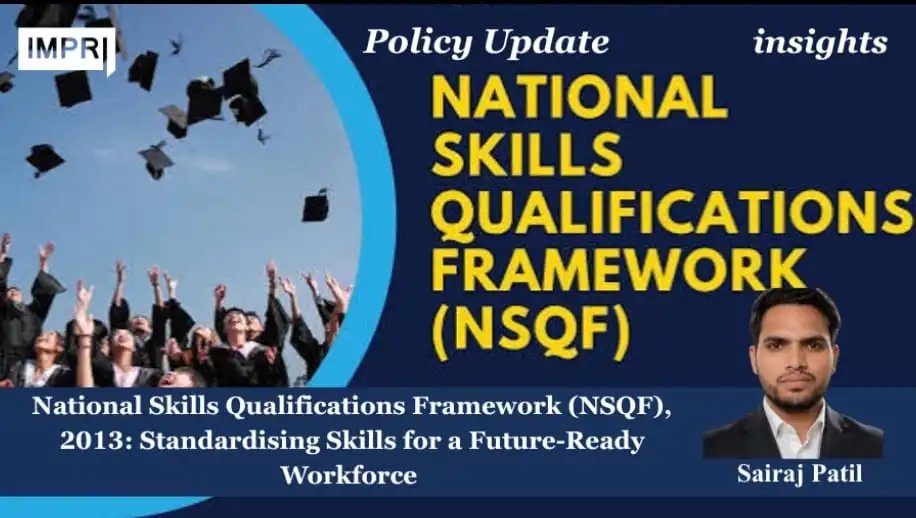
The National Skills Qualifications Framework (NSQF) was launched by the Government of India in December 2013 to address a basic problem: the country had no common way to compare a diploma, an ITI certificate, and skills picked up informally on the job. As an outcome and competency-based framework, NSQF organizes qualifications across a series of levels defined by learning outcomes, the knowledge, skills, and aptitude a person must demonstrate, regardless of whether that learning happened through formal education, non-formal training, or informal experience. This let millions of Indians who had gained skills outside the classroom get that learning formally recognized through Recognition of Prior Learning (RPL).
The framework’s most significant evolution came on 6 June 2023, when it was substantially revised and re-notified in supersession of the original 2013 version, following the introduction of the National Credit Framework (NCrF) in April 2023. Where the 2013 framework organized qualifications across ten rigid levels, the 2023 revision restructured this into eight levels with intermediate half-levels (for example, 2 to 2.5 to 3), a shift designed to reflect how real-world learning actually progresses rather than forcing it into fixed, year-long slots (NCVET, 2026). The National Council for Vocational Education and Training (NCVET), established in 2018, now regulates NSQF implementation, recognizing Awarding Bodies and Assessment Agencies and aligning qualifications through the National Skills Qualification Committee (NSQC).
Functioning
NSQF operates as a regulatory and classification system that other skilling schemes and educational institutions align to, rather than a training program in itself. It functions through the following key elements:
- Level Structure: Following the 2023 revision, NSQF organizes qualifications across a defined sequence of levels: Level 1, Level 2, Level 2.5, Level 3, Level 3.5, Level 4, Level 4.5, Level 5, Level 5.5, Level 6, Level 6.5, Level 7, and Level 8. The half-levels let institutions design shorter, modular courses without forcing learning into rigid year-long slots. Each level is defined by specific learning outcomes covering knowledge, skills, aptitude, and responsibility.
- Regulatory Oversight: The National Council for Vocational Education and Training (NCVET), established in 2018, regulates the entire ecosystem. It recognizes Awarding Bodies, which design and issue qualifications, and Assessment Agencies, which certify that learners have actually met a qualification’s learning outcomes.
- Qualification Alignment Process: New or revised qualifications are submitted for review to the National Skills Qualification Committee (NSQC), a body comprising representatives from key central ministries, state skill missions, and sector-specific stakeholders. Once approved, qualifications are published on the National Qualifications Register (NQR), a public record of all NSQF-aligned qualifications and their accrediting authorities.
- Recognition of Prior Learning (RPL): NSQF allows individuals who gained skills informally, through work, apprenticeship, or life experience, to have that learning assessed and certified against a formal NSQF level, without requiring them to complete a full course from scratch.
- Credit Integration with NCrF: Following the 2023 revision, NSQF levels are harmonized with the National Credit Framework (NCrF), allowing credits earned through vocational or skill-based learning to be accumulated, stacked across short courses, and transferred between vocational and academic streams.
Further details can be found in official NCVET notifications and Ministry of Skill Development and Entrepreneurship releases (Press Information Bureau, 2026).
Performance
Since NCVET’s operationalization in 2018, the qualification alignment process under NSQF has been active and cumulative. As per the minutes of the 43rd NSQC meeting (NCVET, 2025), 8,505 qualifications have been NSQF aligned and approved to date, spanning 59 sectors tracked through the National Qualifications Register (NQR). This breadth suggests NSQF has moved well beyond its early years as a framework covering a handful of pilot sectors; it now functions as a genuinely cross-cutting reference system spanning most of India’s major industries, from manufacturing and healthcare to IT and agriculture.
The framework continues to see regular submissions from Awarding Bodies, though not every submission clears NCVET’s compliance checks. As of February 2025, a total of 353 Qualification Files, National Occupational Standards (NOS), Model Curricula (MC), and Nomenclature Codes (NC) had been received by NCVET. Of these, only 197, about 56%, met the criteria for consideration by the NSQC, while the remaining 156 were held back over compliance issues (NCVET, 2025).
CHART: NSQF Qualification Submissions Reviewed by NCVET, February 2025
Read together, these two figures point to a framework that is wide in reach but selective in growth. The 8,505 aligned qualifications indicate NSQF has achieved substantial cumulative coverage since 2018, yet the roughly 56% first-submission pass rate suggests this scale has not come at the cost of diluted standards, NCVET is evidently applying a real quality filter rather than approving submissions on volume alone. At the same time, the fact that 44% of submissions are held back over compliance issues signals a persistent gap in how well Awarding Bodies understand or can meet NSQF’s documentation requirements, a friction point that likely slows the pace at which new sectors or job roles get formally recognized under the framework.
The NSQC’s regular meeting cadence (NCVET, 2025), evident from recent agenda items covering the reactivation of 99 previously archived qualifications, removal of age criteria from qualification listings except where legally required or for hazardous jobs, and the archival of non-active or expired qualifications, further indicates that implementation is not simply about expanding the aligned pool, but also about actively maintaining its quality and relevance over time. This suggests NCVET treats NSQF less as a one-time notification and more as a continuously managed national asset, though it also means a meaningful share of regulatory capacity goes toward upkeep rather than expansion.
Impact
NSQF’s influence extends well beyond its role as a classification system. Its impact can be traced across four areas: how it has changed the way qualifications are recognized, how it supports labour mobility, how it connects to India’s broader education reforms, and how it has begun shaping international recognition of Indian skills.
- Standardization and Comparability: For the first time, a diploma, an ITI certificate, and skills gained informally through work can be compared on a single scale. This has made it possible for employers, educational institutions, and other skilling schemes such as the Pradhan Mantri Kaushal Vikas Yojana (PMKVY) and the National Apprenticeship Promotion Scheme (NAPS) to reference a common set of levels rather than relying on scheme-specific or institution-specific criteria.
- Recognition of Prior Learning: By allowing informally acquired skills to be assessed and certified against NSQF levels, the framework has extended formal recognition to workers who never went through structured training, an especially significant shift for India’s large informal workforce, where skills are often self-taught or learned on the job. This has translated into concrete, on-the-ground initiatives: under one RPL project run with the New Delhi Municipal Council and funded in part through SANKALP, the Ministry of Skill Development and Entrepreneurship (MSDE) and the National Skill Development Corporation (NSDC) set out to assess and certify the prior skills of 75,000 workers aged 18-45 in the NDMC jurisdiction, aligning their existing competencies to NSQF standards without requiring them to undergo full retraining (PIB, 2022).
- Alignment with NEP 2020 and NCrF: NSQF’s 2023 revision and its harmonization with the National Credit Framework (NCrF) have positioned it as a structural pillar of the National Education Policy (NEP) 2020’s vision of blurring the line between vocational and academic education, allowing credits earned through skill-based learning to count toward broader educational qualifications.
- International Alignment: NSQF has supported efforts to align Indian qualifications with international qualification frameworks, an important step for Indian workers seeking overseas employment and for global employers seeking to verify Indian credentials against familiar standards. For instance, NSQF Levels 5 to 7 have been mapped to European Qualifications Framework (EQF) Levels 5 to 6, roughly corresponding to diploma-to-bachelor’s equivalence, while NSQF Levels 8 to 10 map to EQF Levels 7 to 8, covering master’s to doctoral-level equivalence, though formal mutual recognition agreements between India and the EU have not yet been finalized.
Emerging Issues
While NSQF has succeeded in creating a common language for qualifications across India’s skilling landscape, its implementation still faces structural and adoption-related challenges. These fall broadly into three areas: how consistently the framework’s own quality checks are applied, how well it has actually been adopted by employers and institutions, and how smoothly its recent structural changes and international ambitions are being realized.
- Uneven Compliance Among Awarding Bodies: As of February 2025, 44% of qualification submissions received by NCVET were held back over compliance issues, indicating that a significant share of Awarding Bodies still struggle to meet NSQF’s documentation and validation standards on first submission, a gap that continues to need attention even as the framework’s overall coverage grows.
- Employer Awareness and Recognition Gaps: Despite NSQF’s design as a universal reference framework, awareness remains uneven across India’s employer base. Industry commentary suggests that while large corporations and multinationals are generally aware of NSQF, the vast majority of India’s roughly 63 million MSMEs continue to hire based on informal assessments and personal references rather than NSQF-aligned credentials, limiting the framework’s practical value as a labour-market signal for the segment of employers who dominate India’s workforce.
- Transition Friction from the 2023 Revision: The shift from ten levels to eight, with the introduction of half-levels, requires institutions, Awarding Bodies, and academic regulators to recalibrate existing course mappings, credit structures, and student records, a transition that takes time and may create temporary inconsistencies across the ecosystem.
- Incomplete International Recognition: Although NSQF levels have been informally mapped to international frameworks, such as the European Qualifications Framework (EQF), where NSQF Levels 5-7 correspond to EQF Levels 5-6 and NSQF Levels 8-10 to EQF Levels 7-8, formal mutual recognition agreements between India and counterpart frameworks like the EQF have not yet been finalized, meaning the practical portability of Indian qualifications abroad remains limited despite this conceptual alignment.
- Archival and Maintenance Backlog: Recent NSQC agenda items, including the reactivation of 99 previously archived qualifications and the ongoing archival of non-active or expired listings, indicate that a meaningful share of NCVET’s regulatory bandwidth is spent maintaining and correcting the existing qualification pool rather than expanding it.
- Limited Public Visibility of Outcomes: While the National Qualifications Register (NQR) makes aligned qualifications publicly searchable, there is limited publicly available data on downstream outcomes, such as how many NSQF-certified individuals actually secured employment or wage improvements, making it difficult to assess the framework’s real labour-market impact beyond alignment counts.
Way Forward
Strengthening NSQF’s real-world impact requires coordinated action across the stakeholders who together determine whether the framework translates into genuine employability gains.
- NCVET should simplify the documentation and validation process for awarding bodies without compromising quality checks, reducing the compliance burden currently holding back a substantial share of first-time submissions. Clearer, more accessible guidance during the transition to the eight-level, half-level structure would similarly help Awarding Bodies and academic regulators recalibrate existing course mappings and credit structures with fewer inconsistencies.
- Awarding Bodies and Assessment Agencies should invest in stronger internal documentation practices and seek early guidance from NCVET before submission, rather than treating compliance as a final-stage hurdle, helping shift the current pattern of repeated back-and-forth over incomplete submissions toward smoother first-pass approvals.
- Employers, particularly MSMEs, need targeted outreach and awareness campaigns, potentially led jointly by NCVET, NSDC, and Sector Skill Councils, to close the gap between large corporations’ familiarity with NSQF and the limited awareness among smaller firms that make up the bulk of India’s employer base. Without this, NSQF risks functioning as a credential recognized mainly within government and large-firm hiring, rather than as a genuine, universal labour-market signal.
- MSDE and NCVET jointly should prioritise finalising formal mutual recognition agreements with international counterpart frameworks, building on the existing informal mapping between NSQF and frameworks like the EQF, to convert conceptual alignment into practical portability for Indian workers seeking employment abroad.
- Policymakers and NCVET should move beyond alignment counts toward outcome-linked accountability by publishing data on employment and wage outcomes for NSQF-certified individuals alongside existing statistics on the National Qualifications Register (NQR). This would allow the public and future employers to assess NSQF’s real impact on employability, not just its administrative reach, addressing the current gap in downstream outcome visibility
Selected References and Important Links
- Press Information Bureau. (2024, August 7). National skill qualification framework [Press release]. Ministry of Skill Development and Entrepreneurship, Government of India. https://www.pib.gov.in/PressReleasePage.aspx?PRID=2041498®=3&lang=2
- Press Information Bureau. (2013). National Skills Qualifications Framework [Press release]. Cabinet Committee on Skill Development, Government of India. https://www.pib.gov.in/newsite/PrintRelease.aspx?relid=102050
- National Council for Vocational Education and Training. (2026). NSQF notification. Ministry of Skill Development and Entrepreneurship, Government of India. https://ncvet.gov.in/national-skills-qualification-framework/nsqf-notification/
- National Council for Vocational Education and Training. (2025, May 8). Minutes of the 43rd meeting of the National Skills Qualification Committee (NSQC). Ministry of Skill Development and Entrepreneurship, Government of India. https://ncvet.gov.in/wp-content/uploads/2025/06/MoM-43rd-NSQC.pdf
- National Qualifications Register. (2026). Ministry of Skill Development and Entrepreneurship, Government of India. https://nqr.gov.in
- Press Information Bureau. (2022). Shri Dharmendra Pradhan launches draft of National Credit Framework (NCrF) for public consultation [Press release].Ministry of Education, Government of India. https://www.pib.gov.in/PressReleasePage.aspx?PRID=1869278
About the Contributor
Sairaj Patil is a research intern at the Impact and Policy Research Institute (IMPRI), pursuing a Master’s degree in Political Science. His research interests lie in public policy, skill development and employment, and governance, with a focus on analyzing government schemes and their socio-economic impact.
Acknowledgement
The author extends sincere gratitude to Anushree Khare and Amrutha Lahari Kolluru for their invaluable guidance and support.
Disclaimer
All views expressed in the article belong solely to the author and not necessarily to the organization.
Read more at IMPRI:
The Evolution and Stagnation of Local Governance in J&K through DDCs