









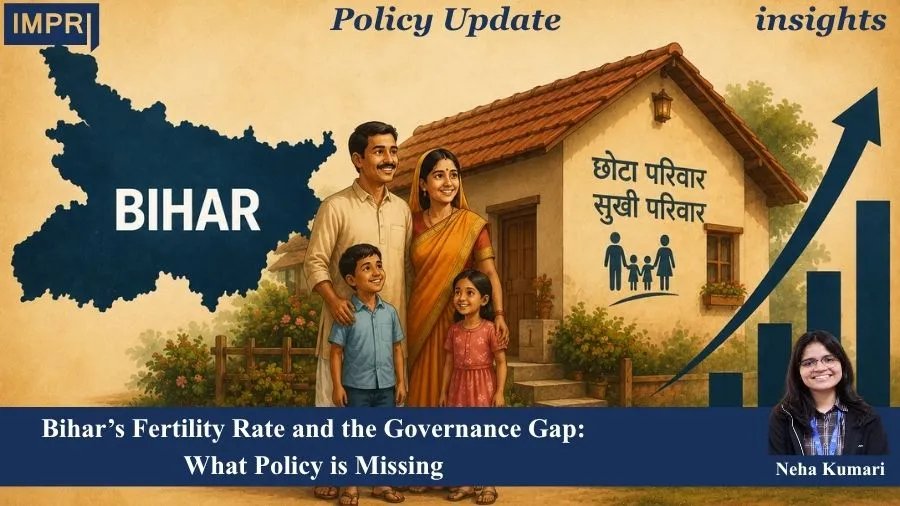
Policy Update
Neha Kumari
Background
Bihar holds a distinction that no state wants. Despite a decline from 3.4 in NFHS-4 (2015-16) to 3.0 in NFHS-5 (2019-21), Bihar still records the highest Total Fertility Rate among all major states in India. The national average has reached 2.0, the replacement level. All other medium and large states in India, those with a population above one crore, now have a TFR below the replacement level of 2.1. Bihar stands alone.
This is not a story about a state that has not tried. Bihar has been a priority target of every major national family planning initiative, from Janani Suraksha Yojana to Mission Parivar Vikas to POSHAN Abhiyaan. It has received significant central funding, repeated policy attention, and near-universal scheme coverage for two decades. And yet its fertility rate remains the highest in India.
The question this article asks is not whether Bihar has schemes. It clearly does but the question is why those schemes are not working and what governance failures lie behind the gap between policy intent and demographic reality.
Table 1: Bihar’s Total Fertility Rate Across NFHS Surveys
| Survey | Year | Bihar TFR | National TFR |
| NFHS-1 | 1992-93 | 4.0 | 3.4 |
| NFHS-2 | 1998-99 | 3.5 | 2.9 |
| NFHS-3 | 2005-06 | 4.0 | 2.7 |
| NFHS-4 | 2015-16 | 3.4 | 2.2 |
| NFHS-5 | 2019-21 | 3.0 | 2.0 |
Source: Economic Survey 2025–26 Statistical Appendix, Table 8.18; Ministry of Finance, Government of India
Bihar’s TFR has declined, but the pace has been insufficient, and the gap with the national average has not meaningfully narrowed. In urban areas, the fertility rate was 2.4, while in rural areas it was 3.1, revealing a stark rural-urban divide that scheme design has not adequately addressed. Unlike most states, Bihar’s urban fertility remained unchanged at 2.4, indicating a slower demographic transition in urban areas compared to other states.
Functioning
The central and state governments have implemented multiple schemes specifically targeting Bihar’s demographic challenge.
Janani Suraksha Yojana (JSY, 2005): JSY focuses on poor pregnant women, with Bihar specifically named as a low-performing state warranting special attention. Cash incentives of ₹1,400 per institutional delivery in rural areas are provided to women, alongside an ASHA package of ₹600. Expenditure on JSY has increased from ₹38 crore in FY 2005-06 to ₹1,814 crore in FY 2023-24, a 47-fold increase in funding over two decades, making it one of the largest maternal health investments in India’s history.
Mission Parivar Vikas (2016): The mission covers 146 high-priority districts across seven states, including Bihar, which collectively account for a disproportionate share of India’s population growth. Its stated goal was to achieve a replacement-level fertility rate by 2025, a target Bihar has clearly not met.
POSHAN Abhiyaan: A national nutrition mission targeting maternal and child health outcomes, with Bihar as a priority state given its high rates of anaemia and malnutrition cases among women and children. Bihar remains among the worst-performing states for child stunting nationally.
Mukhyamantri Kanya Utthan Yojana (Bihar State Scheme): The scheme provides financial assistance of ₹54,100 from the birth of a girl child to her graduation, designed to incentivise girl child education and delay early marriage. NFHS-5 data indicates stark realities regarding female education in Bihar; while every state in the country has improved its overall literacy, Bihar remains at the bottom of the list.
ASHA Worker Network: Accredited Social Health Activists form the critical frontline link between government schemes and rural women. They are tasked with motivating institutional deliveries, encouraging family planning, tracking immunisation, and improving awareness about nutrition and sanitation. Their effectiveness, or lack of it, directly determines whether any scheme reaches the last mile.
Performance
The schemes have produced measurable results in some areas while falling significantly short in others.
Table 2: Bihar’s Key Social Indicators vs. National Average (NFHS-5)
| Indicator | Bihar | National Average |
| Total Fertility Rate | 3.0 | 2.0 |
| Female Literacy Rate (women 15-49) | 55% | 71% |
| Child Marriage (women aged 20-24 married before 18) | 40.8% | 23.3% |
| Institutional Delivery | 75.9% | 88.6% |
| Family Planning Prevalence (modern methods) | 55.8% | 56.5% |
| Teenage Pregnancy | 11% | 7.9% |
| Spousal Violence (married women) | 40% | 29.3% |
Source: NFHS-5 (2019–21), International Institute for Population Sciences (IIPS), Mumbai
JSY has successfully increased institutional deliveries in Bihar to 75.9%, a genuine improvement from near-zero baseline levels twenty years ago. Family planning prevalence has risen dramatically from 24.1% in NFHS-4 to 55.8% in NFHS-5. These are real gains and should be acknowledged as such.
But they have not been enough. If all women were to have only the number of children they wanted, the total fertility rate would have been 2.3 children per woman instead of the current level of 3.0, indicating a significant unmet need for family planning that existing delivery mechanisms are failing to address. The gap between desired and actual fertility is not a cultural preference for large families. It is a governance failure.
Table 3: State Comparison: Fertility Rate and Female Literacy (NFHS-5)
| State | TFR | Female Literacy (%) |
| Bihar | 3.0 | 55% |
| Uttar Pradesh | 2.4 | 66% |
| Rajasthan | 2.0 | 57% |
| Tamil Nadu | 1.8 | 80% |
| Kerala | 1.8 | 95% |
| National Average | 2.0 | 71% |
Source: NFHS-5 (2019–21), IIPS Mumbai; Economic Survey 2025–26
The pattern is consistent and difficult to ignore: states with higher female literacy consistently record lower fertility rates. Bihar’s 55% female literacy rate, against a national average of 71%, is not incidental to its 3.0 TFR. It is central to it.
Impact
Bihar’s persistent high fertility rate has consequences that extend well beyond demographics, into governance, economics, and national policy in ways that are rarely discussed together.
The most immediate impact is on public services. Bihar’s population continues to grow faster than any other major state, putting sustained pressure on schools, hospitals, water supply, and employment. This creates a vicious cycle: high fertility produces resource pressure, resource pressure weakens governance capacity, and weak governance capacity makes it harder to reduce fertility. The state struggles to invest adequately per citizen not because it lacks resources in absolute terms but because its population growth outpaces whatever it invests.
The social data from NFHS-5 adds another layer. Approx 40.8% of women in Bihar are married before 18 years, giving it the second-highest child marriage rate after West Bengal. The literacy rate among women aged 15-49 in Bihar is only 55 percent. Bihar also reports 11% teenage pregnancies against a national average of 6.8%. These numbers are not separate social problems; they are the structural foundations of high fertility.
There is also a national political dimension that rarely makes it into policy discussions. When parliamentary constituency boundaries are redrawn, and the freeze on delimitation is expected to lift after 2026, states with high populations will gain Lok Sabha seats while southern states that successfully reduced their fertility will see their representation decline. Bihar’s fertility rate, in other words, has direct implications for India’s democratic architecture. States that invested in demographic transition are structurally penalised for their success. The findings underline that demographic transition alone cannot ensure human development without simultaneous investments in education, women’s empowerment, healthcare, nutrition and social awareness.
Emerging Issues
Despite decades of scheme implementation, several structural problems continue to undermine Bihar’s family planning outcomes.
The ASHA Worker Infrastructure Gap
The Bihar government announced the recruitment of 27,375 ASHA workers in 2025, twenty years after JSY was launched. The scale of this recruitment tells its own story. ASHA workers are supposed to be the backbone of Bihar’s health delivery system, yet thousands of positions remain vacant or frequently turn over.
A 2018 study of ASHA workers in the Siwan district, Bihar, found that workers from lower socio-economic backgrounds were completing more family planning targets not because of better training or motivation, but because they needed the incentive payments to support their own families, revealing a perverse incentive structure at the core of scheme delivery (Mankar & Sagar, 2018). In many households, mothers-in-law control access to healthcare workers like ASHA, limiting exposure to family planning services. Even where workers are present, social and patriarchal structures limit their effectiveness in ways that recruitment numbers cannot fix.
Institutional Delivery Without Follow-Through
JSY has genuinely increased institutional deliveries. But institutional delivery alone does not reduce fertility, and this is where Bihar’s implementation gap is most damaging. The critical post-delivery family planning counselling, where women are informed about contraception and birth spacing, is largely absent across Bihar’s primary health centres. A woman can deliver in a government facility and leave without a single conversation about spacing her next pregnancy. That is not a scheme design failure but a delivery quality failure.
Child Marriage: The Self-Perpetuating Cycle
Child marriage remains one of Bihar’s biggest social challenges, with 40.8% of women in the age group of 20–24 marrying before 18 years. What makes this particularly damaging is how it compounds across generations. A girl who marries at 16 has children earlier, has more children, and raises daughters with lower education, who are then more likely to marry young themselves.
Multiple regression analysis indicates that a one-year increase in the education of girls leads to a higher age at marriage by 0.36 years, after controlling for wealth index and place of residence. Despite this evidence, only 19 cases were registered under the Prohibition of Child Marriage Act between 2020 and 2024 in Bihar – revealing the enormous gap between law on paper and enforcement on the ground.
Female Literacy: The Root That Everything Grows From
NFHS-5 data reveals that in Bihar, women’s literacy rate is 55% compared to 76.4% for men aged 15-49 years, a gender gap of 21.4 points that demands immediate attention. Female literacy is not an education metric that sits separately from fertility; it is the single most important structural driver of fertility outcomes. Educated women marry later, use contraception more effectively, have fewer children, and navigate healthcare systems more successfully. Bihar’s gender literacy gap is not a social welfare concern alone. It is the root cause of its demographic crisis.
NFHS-5 data shows girls who should be pursuing education aged 15-19 are found to be getting married and having children at that age. Overall, Bihar reports 11% of teenage pregnancies compared to the national average of 6.8%.
Weak State Capacity
There is a harder truth underneath the scheme failures. Bihar’s administrative capacity to translate policy design into ground-level outcomes is genuinely constrained. High-performing states like Tamil Nadu and Kerala did not reduce their fertility rates primarily through family planning campaigns; they reduced it through sustained, multi-decade investment in female education, functional public health infrastructure, and local governance that actually worked. Bihar has not built these institutional foundations. Without these, even well-designed schemes become paper commitments.
Way Forward
Bihar’s fertility challenge will not be solved by launching new schemes. It will be solved by fixing the governance failures that are preventing existing schemes from working and by addressing the structural drivers that no scheme has seriously touched yet.
Fix ASHA Infrastructure Before Adding More Schemes: The recruitment of 27,375 ASHA workers in 2025 must be followed by genuine investment in training, incentive restructuring, reduced turnover, and protection from social pressure. Numbers matter, but quality of deployment matters more. An untrained ASHA worker in a household where the mother-in-law controls healthcare decisions is not a functioning frontline worker.
Treat Female Secondary Education as a Fertility Intervention: Every year a girl stays in school beyond Class 8; it reduces her likelihood of early marriage and increases her likelihood of having fewer children. Bihar needs girls’ secondary schools accessible in every panchayat, with hostels and safe transportation for girls from remote areas. The Mukhyamantri Kanya Utthan Yojana’s financial incentives are a good start, but incentives to attend schools only work when schools exist within reach.
Enforce Child Marriage Prevention With Real Consequences: Only 19 cases were registered under the Prohibition of Child Marriage Act in Bihar over four years, a figure that reveals just how hollow enforcement has been. District-level Child Marriage Prohibition Officers with genuine authority, coordination with Panchayati Raj institutions, and community accountability mechanisms are needed. Awareness campaigns alone have demonstrably not worked.
Integrate Post-Delivery Family Planning Counselling Into JSY: Every institutional delivery in Bihar should be followed by mandatory, trained counselling on contraception and birth spacing before the woman leaves the facility. This does not require a new scheme or a new budget line. It requires improving delivery quality within an existing one, which is precisely the kind of governance intervention Bihar most needs.
Strengthen Panchayati Raj as a Genuine Governance Vehicle: Women’s reservation in Bihar’s Panchayats exists on paper, but elected women representatives are frequently proxies for male family members with no independent decision-making authority. Real women’s participation in local governance requires literacy support, legal protection, and sustained capacity building over years, not election cycles.
References
International Institute for Population Sciences (IIPS) and ICF. (2021). National Family Health Survey (NFHS-5), 2019–21: Bihar. Mumbai: IIPS. https://dhsprogram.com/pubs/pdf/FR374/FR374_Bihar.pdf
Ministry of Finance, Government of India. (2026). Economic Survey 2025–26 Statistical Appendix: Table 8.18 — Total Fertility Rate across States and UTs of India. https://www.indiabudget.gov.in/economicsurvey/doc/stat/tab8.18.pdf
National Health Mission, Ministry of Health and Family Welfare. (n.d.). Janani Suraksha Yojana. Government of India. https://nhm.gov.in/index1.php?lang=1&level=3&lid=309&sublinkid=841
UNFPA India. (2022). Child marriage in Bihar: Key insights from the NFHS-5 (2019–21). https://india.unfpa.org/sites/default/files/pub-pdf/analytical_series_1a_-_child_marriage_in_bihar_-_insights_from_nfhs-5_final_2.pdf
UNFPA India. (n.d.). Concurrent assessment of Janani Suraksha Yojana (JSY) in selected states. https://india.unfpa.org/en/publications/concurrent-assessment-janani-suraksha-yojana-jsy-selected-states
Centre for Development Policy and Practice. (n.d.). Policy brief: Female literacy in the state of Bihar. https://www.cdpp.co.in/articles/policy-brief-female-literacy-in-the-state-of-bihar
PRS Legislative Research. (n.d.). Vital stats — National Family Health Survey 5. https://prsindia.org/policy/vital-stats/national-family-health-survey-5
Mankar, D., & Sagar, N. (2018). A study of ASHA workers achievement with respect to family planning. Abhinav: International Monthly Refereed Journal of Research in Management & Technology, 7(10).
Pauljoseph, A. H., & Ragavane, P. (2025). Bridging the gaps in Janani Suraksha Yojana: Addressing challenges through innovative solutions. Journal of Family Medicine and Primary Care, 14(7). https://pmc.ncbi.nlm.nih.gov/articles/PMC12349832/
Global Alliance Against Hunger and Poverty. (2025). India: Safe motherhood scheme — Janani Suraksha Yojana (JSY). https://globalallianceagainsthungerandpoverty.org/country-example/india-safe-motherhood-scheme-janani-suraksha-yojana-jsy/
About the Contributor
Neha Kumari is a Research and Editorial Intern at IMPRI and a first-year M.A. student in Defence and Strategic Studies at the Central University of Gujarat. She holds an undergraduate degree in Social Management from the same university. Her research interests include governance, public policy, national security, and India’s foreign policy.
Acknowledgements
I would like to express my sincere gratitude to IMPRI for providing me the opportunity to prepare this article and for fostering a rigorous learning environment that connects research with public policy practice. I also extend my sincere thanks to Raushan Kumar and Vinita Sharma for their valuable feedback.
Disclaimer:
All views expressed in the article belong solely to the author and not necessarily to the organisation.
Read More at IMPRI:
The Malabar Salinity Frontier: Policy Blind Spots in Non-Kuttanad Estuarine Agriculture