






Policy Update
Ayan Bordoloi
Background
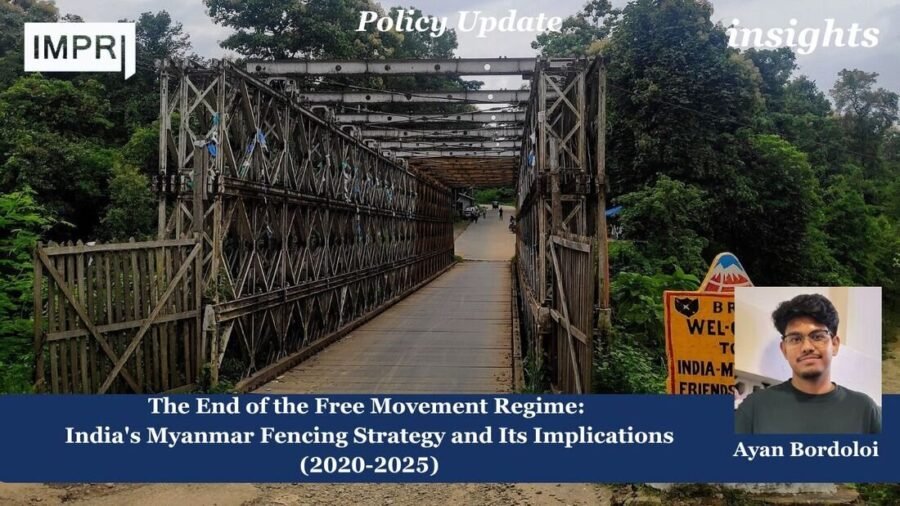
The 1643 km India-Myanmar border which traverses through Arunachal Pradesh, Nagaland, Manipur and Mizoram was not bounded by walls but by kinship for more than 70 years. Established under the Passport Rules of India, in 1950 and further codified, the Free Movement Regime (FMR) permitted communities within a certain radius of the Border to cross the border without visa.The Free Movement Regime (FMR) was introduced through changes in the Passport Rules of India in 1950 and formalised in further detail since the exemption of border tribes in Myanmar in 1948.
The agreement took cognisance of the fact that boundaries drawn during colonial times had divided the Naga, Kuki-Chin-Mizo and other people into two different states irrespective of the ethnic geography. The regime has permitted the tribesmen to cross into the other country and remain within its territory for 72 hours in India and 24 hours in Myanmar and have allowed them to bring limited quantities of goods (earlier they had been able to bring 40km, now 16km). In 2018 a Land Border Crossing Agreement was also finalised and the system of passing through the border was formalised with a limit of 14 days for each crossing point.
Two shocks occurred in 2021-23 that shook the foundations of the regime. Since the military coup in Myanmar in February 2021, about 78,000 Chin and Sagaing people have entered Mizoram and Manipur, including tens of thousands who came since the coup.Tens of thousands of Chin and Sagaing people entered Mizoram and Manipur from Myanmar since the military coup in February 2021, with estimates reaching over 78,000. Later the May 2023 ethnic conflict in Manipur, that claimed over 260 lives and displaced over 50,000 people, reinforced the Government of India’s stance that an open border was adding to its internal security dilemma.
In February 2024, the Union Home Minister Mr Amit Shah announced that the government would do away with the FMR, due to the fear of the open border being exploited by the insurgents, drug cartels and undocumented migration. The Cabinet Committee on Security gave in-principle approval for a 10-year, ₹31,000-crore plan to fence and build patrol roads along the entire border in September 2024—signifying the most significant change in India’s Northeast border management policy in decades.
Functioning
There are three institutional pillars underpinning the post-2024 border architecture. First, rather than an immediate and complete withdrawal of free movement, the Ministry of Home Affairs opted to regulate it: new rules replaced the FMR with a biometric, QR-coded border-pass system that came into effect in December 2024, under which Assam Rifles personnel record biometrics and issue passes to residents within 10 km of the Manipur-Myanmar border, with all documentation uploaded to the Land Ports Authority of India’s portal for centralised monitoring. Second, physical construction is proceeding unevenly across the four border states: in Manipur, the Border Roads Organisation is implementing fencing under “Project Sewak,” while in Arunachal Pradesh and Mizoram, survey work is still ongoing.
Because the difficult, forested terrain in Arunachal Pradesh and Manipur makes conventional fencing impractical, planners have piloted a Hybrid Surveillance System that combines sensors, night-vision cameras and physical barriers across one-kilometre stretches, operating under the oversight of the Home Ministry. Third, a proposed Indo-Myanmar Border Force of 29 battalions—comprising 25 battalions of Assam Rifles and 4 of the Indo-Tibetan Border Police—is intended to eventually take over the Border Guard Corps’ responsibility for guarding the Indo-Myanmar border, consolidating command of the frontier under a single dedicated force.
Implementation, however, has been patchy and politically fraught. The state assemblies of Mizoram and Nagaland have adopted resolutions opposing fencing and the abrogation of the FMR, while Manipur and Arunachal Pradesh have endorsed the Centre’s stance, reflecting a sharp Centre-state and inter-state divide over the policy. This disagreement has translated into real conflict on the ground: Mizoram refused to deport Myanmar refugees, instead sheltering them and providing healthcare, schooling and other services, even as New Delhi insisted on their biometric registration; in Manipur, by contrast, deportation processes began even before conditions in Myanmar had stabilised, underscoring how the same national policy has produced starkly different outcomes depending on the state administering it.
Performance
The overall project of fencing is still in its early stages, as evidenced by its status as an “early” project. At present (2025), only 30 km of the 1,643-km border (less than 2 per cent) has been physically fenced and in the Manipur border area this is only at a stretch of about 10 km in Moreh in Manipur, along with the two 1-km hybrid surveillance pilots.
The timeline set by the Border Roads Organisation itself puts the completion of the work till 2035-36, which is a huge challenge with respect to the more advanced fencing programmes in the Pakistan and Bangladesh borders, where the fence is over 60 per cent complete. The outlay of ₹31,000 crore was approved in September 2024 and the disbursement and land-acquisition processes have been slow in the hill areas where customary and community land tenure holds significant sway.
Figure 1: India’s Border Fencing Progress — A Comparative Snapshot (as of 2025). Source: Author’s compilation based on CSEP (2025), Fencing, Security and Border Management: The Indian Experience; and PIB/Ministry of Home Affairs, Lok Sabha reply on India-Bangladesh border fencing (2025).
In terms of regulation, the border-pass regime is a more tangible change which came into effect in December 2024: previously, movement was informal and undocumented, but is now, in principle, processed through 43 fixed points, with biometric verification. However, independent reports have pointed out that the main reason for the fence — to stop insurgents from moving and narcotics traffickers — has yet to show tangible results: The fence has been built up through forested, hilly areas where the effective control of ethnic armed groups like the Arakan Army is maintained, and where Indian security agencies have limited visibility.
Impact
The policy change is having dramatic effects on security, and dramatic effects on social issues. In terms of security, officials say the open border has been a source of trouble for India as insurgents have been able to infiltrate into India and come back to Myanmar, and the lack of fixed checkpoints has provided opportunities for drug syndicates to operate. They see the withdrawal of the FMR and the planned fencing as corrective measures to the problem, especially after the Manipur conflict has revealed how fast cross-border dynamics can exacerbate an internal ethnic conflict.
Table 1: Myanmar Refugees Sheltered in Indian Border States (Since the February 2021 Coup)
| Host State | Myanmar Refugees Sheltered | Share of Total |
| Mizoram | 40,000+ | ~51% |
| Manipur | 8,250+ | ~10% |
| Other states / unaccounted | ~30,480 | ~39% |
| Total (since Feb 2021 coup) | 78,731 | 100% |
Source: Author’s compilation based on Discover Public Health (Springer Nature, 2024), “India’s refugee policy dilemma and its impact on Myanmar refugees at the India-Myanmar frontier,” citing Government of India and UNHCR-referenced estimates as of 2023. Figures for “other states/unaccounted” are derived residually and are approximate; state-wise numbers have likely risen further amid continuing conflict in Myanmar through 2024-25.
The social and humanitarian repercussions have been significant, however. The FMR did not represent a matter of convenience for the border communities (the Nagas, Kuki-Chin-Mizo and Kachins, etc.), but rather a reflection of their shared pre-national identity. The elimination of this has happened as a sudden break in familial relations, in the informal trading of commodities like rice, bamboo and motorbikes, cross-border education, and healthcare access.
This has led to persistent civil society mobilisation, including a petition by the United Naga Council to Union Home Ministry in mid-2025; mass rallies in Aizawl in January 2025 demanding that the new border-pass rules be scrapped, with some youth leaders warning of a resort to militancy if fencing proceeded without consultation; and a claim by the Kachin Women’s Students’ Association and others that the move infringes on an ethnic “birthright” to an contiguous homeland.
Aside from India, the impact has been felt beyond the borders: In May 2025, the Myanmar government’s National Unity government strongly demanded India to halt fencing on the areas where the border has not been officially demarcated and there was an escalation in tensions as the Assam Rifles clashed with armed groups of Myanmar’s anti-junta civil war group People’s Defence Force in May 2025, killing 10 of them attempting to disrupt the fencing work.
Emerging Issues
There have been a number of structural issues that have emerged in the 2020-2025 period. The first is a legal and constitutional issue with regard to the sovereign rights of the Centre and the rights of the tribal communities of Northeast to protection of the customary practices, as guaranteed by Article 371A, Article 371G and Sixth Schedule of the Constitution of India, which will be affected by the fencing project, unless the project is carried out with full consultation.
Second, the unilateral suspension of the FMR is problematic in terms of diplomatic etiquette as it is a bilateral arrangement; and because of the fragmented nature of the Government in Myanmar, the Indian government will simultaneously have to deal with the military junta, the NUG and ethnic armed organisations that run the border region.
Thirdly, the topography itself – the elevated terrain in some areas rising above 6,000 metres, the high percentage of forest cover and the lack of infrastructure for transportation – also make traditional fencing technically challenging and has encouraged planners to adopt more expensive hybrid surveillance systems that have not yet proven their scalability.
Fourth, the political economy of implementation is further complicated by the Centre-state divide: Mizoram and Nagaland, which have been withholding support to support the land acquisition, could stall the same fencing that the CCS has approved.
Lastly, research institutes like the Centre for Land Warfare Studies have warned that blanket fencing or even outright withdrawal from the FMR is not a silver bullet, as both these extremes could have the effect of hurting livelihoods, education, healthcare access while not proportionately hurting trafficking or infiltration of insurgents.
Way Forward
The Indian strategy should be more nuanced, based on evidence, and not an either-or scenario of an open border or a tough fence. The priorities should be the Hybrid Surveillance System (HVS) with sensors, cameras and modular barriers in the most inaccessible mountainous areas, to achieve better security Returns on Investment (RoI) and minimise the environmental and social impact of fencing.
The 43 point biometric border-pass mechanism that was introduced in December 2024 should be examined transparently with the state governments and tribal councils to expand its coverage area and make documentation of genuine kinship and livelihood crossings easier, to ensure that regulation is not turned into a de facto closure.
The Nagaland state government, the Mizoram state government, the Autonomous Councils and civil society organisations like the United Naga Council and Zo Reunification Organisation have constitutionally defined roles in customary governance and should be consulted before further acquisition of land.
On the external front, India must have a calibrated diplomatic dialogue mechanism to involve all the Myanmar-side authorities, particularly those from ethnic armed groups in border tracts responsible for flashpoints like what happened in May 2025 and protect the larger interest of the Act East Policy, in which Myanmar still has only one land gateway with India.
At last, there is an opportunity for India to make sustained investments in the surveillance and speedy response capacity of the Assam Rifles, along with humanitarian protocols for those refugees who have been crossing the Indo-Myanmar frontier in response to the civil war in the latter, and solve its legitimate security needs without compromising the historic bonds that have always existed on the borders of the Northeast.
Selected References and Important Links
Ministry of Home Affairs (2024), Free Movement Regime with Myanmar, Government of India. Available at: https://www.pib.gov.in/PressReleasePage.aspx?PRID=2003884
Das, P. (2024), Free Movement Regime: A Unique Feature of the India-Myanmar Border, Manohar Parrikar Institute for Defence Studies and Analyses (MP-IDSA). Available at: https://www.idsa.in/publisher/comments/free-movement-regime-a-unique-feature-of-the-india-myanmar-border
Pant, H.V. and Banerjee, S. (2024), Fencing frontiers with Myanmar: The benefits and challenges of FMR along India-Myanmar border, Observer Research Foundation. Available at: https://www.orfonline.org/research/fencing-frontiers-with-myanmar-the-benefits-and-challenges-of-fmr-along-india-myanmar-border
CSEP (2025), Fencing, Security and Border Management: The Indian Experience, Centre for Social and Economic Progress. Available at: https://csep.org/blog/fencing-security-and-border-management-the-indian-experience/
MP-IDSA (2025), The Indo-Myanmar Border Fence: Challenges and Way Forward. Available at: https://www.idsa.in/publisher/comments/the-indo-myanmar-border-fence-challenges-and-way-forward
Asian Confluence (2025), Securing the Northeast: India’s Border Fence with Myanmar. Available at: https://www.asianconfluence.org/publication-details-full/securing-the-northeast-india-s-border-fence-with-myanmar
The Diplomat (2025), Scrapping the Free Movement Regime With Myanmar Has Created Challenges for India. Available at: https://thediplomat.com/2025/02/scrapping-the-free-movement-regime-with-myanmar-has-created-challenges-for-india/
Oxford Border Criminologies Blog (2025), The end of the India-Myanmar Free Movement Regime: looking at cross-border trade, kinship, and security. Available at: https://blogs.law.ox.ac.uk/border-criminologies-blog/blog-post/2025/06/end-india-myanmar-free-movement-regime-looking-cross
BorderLens (2025), The India Myanmar border and the future of free movement. Available at: https://www.borderlens.com/2025/08/22/the-india-myanmar-border-and-the-future-of-free-movement/[1]
About the Contributor
Ayan Bordoloi is an intern with IMPRI, currently pursuing his master’s in political science at the University of Delhi. His research interests lies in federalism, tribal governance, and Northeast India’s political landscape.
Acknowledgement
The author extends sincere gratitude to the IMPRI team for their guidance and support, along with the reviewers Simona Hughes and Gautam Shine for their valuable feedback and insights.
Disclaimer: All views expressed in the article belong solely to the author and not necessarily to the organisation.
Read More at IMPRI:
Production Linked Incentive (PLI) Scheme for Telecom and Networking (2025)
iGOT Karmayogi: Digital Capacity Building for Civil Servants and Its Future