






Policy Update
Simona Miriam Hughes
Background:
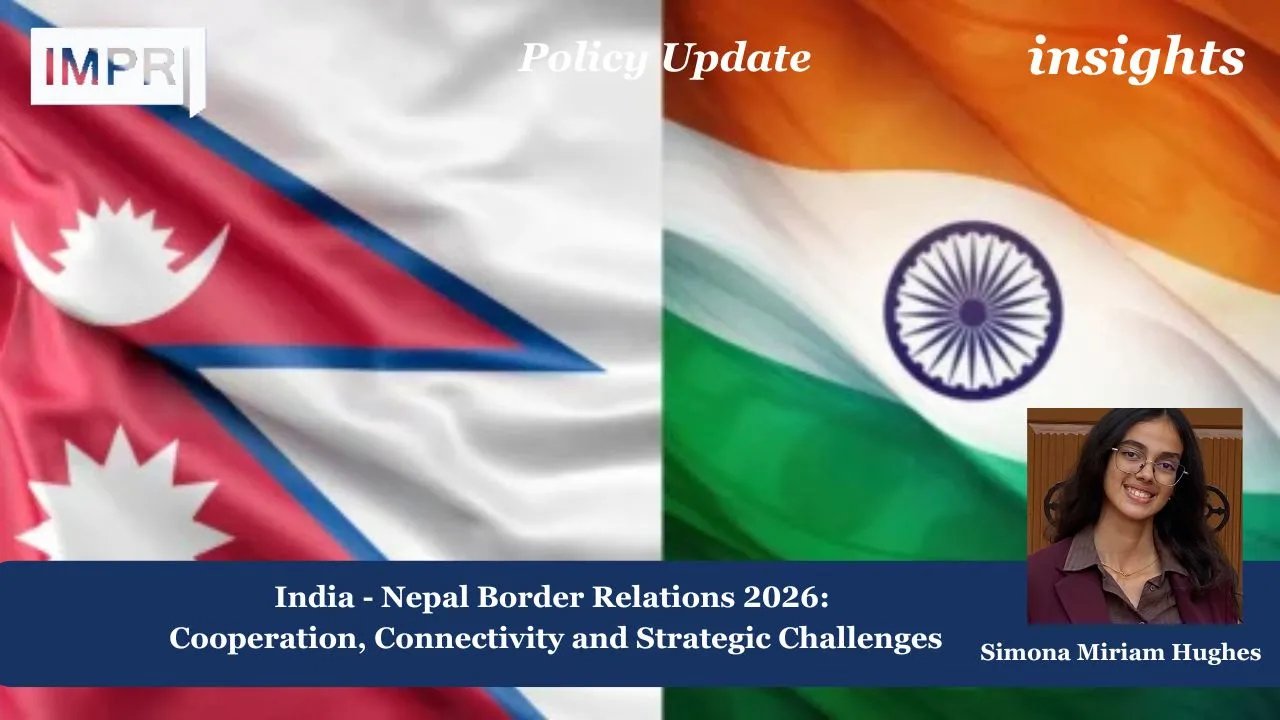
The India-Nepal border has been regarded as one of the most distinctive international boundaries in the world. The boundary is approximately 1,751 kilometers, extending across Uttarakhand, Uttar Pradesh, West Bengal, Sikkim and Bihar and is governed by the provisions from the 1950 Treaty of Peace and Friendship, allowing citizens of both the countries to cross boundaries without the need of passports and visas. Although the border symbolizes the historical relationship between the two nations, there are still prevailing challenges related to security, smuggling and migration.
India and Nepal have faced several border fluctuations over the past decade involving disagreements regarding economic blockade, constitutional issues and particularly the Kalapani-Lipulekh-Limpiyadhura territorial dispute which gained prominence in 2020. Although both nations face challenges and disagreements with each other, recent years have witnessed several improvements in the partnership in fields of connectivity projects, energy cooperation, trade facilitation and diplomatic exchanges.
The recent visit of Nepal’s Foreign Minister Shisir Khanal to India during 5-7th June 2026 marked a development in this process. During official diplomatic talks, both nations reaffirmed commitment to deepen bilateral cooperation especially under India’s Neighbourhood First Policy and Nepal’s objective of balancing its regional partnership while maintaining strategic autonomy. The discussions held during the visit highlighted the importance of border management, regional stability and infrastructure connectivity between India and Nepal in 2026.
Functioning:
The functioning of the India – Nepal Border cooperation is based on a number of diplomatic engagement, institutional mechanisms and people – centric arrangements that have evolved over the decades. The open border regime remains the central pillar of this relationship, enabling millions of citizens to cross the border easily for education, employment and tourism. This very framework distinguishes the India – Nepal border from other cross border frameworks and contributes to regional integration and economic interdependence.
At the diplomatic level, cooperation is maintained through continuous meetings with foreign ministers, foreign secretaries and several commissional mechanisms. These diplomatic meetings help maintain partnership and also serve as a platform to address issues relating to infrastructure, connectivity and security cooperation. The 2026 June visit saw several implications, one of which was External Affairs Minister Dr. S Jaishankar’s idea of expanding economic cooperation and strengthening people-to-people ties.
Border relations are maintained by India’s Sashastra Seema Bal and Nepal’s Armed Police force. With the help of these agencies, issues such as human trafficking, smuggling and any other forms of trans-national crime are addressed. Regular meetings and Joint Commission Mechanisms have helped improve surveillance and information sharing while maintaining a cross-border framework. Simultaneously, technical committees work on maintaining border pillars.
The expansion of Cross-border railway links, integrated checkposts and electricity transmission lines work as an important tool for maintaining cross-border relations. Rather than only focusing on trade and transportation, these initiatives work towards modernizing border infrastructure and enhance economic integration among the two countries.
Performance:
The period between 2023 and 2026 has seen a noticeable improvement in bilateral engagement and practical cooperation. Both the countries have demonstrated a willingness to address differences through dialogue rather than confrontation. Diplomatic meetings have also become frequent, serving as an important mechanism of relations. Diplomatic visits such as the June 2026 visit, has improved the communication and helps in maintaining proper relations.
One of the most significant achievements during this period is the expansion of connectivity infrastructure. Integrated Check Posts at major border crossings have improved the efficiency of trade and passenger movement, while railway projects have enhanced physical connectivity between Nepal and the Indian rail network. These initiatives have reduced transportation costs, facilitated commerce and strengthened economic ties. To add on to this,Nepal’s hydropower sector has benefited from greater access to the Indian market, while India has gained access to cleaner and more reliable sources of electricity.
Trade and investment have continued to grow despite disruptions on the global level. India remains Nepal’s largest trading partner and a major source of foreign direct investment. Improved infrastructure and simplified connectivity arrangements have contributed to greater economic interaction across the border. At the same time, security cooperation has expanded through enhanced coordination between border agencies, leading to better monitoring of illegal activities and more effective responses to cross-border challenges.
The June 2026 visit acquired additional significance because it occurred within a broader geopolitical context marked by increasing regional competition. Shortly after engaging with Indian leaders, Nepal’s Foreign Minister visited China, reflecting Kathmandu’s efforts to maintain balanced relations with its two largest neighbours. This development highlighted the growing strategic importance of Nepal and underscored India’s efforts to strengthen bilateral cooperation through economic partnerships and connectivity initiatives rather than purely security-oriented approaches.
Impact:
The impact of the India and Nepal cooperation has been visible over several dimensions especially economic, social and strategic dimensions. Economically, extensive connectivity has facilitated greater trade and strengthened regional integration. Similarly, the open-border arrangement has had a great impact on the livelihoods of the people who depend on cross border employment and social networks for daily life. Enhanced infrastructure has improved access to markets, services and opportunities for communities located near the border. Nepal’s growing hydropower exports to India in the field of energy cooperation have created new revenue streams and supported Nepal’s development objectives while simultaneously contributing to India’s energy security goals.
Socially, the relationship between the two countries have emerged and continue to grow on grounds of shared historical linkages and religious practices. Shared traditions and people-to-people interactions ensure that relationships go way more deep rather than just diplomatic partnership. Other than this, tourism also remains one of the most important concepts in ensuring relationships are maintained. These concepts make the India and Nepal Partnership one of the most socially integrated bilateral relationships in South Asia.
Strategically, the emphasis on dialogue and cooperation has contributed to greater regional stability. The willingness of both the governments to engage despite unresolved tensions between the two, show the mature relationship between the two countries. The June 2026 diplomatic exchanges demonstrated that both countries recognize the importance of maintaining a stable and cooperative relationship in an increasingly complex regional environment.
Emerging Issues:
Despite significant progress in bilateral cooperation, several challenges continue to shape India–Nepal border relations. The unresolved Kalapani–Lipulekh–Limpiyadhura dispute remains a sensitive issue that continues to affect diplomatic discourse, while the open border presents concerns related to human trafficking, smuggling and other transnational crimes. Nepal’s growing strategic importance amid regional geopolitical competition, particularly involving India and China, also requires careful diplomatic management. Additionally, delays in infrastructure implementation, bureaucratic hurdles and the increasing impact of climate change and floods in border regions highlight the need for sustained coordination and long-term planning. Way Forward:
The developments of 2026 suggest that India–Nepal relations are entering a phase of deeper economic integration, stronger connectivity and enhanced strategic engagement. The June 2026 visit of Foreign Minister Shisir Khanal reaffirmed both countries’ commitment to expanding cooperation through dialogue, connectivity projects and energy partnerships. Going forward, both sides must focus on accelerating infrastructure development, strengthening border management and adopting technology-enabled governance to address security concerns while preserving the openness of the border. Through continued collaboration on trade, energy and connectivity, India and Nepal can transform their shared border into a space of mutual prosperity, stability and regional partnership.
References:
Ministry of External Affairs. (2026, June 5). Official visit of Hon. Mr. Shisir Khanal, Minister of Foreign Affairs of Nepal to India (June 5–7, 2026). Government of India. https://www.mea.gov.in
Ministry of External Affairs. (2026, June 6). Opening remarks by External Affairs Minister Dr. S. Jaishankar during his meeting with Foreign Minister Shisir Khanal of Nepal. Government of India. https://www.mea.gov.in
Ministry of External Affairs. (2026). Press release on India–Nepal bilateral discussions. Government of India. https://www.mea.gov.in
Press Information Bureau. (2026). India–Nepal connectivity and bilateral cooperation initiatives. Government of India. https://pib.gov.in
Reuters. (2026). Nepal’s foreign minister visits China after first calling on regional rival India. Reuters. https://www.reuters.com The Hindu. (2026). A new phase in India–Nepal relations. The Hindu. https://www.thehindu.com
About the Contributor:
Simona Miriam Hughes is a research and editorial associate intern at IMPRI. She is currently pursuing her Master’s degree in International Relations at Loyola College and has worked in several Non Governmental Organisations during her Undergraduate years. She has attended the 2025 Global Citizenship programme which is associated with the Washington DC university
Acknowledgement:
The author would like to thank IMPRI and the reviewers for their valuable feedback and continuous support and encouragement in all the activities up until now
Reviewers:
The article was reviewed by Sruthi Sethi and Riddhi Suthar.
Disclaimer:
The content in the article belongs solely to the author and not exactly related to the organization
Read more at IMPRI:
India-China Border Affairs 2026: Assessing Progress Through the 35th WMCC Meeting
The Trilemma of Direct Benefit Transfers and Welfare Fiscal Policies on Governments During Inflation