








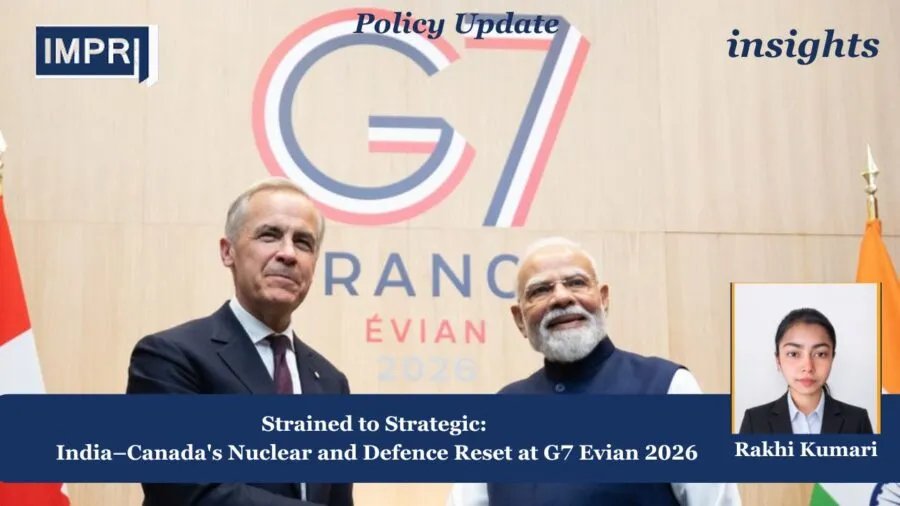
Policy Update
Rakhi Kumari
Background
India and Canada’s relationship goes back a long way, built on shared democratic values, a large Indian diaspora of nearly 1.8 million people, and growing trade ties. It’s a partnership that runs deeper than just Commonwealth history. Both countries have genuinely seen strategic value in working together. That became official in 2010, when they signed a nuclear cooperation agreement, which later led to a 2015 uranium supply deal between Canada’s Cameco Corporation and India’s Department of Atomic Energy. This was the first real sign of the two countries working together on civil nuclear energy (MEA, 2026).
Still, the relationship hit a major roadblock in September 2023. Justin Trudeau, who was the Prime Minister of Canada at the time, accused Indian government agents of being linked to the killing of Khalistan separatist Hardeep Singh Nijjar in Canada (The Wire, 2026). India denied this completely, calling the claims “absurd and motivated” (Outlook India, 2026). Things got worse fast after that. Both countries expelled each other’s diplomats, trade talks under CEPA were paused, High Commissioners were pulled back by October 2024, and almost all cooperation on political and intelligence matters stopped completely.
Several analysts called this a genuine “diplomatic rupture” and they pointed out it wasn’t really about just one incident. It exposed bigger, long-standing disagreements between the two countries over diaspora politics, sovereignty, and security concerns (Foreign Policy India, 2026).
Things started improving after Mark Carney became Canada’s Prime Minister following the April 2025 election. His approach was very different from Trudeau’s — quieter and more practical, he avoided directly blaming India in the Nijjar case. The recovery took time but stayed on track: High Commissioners returned by August 2025, and trade talks picked back up by November 2025. It showed that both countries were more interested in rebuilding ties than staying stuck in conflict (Open Canada, 2025; MEA, 2026).
Functioning
When Canadian Prime Minister Mark Carney landed in India in March 2026, it was the first such bilateral visit in eight years and both sides were clearly determined to make it count (MEA, 2026). The two-day programme moved from Mumbai to New Delhi, with the Mumbai leg focused on business and investment, and Delhi reserved for the heavier political and strategic conversations.
The headline outcome was the uranium deal. Cameco Corporation and India’s Department of Atomic Energy signed a long-term agreement under which Canada will supply nearly 22 million pounds of uranium between 2027 and 2035, valued at approximately CAD 2.6 billion, almost ten times what the 2015 agreement was worth (World Nuclear News, 2026). Prime Minister Modi called it “a landmark deal,” and went further, signalling that both sides would explore small modular reactors and advanced reactor technologies together (Energy Digital, 2026). Canada also joined India’s International Solar Alliance and became a full member of the Global Biofuel Alliance, rounding out what the MEA described as a comprehensive strategic energy partnership (MEA, 2026).
Trade was the other major pillar. Both sides formally signed the Terms of Reference for CEPA negotiations, with a deadline of end-2026 and an ambitious target of growing bilateral trade from USD 9 billion to USD 50 billion by 2030 (MEA, 2026). To keep this momentum going, the India-Canada CEO Forum was revived and a new Finance Ministers’ Economic and Financial Dialogue was launched.
On defence, the two countries moved beyond rhetoric. A Canada-India Defence Dialogue was set up at the Joint Secretary level, with a shared work plan covering maritime security, cybersecurity, counterterrorism, and organised crime — involving India’s NIA and IB on one side, and Canada’s RCMP and CSIS on the other (MEA, 2026).
Technology rounded off the agenda. During the visit, leaders relaunched the Joint Science and Technology Cooperation Committee in 2026 and committed to a structured AI, supercomputing, and semiconductor work plan under the Australia-Canada-India Technology and Innovation Partnership (MEA, 2026).
A joint talent strategy was also announced, deliberately shifting the focus from sheer numbers of Indian students in Canada toward quality-driven, innovation-led academic collaboration (MEA, 2026).
Performance
The outcomes of Prime Minister Carney’s March 2026 visit show that the relationship between the two countries has become much stronger than just symbolic gestures.
The uranium deal is the clearest example of how the relationship has changed. India has been trying to diversify its nuclear fuel supply for many years, and the 2015 Cameco agreement, which covered 7 million pounds of uranium, was an important first step. The 2026 agreement is much bigger. It covers 22 million pounds over nine years and is worth CAD 2.6 billion, showing a long-term commitment rather than a one-time business deal (World Nuclear News, 2026). This time, both countries are making a stronger commitment. Canada is willing to become a long-term supplier, while India, which aims to reach 100 GW of nuclear power capacity by 2030, needs reliable fuel supplies to achieve that goal (MEA, 2026).

The financial relationship also shows how ties between the two countries have become stronger. Canadian pension funds, known for being careful and long-term investors, have invested more than USD 107 billion in India (MEA, 2026). What is especially significant is that these investments continued even during two years of diplomatic tensions. This suggests that Canadian investors remained confident in India’s long-term economic growth despite political disagreements.
People-to-people ties are equally important. Around 400,000 Indian students are studying in Canada, making it one of the most popular destinations for Indian students. The Indian diaspora of about 1.8 million people has also built strong connections between the two countries that are not easily broken by political disagreements.
Trade tells a similar story. India and Canada currently trade about USD 9 billion each year, and both countries want to increase this to USD 50 billion by 2030. While this is a challenging target, ongoing CEPA talks, the revived India–Canada CEO Forum, and the new Finance Ministers’ Dialogue show that both sides are working seriously to make it happen (MEA, 2026).

Impact
The India–Canada reset has effects that go beyond the relationship between the two countries.
The Cameco uranium deal helps solve one of India’s long-standing energy challenges. India currently has 25 nuclear reactors with a total capacity of about 8,145 MWe, which is far below its goal of reaching 100 GW of nuclear power by 2030 (MEA, 2026). India’s own uranium reserves are not enough to support this expansion, and depending on just one supplier is risky. The 2026 Cameco deal reduces that risk by giving India another reliable source of uranium and securing a long-term supply of nuclear fuel (World Nuclear News, 2026).
On the strategic front, the reset shows that economic ties can move forward even when politics gets messy, and that security cooperation can later be rebuilt once trust returns. The Khalistan episode put that to the test, yet Canadian pension funds stayed invested in Indian markets, and people-to-people ties never really broke down. What the March 2026 visit did was formalise all of this, turning an informal understanding into structured frameworks for defence dialogue, counterterrorism cooperation, and technology partnership (MEA, 2026).
For Canada, facing protectionist pressures from Washington, deepening its Indo-Pacific economic footprint has become a strategic imperative. India, with its large consumer market, skilled technology workforce, and growing institutional weight, is a natural anchor for that pivot (Open Canada, 2025).
More broadly, the India–Canada reset illustrates a wider trend in contemporary diplomacy: the gradual decoupling of economic engagement from political disagreement. In an era of fragmented multilateralism, such compartmentalisation may well define the operating logic of major strategic partnerships going forward.
Emerging Issues
Despite the momentum generated by the March 2026 visit, several structural challenges could test the durability of this reset:
- Khalistan Issue: The Nijjar case, which led to the breakdown in relations in 2023, is still unresolved. With the criminal trial now underway in Canada, the issue remains politically sensitive and difficult for either government to control. If new developments in the trial or renewed protests by groups such as Sikhs for Justice increase public tensions, the Canadian government could face domestic political pressure that may once again affect its relationship with India.
- Student & Immigration Concerns: Around one million Indian work permits are expected to expire in 2026, and limits on student visas have already weakened one of the strongest links between India and Canada. If there is no clear policy to address these issues, growing frustration among affected people could become a more visible source of tension between the two countries (MEA, 2026).
- CEPA Negotiations: Earlier efforts to reach a comprehensive trade agreement failed because of strong domestic interests in both countries. The goal of finalising an agreement by the end of 2026 remains ambitious. Differences over Canada’s access to India’s agricultural market and India’s approach to opening its services sector are likely to continue unless both governments show strong political commitment (Foreign Policy India, 2026).
- Defence Industrial Cooperation: Canada plans to invest about USD 500 billion in modernising its defence sector over the next decade. This could create important opportunities for India to become a strategic defence and industrial partner. However, the institutions and mechanisms needed for deeper cooperation are still underdeveloped, and both governments will need to make sustained diplomatic efforts to turn this potential into reality (MEA, 2026).
Way Forward
The India–Canada partnership has reached an important turning point. The basic framework for stronger cooperation is now in place. What matters now is whether both governments have the political commitment and consistent institutional support to build on this progress.
- Nuclear Technology Cooperation: Both countries should expand their cooperation beyond uranium supply and work together on Small Modular Reactors (SMRs). Canada’s experience with CANDU reactor technology and India’s goal of reaching 100 GW of nuclear power by 2030 make this a natural area for partnership. Starting early discussions on the technical and economic feasibility of SMRs would give the relationship a stronger long-term focus, instead of limiting it to uranium supply alone (World Nuclear News, 2026).
- CEPA as Priority, Not Aspiration: The goal of completing a trade agreement by the end of 2026 will be difficult to achieve unless both governments are willing to make political compromises on issues such as agricultural market access and services liberalisation. They should also make full use of the revived CEO Forum and the Finance Ministers’ Dialogue to keep the negotiations moving forward (MEA, 2026).
- Institutionalising the Compartmentalisation Model: The best way forward on security is to let the Nijjar case proceed through the courts while strengthening cooperation between the NIA, RCMP, and CSIS on counterterrorism, cybercrime, and organised crime. Both countries should avoid allowing one unresolved case to shape their entire relationship, as that would be a strategic mistake (MEA, 2026).
- Restoring People-to-People Confidence: Both governments should create a clear framework that makes student visa rules more predictable and provides better post-study work opportunities for Indian students. This would help restore Canada’s reputation as a preferred destination for Indian students and strengthen the people-to-people ties that support the broader partnership (MEA, 2026).
- Indo-Pacific Strategic Alignment: Both countries should build on their shared interests in maritime security, clean energy, and supply chain resilience. Strengthening cooperation in these areas would place the India–Canada relationship within a broader regional framework and make the partnership stronger and more sustainable over the long term (Open Canada, 2025).
Conclusion
Prime Minister Mark Carney’s March 2026 visit to India, followed by the bilateral meeting at the G7 Summit in Evian, marked an important turning point in the India–Canada relationship.
- India and Canada have shown that when their strategic interests are aligned, they can continue working together despite political differences. Instead of allowing tensions to damage the relationship, both countries have moved towards a more structured partnership based on cooperation in several key areas.
- The uranium deal, defence dialogue, technology partnership, and CEPA negotiations all show that the India–Canada relationship is increasingly based on shared interests rather than goodwill alone.
- Challenges remain real: the Nijjar case is unresolved, CEPA faces structural hurdles, and people-to-people ties have yet to fully recover. These are fault lines that could reopen if handled carelessly.
- As India works towards becoming a developed country by 2047 and Canada looks to reduce its economic dependence on an increasingly unpredictable United States, there are even stronger reasons for both countries to deepen their partnership.
- The G7 Evian Summit in 2026 has created an opportunity to strengthen the relationship. What happens next will depend on the decisions made by the governments in New Delhi and Ottawa.
Reference
Cameco Corporation (2026). Cameco and India sign a new uranium supply agreement.
World Nuclear News.
https://www.world-nuclear-news.org
Energy Digital (2026). Inside India & Canada’s nuclear, hydrogen & renewables deal.
Foreign Policy India (2026, January). From rupture to reset: The slow and cautious repair of India–Canada relations.
https://www.foreignpolicyindia.in
Ministry of External Affairs, Government of India (2026, January).
India–Canada bilateral brief.
https://www.mea.gov.in/Portal/ForeignRelation/India-Canada_Bilateral_Brief__Jan_2026_.pdf
Ministry of External Affairs, Government of India (2026, March 2).
Joint leaders’ statement on Prime Minister Carney’s visit to India.
https://www.mea.gov.in/bilateral-documents.htm
Ministry of External Affairs, Government of India (2026, March 2).
Press briefing on Prime Minister Carney’s visit to India.
https://www.mea.gov.in/media-briefings.htm
Open Canada (2025, September). India & Canada: Measured and cautious diplomacy. https://opencanada.org
Outlook India (2026, February). India, Canada set to rebuild ties as PM Mark Carney visits India. https://www.outlookindia.com
The Wire (2026, February). Canadian PM Carney’s India visit signals strategic reset after diplomatic rupture.
About the Contributor
Rakhi Kumari is a Research & Editorial Intern at IMPRI. She is currently pursuing a Bachelor’s degree in Political Science from Annada College, Hazaribagh (affiliated with Vinoba Bhave University, Jharkhand). Her research interests include Diplomacy, International Relations, Public Policy, Geopolitics, Sustainable Development, Energy Security, and the global trade dynamics of coal and natural gas, with a particular focus on South Asia.
Acknowledgement
The author sincerely thanks Ameya Sushilchandra Satam, and the IMPRI team for their constructive comments and editorial guidance during the review of this policy update.
Disclaimer: All views expressed in the article belong solely to the author and not necessarily to the organisation.
Read More at IMPRI:
Future of Gig Workers: Analysing Emerging Social Security Measures