







Policy Update
CB Kavin Adithya
Introduction
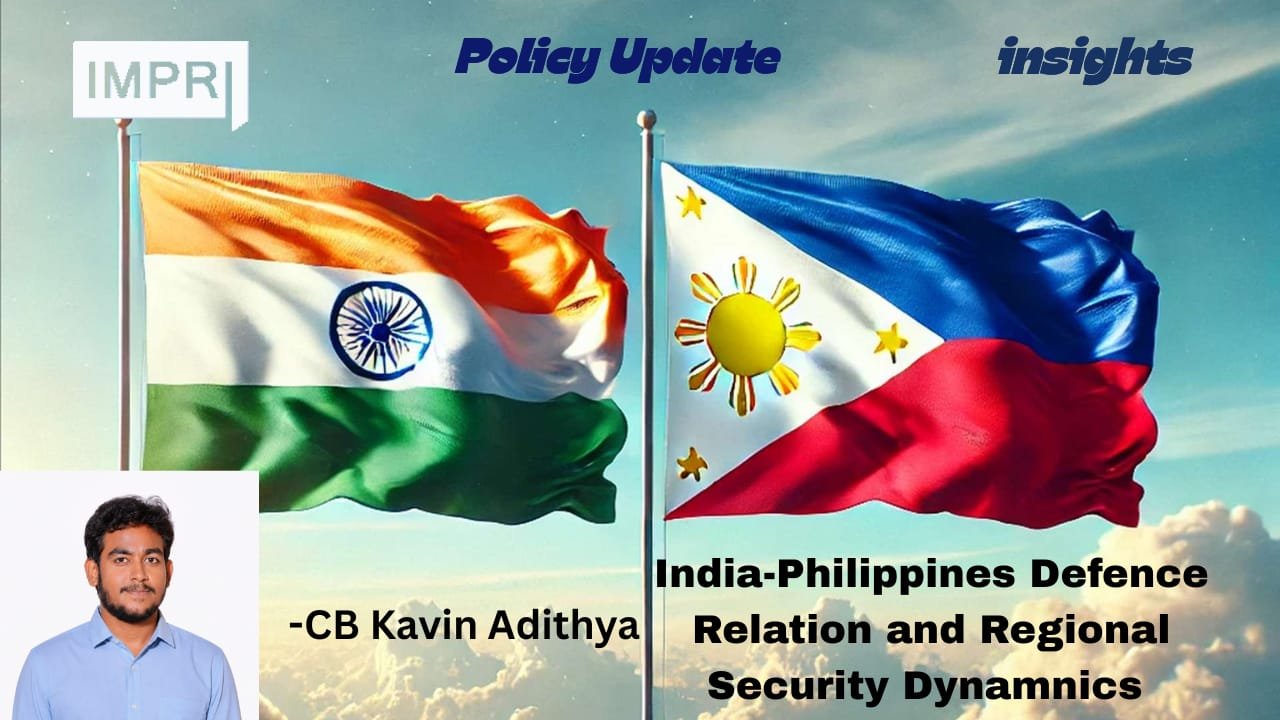
The Indo-Pacific region has emerged as one of the most strategically significant regions in contemporary international politics. Growing geopolitical competition, maritime disputes, and evolving security challenges have encouraged regional states to strengthen defence partnerships and strategic cooperation. In this context, India and the Philippines have developed a closer defence relationship based on shared interests in maritime security, regional stability, and the maintenance of a rules-based international order. Over the past decade, defence cooperation between the two countries has expanded through military exchanges, defence dialogues, capacity-building initiatives, and defence technology collaboration. The growing partnership reflects the increasing strategic importance of both countries in shaping the evolving security architecture of the Indo-Pacific region.
Background
India and the Philippines established diplomatic relations on 16 November 1949. Although cultural and commercial interactions between South Asia and Southeast Asia have existed for centuries, defence cooperation remained limited for much of the post-independence period. The relationship gained momentum following India’s Look East Policy in the 1990s and later the Act East Policy launched in 2014, which sought to deepen India’s engagement with Southeast Asia.
Growing concerns regarding maritime security, freedom of navigation, and regional stability encouraged both countries to strengthen strategic cooperation. A major milestone in bilateral relations was the acquisition of the BrahMos supersonic cruise missile system by the Philippines. This agreement not only represented India’s first major defence export but also demonstrated increasing strategic trust between the two countries. As a result, India–Philippines relations have gradually evolved into an important component of broader Indo-Pacific security cooperation.
Purpose
The primary objective of India–Philippines defence cooperation is to strengthen regional security and contribute to the maintenance of a free, open, inclusive, and rules-based Indo-Pacific order. The partnership seeks to enhance maritime security, improve defence preparedness, strengthen deterrence capabilities, and promote military-to-military cooperation. In addition, both countries aim to expand collaboration in defence technology, cybersecurity, humanitarian assistance, disaster relief, and capacity-building initiatives.
Functioning / Working Mechanism
India–Philippines defence relations play an important role in advancing both bilateral and regional security objectives. Defence cooperation is carried out through military-to-military engagement, professional training programmes, strategic dialogues, and operational coordination. These initiatives help strengthen maritime surveillance capabilities, support defence modernisation efforts, and promote capacity building through institutional exchanges and training activities.
The partnership also facilitates defence technology transfer, military procurement cooperation, and greater interoperability between the armed forces of both countries. A major example of this cooperation is the acquisition of the BrahMos supersonic cruise missile system by the Philippines. As India’s first major defence export, the BrahMos agreement marked a significant milestone in bilateral relations and enhanced the Philippines’ coastal defence and deterrence capabilities.
Another important aspect of the partnership is maritime security cooperation under India’s SAGAR (Security and Growth for All in the Region) vision. Through naval interactions, defence dialogues, training programmes, and technology cooperation, both countries continue to strengthen maritime security and regional stability in the Indo-Pacific. These initiatives demonstrate that India–Philippines defence relations have expanded beyond traditional military cooperation and are gradually developing into a broader strategic partnership.
Performance

Strengths
• Strong strategic convergence on Indo-Pacific security.
• Successful defence cooperation through the BrahMos missile agreement.
• Growing maritime security collaboration and defence dialogues.
• Capacity building through military exchanges and training programmes.
• Expanding opportunities for defence-industrial cooperation.
Limitations
• Limited frequency and scale of joint military exercises.
• Defence trade remains concentrated around a few major agreements.
• Absence of a comprehensive long-term defence cooperation framework.
• Limited collaboration in advanced defence research and development.
• Cybersecurity cooperation remains relatively underdeveloped.
Critical Evaluation
India–Philippines defence relations have made considerable progress over the past decade. The BrahMos missile agreement represents a landmark achievement that has strengthened strategic trust and enhanced defence cooperation between the two countries. Defence dialogues, military exchanges, and maritime cooperation have also contributed to improving bilateral engagement and regional security cooperation.
However, despite these achievements, the partnership continues to rely heavily on a limited number of initiatives. Joint military exercises remain relatively limited, while cooperation in areas such as defence research, cybersecurity, and defence-industrial collaboration has yet to reach its full potential. Furthermore, the absence of a comprehensive institutional framework may affect the long-term sustainability of defence cooperation. Therefore, while the partnership has evolved significantly, deeper institutionalisation and broader operational engagement will be necessary to realise its full strategic potential.
Impact and Significance
India–Philippines defence cooperation has important implications for both bilateral relations and regional security dynamics. Maritime security remains a key pillar of the partnership, as both countries depend on secure sea lanes for trade, energy security, and economic growth. Enhanced cooperation contributes to maritime domain awareness, freedom of navigation, and the protection of critical maritime routes.
The partnership has also supported defence modernisation efforts through military training, capacity-building programmes, defence technology cooperation, and procurement diversification. The BrahMos missile agreement has strengthened the Philippines’ defence capabilities while demonstrating India’s growing role as a defence partner in Southeast Asia.
At the regional level, defence cooperation contributes to peace and stability by promoting strategic balance, strengthening deterrence capabilities, and supporting adherence to international law. Both countries share a common commitment to a free, open, inclusive, and rules-based Indo-Pacific, which has strengthened their strategic convergence on regional security issues.
In addition, cooperation increasingly extends beyond traditional defence concerns to address emerging challenges such as cybersecurity threats, piracy, transnational crime, disaster management, and humanitarian assistance. These efforts have enhanced resilience against non-traditional security threats and broadened the scope of bilateral cooperation.
Emerging Issues in India–Philippines Defence Relations
• Growing geopolitical competition in the Indo-Pacific creates strategic uncertainties for regional security partnerships.
• Maritime disputes and tensions in the South China Sea continue to influence the security environment of the region.
• Defence cooperation remains heavily dependent on a few major initiatives, particularly the BrahMos missile agreement.
• Joint military exercises are limited in frequency and scope, reducing opportunities for deeper operational coordination.
• Cooperation in cybersecurity and emerging technologies is still at an early stage of development.
• Limited collaboration in defence research and innovation restricts the long-term growth of the partnership.
• Defence-industrial cooperation has not yet expanded beyond a few procurement arrangements.
• Intelligence-sharing mechanisms require further strengthening to address evolving security threats.
• Differences in defence priorities and resource allocation may affect the pace of cooperation.
• Rapid technological changes in warfare require continuous adaptation and investment in new capabilities.
• Non-traditional security threats such as cyberattacks, piracy, illegal fishing, and transnational crime continue to pose challenges.
• The absence of a comprehensive long-term institutional framework may affect policy continuity and implementation.
Way Forward
• Expand the scale and frequency of bilateral and multilateral military exercises.
• Strengthen maritime domain awareness through greater information and intelligence sharing.
• Promote regular naval interactions and coordinated maritime security initiatives.
• Enhance cooperation in cybersecurity through joint training programmes and cyber defence exercises.
• Encourage defence-industrial partnerships and joint production initiatives.
• Increase collaboration in defence research, innovation, and emerging technologies.
• Develop mechanisms for technology transfer and technical cooperation.
• Establish a structured long-term defence cooperation framework to guide future engagement.
• Improve interoperability between the armed forces through specialised training and operational exchanges.
• Strengthen cooperation in humanitarian assistance and disaster relief operations.
• Expand collaboration in counter-terrorism, anti-piracy operations, and transnational crime prevention.
• Encourage greater engagement through ASEAN-led security platforms and regional forums.
• Facilitate academic, strategic, and policy-level exchanges between research institutions and defence experts.
• Promote capacity-building programmes for military personnel and security professionals.
• Explore new areas of cooperation such as artificial intelligence, space security, and critical infrastructure protection.
Relevance in the 21st Century
The relevance of India–Philippines defence relations has increased significantly due to evolving security challenges in the Indo-Pacific region. Both countries share common interests in maritime security, freedom of navigation, regional stability, and adherence to international law. Defence cooperation has expanded through military exchanges, maritime collaboration, capacity-building initiatives, and defence technology partnerships, particularly the BrahMos missile agreement. The partnership also helps address emerging challenges such as cyber threats, piracy, terrorism, and disaster management. Therefore, stronger India–Philippines defence relations contribute not only to bilateral security interests but also to peace, stability, and cooperation across the Indo-Pacific region.
Conclusion
India–Philippines defence relations have evolved into a significant pillar of bilateral engagement and an important component of the broader Indo-Pacific security architecture. Growing cooperation in defence technology, maritime security, military training, and strategic dialogue reflects the increasing convergence of interests between the two countries. The strengthening of defence ties demonstrates a shared commitment to regional stability, maritime security, and a rules-based international order.
Although challenges such as geopolitical competition, financial constraints, and policy gaps remain, sustained engagement and deeper cooperation can significantly enhance the effectiveness of the partnership. By expanding defence collaboration, strengthening institutional frameworks, and addressing emerging security challenges, India and the Philippines can contribute meaningfully to peace, stability, and prosperity in the Indo-Pacific region. The continued development of this strategic partnership will not only reinforce bilateral relations but also support the creation of a secure, inclusive, and resilient regional order.
References/Bibliography :
Department of National Defense, Philippines. (2024). Philippines–India defence cooperation. Government of the Philippines.
Ministry of Defence. (2024). Annual report 2023–24. Government of India.
Ministry of External Affairs. (2025). India–Philippines bilateral relations. Government of India.
Observer Research Foundation. (2024). India–Philippines strategic relations in the Indo-Pacific.
The Diplomat. (2024). The growing India–Philippines defence partnership.
About the Contributor
Kavin Adithya CB is a Research and Editorial Intern at IMPRI currently pursuing M.A International Relations in Loyola College, Chennai. I have a strong Interest in International Political Economy ,International Relation Defence ,Public policy ,Geopolitics and Human Rights Strong area of interest to explore and develop my skills.
Acknowledgement:
The author sincerely thanks the reviewers and editorial team for their valuable comments, constructive suggestions, and guidance. Their feedback helped improve the clarity, structure, and analytical depth of this policy update.
Disclaimer
This article is intended for academic and informational purposes only. The views expressed are those of the author and do not necessarily reflect the views of IMPRI or any government institution.
Reviewers :
Paridhi passi& Sana Ansari – Thank you for your feedback , support and Guidance
Read More at IMPRI:
One Nation One Ration Card: Portability, Inclusion and Food Security