








Policy Update
Varisha Sharma
Introduction
The 21st century is fast paced yet aims at being sustainable. This rare balance is achieved by using a set of minerals that are present in very few geographical pockets of the Earth- critical minerals, which can be dubbed as the new oil of the 21st century. The global energy transition, the focus on sustainable and green transportation and rapid technological development and advancements have resulted in an increased demand for certain minerals classified as critical due to their economic importance, geographical concentration in few locations that results in fragmentation of the global supply chains.
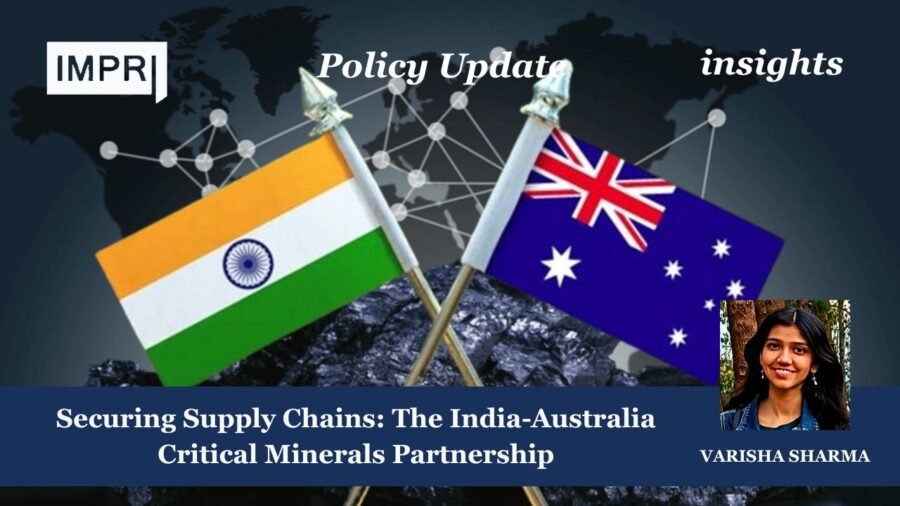
In light of this, The 2022 India-Australia Critical Minerals Investment Partnership was an important step taken by the leadership of both countries. For both India and Australia, the security of critical minerals is an economic and strategic priority: Australia is one of the world’s richest sources of many of these minerals, while India is an emerging giant in manufacturing and green energy deployment that requires secure imports and technology partnerships to develop domestic value chains.
In recent years the two democracies have formalized collaboration through a series of dialogues, memoranda of understanding (MoUs), and ministerial statements. Their cooperation spans mining investment, co-financing of projects, research and skills exchange, and support for downstream processing to create reciprocal value especially to counter global competitors like China.
Background
The Importance of Critical Minerals
Critical minerals are those needed for almost every modern industry- electrification, semiconductors, technology and defense, but are at the centre of risky supply chains, concentrated production and geopolitically sensitive extraction and processing. The International Energy Agency and multiple national governments designate lists of such minerals such as Lithium, Cobalt, Nickel, Graphite, Rare Earth Elements, Titanium, Vanadium and Copper. (Ministry of Mines, Government of India, 2025; DFAT, Australia,2022). In recent years, critical minerals have become important for multiple reasons-:
- Shift to renewable energy: owing to the current climate crisis there has been a call for shift to more renewable sources of energy. This shift necessitates use of large quantities of critical earth minerals such as Lithium, Cobalt, and nickel. Moreover there is an increase in the use of Electronic Vehicles as well which require the use of large quantities of battery metals and rare earth elements.
Lithium, cobalt, and nickel are vital components of lithium-ion batteries used in electric vehicles and grid-scale energy storage systems. As countries pursue decarbonisation and commit to reducing greenhouse gas emissions under international frameworks such as the Paris Climate Agreement, demand for these minerals has surged. According to the International Energy Agency, clean energy technologies require significantly higher quantities of minerals compared to fossil fuel-based systems (IEA, 2023) - Strategic and national security importance: Critical minerals are increasingly viewed as strategic resources because they are crucial for technologies essential for defense, aerospace, and advanced electronics. Modern military systems rely on rare earth elements and other specialty minerals used in radar systems, precision-guided weapons, fighter jets, satellites, and communication systems. Moreover the processing and refining of these minerals is concentrated in very few countries, notably China which raises concerns about supply chain disruptions.
- Technological and industrial development: Critical minerals are fundamental inputs for many high-tech industries. Electronics, telecommunications, robotics, aerospace engineering, and semiconductor manufacturing depend on these minerals. For example, semiconductors rely on elements such as gallium, germanium, and silicon. Smartphones, computers, and other digital devices require a range of critical minerals including indium, tantalum, and rare earth elements. As digitalisation expands globally and industries adopt advanced technologies such as artificial intelligence, robotics, and quantum computing, the demand for these materials continues to grow.
These motivations explain why resource diplomacy, arrangements that combine trade, investment, and security considerations, has become central to bilateral relationships among like-minded countries, including India and Australia (Ministry of Mines, PIB, 2023; DFAT,2022).
Historical and Geopolitical Context
The Critical Minerals Investment Partnership that was signed in 2022 is geopolitically significant for both India and Australia. India faces near-complete import dependency for key battery minerals even as it harbours ambitious plans for a manufacturing-led green transition under frameworks such as Make in India, Atmanirbhar Bharat, and the net-zero by 2070 commitment (Sachdeva, 2025).
China supplies over 82 per cent of India’s lithium needs, and India’s import dependence extends across cobalt, nickel, and rare earth elements even as domestic reserves of cobalt ore (44.9 million tonnes), copper (163.9 million tonnes), graphite (211.6 million tonnes), and nickel (189 million tonnes) remain largely untapped due to insufficient processing infrastructure (Sachdeva, 2025; Whalesbook, 2025).
Australia occupies a complementary position in this strategic equation. It produces almost half of the world’s lithium, ranks as the second-largest producer of cobalt globally, and holds the fourth-largest reserves of rare earth elements (Press Information Bureau, India, 2023). Yet, despite these endowments, much of Australia’s mineral output has historically been exported to China for mid-stream processing, creating a structural dependency that has exposed Australian producers to price manipulation and market shocks, as vividly illustrated by the collapse of nickel prices precipitated by Chinese overproduction in recent years (Sinh, 2025).
The geopolitical urgency of the partnership is inseparable from China’s structural dominance in the critical minerals value chain. Beijing controls between 60 and 90 per cent of mining and processing capacity for more than 20 critical minerals, according to US Geological Survey data for 2025 (Fathima, 2025). China further entrenched this leverage by applying export controls on rare earth magnets and invoking the Foreign Direct Product Rule to assert jurisdictional control over foreign defence and technology supply chains, a move that sent shockwaves through allied supply chain planners (Fathima, 2025).
India-Australia Critical Minerals Investment Partnership
COVID-19 showed the world how fragile supply chains can be and kick-started a new era of increased reshoring and bilateral strategic agreements. In 2020, a MoU was signed between India and Australia during a virtual meeting between Prime Minister Modi and Australian Prime Minister Scott Morrison which elevated the relationship between the two countries to a Comprehensive Strategic Partnership (Australian Government, Department of Industry, Science, Energy and Resources, 2020). This MoU paved the way for the 2022 Critical Minerals Investment Partnership to secure the supply chains for lithium, cobalt and other key minerals for clean energy transitions.
In March 2022, Australia’s Critical Minerals Office and Khanij Bidesh India Limited (KABIL), a joint venture company formed by three state-owned Indian enterprises under the Ministry of Mines signed a Memorandum of Understanding (MoU) to jointly fund project identification and support potential Indian investment in Australian critical minerals projects (IEA, 2022).
Australia committed AUD 5.8 million over three years under this Critical Minerals Investment Partnership (CMIP) with the explicit aim of encouraging Indian investment in Australian projects, building robust and sustainable supply chains, and supporting India’s ambitions to become a global manufacturing hub for electric vehicles and clean energy technologies.
Source: Press Information Bureau of India
Australia’s particular mineral endowments are directly relevant to India’s most pressing import dependencies: lithium for the lithium-ion batteries that power electric vehicles and energy storage systems, and cobalt for cathodes in battery chemistries. India’s Production-Linked Incentive (PLI) schemes for advanced chemistry cells (batteries), valued at ₹18,100 crore, and for solar photovoltaic modules, valued at ₹24,000 crore, create domestic demand anchors that underpin the commercial viability of these supply chain investments.
Western Australia, with its rich lithium endowments, has been a particular focal point of bilateral engagement. India’s Minister Joshi toured the Tianqi Lithium Energy Kwinana Lithium Hydroxide Refinery in Western Australia in 2022 and Indian mining companies have also engaged directly with the Western Australian government to explore investment opportunities, reflecting a broadening of the engagement beyond federal-to-federal diplomacy to include sub-national and industry-level interactions (Vashisht and Hawkins, 2024).
The partnership took a significant diplomatic step forward during the inaugural India–Australia Annual Summit and ministerial dialogues in 2023. Leaders and ministers explicitly recognized Australia’s resource strengths and India’s market scale and manufacturing ambitions as complementary, and committed to deepen cooperation to build diversified, resilient supply chains and spur joint investments (MEA, 2023).
Ministers from both countries, India’s Union Minister for Coal, Mines and Parliamentary Affairs, Shri Pralhad Joshi, and Australia’s Minister for Resources and Northern Australia, Madeleine King , announced that the partnership had completed its first phase, identifying five target projects: two lithium and three cobalt projects on which detailed due diligence would be undertaken (Ministry of Industry, Science and Resources, Australia, 2023). These identifications were accompanied by the signing of non-disclosure agreements and the commencement of commercially-oriented assessments, signalling a shift from diplomatic engagement to transactional investment facilitation (Press Information Bureau, India, 2023).
Trade and Tariff Framework of the Partnership
The Australia–India Economic Cooperation and Trade Agreement (ECTA), which entered into force on 29 December 2022, provides the overarching trade architecture within which the critical minerals partnership operates. Under ECTA, tariffs were eliminated on a range of critical mineral products including manganese, copper, cobalt, nickel, aluminium, tin ores, zirconium, and titanium, unlocking new commercial pathways for Australian producers seeking diversified export markets (DFAT, 2022). Australia exported AUD 170 billion of metallic ores globally in 2021 and India increasingly presents itself as the prime destination for high quality, competitively priced mineral outputs.
Developments in Research
Parallel to the investment dimension, both governments established research and technology cooperation frameworks of considerable ambition. In 2023, two Australian Government-funded Research and Development partnerships were launched. The India-Australia Critical Minerals Research Partnership, with a total funding commitment of AUD 12.2 million, focuses on developing sustainable and resilient supply chains for critical minerals and materials, with work areas spanning novel extraction techniques, rare earth processing alternatives, and the development of cathode active materials for next-generation batteries (Williams, 2024).
The India-Australia Green Steel Research Partnership, capitalised at AUD 10.4 million, targets the reduction of greenhouse gas emissions in steelmaking, a sector of particular relevance given that India ranks second globally in steel production and both countries face hard-to-abate emissions challenges in this industry (Williams, 2024). Both partnerships are currently managed by Australia’s Commonwealth Scientific and Industrial Research Organisation (CSIRO) and run from January 2023 to June 2026.
The institutional ecosystem was further enriched by the establishment of the Australia-India Critical Minerals Research Hub, arising from a 2023 MoU signed between Monash University and the Indian Institute of Technology Hyderabad. This hub focuses on enriching collaborative research across mineral exploration, extraction, recycling and processing.
In 2024, the bilateral partnership expanded further with the launch of the India-Australia Renewable Energy Partnership, which plans to catalyse investment in solar manufacturing, battery and mineral processing, green hydrogen, and green iron, sectors that form the downstream industrial applications of critical minerals supply chains (Sinh, 2025).
The CSIRO-managed Critical Minerals Research Partnership engages Indian counterparts including researchers at the Council of Scientific and Industrial Research (CSIR) and the Institute of Minerals and Materials Technology (IMMT). Key research streams include the development of novel extraction techniques for titanium and vanadium. The Minerals Scholar Network component of the partnership invests in longer-term human capital development, creating the technical expertise and institutional relationships that will sustain the partnership beyond the current funding cycles. This is of particular significance given India’s ambition, articulated under the NCMM, to establish skill development centres in partnership with relevant ministries and to build a domestic workforce capable of supporting advanced mineral processing and value addition. (Sinh, 2025).
Multilateral Alignment
The bilateral partnership does not operate in isolation but is embedded within a broader web of multilateral frameworks that both countries have helped to shape. Both India and Australia are founding members of the Mineral Security Partnership (MSP), a US-led security dialogue of 15 countries aimed at securing critical mineral supply chains through trusted partner cooperation (Vashisht and Hawkins, 2024). The 2023 Quad Leaders Summit in Japan included the launch of the Clean Energy Supply Chain Initiative to de-risk global critical mineral supply chains from overconcentration, directly reflecting shared concerns about Chinese dominance (Vashisht and Hawkins, 2024).
The Indo-Pacific Economic Framework (IPEF), to which both countries are signatories, includes a dedicated pillar for deepening critical minerals dialogue, mapping mineral resources across partner countries, promoting trade, fostering technical collaboration, and enhancing business engagements (Sinh, 2025).
Emerging Issues
While the partnership has had positive reception it faces many structural obstacles as well. The current investments are not enough to establish a meaningful restructuring of the supply chain especially when compared to China. India needs more private capital investment to bridge this deficit (Whalesbook, 2025). Even Australia’s AUD 5.8 million commitment under the CMIP, while symbolically significant, lacks to fulfil the capital requirements of commercially viable lithium hydroxide or cobalt refinery projects.
The regulatory mechanisms of both countries also present a huge challenge. Australia’s foreign investment review framework, which applies heightened scrutiny to acquisitions by state-affiliated entities in the resource sector, complicates KABIL’s mandate as a vehicle for Indian public sector investment in Australian projects (Sinh, 2025). Australia’s resource nationalism impulses, reflected in requirements for domestic processing and value-addition under the Future Made in Australia agenda, can create tension with Indian preferences for raw material exports at competitive prices.
Moreover, concentration in Chinese refining capacity is projected to persist well beyond 2035 even under optimistic investment scenarios, implying that India and Australia will need to develop supply chains that coexist with Chinese dominance rather than simply substituting for it in the near term (Fathima, 2025). Emerging projects outside China are more expensive to build and create a structural cost disadvantage that requires sustained policy support to overcome (Whalesbook, 2025).
Mining and processing carry significant environmental and social risks that can delay project timelines and expose companies to reputational and regulatory liability. India’s domestic mining sector has historically faced challenges in adhering to global ESG standards, which can complicate investment partnerships with Australian entities that operate under stricter domestic and international frameworks. (Sinh, 2025)
The threat of geopolitical instability in the contemporary era is ever looming. From Trump’s reciprocal tariffs to the current war in the Middle-East, the escalation of trade tensions amidst warfare presents a huge structural risk outside the control of both countries.
Conclusion
The India-Australia Critical Minerals Partnership represents a strategic response to one of the defining challenges of the contemporary global economy: building resilient, diversified supply chains for the minerals that power the clean energy transition. For India, the partnership offers a pathway to reduce structural dependence on China for battery minerals, secure the material foundations of its green transition and advanced manufacturing aspirations, and embed itself in the trusted multilateral architecture of like-minded democratic partners. For Australia, it offers new markets, a pathway to mid-stream processing and value addition, and the strategic positioning of being a preferred supplier in a world increasingly organised around supply chain resilience.
The institutional foundations of the partnership have been well laid, however the success of the partnership will depend on sustained political will, stable financial structuring and investment in technical capabilities necessary for the partnership. In the era of resource geopolitics, this partnership emerges as one of the most important bilateral agreements of India as a part of its broader diversification strategy for critical minerals as well one that represents India’s commitment towards building a resilient and trusted Indo-Pacific economic architecture.
References
Australian Government, Department of Foreign Affairs and Trade.(2022). Australia-India ECTA benefits for Australian critical minerals and resources sectors. Retrieved from https://www.dfat.gov.au/trade/agreements/in-force/australia-india-ecta/outcomes/australia-india-ecta-benefits-australian-critical-minerals-and-resources-sectors
Australian Government, Minister for Resources. (2023). Milestone in India and Australia critical minerals investment partnership. Retrieved from https://www.minister.industry.gov.au/ministers/king/media-releases/milestone-india-and-australia-critical-minerals-investment-partnership
Australian Government, Department of Industry, Science, Energy and Resources. (2020, June 4). Australia and India sign critical minerals agreement. https://www.minister.industry.gov.au/ministers/pitt/media-releases/australia-and-india-sign-critical-minerals-agreement
Fathima, A. (2025, December 31). The geopolitics of critical minerals: China’s stranglehold, global de-risking, and India’s strategic imperative. Chennai Centre for China Studies (C3S India). https://www.c3sindia.org/post/the-geopolitics-of-critical-minerals-china-s-stranglehold-global-de-risking-and-india-s-strategic
International Energy Agency. (2022). Australia–India Critical Minerals Investment Partnership .https://www.iea.org/policies/17873-australia-india-critical-minerals-investment-partnership
Ministry of External Affairs, Government of India. (2023, March 10). 1st India–Australia Annual Summit: Joint statement. Retrieved from https://www.mea.gov.in/incoming-visit-detail.htm?36342%2F1st+IndiaAustralia+Annual+Summit++Joint+Statement+March+10+2023
Ministry of Mines, Government of India. (2023, March 11). Milestone in India and Australia reach critical minerals investment partnership [Press release]. Press Information Bureau. https://www.pib.gov.in/PressReleaseIframePage.aspx?PRID=1905863
Ministry of Mines, Government of India. (2025, April 9). National critical mineral mission: Powering India’s clean energy future (Press release). Press Information Bureau. https://mines.gov.in/admin/storage/ckeditor/Press_Release_Press_Information_Bureau_1750738094.pdf
Sachdeva Michael, S. (2025, April 24). Critical minerals: India must step up its strategies. Institute for Energy Economics and Financial Analysis (IEEFA). https://ieefa.org/resources/critical-minerals-india-must-step-its-strategies
Sinh, A. (2025, April 17). India–Australia cooperation: Critical minerals for economic security. Centre for Social and Economic Progress (CSEP). https://csep.org/blog/india-australia-cooperation-critical-minerals-for-economic-security/
Vashist, T., & Hawkins, Z. J. (2024, August 8). Mission possible: Making the most of Australia–India cooperation on critical minerals. The Interpreter, Lowy Institute. https://www.lowyinstitute.org/the-interpreter/mission-possible-making-most-australia-india-cooperation-critical-minerals
Williams, T. (2024, August 12). International partnerships in the mineral world work to achieve real-world solutions. Commonwealth Scientific and Industrial Research Organisation (CSIRO). https://www.csiro.au/en/news/All/Articles/2024/August/Australia-India-Partnerships-update
Whalesbook. (2025, March). India’s critical minerals push: Investment gap fuels strategic concerns. https://www.whalesbook.com/news/English/economy/Indias-Critical-Minerals-Push-Investment-Gap-Fuels-Strategic-Concerns/69a8d7673d2913aa7c2c7ab7
About the Contributor
Varisha Sharma is a research intern at IMPRI and a final year student of Political Science Hons at Miranda House, University of Delhi. Intellectually driven and curious, her interest in International Relations stems from her love for traveling and learning about new cultures.
Acknowledgement
I would like to extend my sincere gratitude to the team at IMPRI India for their guidance and support.
Disclaimer
All views expressed in the article belong solely to the author and not necessarily to the organisation.
Read More at IMPRI:
How Backchannel Diplomacy Is Setting the Stage for the Trump -Xi Summit
Thirteen years after Delhi gangrape, women’s safety is still a huge issue