






Srikanth Kondapalli, Kyounghee Min
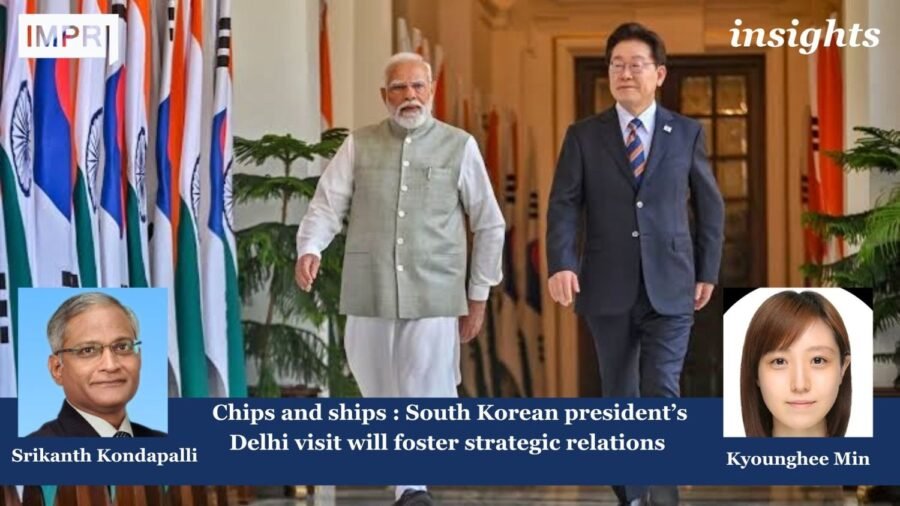
President Lee Jae Myung’s visit is expected to serve as a critical opportunity for both countries to advance strategic economic cooperation, positioning India as a key global hub, a supply chain pillar, and a new engine of growth amid geopolitical uncertainty
As President Lee Jae Myung embarks on his visit to India on April 19, bilateral relations between South Korea and India are expected to see significant upgrades across trade, investment, energy supply chains, technology, shipbuilding, semiconductors, maritime security, defence, and the “Special Strategic Partnership” established eleven years ago.
This meeting with Prime Minister Narendra Modi is not their first, following previous encounters at the G7 Summit in Canada last year and the G20 Summit in South Africa this year; however, this summit in New Delhi is expected to carry particular significance amid intensifying geopolitical turbulence, great power rivalry, and ongoing disruptions in global energy supply chains.
South Korea’s leading shipbuilding capabilities, characterised by technological sophistication, an integrated industrial ecosystem, and global leadership in high-value, eco-friendly LNG carriers, together with India’s policy-driven push for maritime self-reliance, talent pool, and scale, suggest a structurally complementary partnership.
Amid supply chain fragmentation driven by US-China rivalry and expanding export controls, shipbuilding cooperation is critical as it underpins both energy transport through LNG carriers and global trade logistics through container shipping.
Major South Korean shipbuilders such as HD Hyundai Heavy Industries, Hanwha Ocean, and Samsung Heavy Industries are at the forefront of this collaboration, with HD Hyundai Heavy Industries having already signed a comprehensive MoU last November with Cochin Shipyard Limited, India’s largest state-owned shipyard, for long-term cooperation.
Cooperation in this field can also be expanded in steel, engines, marine engineering education, port automation, services, and consultancy. These have the potential to transform India’s 32 shipyards.
The second major area of collaboration is in the semiconductor industry. With South Korea being the 3rd largest semiconductor powerhouse, the visit is expected to roll out new initiatives, enhancing India’s capabilities in automobiles, electronics, smartphones, industrial automation, 5G deployment and defence.
Already, India has rolled out subsidies for the $10 billion Semicon India programme and the Production Linked Scheme. Twenty-five of the world’s top semiconductor design companies have established R&D centres in India. Gujarat’s Dholera and Assam semiconductor fabs are poised to produce wafers. Relatively low labour costs, 20 per cent of the global semiconductor design talent pool, and a strong base of highly skilled, English-speaking IT professionals make India an attractive destination for semiconductor manufacturers.
Moreover, India ranks fourth in the world in automobile production, has the second-largest smartphone market, and has a rapidly expanding digital economy. Smartphones became India’s top export item in the 2024–2025 fiscal year, while electric vehicle production continues to expand.
Against this backdrop, collaboration with India will help South Korea to diversify supply chains, reduce dependence on China-centric production networks, and secure long-term strategic market access in a rapidly expanding semiconductor ecosystem.
A third area of cooperation is upgrading the 16-year-old Comprehensive Economic Partnership Agreement (CEPA) due to its low utilisation. Bilateral trade increased to nearly $26 billion, but there is substantial room for growth to reach $50 billion by 2030. The trade structure is concentrated in specific items, with South Korea exporting mainly high-value intermediate and capital goods, while India exports primarily raw materials. India’s low labour costs, expanding domestic market, service sector, pharmaceuticals and refineries are attractive to South Korea.
A fourth and pressing area of cooperation is rare earth minerals, given their export restrictions by China since 2020. Both India and South Korea suffered due to these restrictions and hence need to explore further cooperation in rare earth supply chain cooperation.
Amid recent turbulence in global energy flows, a fifth area of concern and cooperation is in the maritime domain, including the protection of sea lines of communication (SLOCs) and countering piracy, illegal, unreported, and unregulated (IUU) fishing, trafficking, and maritime terrorism.
In areas such as maritime domain awareness, supply chain security and emerging technology standards, South Korea and India could serve as important nodes in a multilateral network designed to promote a free, open, and inclusive Indo-Pacific order.
Lastly, South Korea’s advanced defence manufacturing capabilities—combined with India’s growing demand for indigenisation—create strong potential for joint production, technology transfer, and co-development. Maritime security cooperation can be deepened through naval collaboration, shipbuilding, and joint exercises, reinforcing both economic and strategic alignment.
This summit is expected to serve as a critical opportunity for both countries to advance strategic economic cooperation, positioning India as a key global hub, a supply chain pillar, and a new engine of growth amid geopolitical uncertainty.
About the Contributor
Srikanth Kondapalli is a Professor in Chinese Studies at Jawaharlal Nehru University, New Delhi, India. He was the former Dean of the School of International Studies, JNU. He is a frequent writer and commentator in the national and international media. Kyounghee Min is a Doctoral Candidate at Department of India-ASEAN Studies at Hankuk University of Foreign Studies
Maps
This article was first published in The Firstpost as Chips, ships and strategy: South Korean president’s Delhi visit will boost strategic ties on April 18, 2026.
Disclaim: All views expressed in the article belong solely to the author and not necessarily to the organisation.
Read more at IMPRI:
The Great Nicobar Project: A Key Economic and Strategic Initiative in Indo-Pacific
China’s Balancing Act Grows Harder Amid U.S. Iran Policy Reversals
Acknowledgement
This article was posted by Aananya Atri a Research Intern at IMPRI.