






Srikanth Kondapalli
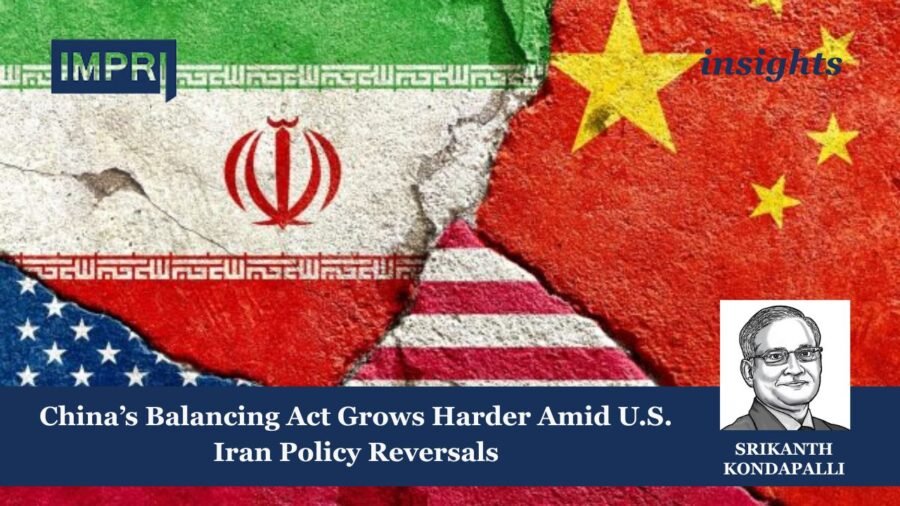
China’s carefully crafted, if contradictory, policy on the current conflict in Iran is coming under increasing strain, threatening to derail its trade, energy flows, its relations with the United States and the Gulf countries, and its ambitions to invade Taiwan.
The flip-flops in the US policies have been taking a toll on China, as with many other countries. President Donald Trump’s avowed policy of restructuring global and regional orders is affecting China. The capture of Venezuelan President Nicolas Maduro soon after the visit of a high-level Chinese delegation, the cancellation of a Chinese company’s hold over the Panama Canal, and the increasing scrutiny of Chinese investments in Latin American ports are unnerving Beijing.
So is the current US-Israeli war against Iran and the blockade of the Strait of Hormuz. China has shifted from its initial pro forma position on the violation of international law and sovereignty to active negotiation. On April 14 and April 20, President Xi Jinping explicitly underscored resolution of the conflict – a stance markedly different from the nuanced earlier position favouring back-channel diplomacy. China’s position is clearly inconsistent here, as seen in its militarisation of the South and East China Seas and the border with India.
On April 20, President Xi called Saudi Crown Prince Mohammed bin Salman as part of efforts to open the Strait of Hormuz. Despite diversification of its energy needs to Russia, Central Asia, and Africa, a surge in renewables, and stronger strategic oil reserves, China is feeling the heat of energy disruptions. Domestic fuel prices are up by 20% – the fifth hike this year – while the uncertainty about the Hormuz blockade is hampering its economic growth prospects.
Also, China has been selectively blocking the South China Sea waterways for vessels from the US, India, and other countries. In 2011, China reportedly harassed the Indian naval vessel INS Airavat. Later, ONGC Videsh Limited rigs came under China’s pressure even though they were located in areas held by Vietnam. The USNS Impeccable incident in 2009 was another instance of harassment.
At the centre of the present crisis, however, is the Iranian nuclear programme, cited by the US and Israel as the “fundamental” issue in the conflict. Russia and China are, separately, toying with the idea of taking away Iran’s enriched uranium. Since the 1990s, Russian and Chinese scientists have helped Iran in developing the programme; both countries have leverage over Tehran on this account. No wonder Trump stated on April 8 that China is contributing towards turning around Iran’s leadership for negotiations.
About the Contributor
Srikanth Kondapalli is a Professor in Chinese Studies at Jawaharlal Nehru University, New Delhi, India. He was the former Dean of the School of International Studies, JNU. He is a frequent writer and commentator in the national and international media.
This article was first published in The Deccan Herald as China’s Iran imbroglio on April 26, 2026.
Disclaimer: All views expressed in the article belong solely to the author and not necessarily to the organisation.
Read more at IMPRI:
India Needs State-Backed AI Capacity, Not Mythmaking
Iran Is Exposing the Limits of American Power
Acknowleddgement
This article was posted by Varisha Sharma, a Research Intern at IMPRI.