









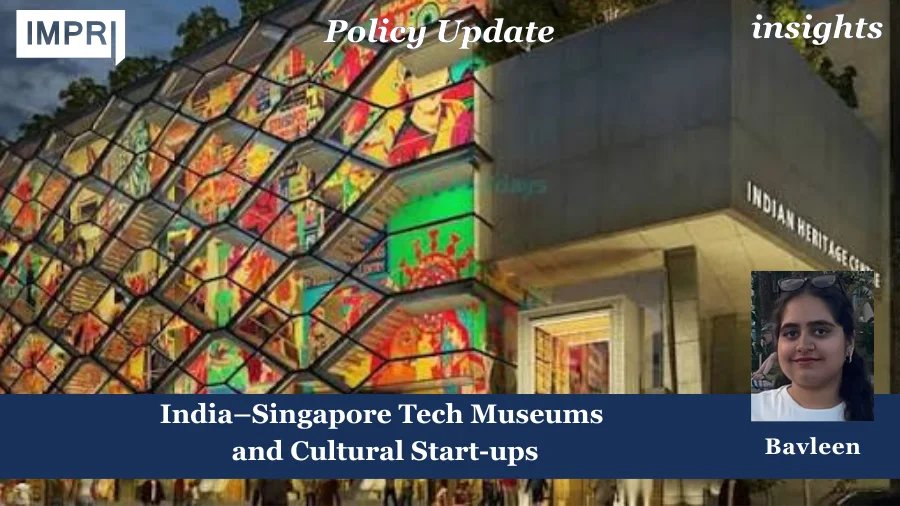
Policy Update
Bavleen
Background
The India–Singapore relationship has transcended traditional bilateralism, entering a sophisticated era of Innovation Diplomacy. Since the 2015 Strategic Partnership, the focus has shifted toward the “Creative Economy.” In 2025, the synergy between Singapore’s advanced digital infrastructure and India’s vast cultural repository has positioned tech-enabled museums and cultural start-ups as pivotal instruments of soft power.
- Singapore’s Edge: Institutions like the ArtScience Museum and the National Museum of Singapore serve as global benchmarks for AI-driven curation and “phygital” (physical + digital) experiences.
- India’s Momentum: Driven by Digital India and Ek Bharat Shreshtha Bharat, the Indian ecosystem is witnessing a “Heritage-Tech” revolution, with start-ups focusing on VR-based history and blockchain-secured digital archives.

Singapore’s ArtScience Museum
Functioning
The India–Singapore collaboration in tech museums and cultural start-ups functions through three interlinked channels:
- Institutional Partnerships and MoUs: Museums and cultural institutions engage in staff exchanges, joint exhibitions, and technology transfer. Singaporean museums share best practices in audience analytics, digital preservation, and immersive design, while Indian institutions provide rich civilisational content and large-scale outreach models.
- Start-up and Innovation Ecosystem Linkages: Cultural start-ups from India access Singapore’s innovation infrastructure – accelerators, venture capital, and global markets – while Singapore-based creative tech firms pilot solutions in India’s vast museum and tourism ecosystem. Incubators and innovation hubs facilitate cross-border mentorship and co-funding.
- Policy and Government Facilitation: Supportive policies in both countries enable collaboration through grants, innovation challenges, and cultural exchange programmes. India’s Ministry of Culture and Ministry of Electronics and IT, alongside Singapore’s cultural and innovation agencies, act as nodal facilitators.
Despite this structured functioning, literature and policy reviews highlight challenges: limited standardisation of digital heritage data, high costs of immersive technologies for public museums, uneven digital capacity across Indian states, and intellectual property concerns for start-ups operating across jurisdictions.
Performance (2022–2025)
Over the last three years, performance trends indicate gradual but meaningful progress:
- Digital Museum Expansion: Indian museums have increasingly adopted digital galleries and virtual walkthroughs, often inspired by Singaporean models. Pilot projects involving AR/VR storytelling and AI-based curation have expanded in metropolitan museums.
- Start-up Growth: Cultural and creative-tech start-ups in India have grown in number, many focusing on heritage gaming, digital archives, and experiential tourism. Singapore has emerged as a preferred gateway for scaling these start-ups globally.
- Bilateral Engagements: Joint exhibitions, workshops, and innovation dialogues have increased, particularly in areas of museum digitisation and creative entrepreneurship.
However, performance assessments based on ministry reports, budget allocations, and cultural programme updates suggest that funding remains project-based, with limited long-term financial commitments. Data from annual cultural reports indicate uneven regional uptake, with benefits concentrated in urban centres.
Impact
The India–Singapore collaboration has had multi-dimensional impacts:
- Cultural Diplomacy and Soft Power: Technology-driven exhibitions have made Indian heritage more accessible to global audiences, while Singapore benefits from showcasing Asian cultural diversity through Indian narratives.
- Creative Economy Development: Cultural start-ups have gained international exposure, improved investment prospects, and access to advanced technologies, contributing to employment in design, content creation, and digital services.
- Knowledge and Skill Transfer: Museum professionals and start-up founders have benefited from cross-border learning in digital curation, audience engagement, and sustainable business models.
- Tourism and Urban Experience: Tech-enabled museums enhance experiential tourism, aligning with urban regeneration and smart city goals in both countries.
Analytical literature and recent policy commentaries emphasise that such collaborations help reposition culture as an economic and innovation asset, rather than merely a heritage conservation activity.
Emerging Issues
- Digital Divide: Smaller museums and regional cultural institutions in India struggle to adopt high-end technologies.
Suggestion: Tiered funding models and shared digital infrastructure. - Sustainability of Start-ups: Cultural start-ups face revenue volatility and dependence on grants.
Suggestion: Blended finance models combining public grants, CSR, and private investment. - Data Governance and IP Rights: Cross-border use of cultural data raises ownership and licensing concerns.
Suggestion: Clear bilateral frameworks on digital heritage IP. - Limited Community Participation: Technology-led projects sometimes overlook local narratives.
Suggestion: Co-creation with local artists, historians, and communities.
Way Forward
To move from pilot projects to a self-sustaining ecosystem, the partnership must prioritize:
- A Bilateral Cultural Innovation Fund: A dedicated pool of capital for high-risk, high-reward creative tech.
- Academic-Industry Integration: Linking university history departments with tech-incubators to ensure historical accuracy in gaming and VR.
- Standardization: Developing common digital metadata standards to allow for “Virtual Indo-Singaporean Museums.”
By 2030, this partnership has the potential to redefine how the global south preserves and promotes its identity, transforming culture from a “legacy asset” into a “future engine” of growth.
References
About the Contributor:
Bavleen, Research Intern at IMPRI, pursuing Economics Honors from Sri Guru Gobind Singh College of Commerce, Delhi University.
Acknowledgment: The author sincerely thanks Ms. Aasthaba Jadeja and the IMPRI team for their valuable support.
Disclaimer: All views expressed in the article belong solely to the author and not necessarily to the organisation.
Read More at IMPRI:
Fostering Inclusivity in Technical Education: Saksham Scholarship Scheme (2014)