






Harsh V Pant and Samir Bhattacharya
South Africa’s G20 Presidency represents a landmark moment for Africa and the broader Global South, building on the momentum generated by preceding Global South chairs, Indonesia, India, and Brazil. With South Africa taking charge in 2025, the G20 will complete an uninterrupted four-year run of Global South presidencies. This creates a clear line of continuity and helps keep the development priorities of the Global South firmly on the G20 agenda.
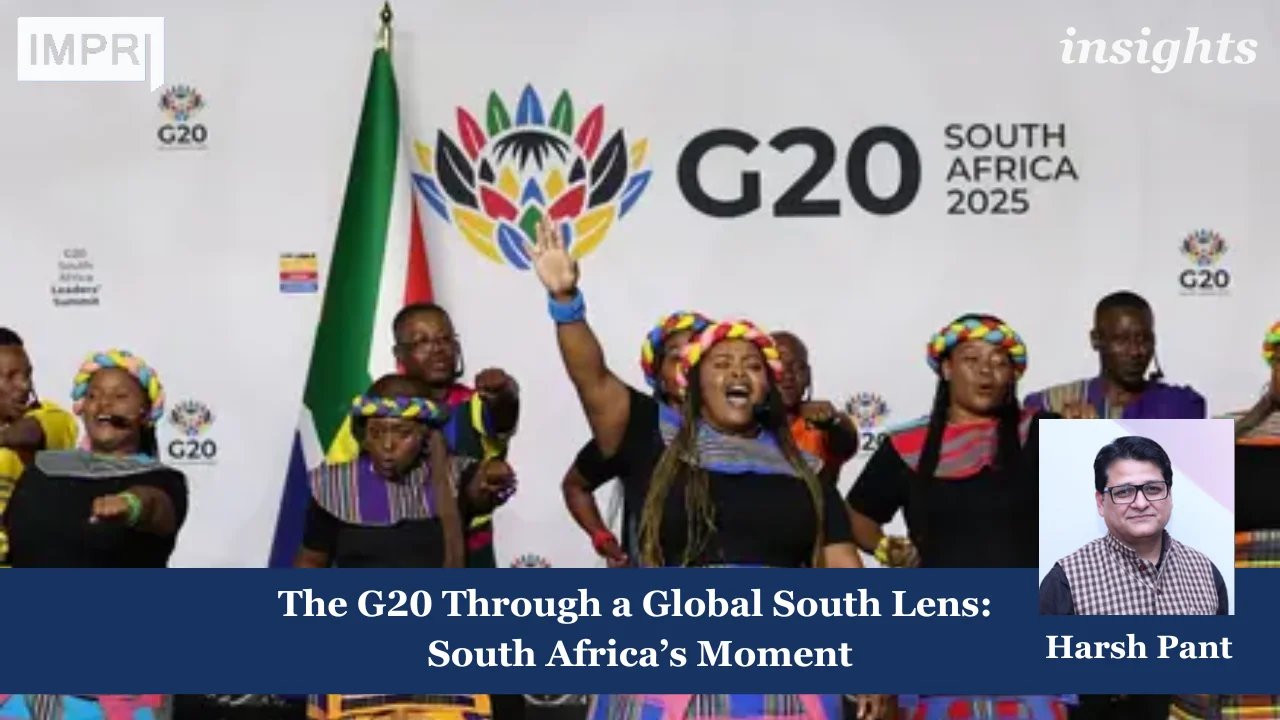
Scheduled to take place in Johannesburg on 22 and 23 November 2025, the summit will be the first G20 Leaders’ gathering on African soil. The occasion is symbolically powerful as it situates Africa from the fringes of global governance to its centre. Interestingly, it was during India’s G20 presidency that the African Union, the continental body, became a permanent member of the G20.
South Africa approaches its presidency as both a continental mandate and a contributor to global governance debates. As the only African member of the grouping, its leadership extends beyond national interests and embodies the continent’s aspiration for a more equitable international order. This aspiration is rooted in African political philosophy, particularly the principle of ‘Ubuntu’. Similar to the theme of India’s G20 Presidency, ‘Vasudhaiva Kutumbakam’, which means “the world is one family”, Ubuntu emphasises shared humanity, interconnectedness, and collective responsibility.
Furthermore, South Africa’s presidency coincides with a moment of deep geopolitical tension and eroding trust in multilateralism. International institutions are strained by conflicts such as the Russia–Ukraine conflict, the Gaza crisis. Issues such as trade weaponisation and increasing fracture between the Global North and South are making global governance increasingly difficult. At the same time, the world is confronting widening inequality, technological disruption, slow post-pandemic recovery, and a systemic debt crisis in developing economies. South Africa needs to step up and reaffirm the G20’s relevance by prioritising collective solutions.
At the heart of this year’s agenda is the challenge of global inequality. South Africa, therefore, advocates the establishment of a permanent global panel on inequality that can provide systematic monitoring and policy guidance. It also seeks reforms in global financing frameworks to reverse growing disparities between and within nations.
A second central issue is food security, which remains one of the most urgent global challenges. One in four people experiences moderate or severe food insecurity, a figure exacerbated by conflict, climate change, economic volatility, and supply chain disruptions. South Africa aims to enhance global resilience by advocating for improved coordination on agricultural innovation, climate-resilient farming practices, and equitable distribution systems.
The governance of artificial intelligence and digital technologies constitutes a third priority. South Africa recognises both the transformative developmental potential of AI and its risks, particularly the prospect that unregulated systems will deepen global digital divides. Through its presidency, South Africa aims to promote ethical governance frameworks, fair access to digital public goods, and institutional mechanisms that ensure AI contributes to inclusive and sustainable growth rather than reproducing structural inequalities.
Critical minerals and the green transition constitute another key pillar. Given Africa’s immense reserves of minerals essential for clean energy technologies, South Africa aims to move the G20 away from extractive economic models toward equitable beneficiation, technology transfer, and shared value creation. This approach challenges historical patterns in which resource-rich developing countries remained locked in low-value segments of global supply chains, while wealthier nations accumulated the gains of industrial transformation.
Last but not least, debt sustainability constitutes a significant concern that needs to be addressed during its presidency. Many African countries allocate an unsustainable proportion of their national income to debt servicing, which constrains investments in health, education, and climate adaptation. South Africa has reinvigorated discussions on debt restructuring and drawn on findings from the African Panel on Debt to strengthen the G20’s Common Framework and introduce more flexible mechanisms for responsible borrowing and long-term financial stability.
Yet South Africa’s ambitious agenda faces formidable obstacles. The most problem is the announced boycott of the summit by the President of the United States and the withdrawal of the US delegation. Because G20 decisions rely on consensus, the absence of the world’s largest economy complicates negotiations, including the possibility of issuing a Leaders’ Declaration. Paradoxically, the US has also requested that no declaration be adopted in its absence.
South Africa has affirmed that the G20 remains “too big to fail,” but the boycott underscores growing geopolitical fragmentation and potentially foreshadows an existential crisis for the forum itself.
Broader geopolitical tensions further threaten consensus. Divisions over global conflicts, competing trade blocs, and hardened attitudes toward rising powers within BRICS fuel distrust between developed and developing members. At the same time, domestic pressures within G20 economies—ranging from inflation and slow growth to polarised political climates—reduce their willingness to commit to international reform agendas. Even the technical exercise of drafting a joint declaration has become increasingly fraught, as illustrated recently by the G7’s inability to reach agreement.
Against this troubled backdrop, the role of the G20 Troika has become indispensable. The Troika, consisting of Indonesia, India, Brazil, and now South Africa, has preserved continuity and strengthened institutional memory during a period of acute geopolitical disruption. It has allowed Global South priorities to remain central to G20 processes for four consecutive years.
Indonesia advanced climate finance commitments; India elevated digital public infrastructure as a global public good; Brazil launched initiatives to fight hunger and poverty. South Africa’s agenda builds upon these foundations, emphasising inequality reduction and structural reform. Through coordinated Troika action, these presidencies have institutionalised new mechanisms, alliances, and frameworks that are likely to outlast individual priorities.
In conclusion, South Africa’s presidency marks a defining moment for Africa and the Global South. South Africa seeks not only to advance a progressive development agenda but also to reinforce multilateral cooperation at a time of profound uncertainty. Despite significant geopolitical and structural challenges, South Africa’s G20 presidency affirms that solving global problems requires inclusive leadership and that Africa’s voice is essential to building a fairer international order. This was also a message that resonates with Indian foreign policy and G-20 priorities, marking an important convergence between two critical players in global politics of today.
Harsh V. Pant is the Vice President, Observer Research Foundation and Professor of International Relations, King’s College London.
The article was first published in The Economic Times as South Africa’s G20 Presidency and the Global South Continuum on 20th November, 2025.
Disclaimer: All views expressed in the article belong solely to the author and not necessarily to the organisation
Read more at IMPRI:
Acknowledgment: This article was posted by Swati, a Research Intern at IMPRI.