





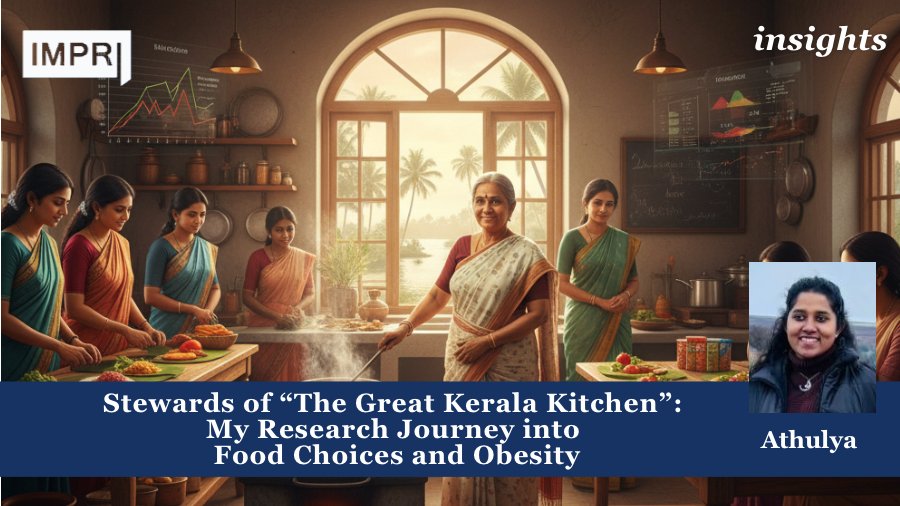
Athulya
When I first set out to explore the dynamics of food purchase, cooking and consumption in Kerala households, I imagined a straightforward path of recruiting participants, conducting interviews, and uncovering insights. Yet, like most qualitative research, the journey has turned out to be layered, unpredictable, and sensitive to approach. The process of engaging with families has taught me as much about the practice of research, impromptu improvisations and the subject itself.
Background: Kerala at a Crossroads
Kerala holds a paradoxical position in India’s public health landscape. On one hand, the state boasts remarkable health indicators, but on the other, it also faces one of the country’s highest burdens of obesity and diabetes. According to NFHS-5 (2019–21), 36.4% of men and 38.1% of women aged 15–49 years in Kerala are obese. These statistics prompted my study titled “Stewards of The Great Kerala Kitchen: Understanding Drivers of Food Choices in Homemakers across Obesity Status.”
The idea of “stewards” reflects the pivotal role of homemakers—women and, in some cases, men—who shoulder the responsibility of feeding their households. They decide what gets purchased, what gets cooked, how food is served, and ultimately, if these daily decisions could be targeted for combating obesity. In Kerala, where culinary traditions are rich but lifestyle diseases are rising, understanding the stewards’ perspectives felt like the right entry point.
Recruiting Participants: Sensitivity of Obesity
One of the first challenges I encountered was recruiting suitable participants. Asking upfront if a family had members who were overweight or obese was not only socially sensitive but also impractical. Obesity, while visible, is also tied to a lot of stigma. Direct questioning could easily alienate potential participants.
This forced me to adopt purposive and convenient sampling, often relying on visual assessments of body composition. Families were classified as “obese” or “non-obese” households based on observable weight statuses. While I am aware this approach bypasses clinical parameters and excludes hidden conditions such as metabolic disorders in seemingly non-obese individuals, it seemed most appropriate given the qualitative and exploratory nature of my study.
This experience highlighted a dilemma often faced in qualitative research: balancing scientific rigor with cultural sensitivity and feasibility. In this case, prioritizing trust on visual cues over invasive questioning felt appropriate.
Homemaker’s Voice
Another methodological choice I made was to direct my interviews primarily toward homemakers, usually women. In India, women continue to dominate decisions about food purchasing, cooking, and portioning, even if others contribute financially or assist occasionally.
A female participant is more likely to articulate the rhythms of her kitchen and explain how cultural, health, and economic considerations shaped decisions around daily meals. However, I also remained open to speaking with men if they were identified as the primary food decision makers. The goal was not to reinforce gender stereotypes but to understand who truly played the role of steward in each household.
Power of Social Desirability
A striking observation I made during my initial interviews was how the word “research” or “interview” altered participant responses. People often became more conscious, careful, and perhaps aspirational in describing their practices. Social desirability bias crept in as homemakers refined their answers to present their families in the best possible light. For example, when the research focus touched upon obesity and overweight, one participant repeatedly emphasized the household’s constant efforts to choose healthier options. I noticed that homemakers often adopted a non-blaming stance when describing their family’s lifestyle, which helped me realize the importance of framing my questions in a more probing, non-judgmental, and conversational manner.
In my first face-to-face interview, I had the advantage of observing the household setting directly—the stocked kitchen shelves, the utensils in use, and even the dining arrangements. These visual cues enriched my understanding and helped me to probe the appropriate questions. However, subsequent interviews had to be conducted remotely, often through virtual platforms. While convenient, this format limited my ability to observe context and made me more dependent on the participant’s narrative alone. I now recognize this as a methodological limitation that could shape the interpretation of findings.
Methodological Framework
The study is structured as an exploratory qualitative design with a purposive sample of 12 participants. Semi-structured interviews form the core data source, allowing me to explore themes such as:
1) Health beliefs and perceptions of obesity
2) Cultural practices influencing diet
3) Affordability and access to foods
4) Convenience and time constraints
5) Family influences on food decisions
The analysis will rely on thematic coding, identifying both shared concerns across households and distinct patterns based on obesity status. I am attempting to add an innovative element with the use of visual documentation. With participants’ consent, I plan to create a photo essay that captures the family members. Denial or withdrawal of consent or anonymity concerns at any stage of the research will be respected and addressed appropriately.
Reflections
This early phase of fieldwork has already given me valuable insights into the subtle dynamics of conducting qualitative research in sensitive domains:
1. Sensitivity over precision: Cultural appropriateness takes precedence over methodological perfection, as seen in my reliance on visual obesity assessments.
2. Stewards of kitchens: Homemakers, especially women, continue to hold deep knowledge and control over food practices, making them indispensable narrators of household health.
3. Limits of virtuality: Remote interviews, while practical, filter out much of the contextual richness of in-person visits.
4. Words shape responses: The urge of social desirability was evident during the research interview.
Looking Ahead
As I move forward, my aim is to balance empathy with critical inquiry. I hope to document not only the challenges homemakers face—rising food prices, shifting work patterns, or pressure to cook “healthy” meals—but also the resilience and creativity they demonstrate in sustaining their families daily nutrition.
By listening to the stewards of Kerala kitchens, this study aspires to shed light on the cultural, economic, and social drivers of obesity. More importantly, it seeks to provide insights that can guide public health strategies tailored to Kerala’s unique context—where culinary heritage must coexist with the urgent need for healthier living. The future interventions should be based on the combined approaches including pharmacological, socio-cultural, and psychological drivers aiding better lifestyle management.
Athulya is a student of PPQARF 6
Disclaimer: All views expressed in the article belong to the author and not necessarily to the organisation.
Acknowledgement: This article was posted by Aashvee Prisha, a research intern at IMPRI.
Read more at IMPRI:
Energy, Security, and Strategy: Why Central Asia Matters to India
Why has the Rise in Security Alliances been Inversely Proportional to Global Peace?