








Saniya Verma
Policy Update
Introduction
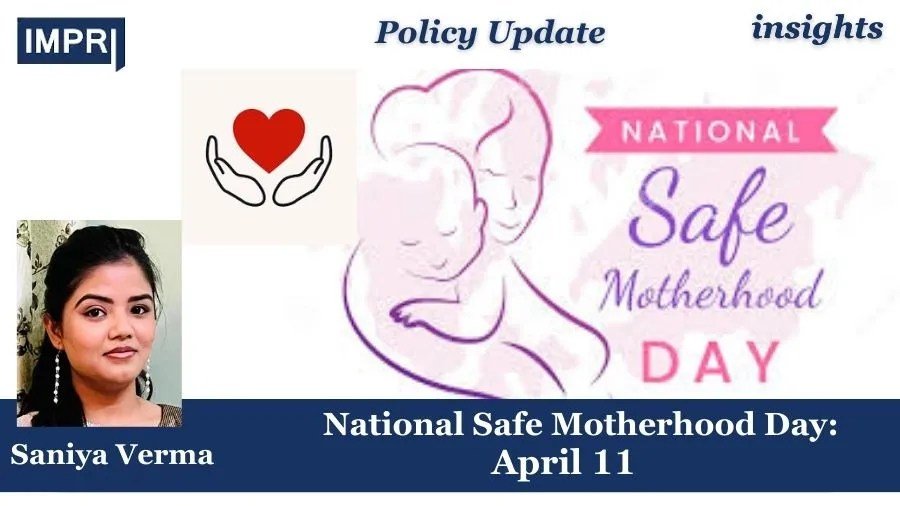
When the sun rises on April 11th every year, India celebrates National Safe Motherhood Day as a serious wake-up call which has been started by the Government of India in 2003 to honour the birth anniversary of Kasturba Gandhi on April 11, 1869, based on a White Ribbon Alliance India (WRAI) coalition of 1,800 organizations’ proposal. This day, which marks the importance of maternal and newborn health, is advocated by WRAI along with the country’s national health administration. It is a reminder of the stark reality of 44,000 preventable deaths each year that was estimated by the Registrar General of India’s 2017–19 Maternal Mortality Ratio (MMR) survey.
At an MMR of 103 per 100,000 live births reduced from 113 for the years 2016–18—the path is open for further improvement, though the task remains uncompleted till date. An overwhelming majority of these deaths are preventable or can be avoided with appropriate facilities for healthcare provided with effective interventions in prevention of complications of pregnancy, childbirth, and post-partum complications.
It is thus essential that women are made aware of the care they require in pregnancy, childbearing, and post-partum so that they can have a healthy and secure experience of motherhood. The article analyzes the existing situation of maternal health, its current problems, and paints a vision-led path towards realization of the day’s long-promised promise of security and equality to all mothers of India’s vast landscape.
Current Landscape: Progress and Promises
The foundation of National Safe Motherhood Day is based on a series of government initiatives aimed at improving maternal care. Among them, the Janani Suraksha Yojana (JSY), a flagship scheme of the National Health Mission (NHM), promotes institutional deliveries by disbursing over ₹4,000 crore annually, benefitting around 1.5 crores of women since it began in 2005, according to the 2023 report of the Ministry of Health and Family Welfare. Launched on April 12, 2005, by the then Hon’ble Prime Minister, the Late Dr. Manmohan Singh, the scheme is implemented in all states and Union Territories (UTs) with a focus on Low Performing States (LPS).
JSY is a centrally sponsored scheme that integrates cash incentives with delivery and post-delivery care. It also recognizes Accredited Social Health Activist (ASHA) as a critical interactor between the government and pregnant women. JSY’s complement is the Pradhan Mantri Surakshit Matritva Abhiyan (PMSMA), introduced in 2016, which provides free antenatal tests and covered 2.5 crore women as of 2023, as per NHM dashboards.
Similarly, the LaQshya initiative, which was initiated in 2017, attempts to enhance the quality of care at the time of birth by accrediting labor rooms—1,800 of which were accredited as of 2023, according to the Ministry’s progress report. The National Family Health Survey (NFHS-5) 2019–21 also points to the success of these schemes, noting that institutional births have increased in the nation to 89%, from 79% in 2015–16. But this progress is uneven: the cities have advanced significantly, and the rural tracts, in which 65% of Indian citizens reside, lag behind with institutional delivery levels of a paltry 75%, NHM data shows. This image, painted in colors of achievement and disparity, paves the way for more scrutiny.
Challenges in Maternal Health Equity
Despite remarkable strides in maternal healthcare, the vision of universal safe motherhood in India remains elusive, hindered by an intricate web socioeconomic barriers. According to the Ministry of Health’s 2022 annual report, 30% of Primary Health Centers (PHCs) in rural India still lack trained midwives—a gap that starkly endangers maternal lives, particularly during emergencies. The Janani Shishu Suraksha Karyakram (JSSK), launched to provide free transport and care to pregnant women and their newborns, is failing to deliver on its promise, with only 75% of the intended beneficiaries reached, per a 2023 NHM evaluation. In a country where institutional care often spells the line between life and death, these shortfalls are not merely administrative—they are fatal.
Inter-state disparities sharpen the divide: Kerala, often hailed as a model of public health, records a Maternal Mortality Ratio (MMR) of just 19, while Assam struggles at a grim 195, as per the 2023 update from the Registrar General of India. Yet, the myth of Kerala’s safety net was punctured recently by a haunting tragedy in Malappuram district, where a 34-year-old woman named Asma died during childbirth at home.
According to The Indian Express, she had opted for a home delivery under the guidance of her husband, a self-styled orthodox cleric, despite having four children and having given birth at home multiple times before. The family attempted a quiet burial, but suspicions were raised and a case of unnatural death was registered.
This chilling incident underscores the persistent cultural resistance to institutional care. As noted by NFHS-5, nearly 20% of births in India still take place at home, many under unsafe conditions. The reasons range from mistrust in public healthcare, religious conservatism, to sheer geographical and infrastructural inaccessibility. In Asma’s case, it was also the silencing of a woman’s agency. ASHA workers who tried to reach her during a health survey were turned away; she never disclosed her pregnancy. Her death wasn’t just medical—it was social, political, and deeply gendered.
Socioeconomic divides further deepen this crisis. NHM’s 2023 data reveals that 36% of women in the lowest wealth quintile do not receive even the basic four antenatal check-ups. The COVID-19 pandemic only worsened the gaps, with a 15% decline in antenatal visits in 2020-21, as recorded by the Ministry’s own pandemic response report. The poorest, most marginalized women continue to be denied the dignity of safe childbirth. When services collapse or never arrive, it is their bodies that bear the burden.
These aren’t isolated failures—they’re symptoms of a healthcare system still struggling to reconcile its aspirations with on-ground realities. National Safe Motherhood Day must, therefore, be more than a symbolic gesture. It must act as a catalyst for deeper reforms, pushing for improved last-mile delivery of services, cultural sensitization, and robust monitoring of maternal health schemes. For every Asma whose story becomes public, there are countless others silenced by invisibility. We owe it to them to make motherhood not a gamble, but a right—safe, supported, and dignified.
Way Forward: A Blueprint for Maternal Empowerment
To overcome these barriers, a robust policy blueprint is critical.
First, augmenting the ASHA (Accredited Social Health Activist) cadre is a Pre Requisite. The Ministry of Health would need bi-monthly training, increasing ASHA coverage to 80% rural births by the year 2027, up from the current 60% deployment, under the 2023 ASHA program update.
Second, a Digital Maternal Health Initiative as part of the NHM digital portal would provide telemedicine and real-time tracking, to extend to the 70% digitally connected youth to fill rural-urban divides, as per the 2023 Periodic Labour Force Survey. This may take cues from international models to boost access in the shape of the UK’s NHS digital services.
Third, a National Safe Motherhood Fund, seeded with ₹5,000 crore every year from the Union Budget, would subsidize transport and infrastructure in high-MMR states such as Bihar and Assam with the vision of lowering MMR to below 70 by 2030, consistent with NITI Aayog’s health objectives. Community participation, through village health councils, would enable women to express needs, creating a participatory health setting.
This progressive approach aims to create a India where each April 11 is not one of memory, but of real maternal victory.
References
Ministry of Health and Family Welfare. (2022). Pandemic response report 2020–21. Government of India. https://main.mohfw.gov.in/covid-19
Ministry of Health and Family Welfare. (2023). Annual report 2022–23. Government of India. https://main.mohfw.gov.in/sites/default/files/Annual%20Report%202022-23.pdf
Ministry of Health and Family Welfare. (2023). ASHA program update 2023. Government of India. https://nhm.gov.in/asha
National Family Health Survey (NFHS-5). (2021). India fact sheet (NFHS-5, 2019–21). Ministry of Health and Family Welfare. https://main.mohfw.gov.in/sites/default/files/NFHS-5_Phase-II_0.pdf
National Health Mission. (2023). NHM dashboard and progress report 2023. Government of India. https://nhm.gov.in/nhm_components/reproductive_and_child_health
National Health Mission. (2023). Periodic Labour Force Survey 2023 highlights. Government of India. https://nhm.gov.in/labour-force-survey
NITI Aayog. (2023). Health goals for sustainable development. Government of India. https://www.niti.gov.in/health-policy
Registrar General of India. (2023). Special bulletin on maternal mortality in India 2017–19. Ministry of Home Affairs. https://www.censusindia.gov.in/2011-Documents/MMR_Bulletin_2017-19.pdf
About the Author: Saniya Verma is a researcher at IMPRI and is pursuing an Honours degree in Sociology at the University of Delhi.
Disclaimer: All views expressed in the article belong solely to the author and not necessarily to the organisation.
Acknowledgement: I would like to heartily thank Ms. Aasthaba Jadeja, for thorough guidance & support.
Read more at IMPRI:
The Ministry of Minority Affairs: Empowering India’s Diverse Fabric
Strengthening Bihar’s Makhana Industry: The Role of Makhana Board-2025