









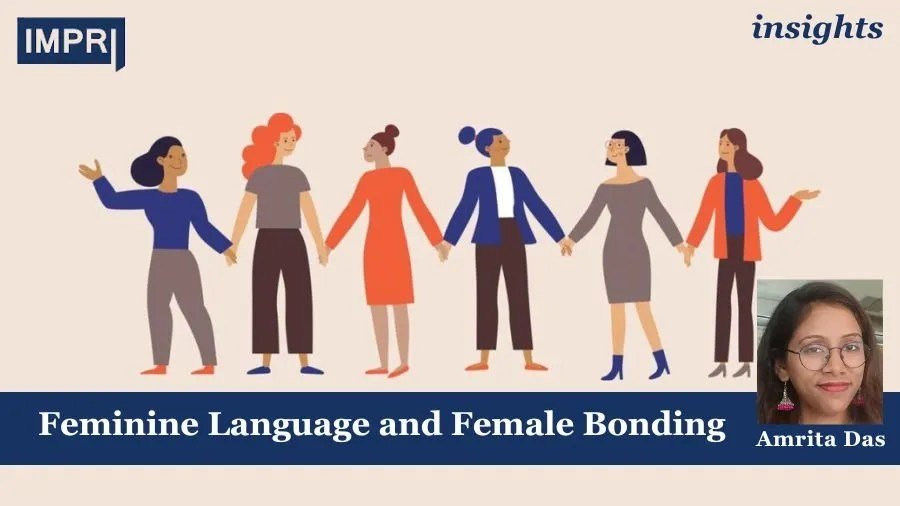
Amrita Das
Two women have many diverse topics to chitchat. But it is not possible with men. So, it is very difficult to spend hours over the phone with boyfriends, one of my friends once stated this after our French class, I remember.
Since childhood, I have been growing up with the statement from all my elders especially women that a man can be a good friend of a woman, not a woman, because two women are in a hostile relationship. They do not help each other, instead they are judgmental, and condescending to each other. Believing this and to persist this myth, I have also grown up with the impression of a disapproving relationship with other women, including my mother, sister and friends.
What is the reason behind this sanctimonious and disdainful relationship? What has triggered history to subvert this myth into fact? There are very few who have focused on this serious issue. This is the most neglected part. Among those few, there is the French feminist Luce Irigaray who throughout her research about women and women’s issues has worked on women’s language system. In her books, she mentions that women cannot imagine their superiority or their subjective position because they don’t have their own language. Two women can never be friends, is the most believed part because women’s language is always already speculated through patriarchy.
Being uncertain about their own destiny, virtue and fortune, women forget to speak. If I imitate the famous line by Descartes, ‘I think, therefore I am!’ Can a woman say, ‘I speak, therefore I am’? Possibly not, because all actions are solely male attributes, whether it is thinking or speaking. Now the point may arise about the recurrent speech of women. Whatever they do, say, express or believe – Do these carry any importance? The language she speaks is the language that has been spoken by all, accepted by all, then when and how this statement has popped up that women do not speak in the language of their own?
Now the A, B, C and all other alphabets of any language are taught to both boys and girls irrespective of their sex and gender. So, would language of her own mean some different alphabets, signs or sounds? The answer is obviously no. There does not need to be any change in metalanguage. Robin Lakoff, a professor emerita of linguistics, says, that till the age of 4, the language is the same for both genders. After that, the discrimination starts – where, when and how- this is a huge topic of discussion.
However, the imprint of this discrimination that has resulted in patriarchy creates differences among women as well. The heavy dose of patriarchy creates drowsiness and tames both genders. It makes a strong belief system where social, cultural, economic and linguistic -all the phases have been dominantly believing the patriarchal system.
Now the question is if not meta language, then how can women construct a language of their own? This is a language of emotion, of feelings, of filial love. Helene Cixous, a French feminist talks about the ecriture feminine, which describes women’s writing system. After her, Luce Irigaray another French feminist talks about women’s language which is the language of love, divine and that can create a filial bond between two women.
Women possess enmity among each other, which is a long-term belief system. They judge and convey negative attitudes towards each other. Psychoanalysts Sigmund Freud and later Jacques Lacan in their psychoanalytic theories gave reasons for women’s enmity between each other. According to them, a child’s first caretaker is his/her mother.
The subject and object relation is limited to mother and child only at that time. With the entry of the father figure, the subject object relation changes. The child then understands the superiority of the father and the subjugated condition of the mother. Accordingly, the boys pursue the path of their fathers because of their sexual identity and girls understand their repressed situation and realize that mothers are responsible for their oppression. But girls too need to create this sexual identity like wise boys with their mothers. But, how?
Both Freud’s and Lacan’s philosophies are wrong analysis. Mothers cannot be the reason for a girl’s inferiority. It is the power structure of the patriarchy that makes the mother believe so. So, mothers and their daughters and also two women of any kind of relationship (except lesbianism) can be friends. Women are not in enmity of each other. There are certain situations which if analyzed properly and spread among women through education can dispose of the age old taboo of the society. The first and the most important is female genealogies.
Female genealogy means to explore, accept and imply the histories of women’s relationships, love and bonding and supportive nature. Luce Irigaray uses the term ‘original matricide’, in her essay Body against Body that curtail the significance of mothers. Mothers play a vital role in creating a sexual identity. This sexual identity constructs an intergenerational relationship where emotional support, social cohesion and knowledge transfer can occur easily. Mothers pass on their legacy of love, empathy, affection and compassion which should be regarded as the strength, not a matter of decline.
The next important attribute of women’s language system is providing subjective positions to other women by understanding each other. Women are judgmental of each other. Beyond that, an intersubjectivity can be created where women share an emotional connection that strengthens each other. Instead of engaging in conflict, women lean into their relationships, using care and compassion to navigate challenges. This proactive, supportive approach not only alleviates immediate stress but also strengthens the emotional bonds between friends, making the relationship more resilient and enduring. Looking at other women with sympathy and empathy and nurturing pookies. Their embodiment of true complement to each other, organizing get togethers can create a space where they can speak in their own language.
Women possess the quality of nurture that can remodel other women’s emotional vulnerability. This strong bond can make the foundation of women’s relationships stronger. If the two women are friends, then the power of patriarchy can be lessened. There are stories of female bonding where two women have become the reasons for their emotional support and strong bondage and subjective position. There are stories of Kappa Delta, stories of Sisterhood where genuine female friendship can grow.
Women have tried to preserve their relationships with other women by removing their confrontational or detached methods. Mark Travers writes, ‘Empathy and compassion in social interactions shows that these qualities lead to more prosocial behaviour and better reconciliation in both personal and group contexts. Empathy helps de-escalate tensions by addressing emotional undercurrents, fostering mutual respect and reinforcing commitment to the relationship.’
Thus, these shared relationships construct an emotional language that is beyond meta language. This is the language of their own where women speak with their own choices, desires and wishes. The language that can be easily understood by other women and with this, women can empower each other in navigating their path towards compassion, love and care.
Recently there is a movie named ‘Do Patti’ by Shashanka Chaturvedi. The main theme of the movie is domestic violence where the lead character Kajol being a police officer helps the oppressed women who are the victims of domestic violence but remain silent because of their societal pressure. The movie ends with an important monologue of Kajol uttering ‘It’s always better to choose the mother’s path, rather than patriarchy’, and I believe this line is breaking the stereotypical philosophy of Freud and Lacan that has been mentioned earlier.
About the contributor: Amrita Das is a fellow at EGBVF Ending Gender-based Violence Fellowship at IMPRI and an English language and Literature Assistant Professor at Sarvajanik College of Engineering and Technology, Sarvajanik University, Surat, Gujarat.
Disclaimer: All views expressed in the article belong solely to the author and not necessarily to the organisation.
Read more at IMPRI:
Growing up Unsafe: Gender-based Violence and Adolescents
India-China at 75: Elephant-dragon tango and a history of complex relationship
Acknowledgment: This article was posted by Bhaktiba Jadeja, visiting researcher and assistant editor at IMPRI.