







Tanushree Bora
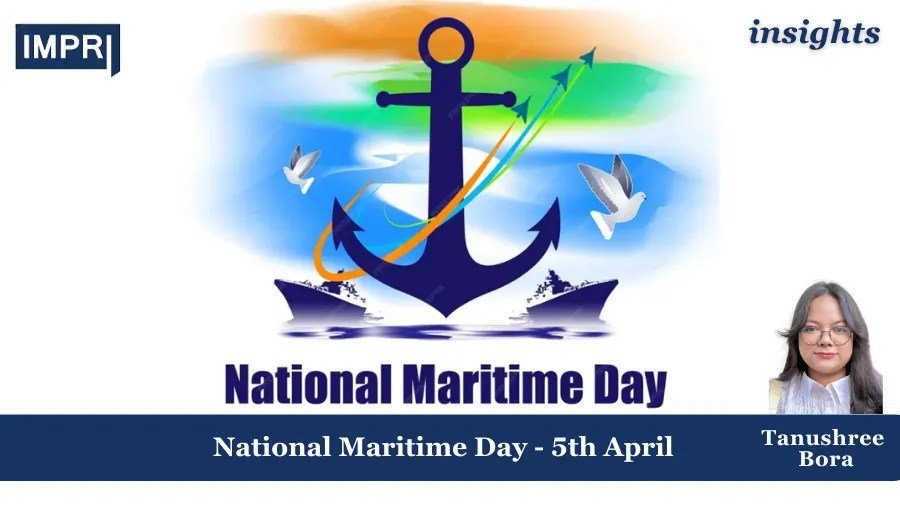
National Maritime Day is observed annually on April 5th in India to commemorate the historic voyage of SS Loyalty in 1919, marking the country’s entry into international shipping. This momentous event laid the foundation for India’s self-reliance in maritime trade, challenging colonial dominance over sea routes. Established in 1964, the day recognizes the contributions of the maritime sector to India’s economy, raises awareness about emerging challenges, and highlights growth opportunities.
The maritime sector has historically played a pivotal role in India’s economic and strategic development, serving as a vital conduit for trade and connectivity. With 95% of India’s trade volume and 70% of trade value dependent on maritime transport, the sector remains indispensable for national progress. The observance of National Maritime Day provides an opportunity to assess India’s maritime infrastructure, policy advancements, and the future trajectory of the sector.
Functioning and Key Components
Recognition of the Maritime Contributions
National Maritime Day plays a crucial role in recognizing the contributions of India’s maritime sector, which is a key driver of exports, port-led industrialization, and employment generation. The day provides an opportunity to highlight the shipping industry’s role in acknowledging trade, supporting economic growth, and ensuring logistical efficiency. Additionally, it acknowledges the efforts of seafarers, maritime professionals, and industry stakeholders who contribute to the seamless functioning of the sector. Awards such as the Sagar Samman and the Varuna Awards are presented to honor outstanding achievements in the maritime industry, thereby motivating excellence and innovation.
Awareness and Capacity Building
A major objective of National Maritime Day is to promote awareness about maritime security, sustainable shipping, and skill development. The observance includes seminars, conferences, and exhibitions focused on technological advancements in port modernization, digital logistics, and green shipping solutions. These discussions facilitate the exchange of ideas and strategies for enhancing efficiency and sustainability in the sector. Furthermore, institutions such as the Directorate General of Shipping (DGS) and the Indian Maritime University (IMU) conduct outreach programs to attract young professionals to maritime careers, ensuring a steady pipeline of skilled workers in the industry.
Policy Integration with Maritime Growth Initiatives
National Maritime Day provides a platform for reviewing and integrating government policies with maritime growth initiatives. A key area of focus is the Sagarmala Programme, which aims to promote port-led industrialization, coastal infrastructure expansion, and multimodal connectivity. Stakeholders also deliberate on policies such as the Merchant Shipping Bill, 2020, which seeks to modernize India’s shipping laws and align them with global maritime standards. These policy discussions help identify gaps and opportunities for regulatory improvements, ultimately strengthening India’s maritime ecosystem.
Global and Regional Maritime Diplomacy
India’s maritime ambitions extend beyond national borders, and National Maritime Day serves as a platform to highlight India’s engagement with the International Maritime Organization (IMO) and regional maritime collaborations. The discussions emphasize Indo-Pacific maritime partnerships, which play a crucial role in trade security, countering piracy, and promoting regional stability. Strengthening these diplomatic ties ensures that India remains a key player in global maritime governance and sustainable ocean resource management.
Performance and Recent Developments
India’s Maritime Growth in Numbers
India’s maritime sector has witnessed significant growth in recent years, reflecting its importance in trade and economic development. The country boasts 12 major ports and over 200 minor ports, which handle over 1.3 billion metric tonnes of cargo annually (Ministry of Ports, Shipping & Waterways, 2024). This expansion in port infrastructure has been complemented by investments under the Sagarmala Programme, which has seen ₹6 lakh crore allocated across 500+ projects aimed at modernizing ports and improving multimodal connectivity. Additionally, the Coastal Shipping and Inland Waterways Policy has resulted in a 25% increase in coastal freight movement, contributing to lower logistics costs and reduced road congestion.
The budget also reinforces India’s commitment to maritime security and infrastructure through investments in the Sagarmala initiative, the Indian Coast Guard, and submarine capabilities. The Sagarmala Programme, aimed at port-led industrialization, coastal connectivity, and logistics efficiency, continues to receive financial backing to enhance India’s trade competitiveness. Additionally, the Indian Coast Guard and the Navy are being equipped with advanced surveillance systems and modernized vessels to strengthen coastal security, counter piracy, and combat illegal maritime activities. The expansion of submarine programs, including indigenous manufacturing under Project-75I, highlights India’s focus on naval deterrence and maritime dominance. These initiatives collectively ensure the safeguarding of India’s trade routes, protection of exclusive economic zones (EEZs), and enhancement of overall maritime security in the Indian Ocean region.
Budget Allocations for Maritime Development
The government has made substantial financial commitments to maritime development, as reflected in the Union Budget 2024-25. A total of ₹2,000 crore has been allocated for the Maritime Amrit Kaal Vision 2047, focusing on port digitization, shipbuilding, and sustainable port management. Another ₹4,000 crore has been earmarked for the expansion of the Deep Ocean Mission, which aims to enhance India’s capabilities in seabed resource exploration and blue economy research. These investments underscore India’s long-term vision for maritime excellence and sustainable ocean resource utilization.
Challenges and Emerging Issues
Decarbonization of Shipping
The maritime sector faces significant challenges in reducing its carbon footprint, particularly in transitioning to low-emission and renewable fuel alternatives. The shift towards green hydrogen fuel, electric ferries, and energy-efficient vessels requires large-scale investments in research, infrastructure, and policy support. While India has made progress in adopting clean maritime technologies, achieving full decarbonization remains a long-term challenge that demands both government and private-sector collaboration.
Security Concerns in the Indian Ocean
Maritime security remains a critical issue due to piracy, illegal fishing, smuggling, and cybersecurity threats in the Indian Ocean region. These challenges necessitate a stronger naval presence, advanced surveillance systems, and international cooperation to safeguard India’s maritime interests. The government has taken steps to strengthen maritime law enforcement, but enhanced regional partnerships and strategic policies are required to effectively counter these threats.
Skill Shortages and Private Sector Participation
Despite the rapid expansion of India’s maritime infrastructure, the sector continues to face a shortage of skilled maritime professionals. There is a need for greater investment in training programs, industry-academic collaborations, and skill certification frameworks. Additionally, private sector participation in shipbuilding, port management, and logistics remains relatively low, limiting the industry’s overall growth potential. Encouraging public-private partnerships (PPPs) and policy incentives could help bridge this gap and create a more dynamic and competitive maritime industry.
Success Stories in India’s Maritime Sector
Cochin Shipyard’s Role in India’s Shipbuilding Industry
Cochin Shipyard Limited (CSL) has emerged as a key player in India’s shipbuilding and ship repair industry, contributing significantly to domestic vessel production and defense requirements. CSL played a crucial role in constructing India’s first Indigenous Aircraft Carrier (INS Vikrant), which was commissioned in 2022. The shipyard also focuses on green shipping solutions, including the development of LNG-powered vessels to support India’s decarbonization goals. This case illustrates the potential for indigenous shipbuilding to reduce reliance on imports and strengthen India’s maritime defense capabilities.
Sagarmala’s Impact on Port-Led Development
Under the Sagarmala Programme, India has developed new deep-draft ports and modernized existing infrastructure, leading to increased cargo handling efficiency. The Krishnapatnam Port in Andhra Pradesh, a success story under Sagarmala, has become one of the fastest-growing ports in India, significantly reducing turnaround time for cargo vessels. As a result, the port has boosted regional economic activity, attracting logistics companies and manufacturing industries to its vicinity.
Inland Waterways Development: National Waterway 1 (Ganga River)
India’s inland waterways transport system is seeing remarkable growth, with National Waterway 1 (NW-1) on the Ganga River being developed under the Jal Marg Vikas Project (JMVP). This initiative has facilitated commercial cargo movement between Varanasi and Haldia, reducing logistics costs by nearly 30% compared to road transport. It also helps in reducing carbon emissions, making it a sustainable alternative for freight transport.
Statistical Insights: Maritime Sector Growth and Trends
Port Capacity and Cargo Handling:
India’s major ports handled over 1.3 billion metric tonnes of cargo in 2023, marking a steady growth of 6.5% annually (Ministry of Ports, Shipping & Waterways, 2024). The Jawaharlal Nehru Port (JNPT) alone accounts for 40% of India’s containerized cargo traffic, making it the country’s busiest container port.
Employment and Skill Development:
The maritime sector employs over 4.5 million people, including seafarers, dock workers, and logistics professionals. Indian seafarers make up nearly 10% of the global seafaring workforce, a figure that has grown due to government-backed training initiatives (Directorate General of Shipping, 2024).
Economic Contribution and Investment:
The Sagarmala Programme has led to ₹6 lakh crore in investments across 500+ port infrastructure projects. Coastal shipping has increased by 25% in the last five years, reducing logistics costs and congestion on highways.
Maritime Sector Boost in Budget 2025-26
In the Union Budget 2025-26, Finance Minister Nirmala Sitharaman introduced several initiatives aimed at bolstering India’s maritime sector. A significant measure is the establishment of a Maritime Development Fund (MDF) with a corpus of ₹25,000 crore. This fund is designed to provide long-term financing for the shipbuilding and repair industry, with the government contributing up to 49% and the remainder sourced from ports and the private sector. The MDF aims to generate investments up to ₹1.5 lakh crore by 2030, fostering competition and growth within the maritime industry.
To further support domestic shipbuilding, the budget announces the continuation of the Shipbuilding Financial Assistance Policy (SBFAP), now revamped as SBFAP 2.0, with an enhanced allocation of ₹18,090 crore. This policy provides direct financial subsidies to Indian shipyards, offsetting operational cost disadvantages and encouraging the securing of new orders.
Additionally, the government has introduced a shipbreaking credit note scheme to promote the circular economy within the maritime sector. Under this scheme, a credit note equivalent to 40% of the scrap value will be issued for vessels recycled at Indian yards. This credit can be redeemed against the purchase of new ships built in India, incentivizing both ship scrapping and new ship construction domestically.
Recognizing the importance of inland water transport, the budget proposes extending the benefits of the existing tonnage tax scheme to inland vessels registered under the Indian Vessels Act, 2021. This move aims to promote the use of inland waterways, which currently have a minimal share in national logistics, thereby enhancing the efficiency and cost-effectiveness of cargo movement within the country.
Way Forward
As India moves toward achieving Maritime Amrit Kaal Vision 2047, National Maritime Day serves as a platform to evaluate policy gaps and strengthen maritime strategies. Some key recommendations for enhancing maritime growth include:
Accelerating Green Maritime Initiatives: Investment in decarbonization technologies, sustainable shipbuilding, and renewable port energy.
Enhancing Maritime Security: Strengthening coastal surveillance, cybersecurity in maritime trade, and Indo-Pacific naval collaborations.
Boosting Skill Development: Expanding maritime training institutes and integrating AI-driven logistics and automation skills.
Increasing Private Sector Investment: Encouraging PPP models in port operations, shipbuilding, and inland water transport projects.
Leveraging India’s Blue Economy Potential: Expanding deep-sea resource exploration, aquaculture, and marine biotechnology research.
With an emphasis on sustainability, digital transformation, and regional leadership, India’s maritime sector is poised for significant expansion. National Maritime Day continues to play a crucial role in aligning national priorities with global maritime advancements, ensuring India’s position as a leading maritime power in the coming decades.
References
- Press Information Bureau (PIB). (2024). National Maritime Day: Strengthening India’s Maritime Future. Retrieved from https://pib.gov.in
- Ministry of Ports, Shipping & Waterways. (2024). Annual Report on Maritime Growth & Infrastructure. Retrieved from https://shipmin.gov.in
- International Maritime Organization (IMO). (2023). Sustainable Shipping and Global Maritime Trends. Retrieved from https://www.imo.org
About the author: Tanushree Bora is a Research Intern at IMPRI and a student from Lady Shri Ram College, University of Delhi. She is passionate about International Relations, Conflict Transformation, and Gender Studies. She aims to contribute to meaningful dialogue and policy frameworks that promote sustainable and inclusive peace.
Acknowledgement: The author extends sincere gratitude to Dr. Arjun Kumar and Aasthaba Jadeja for their invaluable guidance and support.
Disclaimer: All views expressed in the article belong solely to the author and not necessarily to the organisation.
Read more at IMPRI:
Asian and Pacific Centre for Transfer of Technology (APCTT) 2023-2027
World Wetlands Day- 2nd February: A call for Wetland Protection and Restoration