


Press Release
Riya Rawat
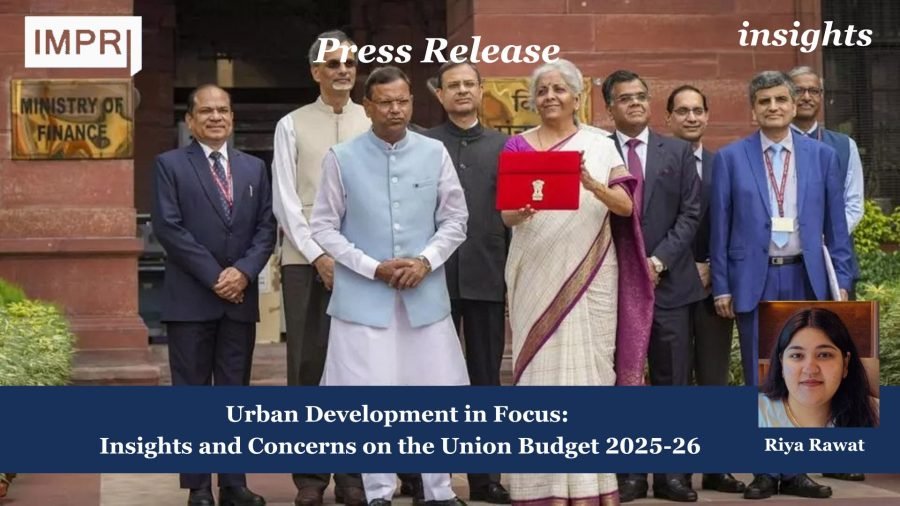
The IMPRI Center for Habitat, Urban and Regional Studies (CHURS), IMPRI Impact and Policy Research Institute, New Delhi, hosted an engaging panel discussion on “Cities, Local Governance, and Union Budget 2025–26” on February 5, 2025, at 6:30 p.m. IST, as part of IMPRI’s 6th Annual Series of Thematic Deliberations and Analysis of the Union Budget. This session brought together leading policymakers, urban experts, and academics to examine the implications of the Union Budget on urban development, governance, and sustainability in India, offering key insights and recommendations for future urban policy reforms.
Dr. Rumi Aijaz, Senior Fellow, Observer Research Foundation (ORF), chaired and moderated the session, ensuring a thought-provoking conversation. The speakers included Mr. Tikender Singh Panwar, Former Deputy Mayor, Shimla; Prof. Mahalaya Chatterjee, Professor at the Department of Economics, University of Calcutta; Prof. Chetan Vaidya, Former Director of the School of Planning and Architecture (SPA), New Delhi; Prof. Tathagata Chatterji, Professor at Xavier University, Bhubaneswar; and Mr. Sameer Unhale, Joint Commissioner, Directorate of Municipal Administration, Maharashtra.
The session provided a critical assessment of the budget, with each speaker bringing unique perspectives on urban development, local governance, and the future of Indian cities.
Dr. Rumi Aijaz (Senior Fellow, ORF)
Dr. Rumi Aijaz opened the discussion by highlighting the budget’s significant allocation of ₹1 lakh crore for urban development, marking a 17% increase from the previous year. He outlined the sector-wise distribution of funds, where 46% was allocated to Mass Rapid Transit Systems (MRTS), followed by 25% for AMRUT. However, he expressed concern over reduced allocations for the Pradhan Mantri Awas Yojana-Urban (PMAY-U) and the National Livelihood Mission.
Dr. Aijaz welcomed the introduction of the Urban Challenge Fund but raised questions about its implementation. He stressed the need for systematic actions, improved accountability for implementing agencies, and capacity-building programs to ensure better outcomes.
Mr. Tikender Singh Panwar (Former Deputy Mayor, Shimla)
Mr. Panwar questioned whether the 2025–26 budget sufficiently addressed urban challenges. He emphasized the growing role of cities in India’s economic growth and advocated for sustainable urban development. He expressed concern over the focus on capital-intensive schemes at the expense of employment-oriented initiatives, which he argued could prove unsustainable.
He highlighted the significant reduction in allocations for urban local bodies and called for an Urban Employment Guarantee Act to promote green jobs and inclusive growth. Mr. Panwar also stressed the importance of democratizing municipal governance to address challenges such as migration and ensure social cohesion.
Prof. Mahalaya Chatterjee (Professor, University of Calcutta)
Prof. Chatterjee emphasized the need for sustainable urbanization, pointing out the budget’s focus on larger metropolitan cities at the expense of smaller towns. She advocated for transit-oriented development and warned of the risks associated with creative redevelopment, which could lead to the loss of traditional cities.
Water and sanitation were also key areas of her discussion. She raised concerns about water pricing and the political implications of water management, calling for a parallel plan that integrates affordable housing with transport and other amenities.
Prof. Chetan Vaidya (Former Director, SPA, New Delhi)
Prof. Vaidya highlighted the benefits of GIFT City and the need for simplified regulations to complement investment and infrastructure. He expressed dissatisfaction with the Urban Challenge Fund’s requirement for cities to bear 25% of project costs, arguing that it could limit its effectiveness.
He stressed the importance of empowering urban local bodies under the 74th Amendment Act and called for performance-based support to improve municipal governance. Prof. Vaidya also referenced the K. Verma Committee’s recommendations on urban development, which have yet to be reflected in the budget.
Prof. Tathagata Chatterji (Professor, Xavier University, Bhubaneswar)
Prof. Chatterji provided a detailed analysis of the budget’s capital-intensive and technology-driven urban schemes, noting the increasing central government intervention in urban solutions. He pointed out the limited access to municipal bonds for smaller cities, which hampers their ability to raise funds.
He emphasized the importance of addressing climate change and urban flooding and questioned the practicality of creative urban renewal without proper planning. Prof. Chatterji also highlighted the need for improved land acquisition processes and clarity on the roles of municipal and state bodies in managing smart cities.
Mr. Sameer Unhale (Joint Commissioner, Directorate of Municipal Administration, Maharashtra)
Mr. Unhale observed that the lack of allocation for Smart Cities indicates the conclusion of the program. He called for increased professionalism in municipalities and stressed the need for competent authorities to ensure timely execution of projects.
He referred to Para 49 of the Finance Minister’s speech and noted the continuation of the July budget. Mr. Unhale advocated for a more holistic view of governance, with greater support from state governments to empower urban local bodies. He also emphasized the importance of creative development, growth hubs, and sanitation as key focus areas.
Conclusion
Dr. Rumi Aijaz concluded the discussion by reiterating the importance of accountability for implementing agencies and the need for capacity-building programs. While several initiatives and ideas have been introduced, Dr. Aijaz emphasized that systematic implementation is crucial to achieving tangible results.
The discussion provided a comprehensive analysis of the Union Budget 2025–26, with the experts collectively calling for innovative solutions, better coordination among various levels of government, and a focus on sustainable and inclusive urban development.
IMPRI’s 6th Annual Series of Thematic Deliberations and Analysis of Union Budget 2025-26
IMPRI’s 6th Annual Series of Thematic Deliberations and Analysis of Union Budget 2025-26
Cities, Local Governance and Union Budget 2025-26
Acknowledgement- This article was written by Riya Rawat, a research intern at the Impact and Policy Research Institute (IMPRI).